Rachel the Hack: Miscellany

rachelhack.jpg

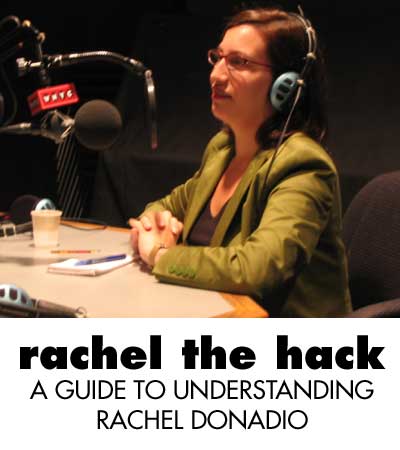
It’s time for a new installment of Rachel the Hack, an essential guide to understanding Ms. Donadio’s warblings.

There were two items we missed last week, articles composed for the annual “Ideas” issue of the New York Times Magazine: “Straw That Saves Lives” and “Walk-In Health Care”. The question, however, is whether these are genuine ideas or adverts for specific products. Presumably, these blurbs are intended to suggest that Donadio is a socially conscious thinker. But it’s telling that these mini-articles seem less concerned with the social circumstances that frame these articles (respectively, the lack of sanitized water and uninsured medical care) and more interested in journalism-as-advertising copy.

A 10-inch plastic tube — think of it as a reverse snorkel — LifeStraw employs a system of seven filters, some using mesh, some using chemicals, some as fine as six microns (more than 10 times finer than a human hair). The straw costs $3 to make and lasts for a year, filtering two liters of water per day.

This is journalism? It sounds to me like a paragraph stolen verbatim from LifeStraw’s Christmas catalog. Why isn’t Donadio employed at an advertising agency? She’s clearly more enthused by trying to describe the dimensions and pricing of items instead of the one billion people her heart allegedly bleeds for. Alas, such humorless “writers” of this ilk often become critics.

Which brings us to the latest “article” written “By Rachel Donadio” in this week’s NYTBR: a compendium of war book titles selected by other authors. But seeing as how Donadio only “wrote” the introductory paragraph and the one-line bios, this is hardly authorship proper. Sure, Donadio (or one of her fellow editors) did the legwork, solicited the authors, and possibly over-edited their sentences so as to suffocate the life out of them. (You’re really asking me to believe that the lively Anthony Swofford contributed the lifeless sentence, “His portraits are as fresh today as when he first stepped into Vietnam as a Marine infantry officer in 1965?”) Why then the need for a personal credit? Is there some kind of end-of-the-year article quota that Donadio has to fill before her annual review? If so, we hope Donadio gets a nice bonus for dulling the NYTBR‘s great promise!

More Tidbits

Roundup, Raw Hide

  • There are two schools of getting babies to sleep: the Ayn Rand “let them cry to their hearts’ content” doctrine and subscribing to the soothing touchy-feely Oprah approach. As it turns out, both schools are correct. So it seems when it comes to babies at least, conservatives and liberals can find a common ground. Of course, since many politicians are enfants terrible, at least when judged against the manner the average population works, it remains to be seen whether the approaching session of Congress will come to similar accord in other matters. (via Amardeep Singh)
  • Michael Richards, Andy Dick, and now Rosie O’Donnell. I’m wondering what’s more offensive: the lousy attempts at humor or the political correctness that demands incessant apologies.
  • Slow news day? Okay. World’s tallest man saves dolphin. So long and thanks for all the inch. (via The Beat)
  • Taking pages from the Bookslut and Edrants playbook, Bookburger lists the best and worst book covers of 2006.
  • Jenny D has a delightful 2006 books list.
  • Over at The Washington Post, Richard Ford participated in an online chat. Even Ford fanboy Tod Goldberg gets name-checked. But I liked Ford’s answer to the wholly ridiculous question “Why do you write?” (via The Millions)
  • Who knew that science fiction was all about whether or not the reader is an attractive woman? Apparently, an assclown named Razib, perhaps pining for the gender gap so prominent during the Eisenhower administration, was shocked (shocked!) that “a very attractive hostess” in a wine bar had read Hyperion and Snow Crash. If we are to use the terms of Razib’s argument, one must then ask why a brown-skinned man like Razib was doing in a wine bar, clearly the exclusive province of Caucasians! I know this, because Ann Coulter told me that racist antebellum times represented “a chivalric, honor-based culture that was driven down by the brute force of crass Yankee capitalism.” I therefore must believe her when she says that this is so! And we all know that the Confederacy meant rewarding the true winner: the glorious white male! So what business does Razib have drinking wine among the elite? It lacks honor and chivalry and respect for the white man. I’m shocked (shocked!) that any brown-skinned man would be doing this. Am I a freak to think this is freaky? I haven’t had a sip of wine, so it isn’t the alcohol. Guess it has to be my specious and outdated logic! (via Gwenda)

[UPDATE: Razib, lacking any sense of irony, has responded, calling me a “white racist” and adding, “I suppose Ed’s point was that stereotyping is pernicious, but I would contend that inaccurate stereotyping is especially pernicious, and I can’t believe that the snippet above reflects anything but rhetoric.” I figured the Ann Coulter reference would say it all, but Razib clearly hasn’t considered that I was actually satirizing inaccurate stereotyping: the same inaccurate stereotyping that Razib himself is guilty of.]