- Jessica begins the first in a promised series on the ideal Brooklyn bookstore.
- Heidi Benson investigates Gerald Nicosia vs. Kerouac Estate battles. (via Jeff)
- Are the corporate video game publishers shaking things up with their new titles? Until we see them get serious about adult concepts and treat sex with the same fervor with which they treat violence (how about a first-person shooter in a different sense of the term?), I harbor considerable doubts.
- Niall Harrison on the Readercon “Reviewing in the Blogosphere” panel. Again, we get more of the same “Internet is bad/print is good” nonsense without specific examples. I wish they would simply title these panels “Four Grumps Who Really Think the Internet Sucks,” which would get closer to the truth of what some of these ill-informed print mavens end up talking about.
- Will the Times regret the error?
- Over at The Millions, Garth offers praise to Wyatt Mason, who I would likewise declare one of the more underrated critics who actually gives a damn about literature that innovates.
- Determining personality from personal font choice seems akin to relying upon tarot and the horoscope to figure out how to live your life. What this purported exegesis doesn’t tell us is what kind of personality a person who is too lazy to change the default font in his email client — as I am. Shall we report these hideous individuals to the Department of Bad Slacker Citizens? (via Maud)
- Orthofer tracks down a book I didn’t know about: Gail Pool’s Faint Praise, an examination of American book reviewing that he’s also reviewed.
- The Sydney Morning Herald delivers a lengthy profile of Matt Rubinstein. (Oddly enough, the byline is attributed to Matt Rubinstein. Did Rubinstein profile himself?)
- Forged Oscar Wilde manuscripts. (via Bill Peschel)
- Okay, folks, I’m off to something called Thrillerfest, which I understand is not a convention for Michael Jackson acolytes, but is a place where people do drinking and thus suits me fine. Have yourselves a fine weekend.
Month / July 2007
“Visions and Violence” — Vollmann and Drew at the Whitney
There are indeed people in New York who are interested in William T. Vollmann. On Thursday night, accompanied by Marydell, Levi, and Jason, I attended the Whitney Museum “Summer of Love” lecture featuring photographer Richard Drew — the man behind the Falling Man photos — and, of course, Vollmann. There, I also met a smart Pynchon enthusiast by the name of Christopher Byrd, a guy named Doug (a Barth fan who I met in the lobby), and another gentleman named Ralph, who apparently discovered The Vollmann Club while trying to find information on the man to teach a class. There was also another pleasant gentleman who reads this site, but whose name I sadly don’t recall. I was pleasantly surprised that my announcement drew a few WTV fans out of the closet who apparently recognized me and were kind enough to say hello.
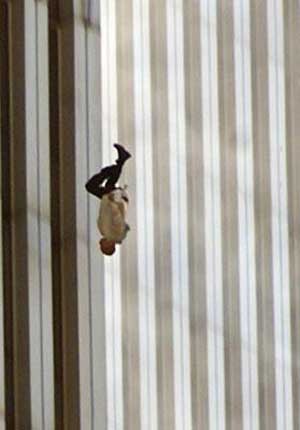 Despite the event’s title “Vision and Violence,” I was particularly surprised that nobody had mentioned the Abu Ghraib photos during the course of the conversation. But both Vollmann and photographer Richard Drew had interesting things to say about the role of photography, of which more anon.
The moderator, whose name I neglected to jot down in my notes because of an unexpected shift in lighting that startled me, was a regrettably stiff gentleman who worked for The New Yorker. I feel that I can sufficiently call him stiff because, when Vollmann read a stirring passage (“The White Knights”) from The Rainbow Stories, the moderator stared at Vollmann the entire time, craning his neck like an affluent ostrich ensnared in the unexpected Swedish cold. I know that he was doing his best and was no doubt apprised by someone that discussing violence was a serious business. Nevertheless, it was a bit awkward to see the moderator, Vollmann, and Drew crammed around a small table on stage right, so that the same twenty-five photographic images — John Filo’s Kent State photo, Nick Út’s Vietnam napalm girl, Eddie Adams’s execution photo, et al. — could be projected on a large screen in front of the audience. But the talk itself was interesting, with Drew even becoming defensive near the end.

The moderator began by asking what the two men were doing during the Summer of Love. Vollmann replied that he was not even a teenager, but said that he remembered his mother driving him home from school, when Kennedy was assassinated. His mother was crying and couldn’t stand this news. The young Vollmann looked to the other cars and saw that other people were crying.
“How do you find your subject matter?” asked the moderator. (This was a sampling of the generalized questions he had at his disposal.) Drew indicated that his daily assignments are determined on a minute-by-minute basis. Recently, he had taken photos of “the girl from Harry Potter on the Today Show,” as well as a 280 point jump at the New York Stock Exchange. Vollmann said that his subject matter came from a desire to understand, learn, and help others. He remarked upon how the 1979 Soviet invasion of Afghanistan had upset him, particularly when it started disappearing from the newspapers. His desire to help became “more attenuated.” Vollmann said that in all journalistic capacities, he wanted to give something to the people he met. In 1992 Sarajevo, Vollmann said that he “wanted understanding of who was more wrong.”
Upon Vollmann’s response, Drew became a bit rankled with this journalistic notion of helping people. “I’m not the Red Cross!” he insisted, shortly after declaring that he “records history every day.” Drew declared that there’s nothing political in what he does. And while one might argue that there may not be much of a political stake in photographing “the girl from Harry Potter” (I’m certain that future historians will be looking back at a Today Show publicity junket when chronicling the important moments of our time), are not Drew’s Falling Man photos political in some sense? Drew later mentioned that some newspapers thought it inappropriate to publish these photos. He also observed that this Channel 4 documentary (full one hour, eleven minute YouTube link) examining the subject of whether the photos were appropriate had not yet aired in the States. During the Q&A session that came later, Drew was adamant that he was not pushed around or pressured to shoot particular photos as an AP photographer. But surely a man with 37 years in the business understands that the decisions of editors and publishers to prioritize lionized firemen over a man plunging to his death from the Twin Towers is certainly political in nature. Without discounting Drew’s artistry as a photographer, surely a man who knows what photos are going to sell is more likely to tilt his lens in a certain direction if it will make ends meet. (Drew later confessed that, despite accepting nearly every assignment that came to him, he elected not to go to Iraq between the two wars because he had a kid on the way. It’s worth noting that Vollmann has continued to travel to faraway locales despite having a family to support, although, unlike Drew, he did not mention his family.)
Vollmann pointed out that he tried not to judge people — “at least not too early.” He offered a novelist’s comparison between flat and round characters, and pointed out distinction between understanding and telling, using an example of Muslims who had never heard of the Holocaust and couldn’t believe that it was true.
In response to the moderator’s question of whether the two men had observed the world becoming a more dangerous place, Drew again divested himself of politics, observing, “You don’t have to choose a side. You just have to be in the right place at the right time.” Vollmann didn’t think the world had become any more dangerous. But when the talk shifted to assignments, he pointed out that his only criteria in turning something down was (1) the publication not paying him enough and (2) whether his work is going to be helpful and worth the risk. Vollmann stated that if he were to go to Iraq today, he would have to think about it. “What good would it do? Would I have anything new to contribute?”
Concerning photography, Vollmann pointed out that he relied on Comtex cameras when going to a war zone because the lenses are very sharp and durable. For situations that are less dangerous, he relied on an 810. The photographs that Vollmann takes often allow his readers to get another sense of a person, such as some of the subjects that Vollmann included in Poor People.
Drew noted that photos tell the story and that he doesn’t have the luxury of 10,00 words. He had only one picture. The moderator noted that the Falling Man photos were “formally beautiful,” and in referring to his Falling Man photos, Drew pointed out that he had not experienced nearly as much controversy when he published his Kennedy photos.
Vollmann said that he didn’t face much in the way of restrictions. “A lot of people don’t read. So I don’t have too many problems.” He then referred to his Bosnia experience, when two friends of his were killed in a jeep. He said that he had the right and the duty to publish something, but that he didn’t want to publish pictures of their dead faces. He didn’t feel this ws right. Nevertheless, Vollmann said, “The job of the reporter is to show conflict, to show suffering.” So while in the back seat, he grabbed his notebook and started writing. Drew grew visibly uneasy over this and Vollmann simply responded, “They were already dead.” He pointed out that had that not been the case, he would have helped them.
Despite Drew’s quibbles over Vollmann’s personal concern for his subjects, Drew nevertheless pointed out that he would carry on taking photos without obtaining the permission of his subjects. Drew said that his motto was Shoot first, ask questions later. “I have to capture reality as it happens.”
Perhaps observing Drew’s growing discomfort, Vollmann then said that he doesn’t necessarily believe that Drew’s approach is wrong, but that his own approach involves “wanting to understand a person or event over time.” He said that it was important to earn the trust of his subjects. If he knew the subject, then he was more inclined to ask their permission. But when it come to depicting naked violence — such as an extreme Serbian nationalist shooting someone — “some of the rules don’t apply.”
 The moderator then asked another regrettably general question: “What made you want to do what you want to do?” Vollmann said that he hopes that he can document moments in time. Drew pointed out that his photography started off as a hobby. When in college, a street sweeper had overturned. He took photos and, upon getting an offer for $5 for the picture or a free roll of film and a photo credit, he chose the latter. He then became a freelance photographer, constantly listening to the police scanner. Today, with digital demand, Drew said that “the beast has become more insatiable.”
Vollmann pointed out, “As the beast becomes more insatiable, it’s for more and more types of meat in smaller bytes.” He said that he was more inclined to write books and less inclined to write magazine pieces, because there was no longer the demand for 20,000 word stories, as there was in the ’90’s. But he also observed, “If your heart is really in something, no one’s going to stop you.”
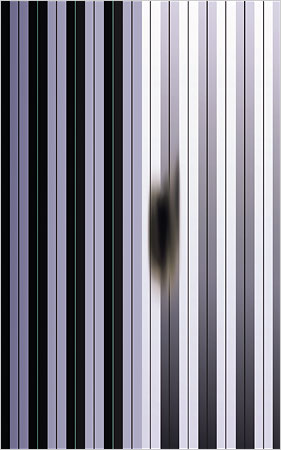
When Don DeLillo’s Falling Man was brought up, Drew offered a remarkable story. When DeLillo’s book was reviewed in the NYTBR, the review came with an accompanying graphic for the cover. Without accreditation to Drew, it seems that Sam Tanenhaus’s team not only stole Drew’s image for the cover, but egregiously smudged out the figure of the man (see above image to left). Drew was understandably upset about this, simply asking for “credit where credit is due.” And it makes one wonder how many other images have been appropriated by Tanenhaus’s team without credit.
[UPDATE: Jason has a brief writeup, which also references the conversation that Vollmann and a good cluster of us had afterwards.]
[UPDATE 2: Marydell also has a report up.]
If James Wood or Daniel Mendelsohn Reviewed “Howl”
Once again, the Beatniks wish to tarnish the good name of realist literature — truly the only form of literature that’s good for you. The latest nonsense comes to us from a thirty-year-old whipper-snapper from San Francisco fond of reciting obscenities. It is rather childishly called “Howl.”
Let us examine this “poem”‘s first few lines:
I saw the best minds of my generation destroyed by
madness, starving hysterical naked,
dragging themselves through the negro streets at dawn
looking for an angry fix,
angelheaded hipsters burning for the ancient heavenly
connection to the starry dynamo in the machin-
ery of night,
who poverty and tatters and hollow-eyed and high sat
up smoking in the supernatural darkness of
cold-water flats floating across the tops of cities
contemplating jazz,
who bared their brains to Heaven under the El and
saw Mohammedan angels staggering on tene-
ment roofs illuminated,
who passed through universities with radiant cool eyes
hallucinating Arkansas and Blake-light tragedy
among the scholars of war,
who were expelled from the academies for crazy &
publishing obscene odes on the windows of the
skull,
And so on. Ginsberg cannot get to the point. He prefers nonsensical religious imagery like “angelheaded hipsters” and “Mohammedan angels.” He cannot put the adjective before “tenement roofs” like a proper writer.
If I were forced to play Pin the Tail on the Donkey after several shots of Stoli, I could easily identify this, without effort, as the kind of prose fashionable among the beret-wearing riff-raff who declare themselves “artists” or “poets” or “writers.” What does Ginsberg mean by ‘dragging themelves through the negro streets at dawn looking for an angry fix?’ Streets are not racial! How is a fix angry? One does not bare one’s brain to Heaven. There is no El in San Francisco last time I checked. Ginsberg can’t even decide on what one must hallucinate. Is it Arkansas or Blake-light tragedy?
I certainly cannot see any literary scholar taking such a preposterous poem seriously fifty years from now.
Roundup
- Paul Shaffer will be writing a memoir. You can be absolutely sure that the man who has sucked up to Letterman for three decades will offer the kind of penetrating insight that good books are known for.
- I saw this cover at a bookstore last night and I have had extremely horrible ideas about furniture. I pondered the sounds that the chairs would make, should such a coupling go down. Sure, there would be some squeaks. But would the chairs find a way to express their euphoria? It struck me that if the chairs were silent about their activity, it would be a very sad thing. Like anyone, they certainly have the right to enjoy themselves. I’m not sure who came up with this book cover, but I’d like to thank them for making me see chiffoniers schtupping dinettes and making me wonder if I should meticulously wipe the chair before I sit down.
- I’m with Darby. I seem to be the last person on the planet who hasn’t read Tom McCarthy’s Remainder. But I do plan to rectify this very soon. If recent responses are any indication, I should end up dancing with strangers, telling everybody I know that Tom McCarthy is better than oral sex, and otherwise getting into a euphoric tizzy over the book. All this is assuming that the book lives up. I suspect I’ve avoided the book because I read it after everybody said that it was cool and I’m supposed to be one of those guys who reads these books before everybody else. Then again, I enjoyed Cormac McCarthy’s The Road after I read it at a much later time than was acceptable. Perhaps I’m simply late on the draw with authors named “McCarthy.” For this, I’m sorry. If you’re a talented author named McCarthy, get in touch with me nine months before your book comes out and I’ll promise to read you before the cool kids.
- Steve Mitchelmore wonders if we’re living in a new age of anxiety about art: “What we see every week is anxiety about personal exclusion. It would be better if critics, rather than hiding, mitigating or condemning the exclusion, brought out how the dual experience is liberating.” I couldn’t agree more.
- A reason to read this month’s Playboy for the articles.
- Carolyn points to Luna Park — a helpful blog investigating literary magazines.
- $3.75MM for a vampire trilogy? Okay, Elizabeth Kostova was one thing. And we all know Max Brooks moved units. But when you have publishing insiders merely gushing, “It is totally awesome,” one wonders if the people who purchased this are aware of just what they are getting into. How do the words “totally awesome” transfer into making back this investment? And were the words “totally awesome” uttered by the person who signed the check?
- I am now convinced that we will see a spate of “Why did science fiction become so popular?” articles in the next year. “Why did science fiction become so popular?” is the next “Comic books are literary too!” If you have to ask what’s going on, you simply aren’t paying attention.
- The 30 Most Popular News Sites in June.
- Kevin Spacey is, according to the BBC, set “to reprise Superman role.” That’s funny. I thought he played Lex Luthor in Superman Returns.
Marianne Wiggins
My profile of Marianne Wiggins can be found in this week’s issue of Time Out New York.