Stereogum: “When the opening guitar of their smash ‘Don’t Dream It’s Over’ rung out, we looked around, frantically; would any of these kids respond, even in passing recognition of the tune? And they responded alright. With a water bottle straight to Neil Finn’s head! What followed just compounded Neil’s embarrassment: He was rattled, the band audibly contemplated aborting the song, but Finn felt for sure he could rely, at least during this one song, on the crowd picking up the slack by singing along. ‘It’s alright, everybody! Come on!’ Neil waved the crowd on to sing the legendary hook. And … nothing. By this point we were far back into the crowd, and you had to be there to appreciate just how thunderous this silence was.”
Year / 2007
BSS #111: John Sheppard
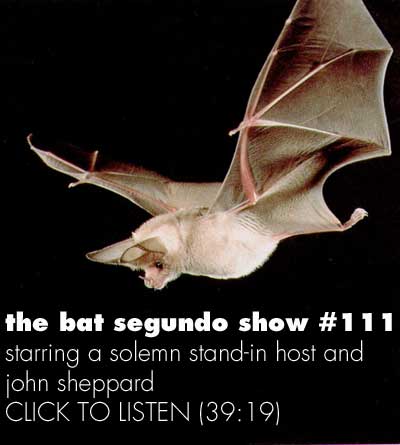
Condition of Mr. Segundo: Avoiding Sheppard tones.
Author: John Sheppard
Subjects Discussed: Responding to Dan Green’s post, on being rejected by publishers and self-publishing, writing without a plot, on doing things twice, the connection between the conscious and subconscious thematics, getting out of the muddy ditch, basing fiction on reality, music and anger, Minor Threat, Pizza Hut, the Reagan era, the “punk” label, imploding labels, abrasive commentary, the circus people of Sarasota, Florida, cartoons vs. writing, the rhythm of Catholic catechisms, writing to a mix tape, orange juice concentrate, sound effects in sentences, and being a comma freak.
Sheppard: I was an illustrator, once upon a time. And I thought of this book — it’s somewhat like making a painting. You start off with the canvas and then you paint on top. And then you paint another layer on top and another layer on top. And eventually at the end, you have a painting. And that’s sort of the way I thought of writing this book. I didn’t write it with a plot in mind. Absolutely no plot in mind. And some people, like a reviewer for the Chicago Sun-Times thought it was pointless that I had no plot, that there wasn’t a South Park moment, “I learned something today,” at the end. But I really don’t believe it’s a pointless book. Otherwise I wouldn’t have written it.
Listen: Play in new window | Download
Bat Torrents
In response to several requests, the first torrent pack for The Bat Segundo Show is now available for your downloading pleasure at The Pirate Bay. Torrent Pack #1 contains the first twenty shows, including conversations with Jonathan Ames, Octavia Butler, T.C. Boyle, Bret Easton Ellis, Jennifer Weiner, and many more authors.
Future torrent packs will be made available soon!
It’s Really All About Andrew Keen’s Ego
Reports from the Los Angeles Times Festival of Books blogging panel are coming in:
Carolyn Kellogg: “Instead I would have loved to have a topic like: ‘litblogs — what’s good, what’s bad, what’s next?’ I know what I’d like to do more of (I think it’s a congenital blogger condition to be cursing oneself for not fill-in-the-blank), but I want the bigger picture. What does it take for a litblog to be successful – voice? genre? regular posting? Have we made any big mistakes (like engaging n+1 in an argument over an article critical of litblogs — an article they never put online)? What exciting, fun things are happening in the litblog world? I would have loved to hear what Tod and Ron and the audience thought.”
Ron Hogan: “I spent most of my time veering away from the money question (after pointing out that I’d figured out how to get paid) and hammering at the notion that online media is inherently less reliable and more susceptible to corruption than its traditional counterparts, and, in the particular case of book reviewing, the online media were frankly picking up the slack for the dwindling coverage in print. Somewhere along the line, Keen said something like, ‘I just think we have enough media already.’ Frankly, I sorta boggled, and called that an incredibly stagnant notion. ‘We have enough books already, too, but we keep publishing new ones,’ I went on. ‘We have enough movies to watch… The horse and buggy was a perfectly good way to travel, what do we need cars for?’ (I’m slightly paraphrasing here; the transcripts and, with luck, an audio recording of the event should be available online one day from the Times.)”
BookFox: “What I found disconcerting was that the panel seemed to revolve around Andrew Keen – his book and his assertion that the only possible model for online content is one that pays financial dividends. Everyone kept mentioning his book The Cult of the Amateur – usually attacking one premise or another – and for most of the conversation, the panel focused on the problem of money. So it seemed that rhetorically, the conversation revolved around rebutting Keen’s arguments, giving him the high argumentative ground, rather than the bloggers being able to establish a neutral space to discuss the facts.”
The Elegant Variation: “Keen’s overriding concern was with the absence of a sustainable business model in the blogosphere, and the problems inevitable for institutional media once the audience gets hooked on free content. As a corollary, when the institutions falter, the superiority that Keen claims for professionalism disintegrates. He claimed that a form of expression that anyone can do is so easily imitable that the risks of corporate corruption and abuse are huge, and the reader is vulnerable not only to some weak-ass literary criticism but out-and-out fraud.”
My response to the muddled arguments in the first 30 pages of Keen’s book can be found here. I am hoping to address the book’s balance in future posts.
Roundup
- I intended to link to it yesterday, but this week at the Litblog Co-Op, folks are discussing Marshall Klimasewiski’s The Cottagers. There’s talk of horrible vacations and, on Friday, a podcast interview will follow.
- Charles Shields reveals how he used the Internet to conduct research for his Harper Lee biography.
- George Eliot’s letters to Henry Lewes have gone online. You can access the letters here. My only question: why didn’t they do this in the middle of March?
- Patti Smith hits the New Yorker.
- Kathleen Parker: “People who read books are different from other people. They’re smarter for one thing. They’re more sensual for another. They like to hold, touch and smell what they read.” What Parker didn’t tell you is that some “people who read books” can also be found in criminal databases and some of the more unsullied readers are prone to displays of snobbery. I’ve known some pretty smart and sensual people who don’t read in my time and have even managed to get more than a few of them attracted to books. Largely because I was able to assure many of them that I was a schmuck. The key to getting people to read is to be humble and to listen very carefully to people. Then you can figure out what kind of books they’re likely to go crazy over. (via Bookslut)
- Niall Griffiths revisits Cormac McCarthy’s The Road and finds that there’s more inside the book than during his initial read. I’d like to see more newspapers do this. Litblogs are often accused of rushing out their posts (and I would agree with this to some degree), but many print critics are equally celeritous in banging out their reviews to meet deadlines. Because of these conditions, I have to ask whether a book like Pynchon’s Against the Day really received a fair reception, or, for that matter, whether most books are fairly assessed in today’s environment. Mr. Asher has more to say about the socioeconomics of book reviewing.
- Tales from the Reading Room compares the postwar Paris cultural atmosphere with today’s troubling media environment.
- Who knew that Harlequins were mining Village People templates for their book covers?
- There’s a documentary about equuphiliacs now making the rounds.
- I got the tip from Maxine, but it appears that Lindsay Anderson’s if… is getting the Criterion treatment. Now if they can somehow get Anderson’s other masterpiece O Lucky Man! onto DVD, we’ll all be very lucky.
- Michiko on Michael.
- The L.A. Times Book Prize winners.
- 50+ Free Resources for Effective Reading. (via Book Glutton)
- Mother Jones: “By the end of the century, half of all species on Earth may be extinct. Who will survive the world’s dwindling biodiversity, and why?” (via Isak)
- Gawker takes the NYTBR podcast theme song appropriately to task.
- Here’s a presidential platform I can get behind — apparently, in more ways than one.
- It had to happen sooner or later: Twitterlit, which comes from one Debra Hamel.
- The Audit Bureau of Circulations has reported sharp drops in newspaper circulation in Spring 2007.
- Also, the New York Times will no longer participate in the White House Correspondents Association dinner. Personally, I blame Rich Little.
- Arrested for holding placards of Orwell and the Magna Carta.
- Against National Poetry Month. (via Books, Words, and Writing)
- Scooby Doo manga. (via The Beat)
- Amazing.
- I agree with Lev Grossman. The X-Files has run its course.