|
You Should Learn Swedish |
 Fantastisk! You’re laid back about learning a language – and about life in general. Peaceful, beautiful Sweden is ideal for you… And you won’t even have to speak perfect Swedish to get around! |
Author / Edward Champion

75 Books, Books #55-60
[NOTE: I did live up to the 75 Book Challenge. The current count for the year is apparently 131, with a few more volumes to be finished before the stroke of midnight. And I’m not even halfway through my writeups. (Again, this list is wildly out of order.) But I’m going to do my best to see if I can get these volumes logged. The problem arises from too much rumination on my end. When I try to write a few sentences, I end up with a paragraph. And so forth. So I’ll see what I can do on this front! But if I don’t get to the end, my profuse apologies. You’ll just have to trust me.]
Book #55 was a reread of Colson Whitehead’s The Intuitionist. I had read this book at the turn of the century, which seemed fitting given this novel’s preoccupation with the 20th, and marveled then at how Whitehead’s use of language served as a skeleton key that sometimes opened doors containing keen observations about racism and sexism. Now that I’m dwelling upon my reread at year’s end, I’m thinking that if Tom LeClair can categorize the early work of Richard Powers, William T. Vollmann and David Foster Wallace as “prodigious fiction,” perhaps Colson Whitehead might be part of a second wave of “prodigious fiction” — a list that might also include Scarlett Thomas. Certainly, taxonomy is as much of a concern in The Intuitionist as it is to this hypothetical “first wave,” particularly the propriety (or lack thereof) we see with the two warring schools of elevator inspectors: the Intuitionists and the Empiricists. But I believe Whitehead is more concerned with how this arranged information affects existence, as opposed to how it is contained within existence, of which more anon. (Podcast interview.)
Book #56 was Colson Whithead’s John Henry Days. This was the first time I had read John Henry Days. I’d been sitting on this book for a while, deliberately holding off on reading it until a special moment arose. When the opportunity to interview Colson Whitehead arose, I knew that the time had come. This book, I’m pleased to report, was more compelling than I expected. Like The Intuitionist, Whitehead’s set up a niche-based coterie — in this case, a group of freelance journalists whose conduct ascribes to a similar set of rules as the elevator inspectors — with which to launch ruminative riffs on the history of John Henry, Meredith Hunter’s death at Altamont (interestingly, Franzen could not bring himself to name Hunter when he reviewed the book), and Paul Robeson, among many others. And I’d argue that these historical tidbits, combined with eccentric moments which challenge our traditional perspective, exist as a way to process arranged information and track its effect upon culture and racism. Ergo, if a second wave of prodigious fiction can be sanctioned, John Henry Days is quite possibly its greatest exemplar. (Podcast interview.)
Book #57 was Colson Whitehead’s Apex Hides the Hurt. So this was it: the third novel by Mr. Whitehead, the novel that certain pals of mine didn’t care for. I didn’t hate this book. I appreciated its frequent inventiveness. But I didn’t find it nearly as enthralling as Whitehead’s other two books. I think this book misfired because Whitehead didn’t surround his unnamed protagonist with advertising figures who challenged his livelihood. Instead, the protagonist is a free agent who operates on his own terms, with a particularly melodramatic figure as one of the foils (a millionaire by the preposterous name of Lucky Aberdeen). The book, as a result, is an enjoyable if pale shadow if the two previous novels. (Podcast interview.)
Book #58 was Jonathan Safran Foer’s Extremely Loud and Incredibly Close. I can understand the antagonistic reactions to Foer’s second book. I don’t quibble so much over the book’s child genius protagonist or even its associations with September 11, but I think Updike was right to suggest that Foer could use “a little more silence, a few fewer messages.” This book often contains playfulness for playfulness’s sake. Gilbert Sorrentino, this is not. Because of the large volume of “playful” experiments, I was unable to penetrate the novel’s heart. Nevertheless, know that I read and save every Foer book, with the hope of one day being able to treat JSF with the proper adulthood he deserves. Until that day, Extremely Loud is clearly the work of a kid still playing around. (Podcast interview.)
Book #59 was Erica Jong’s Fear of Flying. I was probably the last person on earth who hadn’t read this book. This novel was daring for its time. But I found myself more fascinated by Isadora Wing’s neurotic narration, an introspective juggernaut of questions which suggests that gender relations haven’t changed nearly as much as we believe they have, than Wing’s sexual affairs. Thirty years later, the adultery here is no more daring than Peyton Place. But at some point, I hope to investigate the book’s three sequels. (Podcast interview.)
Book #60 was The May Queen, edited by Nicole Richesin. Some of my thoughts on this light but entertaining anthology are contained within my mammoth report from April. (Podcast interview with May Queen contributors.)
Rachel the Hack: Miscellany
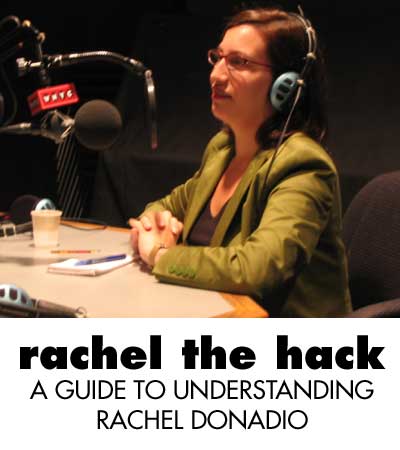
It’s time for a new installment of Rachel the Hack, an essential guide to understanding Ms. Donadio’s warblings.
There were two items we missed last week, articles composed for the annual “Ideas” issue of the New York Times Magazine: “Straw That Saves Lives” and “Walk-In Health Care”. The question, however, is whether these are genuine ideas or adverts for specific products. Presumably, these blurbs are intended to suggest that Donadio is a socially conscious thinker. But it’s telling that these mini-articles seem less concerned with the social circumstances that frame these articles (respectively, the lack of sanitized water and uninsured medical care) and more interested in journalism-as-advertising copy.
A 10-inch plastic tube — think of it as a reverse snorkel — LifeStraw employs a system of seven filters, some using mesh, some using chemicals, some as fine as six microns (more than 10 times finer than a human hair). The straw costs $3 to make and lasts for a year, filtering two liters of water per day.
This is journalism? It sounds to me like a paragraph stolen verbatim from LifeStraw’s Christmas catalog. Why isn’t Donadio employed at an advertising agency? She’s clearly more enthused by trying to describe the dimensions and pricing of items instead of the one billion people her heart allegedly bleeds for. Alas, such humorless “writers” of this ilk often become critics.
Which brings us to the latest “article” written “By Rachel Donadio” in this week’s NYTBR: a compendium of war book titles selected by other authors. But seeing as how Donadio only “wrote” the introductory paragraph and the one-line bios, this is hardly authorship proper. Sure, Donadio (or one of her fellow editors) did the legwork, solicited the authors, and possibly over-edited their sentences so as to suffocate the life out of them. (You’re really asking me to believe that the lively Anthony Swofford contributed the lifeless sentence, “His portraits are as fresh today as when he first stepped into Vietnam as a Marine infantry officer in 1965?”) Why then the need for a personal credit? Is there some kind of end-of-the-year article quota that Donadio has to fill before her annual review? If so, we hope Donadio gets a nice bonus for dulling the NYTBR‘s great promise!
Holiday Film Fare
It’s a Wonderful Life in its entirety.
More Tidbits
- That gossipy minx Kitty Kelley is at it again: this time, locking Oprah Winfrey into her crosshairs.
- If you despise those living-room size theatres in the multiplex, there’s some new signs that the trend may be reversing. (via Kevin Smokler)
- Apparently, the men who robbed novelist Ngugi wa Thoing’o have been sentenced to hang.
- John Freeman, taking his cue from the Stephen Lyons double–dipping playbook, offers the rest of his Richard Powers interview at The Independent.
- Okay, Pessl haters. It appears that the NYTBR wasn’t the only one to put Special Topics in Calamity Physics on their Top 10 list. Really, this Pessl thing must be talked about! Is she still 27? What is she doing this precise second? Forget the mammoth SIZE of the book. Let us gaze upon navels and pride ourselves on being the baddest literary motherfuckers on the planet!
- David Church on the American horror film in the ’90’s. (via The Reading Experience)
- Tayari offers a tasty-looking recipe for red velvet cake!
- Dana Gioia has been confirmed as NEA chairman for the next four years. (via Silliman)
- Have yourself a buy nothing Xmas.
- Mental Multivitamin responds to the entreaty “Be creative!”
- Stephen King’s top ten books of 2006.
- But here’s a better list from Scott.
- The best headline I’ve read this week. Even so, Mr. Hogan, you were on Segundo first! Don’t let that success go to your head. This is Judith Regan we’re talking about here.
- Holy shit! Connie Willis fans rejoice, but save up your cash! (via Chasing Ray)
- The public doesn’t think much of journalists’ current ethics.
- Ways of preening? John Berger is now calling for a cultural boycott of Israel.
- Douglas Dutton on how to suggest books. (via Big Bad Book)
- What Dan Wickett is looking forward to in 2007.