Here’s a hint:
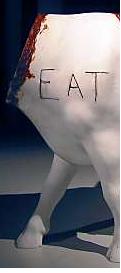
Due to technical mishaps on our main workstation*, the Bat Segundo production schedule has been delayed. But have no fear: we expect to be back next week with fresh podcasts. There are some fantastic interviews coming up. And we’ve also landed a very special guest for Show #100. But we’ll leave you guessing as to who it is.
In the meantime, feel free to check out the backlist.
* — This also explains why we haven’t been able to answer our email.

Condition of Mr. Segundo: Harried and henpecked.
Author: Nina Hartley
Subjects Discussed: The meaning of “total sex,” vanilla vs. “alternative” sex, basics vs. options, self-acceptance, foreplay, the relationship between sexual realities and porn film fantasies, the “three position” proclivity, swinging, sexual alienation, responding to Naomi Wolf’s 2003 article, Hooters, extreme porn, porn as education, Jocelyn Elders, Caitlin Flanagan, “death and babies ay-yi-yi!,” spontaneous sex vs. technical know-how, intrapersonal relationships, acceptance, insecurity, and polyamory.
EXCERPT FROM SHOW:
Hartley: I call it “total sex” because it encompasses the mainstay of most sexual practices. It touches on most things pretty well and it leaves plenty of room for exploration of the more esoteric things. I’m a very wide-ranging sexual creature, but I do know that most people are — many people are a little less broad-ranging than I. And so I do try to make it able to speak to the so-called regular person, who is not identified as a quote unquote kinky or freaky or pervert individual, but the regular person who would like to be more comfortable with sex and to get more pleasure out of it in his or her life.
Listen: Play in new window | Download

Condition of Mr. Segundo: Ready to party in the Biblical sense.
Author: Amy Sedaris
Subjects Discussed: The lost art of hospitality, Martha Stewart, party theme taxonomy, entertaining old people, profiting from party guests, having a first date in your apartment, how to manage shy people, unexpected guests, remembering guests and logging menus, working with artists, Sedaris’s fear of computers, homemade art, children’s books, opposition to brunch, observing party hosts, the safety of counters, hosting vs. guesting, hosting vs. performing, Jonathan Rauch’s “Caring for Your Introvert,” ruminating vs. writing, communication difficulties, solutions for potheads with bad cases of the munchies, on being misinterpreted, shaking off the Jerri Blank persona, hosting for everyday people, indices, organizing cerebral chaos, being in control vs. delegating, on having too many ideas, the atmosphere within Sedaris’s apartment, and operating by instinct.
EXCERPT FROM SHOW:
Sedaris: I don’t normally have gimmicks and I don’t normally have themes for my parties, but, for the book, I came up with what I thought would be challenging for hostess. Like a hot lunch. And I thought who eats hot lunches? Lumberjacks and grips. So I thought, oh, I’ll have a lumberjack for lunch. Or, you know, if you have a bunch of old people over, just what the hostess has to think about. Or children. Or someone grieving or a depressed person.
Listen: Play in new window | Download

Condition of Mr. Segundo: Ready to drink geologists under the table.
Author: Simon Winchester
Subjects Discussed: San Francisco’s edgy impermanence, San Francisco vs. Venice and the North Sea cities, humankind’s geological privilege, New Orleans & Katrina, the hubris of California residents, anonymous threatening letters, denial vs. geology, Japan and disaster preparation, West Coast subliminal fear, editorial input into Winchester’s work, San Francisco vs. Daly City reactions to the earthquake centenary, Bruce Bolt, the true epicenter of the 1906 earthquake, Jim Tanner, Loma Prieta, subparallel faults, the Parkfield drilling, operating in the geological dark, responding to Bryan Burrough’s NYTBR review and Sam Tanenhaus, the importance of geology, Kevin Starr as an influence, Katrina federal aid vs. 1906 federal aid, looting after the 1906 earthquake, Winchester’s stance on tracking casualties, and defining historical context.
EXCERPT FROM SHOW:
Winchester: The San Francisco event was a minor seismic event, but a major social event and a major scientific event that had huge importance on American history. Because it was the first time in world history that we stopped looking at these catastrophes as the work of a malevolent god and started to look at them as a natural event which should be explained. And so instead of unleashing priests on the problem, which we did in Lisbon in 1755 and after Krakatoa — mullahs there, because it was Islamic — in 1883, we unleashed on the orders of the then Republican Governor of California — Mr. Pardee, a rather dull dentist — we unleashed scientists. And scientists gave us answers. And those answers are of such profound importance that niggling around with whether there were 500 or 50 or 300, whether they were shot, whether they died under falling buildings, whether there was a deaf fireman, are so unimportant. They’re the stuff of tabloid journalism. They’re not the stuff of history.
What I was attempting to grapple with in this book was a historical series of realities, why this was an important earthquake. And whether or not the casualty figures were 1,000 or 5,000 is more or less irrelevant. It was the aftermath, the impact on human society, generally that is important.
Correspondent: So in covering any sort of moment in history, it’s not necessarily the fatality —
Winchester: You don’t cover the moments in history. Journalists cover moments. Historians look back on them with perspective and have, I think, a wider view which does not encompass the tiny details of whether there was a deaf fireman shot. It’s of no consequence whatsoever.
Listen: Play in new window | Download