
Brownie Watch on Hiatus

As others have pointed out, the NYTBR is once again an embarassment. It’s the same old song. Richard Posner’s essay is not so much a book review but an excuse to whine about the blogosphere. The writers remain, for the most part, male, offering dull and uninteresting coverage for dull and uninteresting books. The insufferable Joe Queennan continues to earn a paycheck.

We’re so disheartened by the NYTBR now that we must temporarily take leave of the Tanenhaus Brownie Watch if we are to remain emotionally and mentally stable. Too many of our Sunday newspapers have soaked up our tears. It is only the crossword now that gives us comfort. We cry for Tanenhaus’ choice. The adjective “Faustian” comes to mind. We sob over the dismal state of current book coverage. But most of all, since we have enjoyed delivering brownies to him (yes, they have actually been delivered) on the rare occasions that Tanenhaus has cut the mustard (with, of course, not a single thank you note or email from the man), we firmly believe that Sam Tanenhaus cannot and defiantly will not produce a weekly book review section worth reading. Thus, Tanenhaus himself has ensured that no brownies can be delivered and the onus comes back to us in the end.

So we’ve put our little experiment on hiatus. The point has been demonstrated time and time again. We’ve kenneled the little doggy away. And oh does he whimper!

But one day, when Mr. Tanenhaus least expects it and we have talked out this book review contretemps over with our therapist, the brownies will, once again, be rightfully denied.

Round Robin

  • In light of the assaults on eminent domain and flag burning (and with the frightening prospect of Justice Rehnquist resigning looming in the air), there’s at least some good news on the Corporation for Public Broadcasting/PBS budget cuts. Yesterday, the House of Representatives voted by a 284-140 vote to rescind the $100 million cutback. And that’s really what current politics is about these days: finding scant hope in small victories while the fiber and sanctity of this nation is gutted. So bust out the party poppers while the apocalypse ravages across the heartland.
  • The so-called “Pope” has published a book that urges all non-believing Europeans to live as though God exists. If that fails, then there’s always putting on a tin hat and looking for crop circles in the hinterland.
  • It looks like Limbaugh and Noonan are running away from the Klein book. Their latest amusing claim is that The Truth About Hilary was “written and published by a bunch of left-wingers.” Well, that’s pretty interesting, given that Sentinel, the publisher of the book, describes itself on its webpage as “a dedicated conservative imprint within Penguin Group (USA) Inc. It has a mandate to publish a wide variety of right-of-center books on subjects like politics, history, public policy, culture, religion and international relations.”
  • Cynthia Ozick talks with the Melbourne Age.
  • The Connection continues its series of writers talking about other writers who have influenced them. The latest audio installment is Russell Banks talking about Jack Kerouac’s On the Road.
  • Evil Dead star Bruce Campbell is on a book tour for his new novel, Make Love the Bruce Campbell Way.
  • So can James Frey follow up the intensity of A Million Little Pieces with his new memoir? Mike Thomas of the Chicago Sun-Times talks with Frey and learns that Frey’s life is “sort of surreally magnificent.”
  • James McManus has been tapped to write a poker column for the New York Times. Executive editor Bill Keller says that McManus’ column will be “a literate combination of the drama, strategy, psychology and color of card play that should interest both serious players and the simply curious.” This from a guy whose idea of literacy is questionable at best.

Tanenhaus Watch: March 27, 2005

browniewatch4.gif

WEEKLY QUESTION: Will this week’s NYTBR reflect today’s literary and publishing climate? Or will editor Sam Tanenhaus demonstrate yet again that the NYTBR is irrelevant to today’s needs? If the former, a tasty brownie will be sent to Mr. Tanenhaus’ office. If the latter, the brownie will be denied.

THE COLUMN-INCH TEST:

Fiction Reviews: 1 – 1 1/2 page review, 1 one-page review, 1 one-page roundup (Fiction in Translation), 1 half-page crime roundup, 1 half-page review. (Total books: 13. Total space: 4.5 pages.)

Non-Fiction Reviews: 1 2 page review, 1 – 1 1/2 page review, 3 one-page reviews, one half-page review. (Total books: 6. Total space: 6.5 pages.)

This week’s fiction coverage, most of it asphyixiated in roundups, is such a joke that not even Tanenhaus could be compelled to list the crime roundup novels in the table of contents. In fact, I’m surprised that Sarah hasn’t weighed in on this. It’s bad enough that Marilyn Stasio devotes a mere paragraph to the reissue of Joe Gores’ A Time of Predators, only to dwell upon how the Edgar Award-winning novel “shows its age” while declaring it a “good choice.” But Rupert Holmes’ innovative mystery novel-plus-CD, Swing, is pretty much dismissed through a comparison to one of “those interactive mystery game-books that were popular back in the mid-1980s.” Consider, by contrast, an honest assessment of Holmes’ caper, along the lines of what John Orr did last week in the San Jose Mercury News.

You have to love the disingenuouness of the roundup format, where you can offer general platitudes for the blurb whores (“thought-provoking fiction” and “strirring, impassioned glimpses of lost souls amid the rubble of history,” says Anderson Tepper), while avoiding any penetrating insight because you don’t have the space.

Conversely, if the fiction-to-nonfiction ratio isn’t bad enough (a mere 41% this week), adding insult to injury is Clive James’ self-serving takedown of Paglia and poetry (of which more anon) and the deliberate padding within Pete Hamill’s review of Boss Tweed. Hamill not only spends an execrable amount of space summarizing Tweed’s life, but he wastes half a paragraph informing readers about Thomas Nast. Wouldn’t someone interested in Boss Tweed, let alone any NYTBR reader, already know about Nast? Hamill also takes his opening Gore vs. Tweed gimmick a paragraph too far, beating a horse that didn’t deserve to die. (What next, Petey? Telling us you’d rather play sqaush or cross-stitch a quilt with the man? Ha ha! You amuse me. Sushi on me!)

Beyond proving once again how out-of-step he is with today’s fiction (even the Rocky Mountain News covered A Changed Mind two weeks ago), it’s clear that Tanenhaus has abdicated any effort to find the happy medium: the format allowing the reviewer to focus his energies within a taut word count, while preventing unfortunate asides. The 800-900 word review has served several newspapers quite well for so many years. Tanenhaus again demonstrates a truly unfortunate allocation of column-inches.

Brownie Point: DENIED!

THE HARD-ON TEST:

This test concerns the ratio of male to female writers writing for the NYTBR.

A total of four women have contributed to eleven reviews. As usual, three of these are fiction chicks, while the only female-penned nonfiction review goes to (go figure) Fat Girl.

This is infinitely worse than last week, particularly when one considers that the big reviews were handed off to those with Y chromosomes.

While it’s true that Rachel Donadio has penned an essay on Harvard, the essay spends most of its time chronicling Larry Summers’ exploits than the two books it cites (and is thus excluded from the fiction-to-nonfiction ratio).

Brownie Point: DENIED!

THE QUIRKY PAIR-UP TEST:

Pete Hamill, Clive James, Rachel Donadio, Liesl Schillinger, Barry Gewen. Yawn yawn and yawn. We haven’t seen such a predictable crop of names since the Fortune 500. What’s the matter, Sam? Is March Madness keeping you from approaching the interesting people?

Brownie Point: DENIED!

CONTENT CONCERNS:

The Sgt. Pepper-style numbered image collage of poets matches Clive James’ essay to a tee. It is as suitably insipid as James’ arrogance in print, little more than a paint-by-numbers palette for bored children who believe in image first and the love of language last.

James bemoans “the airless space of literary theory and cultural studies.” He claims that John Ashbery is “the combined status of totem pole and wind tunnel.” Most alarmingly, he declares that his “own prescription for making poetry popular would be to ban it — with possession treated as a serious misdemanor, and dealing as a felony.”

That such passive ignorance and anti-intellectualism would be promulgated in a book review section of a major newspaper is truly disheartening.

With such obvious enmity against the liberal arts expressed in the first five paragraphs, one wonders why any level-headed editor assign a book about poetry to an overrated, perhaps permanently impotent essayist. It’s clear enough that James would rather spend hours working himself up into an erection over Daffy Duck, Anne Heche and Charlton Heston. The answer: An editor looking for a train wreck, because the very notion of thinking about an interesting problem like the decline in poetry is too difficult and certainly not good enough for the money men.

If badmouthing poetry isn’t enough, James is ready to decimate Paglia over details that have little to do with the book in question. James has taken the opportunity to pull a Wieseltier here, spending a good chunk of his two pages spouting off ad hominen attacks rather than offering specific examples about why and where one should search Camille Paglia for the Number of the Beast. How dare this woman possess “wide knowledge” and “expressive gifts,” while daring to be a clear thinker “on top of a pair of Jimmy Choos!” To suggest (as the cover does) that James “fancies Camille Paglia” is as great a lie as claiming that a Democrat desires to give George Bush a hug.

What’s interesting is that James has very little to find fault with in the book. He declares that Break, Blow, Burn has “few sweeping statements.” He commends her comparison of Wallace Stevens’ “Disillusionment of Ten O’Clock” with a Satie piano piece. Still unable to separate Paglia the thinker from Paglia the feminist, he points to Paglia’s defense of Ted Hughes as “a quixotic move.”

So why complain that Paglia’s “young students might listen too well?” What the hell does appearing in Inside Deep Throat have to do with the book in question? Why quibble over Ava Gardner being manufactured in a Hollywood studio when Paglia didn’t champion Gardner, but was merely inspired by her at a mere four years old?

Such smears are the telltale signs of a man looking for a fight, combing minutiae and finding nothing to support his argument. This is what’s known in the trade as ignoratio elenchi, or an irrelevant conclusion.

As such, we award Tanenhaus an F for fake, seriously considering the future of our Sunday New York Times subscription.

CONCLUSIONS:

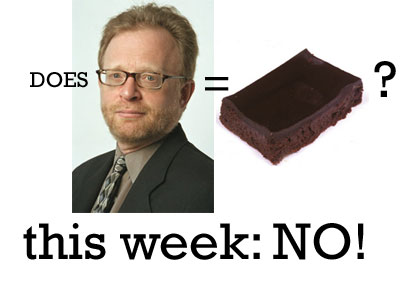
Brownie Points Denied: 3
brownieno.jpg

[UPDATE: Bud Parr has an altogether different response to Clive James’ review.]

Tanenhaus Watch: February 27, 2005

browniewatch1.gif

WEEKLY QUESTION: Will this week’s NYTBR reflect today’s literary and publishing climatet? Or will editor Sam Tanenhaus demonstrate yet again that the NYTBR is irrelevant to today’s needs? If the former, a tasty brownie will be sent to Mr. Tanenhaus’ office. If the latter, the brownie will be denied.

To determine this highly important question for our times, three tests will be conducted each week, along with ancillary commentary concerning the content.

THE COLUMN-INCH TEST:

Fiction Reviews: 1 full-page, 1 full-page round-up (4 books), 3 half-page reviews. (Total books: 8. Total space: 3.5 pages.)

Non-Fiction Reviews: 1 two-page, 3 half-page, 5 full-page reviews. (Total books: 9. Total space: 8.5 pages.)

While the number of books reviewed creates the illusion that the NYTBR is covering fiction, the column-inches reveal the truth! Of the 12 pages devoted to reviews, only 29.1% are for fiction. Tanenhaus has demonstrated yet again that he would rather devote his pages to yet another primer on Churchill (a gutless entry among many other poltiical essays, of which more anon) than concern himself with the exciting world of today’s literature.

While we’re always interested to see Tanenhaus experiment, we’ve long tired of Sam Tanenhaus’ hollow promises on the fiction front. And we will not rest until he devotes a minimum of 48% of his column inches to literature.

Brownie Point: DENIED!

THE HARD-ON TEST:

This test concerns the ratio of male to female writers writing for the NYTBR.

We find it strangely curious that of the five writers contributing to the fiction coverage, three of them are women and two of them are men. We applaud the diversity in coverage, while remaining extremely concerned that only one woman writer has contributed to the nine nonfiction reviews. Beyond this, where are the women for the features? We’d expect this kind of attitude at an Elks Lodge meeting. Surely, in a political atmosphere concerned with women’s issues and with Condi Rice as Secretary of State, Tanenhaus could have found a cross-section of women writers from varying perspectives to grace his pages.

Brownie Point: DENIED!

THE QUIRKY PAIR-UP TEST:

Fortunately, Sam Tanenhaus recovers from his disgrace by having William Vollmann write about Pol Pot. Vollmann’s essay is a good one: erudite, combining personal experience with an attentive read, calling Short on his hubris, and as obsessive as just about anything he’s written.

Then there’s Gore Vidal hoping to restore James Purdy’s reputation. Vidal’s essay (by his own admission) is self-serving. But it’s still nice to see some space in the NYTBR devoted to a forgotten literary figure — even if Jonathan Yardley does this on a weekly basis.

Brownie Point: EARNED!

CONTENT CONCERNS:

Michael Kazin calls Martin Van Buren “the Rodney Dangerfield of presidents” — the sad stretch of an editor demanding a populist metaphor. And why does the population’s perceived failure to understand Stephen Hawking deserve a lead paragraph? It is disturbing to see a newspaper with the New York Times‘ resources not only devoting so much of its space to these desperate attempts to appease Joe Sixpack, but cop to this anti-intellectual tone.

Aside from the priapic instapundits going out of their way to make politics about as exciting as stale muesli, the only real piss and vinegar to be found this week is in Albert Mobilio’s review of J.T. Leroy’s Harold’s End, which is declared “a shiny postcard of a book that offers a paper-thin impression of the author’s talents.”

Where are the daring takes on today’s books? Where’s the wit? The solid arguments that a major newspaper can disseminate among its readers?

CONCLUSIONS:

Brownie Points Earned: 1
Brownie Points Denied: 2

brownieno.jpg