The erstwhile Michelle Richmond will be chatting with Lynn Freed on Word by Word. Show date is September 7. She’ll also be at the Sonoma County Book Festival on September 10. It seems that Ms. Richmond is in the North Bay more than she is the City these days.
Category / Uncategorized
God Damn You, Alan Ball
It’s stuck in my head! Make it stop!
Naughty Reading: Only One Week Left!
But He Can Still Be Seen Wearing Six Gallon Hats, Go Figure
James Tata does indeed like more than the Boss. Oh yes, he does.
Against the Crouton
The time has come to declare war on a culinary obstruction that has caused untold grief for contemporary eaters. I speak, of course, of the crouton: a vile, square-like embellishment that gets in the way of tasty vegetables and is completely incompatible with a salad’s raison d’etre. Should our war be successful (and I assure you, it is a jihad), I shall not be sorry to see the crouton expire. No Geneva Convention can possibly apply here. For the crouton is bunk and must be exterminated as swiftly as possible.
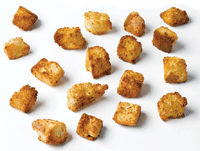 Let’s quibble first over the crouton’s texture, which is often as hard and as impenetrable as the Berlin Wall. When one plunges a fork into a salad, one expects the tines to pierce through like a smooth needle through fabric. But let’s say that a crouton happens to be inside the natural trajectory of the fork’s thrust. As the fork dives into a pleasant leaf of lettuce, perhaps hitting a modest portion of a tomato or onion, perhaps pleasantly lubricated by viscious vinegar, the fork is hindered from its final descent because of this dreadful crouton. The fork user looks down, perplexed, and is likely to cry out, “What the fuck?” A moment of perfection, involving fork plunging into salad, forkful of salad moving to the mouth, and tasty digestion, has been denied. And it’s all because of the crouton.
Now granted, the optimist is likely to try again. But if the salad is polluted by too many croutons, then she will face the same calamity. The only cure for this condition is to adjust the alignment of the fork so that it resembles a spoon and scoop sideways. But since this is lettuce we’re talking about here, and since a fork is not, in fact, a spoon, but a four-pronged instrument featuring small rectangular abysses, the lettuce, being often a thin sheath that requires a forced coupling, is likely to fall between the tines. Even if we presume that the lettuce has formed a blanket to prevent any remnant vegetables from slipping through the cracks, the weight of the crouton might allow a fantastic shredded piece of carrot to fall asunder. Gravity, being what it is, will force all remaining salad components to fall from the fork, which is enough to bring even the most hearty optimists of our world to the same ineluctable cry: “What the fuck?”
From a taste perspective, the crouton also fails. Since the crouton has been fricaseed beyond any redemptive value, it seems designed to provide a harder counterpart (in short, variety) to the soft and naturally crispy texture of vegetables. But while you will encounter humans gnawing on raw carrots and tomatoes, you will very rarely see them snacking on a box of croutons. If the crouton itself cannot stand alone, why then should it partner up with the salad?
Further, there is the troubling fluctuation in the crouton’s hardness. Some croutons are somewhat manageable. Other croutons will crack molars. Nobody has been able to come up with a consistency or standard. Thus, the eater plagued by invasive croutons is doomed to this Russian Roulette.
Who was the asshole who came up with the crouton? Was he a sadist? And why did the crouton catch on? Surely, the crouton’s enduring legacy means that someone must like it. If this is the case, where then are the crouton fan clubs?
Perhaps the ultimate test is the crouton’s cultural bearing: While one might prepare a sonnet to a lover, comparing testicles to ripe cherry tomatoes or wanting to “wrap around you like lettuce” or “lick your sweat off like dressing,” can one ensconce the crouton in a salacious or even a romantic context? Not at all. There isn’t a part of the body that is as square or as tough as the crouton. No surprise that, when compared with the crouton, the human body is much more interesting.