One of my projects over the past few months was reading somewhere in the area of sixteen books (along with a good deal of beginnings) for a science fiction roundup. I’m pleased to report that the fruit of my labors can be read this Sunday at The Washington Post, where the books featured include Gene Wolfe’s An Evil Guest, Nancy Kress’s Dogs, Leslie What’s Crazy Love, and Benjamin Rosenbaum’s The Ant King. I did my best to include a variegated mix of big and small authors, expected and unexpected presses, et al. If I have erred even a quarter as badly as Dave Itzkoff, by all means, feel free to rip me a new one in the comments.
“My Friends”
Back in September, Paul Collins was ahead of the curve. Writing in Slate, Collins investigated McCain’s odd catchphrase, deployed quite liberally on Tuesday night during the second presidential debate. Collins tracked these mad dollops to William Jennings Bryan’s Cross of Gold speech from 1896. Bryan, as you may recall, died in his sleep five days after the Scopes Monkey Trial decision.
If McCain appears to be on the verge of losing this race, the least he can do is to consider the sponsorship opportunities. Let’s say that McCain were to replace “friends” with “space” and charge MySpace $50 for every unfurling of the phrase. Not only would McCain stand to make well over a grand from Tuesday’s appearance, but he would, at long last, demonstrate some familiarity with the Internet at the last minute. (Okay, so he’d be a little behind the curve here, because he’s not exactly aware of Facebook. But we expect some unfamiliarity with the social network of choice among our old geezers.)
Alternatively, I’d like to see John McCain sing “Why Can’t We Be Friends?” in answer to a question if he can’t come up with a cogent answer.
Market Watch
For those paying attention to the remarkable slide of the Dow Jones Industrial Average (10,766 last Friday and 8,635 today), which comes after a colossal amount of money was given to Fannie, Freddie, AIG, and certainly not you and me, there is thankfully one website you can check on until we reach the inevitable economic apocalypse — a period that may be referred to in the history books as The Greater Depression. Or perhaps The Greatest Depression on Earth!
I’m tempted to bet money on whether or not the market will collapse, but my currency may not be around long enough for me to claim my earnings.
Incidentally, we’ll be celebrating the 79th anniversary of the 1929 Wall Street Crash in a couple of weeks. And looking at the eerily similar graphs of that year, perhaps we’ll be “celebrating” in more ways than one. If there’s a bump next week, followed by a plummet, well then you can’t say that history doesn’t have a way of repeating itself.

And David Kipen refused to consider my Federal Writers Project idea.
New Review: Nick Harkaway
Today was quite a busy day. So I only just caught wind of this. But you can read my review of Nick Harkaway’s The Gone-Away World in today’s Barnes & Noble Review. The novel seems to have been strangely categorized as science fiction by the few American newspapers who have bothered to review it. But feel free to judge for yourself. Here’s the first paragraph of my review:
The Gone-Away World is a narrative cloudburst loaded with mordant dust devils whirling close to Iain M. Banks, a philosophical cumulus reminiscent of Neal Stephenson, and a bold downpour of mimes, gong fu, and other torrential tomfoolery. It is not, despite Nick Harkaway’s suggestive nom de plume, a svelte Jazz Age meditation on affluence and perception. But it does tackle these two conditions in a universe close to ours, one that involves Cuba joining the United Kingdom and the All Asian Investment and Progressive Banking Group standing in for the World Bank. Harkaway has written a first novel with an assured and clever voice, riddling his readers with brio and a few unusual thought experiments.
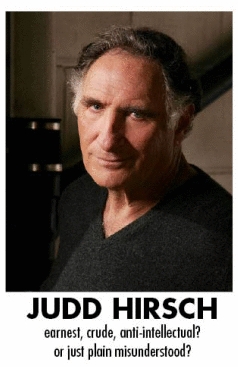
Rhymes with Judd Hirsch
It did not take long for American literary critics to rise to the bait. The real scandal of Adam Kirsch’s comments is not that they revealed a secret bias for insularity on the part of The Adam Kirsch Committee. It is that Adam Kirsch made official what has long been obvious to anyone paying attention: The Adam Kirsch Committee, composed of two members (Kirsch and his ego), has no clue or interest in genre or anything outside of recondite realist literature, no awareness of any writer taking real literary chances, a dismissive interest, at best, with books that challenge conventional notions, and an almost total inability to follow John Updike’s first rule of reviewing. Kirsch should respond not by imploring his editors to have him write more boring and lifeless reviews, but by seceding, once and for all, from the sham that American book reviewing has become.
When Kirsch accuses the American literary community of being raw and backward, and the Nobel committee from selecting writers who “fit all too comfortably on junior-high-school reading lists,” he is failing to live up to an inclusive enlightenment that goes back practically to the Revolutionary War. It was more than 200 years ago that Sydney Smith, the English wit (also a reverend), famously wrote in Elementary Sketches of Moral Philosophy: “Have the courage to be ignorant of a great number of things, in order to avoid the calamity of being ignorant of everything.” Not only does Mr. Kirsch lack that courage, but he fails to cite specifics on the fallacies of these “almost folk writers.” And he uses remarkable generalizations to suggest that these writers reflected the image of America that Europe wanted to see. On the contrary, Paris welcomed such radical American writers as Ernest Hemingway, Henry Miller, and James Baldwin into its fold. In 2001, Philip Roth won the Czech-based Franz Kafka Prize. Richard Powers, Donna Tartt, and Roth have all won the UK-based WH Smith Literary Award in the last decade. Indeed, the Right Livelihood Award — the so-called “alternative Nobel” — handed out an award to an American this year. To judge by these developments, you would think that Kirsch simply hasn’t been paying attention to the last ten years of American-European cultural relations.
But that, of course, is exactly the problem with Adam Kirsch. As long as the Nobel mess could still be mined for a straw man — as long as a sour critic like Kirsch had to leave the New York Sun for the online pastures of Slate in order to become a legend in his own mind — it was easy to make these generalizations and fall into the same trap as Horace Engdahl. And now that the Nobel Literature Prize has been handed out to Jean-Marie Gustave Le Clezio, and some Americans are scrambling to find out who he is, Kirsch can perform his happy little dance of how he knew this French writer all along.
I fully confess that I have not read a single word that Jean-Marie Gustave Le Clezio has written. I am ignorant, and am happy to fill in the gap. And I confess my ignorance here to avoid Kirsch’s greater calamity and his almost total absence of courage.