Weirdass Cinema Review #1

Behind Locked Doors (1948): I’m almost certain that Sam Fuller found some inspiration in this movie for his masterpiece, Shock Corridor. Behind Locked Doors doesn’t offer Fuller’s cultural scope, but it is a strangely entertaining B-movie, with typical yet solid noirish cinematography by Guy Roe. Richard Carlson’s a private eye hired by a San Francisco journalist (Lucille Bremer, who retired from acting shortly after making this movie) to hole up in a sanitarium, pretending he’s insane, so that he can determine if a crooked judge is hiding out there. He’s given the DSM manual, flips through it, and points to “manic depressive” because he “kind of likes it.” The book is thicker than almost anything published by the Library of America, but it’s something of a relief to know that finding insanity credentials is this easy.

In the sanitarium, Carlson befriends an employee with the unlikely name of Hopps (played by the uber-thin Ralf Harolde), who appears here as the Confidant with the Golden Heart. It’s clear early on that Hopps will find his redemption for being such a nice guy. That’s the way these B movies work.
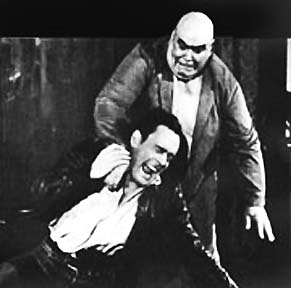
tor1.jpgBut the true genius (or, in this case, mad serendipity) of this movie is Tor Johnson. Johnson, perhaps best known to cinephiles as a kitschy behemoth frequently employed by Ed Wood, somehow stumbled upon the role of his career. In this film, he’s a boxer locked in a private ward. The minute that someone starts hitting the bars of his cell with an ingot, Johnson stirs to life, tearing his chair into pieces and punching at invisible opponents, somehow identifying the sound as a bell. Never mind that bell in a boxing match only rings when a round has concluded. He’s referred to only as “the Champ.”

The reasons for Johnson’s madness are never explained. And I would contend that this is a good thing. Johnson has little in the way of range and this lack of detail provides an unexpected enigma. He’s a big guy capable of picking up people and tossing them over stairwells. An easy enough task for a cinematic brute. But Johnson has a methodical, soporific way of stumbling across the screen that I’ve always enjoyed. It more than makes up for his lack of thespic abilities, limited to raised eyebrows and a face crunched up in unconvincing community theatre horror.

Hopefully, it’s clear enough from my description that the plot is utterly ridiculous. But the film is a brief 62 minutes. Director Oscar Boetticher keeps things moving along at a brisk pace. The dialogue is hard-boiled. This movie has enough courage to bring a hurried austerity to lines like “It’s almost six and I have a dinner date.” Alas, such courage results in unexpected camp.

But if you’re drunk or you have a short attention span, Behind Locked Doors is that questionable morsel illustrating that even a heavy-handed fruitcake can come across as unexpectedly beatific.
Andrew Franklin Is My New Hero

Publisher’s News UK: “[Profile Books Publisher Andrew] Franklin made the point almost as an aside at last month’s SYP meeting. ‘I think it’s despicable to try and pay anybody less than the minimum wage,’ Franklin told PN later. ‘Salaries at the top of publishing are not too bad now, and, when people are paying themselves more than £100,000 a year, it’s awful that they would try to pay people less than £150 a week.’ He also attacked the system’s effect on publishing recruitment, saying, ‘it’s like the debate about tuition fees: it creates a barrier to entry, and people whose parents can’t afford to support them can’t go into publishing. That’s why you have so many people in publishing with names like Rowena and Belinda.’ Profile never pays less than the minimum wage.”

Rest assured, I’ll be buying some Profile titles as soon as possible. (via Publisher’s Lunch)

Sentences That Sum Up Dale Peck

Rake has tried to summarize Dale Peck’s assault on Sven Birkets. But it may be easier by simply singling out sentences:

“Here’s criticism’s trade secret: you can find meaning in anything if you look hard enough.” Meaning you couldn’t find anything constructive to say at all? I guess that’s when you break out the Sontag.

“I sure do laugh a lot” I never knew, Dale.

“Ladies and gentlemen, meet Sven Birkerts.” The ego has landed.

“Indulge me for a moment:” I never thought I’d see dialogue from a James Bond villain appear in a critical essay.

“We must linger a moment longer on the subject of ironies and disappointments . . .” Why linger when you can just segue?

“called by what I think is his middle name” You’re kidding, right? You’re going to hold Sven accountable for his name?

“No, Birkerts’ only subject here is himself, the inevitable progression from frog-killing child to book-killing critic.” Is this a meta confessional or a critical piece?

“Birkerts, in other words, isn’t re-viewing his life in My Sky Blue Trades, he’s reviewing it in much the same way he reviews fiction, telling his readers what they can learn from the text of his life.” And what’s wrong with that? It worked for Henry Miller, Nicholson Baker, too many others to list.

“Let me state the obvious and get it out of the way: Sven Birkerts really loves books. To move beyond that, Birkerts doesn’t love individual books so much as he loves the edifice of literature and his own conception of himself as a small but integral part of that edifice—the keyhole, say, maybe even the doorknob.” If loving books and trying to find a place within them is a sin, then nearly every writer is guilty.

“For example, Birkerts dismissed William Gaddis and Don DeLillo as part of the postmodern plague that had ‘infected’ all the arts in his 1986 essay ‘An Open Invitation to Extraterrestrials,’ but had completely reversed his position by the time of his 1998 review of Underworld.” This may be news to you, Dale, but people change.

“He can take the tiniest premise and stretch it out like a child smearing that last teaspoon of peanut butter over a piece of bread, unaware it’s spread so thin that it no longer has any taste.” That’s rich coming from a man who writes 5,000 word hit pieces.

“about as interesting to watch as a game of Pong” When you can’t cite specific examples, resort to batty metaphors.

“But Birkerts wants to do more than merely bring books to readers. He wants to tell readers how they should be reading them. He doesn’t want to represent the canon, he wants to explain it.” This is a bad thing? And how can we judge Birkets’ overall failure at explanations from a single paragraph?

“in horseshoes, a ringer is worth three points…” I didn’t realize Peck got out of the house.

“It is a large oeuvre. Six books, hundreds of essays. The temptation is to refute each one individually, but to engage with the arguments is, at the end of the day, to give them more credence than they deserve.” In other words, Peck’s approaching his maximum word count. So legitimately addressing the arguments is out of the question.

” I’ve been looking for a contemporary critic’s work to discuss for some time.” So there was a pretext here.