This is a reminder to our readers that our Naughty Reading Photo Contest is still very much alive! While there is still some time, the deadline is August 31 for entries. So be sure to email your naughty reading photos to ed AT edrants.com
Year / 2005
Morning Roundup
- Lethem on Serling. (via TEV)
- Sarah rounds up coverage of the Edinburgh Book Festival.
- The NEH has issued a grant to the Penn State Hemingway Letters Project, continuing the effort to get all of Papa’s correspondence published.
- The Typist Manifesto: valid literary movement, Stuckist ripoff or ULA cover?
- Bret Eatson Ellis’s Lunar Park: Shakespearean?
- Well, here’s a marketing gimmick that will either be a major success or a colossal failure: Harper Collins wants you to name the next Lemony Snicket novel.
- Dario Fo: “There are some people who live only 20 years, but many, many people remember them because they knew how to live the time that was given to them. I’m not suggesting that you should live only 20 years. Live as long as you can, but from time to time, think ’20 years, 20 years, 20 years’, and put them together.” Right. Yo, Dario, you’re a playwright, not a mathematician.
- Bruce Campbell’s book has made big waves on regional bestseller lists.
Et Tu, Posh Spice!
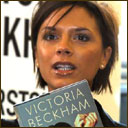
It’s doubtful that any well-adjusted (one might argue: regular) person would expect either a meaty anecdote, much less a bon mot from one-time Spice Girl Victoria Beckham. But I happen to be one of those strange aging men who has retained a soft spot for the Spice Girls and kept the faith over the years . In fact, I’m not ashamed (nor should you be!) to confess that I not only forked out eight bucks for Spice World, but actually enjoyed it!
Throughout the past decade, when in the doldrums, I have turned on “Wannabe,” danced like an ungraceful Caucasian within the privacy of my own bedroom, and connected with the deceptively primitive cadences of “So tell me what you want, what you really really want, I wanna I wanna I wanna I wanna I wanna really, really, really wanna zigazig ha.”
 All along, I’ve had faith that there was something more to these many “wannas.” Perhaps somewhere between the “I” and the “wanna,” the brief pause (as the Spice Girls recaptured their breath) suggested a secret existential void that imparted a certain fortune cookie wisdom from performer to listener. It was, one might argue, a fortune cookie of one’s own making, formed within that milisecond of pause and inhale.
So it disheartens me in the extreme to learn that, all along, the Spice Girls have lied to me and that I’ve been led astray. They are indeed authentically vapid.
Or at least one of them is.
The latest news from England is this: Victoria Beckham, the Spice Girl once known as Posh Spice, has, despite having authored a 528-page autobiography, never read a book in her life. “I prefer listening to music,” says Posh, “althogh I do love fashion magazines.”
Fashion magazines! No possibility of her whispering sweet Shakespearean sonnets into anyone’s ear (well, specifically, that caveman soccer star Beckham’s) anytime soon. Heaven help her children.
How did she get through school? Who sent the checks to the headmasters? Isn’t this attitude a bit like performing fellatio but not receiving cunnilingus in return? More importantly, what hope for Ms. Beckham’s autobiography if she ain’t read none of dem books?
Because of this, I’m afraid that I’m going to have to turn my back on the Spice Girls and sell all of my Spice Girls album to Ameoba, if they’ll take them. This was a tough decision. But I’m a man of honor. And frankly there is nothing that turns me off more than a lady who don’t read.
More Emotion-Induced Blindness Please. We’re Not Driving.
 New Scientist: “The new study by US psychologists found that people shown erotic or gory images frequently fail to process images they see immediately afterwards. And the researchers say some personality types appear to be affected more than others by the phenomenon, known as ’emotion-induced blindness’.”
Hooyah!
Who is Brian Leiter (And Who Really Cares) and Why Did He Invite Himself to Write a Bitter Blog Post?
Brian Leiter quibbles over the New York Times‘ decision to run a lengthy review by William T. Vollmann on the new Curtis Cate biography of Frederich Nietzsche. Mr. Leiter, who apparently is a professor of philosophy, suggests that Vollmann has no expertise in the subject and displays none in his review.
I think Leiter is confusing the act of reviewing a biography (which does, after all, concern itself with a subject and his personal details first) with the act of summing up a man’s philosophy. Aside from Leiter subscribing to the traditional “credentialed” nonsense that often comes from bitter academics (perhaps because, while Leiter remains institutionalized and apparently quite miserable — in Texas, no less — Vollmann is busy turning out endless volumes of books, including a seven-volume treatise on violence), he concerns himself with Vollmann’s alleged failure to discuss Nietzsche’s philosophical ideas.
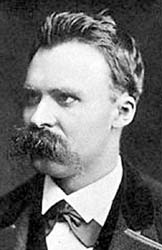 Leiter suggests that Vollmann “bizarrely ascribes” a “realism” to Nietzsche and suggests that Nietzsche does not hold the view that “cruelty is innate,” complaining that Vollmann fails to cite a specific passage. I’m fairly certain that Vollmann was suggesting one of Nietzsche’s most infamous statements from Thus Spake Zarathrusta, something that a certain Austrian perhaps took too much to heart: “Man is the cruelest animal. Whatever is most evil in his best power and the hardest stone for the highest creator.” Far from a “People magazine speculation,” Vollmann is willing to give the NYTBR readership the benefit of the doubt, presuming that they are familiar with Nietzsche’s basics. Further, Vollmann framed the “realism” within quotes, leaving little question to the reader that this was a speculation on Nietzsche’s capacity to tell the truth about the human race. This commonality, of course, what separates Vollmann’s work from many of his contemporaries on both the fiction and the nonfiction fronts.
Leiter suggests that Aristotle’s influence was “notable for his almost total absence from the corpus” and then deflates his argument by pointing to a few examples. I would argue that to dwell into the exact nature and percentage of Aristotle’s influence upon Nietzsche is to not only quibble over pedantics (something that more properly serves the purpose of academic journals, with their reams of paper quibbling over singular passages), but to ignore the realities of editing and publishing a major newspaper that is designed, after all, for mass consumption.
Leiter then offers a cheap shot, suggesting that Vollmann’s stroke has impaired his abilities to think. He then continues on this Aristotle tangent. However, I will agree with Leiter about his nitpicking concerning “individual Jews,” even though his own observation is largely a red herring.
Mr. Leiter’s post is more blustery than helpful and is about as uninviting as it gets. Personally I’m just a guy who knows a little more than the basics about Frederich N. and I’m sure Leiter certainly knows much more than I do about philosophy. But if Leiter seriously believes that the New York Times Book Review is intended to be serious and intellectual, then he clearly hasn’t followed its decline since the Bill Keller pledge to go more commercial from early 2004 and is similarly “uncredentialed” to weigh in. I also sincerely doubt nepotism factored into Sam Tanenhaus’s decision to hire Vollmann. Vollmann has always existed on an uncompromising edge, daring to write about issues that most novelists and journalists keep their heads in the sand about, and has faced a certain stigma enforced by folks too flustered to hear the truth.
While I agree to some extent with Leiter’s cri de coeur for intellectualism, his arrows here are misplaced. A biography is not a philosophical text, nor necessarily a response to philosophy. It tells us about a man and his details, yes. But it is not necessarily concerned with philosphy — although, it is helpful to the scholar wanting to find additional (if tertiary) context.