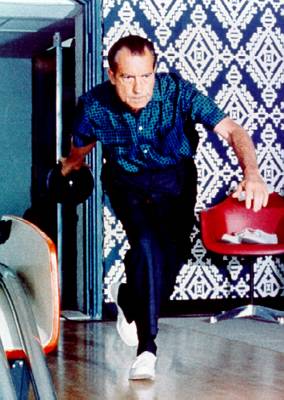
Bowling in San Francisco

One of the things I accomplished over the weekend was returning to bowling after a two-year absence.

nixonbowling.jpgIt wasn’t easy. You see, I hadn’t entirely come to terms with Japantown Bowl’s demise.

In San Francisco, there seems to be an unspoken stigma against casual bowling. You’d be surprised at the paucity of bowling alleys in this town. Is it the City’s purported sophistication that keeps out bowling? Is bowling somehow declasse? Back in November, when I made the list of red state things and blue state things, bowling never really quite fit. It seemed one of those things that cut across party lines. Whether you were a league player or an incompetent bowler drunk off your ass, the common goal of striking down ten pens was what united people. That and the squeals of teenage girls after a strike and the echoes of balls striking pins. Who can say no to this?

My hometown. That’s who.

If you open a bowling alley in San Francisco, it’s almost destined for conversion or desuetude. Before Ameoba on the Haight became Ameoba on the Haight, it was a bowling alley called Park Bowl. And the aforementioned Japantown Bowl, the last of the City’s great bowling alleys, bit the dust a few years ago. This is really pathetic when you consider that even Manhattan has Bowlmor Lanes.

What’s left these days? Yerba Buena Gardens, which has a small bowling alley and nifty Glow-in-the-Dark lighting, might satisfy in a pinch. But a real bowling alley needs to have at least twenty lanes and a few veteran bowlers dispensing advice while practicing lane courtesy. And Yerba Buena doesn’t cut it. There’s also Presidio Bowling Center, but it’s as squeaky-clean and unsullied as Yerba Buena.

So I pretty much lost it when Japantown closed shop. If Yerba Buena was the best that my City could do, then, dammit, I would BOWL NO MORE!

The good news, however, is that a grand bowling experience can be had beyond Serramonte Lanes — just off the coast, no less, at Sea Bowl in Pacifica, a 32-lane affair with beach paintings stretching across the whole alley just above the pins. The people here are real bowlers. They mean business and they want you to bowl well too. You can hear the sounds of the Pacific right off the beach. One suspects that the bowlers who were forced to leave the City somehow ended up in Pacifica.

But if we are to bring back bowling to the Bay Area (real 20+ lane alley bowling!), Pacifica, with its mighty ocean winds and its cool climate, is a good place to start.

Tanenhaus Watch: April 10, 2005

browniewatch6.gif

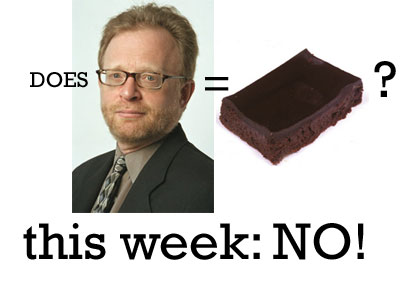
WEEKLY QUESTION: Will this week’s NYTBR reflect today’s literary and publishing climate? Or will editor Sam Tanenhaus demonstrate yet again that the NYTBR is irrelevant to today’s needs? If the former, a tasty brownie will be sent to Mr. Tanenhaus’ office. If the latter, the brownie will be denied.

THE COLUMN-INCH TEST:

Fiction Reviews: 4 one-page reviws, 6 half-page reviews, 1 microscopic blurb in the Children’s Books section (0.2 pages), 1 half-page crime roundup. (Total books: 16. Total space: 7.7 pages.)

Non-Fiction Reviews: 3 two-page reviews, 1 – 1 1/2 page review, 5 one-page reviews, 2 half-page reviews, 1 page roundup on CIA books. (Total books: 18. Total space: 14.5 pages.)

While the disparity here is, as usual, completely out of step with contemporary fiction (case in point: the NYTBR is only now getting around to Meg Wolitzer’s The Position, a book that’s been out for over a month) and very much in favor of non-fiction (a pathetic 34.7% of this week’s coverage is fiction-oriented), I should point out that this is the first NYTBR I’ve seen under Tanenhaus’ tenure that doesn’t feature some unrelated, blustery essay on politics wasting precious column inches. In fact, Tanenhaus can be applauded for getting William Safire and Christopher Hitchens to tie their essays into books.

But one wonders why Tanenhaus is so committed to this type of content. Have you noticed that the letters that come in almost never get excited about any of these essays? (This week’s letters deal with Joe Queenan’s essay on ghost writers and Zoe Heller’s review of Saturday.)

So while I give Sam props for dumping the tangential nonsense, as the great Vince Lombardi once said, “If winning isn’t everything, why do they keep score?” I want Sam to win, but winning means giving your all. And then some.

Brownie Point: DENIED!

THE HARD-ON TEST:

This test concerns the ratio of male to female writers writing for the NYTBR.

Only three women (including the redoubtable Lizzie) contributing to fiction coverage this week (not counting Claire Whitcomb’s microscopic blurb)? Only one (one!) woman contributing to nonfiction? What’s a girl got to do to get a gig with Sam?

Sam should be ashamed of himself.

Brownie Point: DENIED!

THE QUIRKY PAIR-UP TEST:

Fortunately, this week’s slate of contributors makes up for the other two tests. It’s nice to see a full-length review from an illustrator in the Children’s Books section, particularly because his sensibility reveals the unexpected glimpse of an insider. While it’s a shame to see Lizzie Skurnick’s review cramped to a half page, she manages to bring in antecedents and humor into the claustrophobic confines while covering William Henry Lewis’ I Got Somebody in Staunton. Choire Sicha injects sociological introspection into his review of The Position and even manages to coin a new term for people in Connecticut to scratch their pates over: “generational dudgeon.” I plan to use these two words myself the next time I find myself trapped in a conversation with an unimaginative person. And it’s good to see Christopher Hitchens being given a break from writing sensational obituaries.

It’s a steady crop and a fair cop.

Brownie Point: EARNED!

CONTENT CONCERNS:

William Safire’s comparative review does a solid job of introducing the layman to privacy concerns.

Long-time NYTBR readers are aware of David Kamp’s inability to separate fact from fiction. What’s more, Kamp’s widely reported stalking of Neal Pollack sheds an additional doubt on Kamp’s credibility as a NYTBR regular. Apparently, Sam Tanenhaus didn’t get the memo that explained how questionable David Kamp was and has seen fit to let him run amuck with Ruth Reichl’s third memoir.

Kamp starts off with the preposterous notion that most food writers (including Kamp himself?) are “doubtful of the very validity of their profession.” Even if we were to accept the strange notion that food critics suffer from rampant insecurity, what does this have anything to do with Riechl or gourmet writing? Isn’t any gourmand, by way of her tastes and sensibilities, absolutely confident about the foods that permeate her palate? And isn’t this the very quality that makes food writing so exciting?

I grew very uncomfortable reading Kamp’s review. He seems more concerned with Reichl’s physical appearance (the word “bra” can be found twice and there are no limits to Kamp judging Reichl on her sexuality and her cascading “dark curls”), rather than her qualities as a food writer or a memorist. Factor in Kamp’s inability to mention Jayson Blair’s name (“He Who Shall Not Be Mentioned”) and the Gray Lady glorymongering (apparently, Reichl’s stint at the Times is the most fascinating part of the memoir), and we see that Kamp is a man more concerned with voicing his own neuroses rather than assessing a memoir by a seminal gourmand. Perhaps he and Jonathan Franzen might want to sign up for several group therapy sessions, if only to spare us the unpleasant personal revelations.

Personal sartorial choices are also the linchpin of Ben MacIntyre’s review of a Geoffrey Spicer-Simson, which, despite the headline’s playful riff on the John Ford film, spends too much time dwelling on Spicer-Simson’s skirt, as if this, rather then Spicer-Simson’s actions, was where the ultimate meaning behind Lake Tanganyika can be found.

It’s good to see Richard K. Morgan getting a full-page review, particularly when the subhead describes it as “a dystopian novel” rather than a “science-fiction novel.” Tanenhaus is showing signs of thinking outside the box of genre ghettoization. We award him a special half brownie point for doing so.

CONCLUSIONS:

This week’s NYTBR has finally recalibrated its pages to complete and total review coverage. And, as such, it’s the closest that Tanenhaus has come to earning his brownies. But with fiction coverage still caged within soundbyte-sized reviews, not given the room to expand that previous editors had allowed, it still doesn’t cut the mustard for a leading national newspaper.

But if the NYTBR continues further in this direction, and Tanenhaus takes more chances, then we will be more than happy to fulfill our part of the bargain.

Brownie Points Earned: 1.5
Brownie Points Denied: 2
brownieno.jpg

Alternative Press Expo ’05

ape_proghdr_r1_c1.gifOne of the great joys of being a comic book devotee in San Francisco is being able to attend the yearly Alternative Press Expo. Independent comic publishers ranging from the big guys (Drawn & Quarterly, Fantagraphics and Top Shelf) to a limitless array of self-publishers are there to hawk their goods and exchange ideas about where the comic book is heading. Walk only a few steps in the Concourse Exhibition Center and you find yourself talking with the folks behind Too Much Coffee Man or you end up discussing H.P. Lovecraft’s sudden legitimacy with the Library of America volume (I counted four separate Lovecraft comic book projects on tap this year), and whether this newfound respectability will interfere with his indie streetcred.

It’s a bit like being a kid in a candy store. There are quite literally hundreds of vendors. Everything from personal comics to manga to unapologetically titilating titles such as Babes in Space. For the smaller publishers, the artists are often there themselves to promote their own books — costermongers by necessity.

It was only the rapidly depleting funds in my wallet that forced me to leave. But I did manage to speak with a good chunk of cartoonists while walking the floor.

For the most part, I tried to ignore the multi-table setups from the big indie publishers. I was there to scope out titles I hadn’t heard of. To my surprise, I was able to talk to a few off-the-beaten-track artists I was already familiar with.

Besides Lovecraft, the floor was festooned with compilation comics — a dependable way of putting out a comic and splitting the hard labor of drawing among several people to get something put out. Two compilation comics in particular caught my eye. Young American Comics has an ongoing series called The BIZMAR Experiment. The challenge? An artist can tell any tale he wants, but it must involve a bunny, an insect, a zombie, a monkey, an alien and a robot. This unique limitation results in some interesting and off-the-wall tales (one story has the other five relentlessly hitting on an anthrmorphized bunny). The folks at Young American also told me that they were planning a YACtour — essentially, a year-long trip through all the states. Another group project, Unseen on TV, was also recently launched.

The other group project that interested me, a far more morbid offering than BIZMAR, was Mauled!, put out by Manual Comics. It involves collaborative depictions of true-life horror stories. The first two issues deal with, respectively, people attacked at the zoo and surgical malpractice. Fortunately, there’s a sense of humor to go along with this. (A depiction of the infamous Phil Bronstein komodo dragon biting, with Sharon Stone in tow, shows the incident from multiple perspectives.) Manual is based out of Hoboken, New Jersey and Mauled! owes its sustained life by the artists’ ability to coordinate work through email.

Zombies and Broken Hearts is a new self-published offering from Matt Delight and Kevin Cross. Delight and Cross, both zombie lovers (but reportedly not zombies), told me they spawned the title when they noticed the pre-2004 glut of interest in zombies. Little did they realize that the Dawn of the Dead remake and Shaun of the Dead were just around the corner. But their fun little comic continues the new tradition of zombies being misunderstood and almost completely disregarded by the human population. (“Why does Blake smell like dog shit?” says one human obliviously kissing her lover, now a zombie.) Delight and Cross told me that they had plotted through the fourth issue and had enough ideas for twenty.

I noticed that a new TPB of Arsenic Lullaby, a daring and politically incorrect comic book with zombies of aborted fetuses and field agents from the U.S. Census Bureau, was out. Arsenic Lullaby has been in existence for about five to six years. It is perhaps one of the most unapologetically dark comics being turned out today, almost sure to offend anyone. But this no holds barred approach, however, is part of its charm. To my surprise, the thin and bearded man hawking the goods was none other than Douglas Paszkiewicz himself. Doug told me that he had a spinoff called King Donut in the works. Despite having seen other spinoffs start and fail, he assured me that this one contained some of his best work.

I’m a big fan of Andi (Breakfast After Noon) Watson. And Oni Press now has a new title, Little Star, from Watson, which offers a more introspective take than usual on past regrets and fatherhood. Watson’s striking shadings continue to get better, employed for charcoal darkness and even an ultrasound.

Local cartoonist Keith Knight of The K Chronicles (who also has a blog) was there hawking his new book, The Passion of the Keef.

The very animated Batton Lash told me that he’s been working on Supernatural Law for about 27 years. Supernatural Law, which tells the tale of attorneys representing monsters and manages to sustain its premise with heavy injections of cultural satire. It started off as a comic strip (what Lash called his “off-Broadway” period) that was eventually picked up in the National Law Journal. After thirteen years of this, Lash began work on Supernatural Law as a comic book. Lash did ferocious research, perhaps more than was necessary, and was told by his superiors that he needed to give the attorneys some time away from the office. There hasn’t been a new issue of Supernatural Law, Lash tells me, because he’s busy working on the TPB for the first eight issues. While TPBs exist for the remainder of the series, Lash has returned to the beginning to redraw it.

Perhaps the most soft-spoken cartoonist I talked with was the remarkably prolific Jeffrey Brown. Brown was a very amicable guy, but I had to lean in to about a foot away from him to hear what he was saying. He was at the Top Shelf booth with a new title, Minisulk. When I asked him how he was so prolific, he told me that he pretty much drew when rising from bed, before work, and after work. I asked if he drew at his job and he said that he once was able to. But now that security cameras have been added, he’s had to be careful.