John Cleese is the purported author of the Declaration of Revocation, a missive directed at the people of the United States. With Cleese harboring possible ambitions to run as mayor of Santa Barbara, it’s very possible that Cleese may have momentarily merged his comedy with his politics. However, at present, there’s no conclusive evidence that Cleese wrote this. (via Tom)
Year / 2005
And If You Say Anything Ellison Considers Stupid, the Old Guy Will Call You a Cocksucker and Threaten You with Physical Violence
Harlan Ellison will be appearing in Cleveland and the Plain Dealer has the pre-appearance scoop. Apparently, if anyone in the audience uses “like” improperly, they will have to pay 25 cents. Additionally, the Plain Dealer reports that a straight-to-television adaptation of the comic Harlan Ellison’s Dream Corridor (think Ray Bradbury Theatre or Arthur C. Clarke Presents with Ellison stories as the catalyst) is in the works.
Solomon & Foer Sitting in a Tree
“I’m not interesting,” Jonathan Safran Foer announced when I asked him to come out of his palatial home and breathe some oxygen. “People assume that because I’m a writer, I’m naturally interesting. They couldn’t be more wrong. I’m a sad piece of driftwood and the biggest disappointment since Steve Perry left Journey.”
Of course, I tried to cajole poor Foer with some of the trademark wit I used in my one-page Q&As. I asked Foer if he considered stabbing himself because of his youth and his wealth, pointing out the slam-dunk posterity advantages of an early Sylvia Plath-like literary death. I asked Foer if he ever thought about throwing himself in an oven just to see what life might have been like for his grandfather, had not the mystery woman saved him. Casual jokes to make Foer smile. But Foer was adamant about his cipher status.
“I just watched Behind the Music last night,” he said. “I spent all day in bed, trying to work myself up to write. In desperation, I turned on the tube. When I saw Daryl Hall reveal how hard it was for him to write ‘Maneater,’ how he too had spent years working up the courage to be a great artist. I…I wish I could offer you something a little more….” He stopped midsentence and stared at my decolletage.
“Manly?” I ventured.
“No, something fierce and more representative of the Caucasian race,” he said by way of desperation. “Something along the lines of Daryl Hall. Have you been dating?”
“No,” I said. “Most people are afraid to talk with me because I’m such a bitch.”
I looked at his wiry physique and I saw a beautiful 28 year old boy rather than a writer. I saw a few of my own neuroses in Foer and wondered how he might feel against me in bed. Would he read me Nabokov? Could I be his Humbert Humbert?
My friends had warned me of Fatal Attraction types, but there was something of the easy conquest represented in the 150 e-mail messages he sent me every hour. I did everything in my power to resist his attraction, even comparing him to Liberace. But I realized that I could not resist the man who had penned Extremely Loud and Incredibly Close.
Pre-Oscar Reading
If you can’t wait for tonight’s Oscar ceremonies to begin, Bravo’s Indie Spirt blog has been maintained by the fantastic Cinetrix and is well worth your time.
Tanenhaus Watch: February 27, 2005

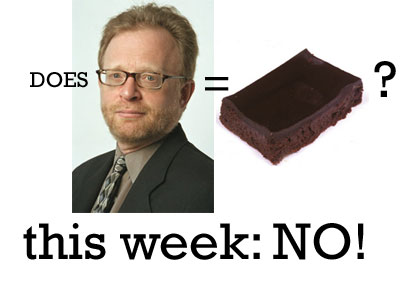
WEEKLY QUESTION: Will this week’s NYTBR reflect today’s literary and publishing climatet? Or will editor Sam Tanenhaus demonstrate yet again that the NYTBR is irrelevant to today’s needs? If the former, a tasty brownie will be sent to Mr. Tanenhaus’ office. If the latter, the brownie will be denied.
To determine this highly important question for our times, three tests will be conducted each week, along with ancillary commentary concerning the content.
THE COLUMN-INCH TEST:
Fiction Reviews: 1 full-page, 1 full-page round-up (4 books), 3 half-page reviews. (Total books: 8. Total space: 3.5 pages.)
Non-Fiction Reviews: 1 two-page, 3 half-page, 5 full-page reviews. (Total books: 9. Total space: 8.5 pages.)
While the number of books reviewed creates the illusion that the NYTBR is covering fiction, the column-inches reveal the truth! Of the 12 pages devoted to reviews, only 29.1% are for fiction. Tanenhaus has demonstrated yet again that he would rather devote his pages to yet another primer on Churchill (a gutless entry among many other poltiical essays, of which more anon) than concern himself with the exciting world of today’s literature.
While we’re always interested to see Tanenhaus experiment, we’ve long tired of Sam Tanenhaus’ hollow promises on the fiction front. And we will not rest until he devotes a minimum of 48% of his column inches to literature.
Brownie Point: DENIED!
THE HARD-ON TEST:
This test concerns the ratio of male to female writers writing for the NYTBR.
We find it strangely curious that of the five writers contributing to the fiction coverage, three of them are women and two of them are men. We applaud the diversity in coverage, while remaining extremely concerned that only one woman writer has contributed to the nine nonfiction reviews. Beyond this, where are the women for the features? We’d expect this kind of attitude at an Elks Lodge meeting. Surely, in a political atmosphere concerned with women’s issues and with Condi Rice as Secretary of State, Tanenhaus could have found a cross-section of women writers from varying perspectives to grace his pages.
Brownie Point: DENIED!
THE QUIRKY PAIR-UP TEST:
Fortunately, Sam Tanenhaus recovers from his disgrace by having William Vollmann write about Pol Pot. Vollmann’s essay is a good one: erudite, combining personal experience with an attentive read, calling Short on his hubris, and as obsessive as just about anything he’s written.
Then there’s Gore Vidal hoping to restore James Purdy’s reputation. Vidal’s essay (by his own admission) is self-serving. But it’s still nice to see some space in the NYTBR devoted to a forgotten literary figure — even if Jonathan Yardley does this on a weekly basis.
Brownie Point: EARNED!
CONTENT CONCERNS:
Michael Kazin calls Martin Van Buren “the Rodney Dangerfield of presidents” — the sad stretch of an editor demanding a populist metaphor. And why does the population’s perceived failure to understand Stephen Hawking deserve a lead paragraph? It is disturbing to see a newspaper with the New York Times‘ resources not only devoting so much of its space to these desperate attempts to appease Joe Sixpack, but cop to this anti-intellectual tone.
Aside from the priapic instapundits going out of their way to make politics about as exciting as stale muesli, the only real piss and vinegar to be found this week is in Albert Mobilio’s review of J.T. Leroy’s Harold’s End, which is declared “a shiny postcard of a book that offers a paper-thin impression of the author’s talents.”
Where are the daring takes on today’s books? Where’s the wit? The solid arguments that a major newspaper can disseminate among its readers?
CONCLUSIONS:
Brownie Points Earned: 1
Brownie Points Denied: 2