Amateur Hour at Studio 360
Kurt Andersen has offered the uncut version of his conversation with Harlan Ellison. But what is particularly astonishing is just how much of an ignoramus Andersen comes across as. He constantly interrupts Ellison. At around the 26:30 mark, Andersen cannot get Dreams with Sharp Teeth director Erik Nelson’s name right and must utter the intro again. An embarrassing suggestion that Ellison wrote “Paladin of the Lost Hour” for the original Twilight Zone is there. In short, Studio 360 is a program that is made almost entirely in the editing room and certainly not from the conversation itself. And if this uncut interview serves as a representative rough version of what the editors have to play with, then I wonder just how much Andersen is relying on his editors to salvage the show and make it sound “professional.”
For the record, while there is some editing on The Bat Segundo Show (mostly to boost levels, remove coughs and popped plosives, make people sound a bit sexier, and the like), what you hear on these shows is 98% of the conversation. If I make a referential mistake, I leave it in. If there’s a strange tangent, I leave it in. If a guest and I get kicked out or something strange happens because of a third party, I leave it in. But I compensate for these fallacies by actually knowing the material: reading the book in full, wading through other interviews to ensure that I don’t ask the same questions, making sure I pronounce the author’s name, the book’s title, and the book’s characters correctly (although there have been a few minor slip-ups; nobody’s perfect). I’m determined to get as much of this right in my conversation because it means less editing time for me. And I only have so much time to commit. Perhaps this “one take” sensibility comes from my theatrical background. But apparently Andersen (or his writers) cannot do this.
Just think of all the man-hours that have been expended towards correct Andersen’s mistakes. Consider the labor costs that might have been avoided had Andersen actually bothered to pay attention to his goddam subject.
But what do I know? I’m just some hapless podcaster.
(Incidentally, at the 30 minute mark, it’s also quite funny to hear Harlan Ellison skewer Andersen’s stereotypical remarks about Los Angeles.)
Boys Will Be Boys
Harlan & Connie: The Video


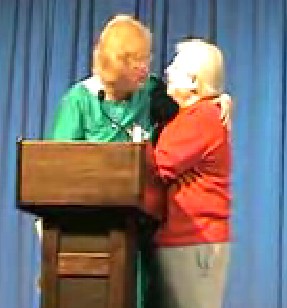
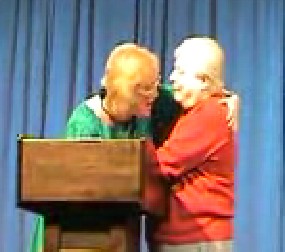
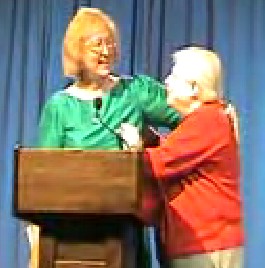
A clear grope at the :44 second mark. No grab? No grope? No fondle? I think not.
Harlan Ellison Responds
At the Harlan Ellison message board, Ellison has posted the following (which he gives permission to disseminate):
Would you believe that, having left the Hugo ceremonies immediately after my part in it, while it was still in progress … and having left the hall entirely … yet having been around later that night for Kieth Kato’s traditional chili party … and having taken off next morning for return home … and not having the internet facility to open “journalfen” (or whatever it is), I was unaware of any problem proceeding from my intendedly-childlike grabbing of Connie Willis’s left breast, as she was exhorting me to behave.
Nonetheless, despite my only becoming aware of this brouhaha right this moment (12 noon LA time, Tuesday the 29th), three days after the digital spasm that seems to be in uproar …YOU ARE ABSOLUTELY RIGHT!!!
iT IS UNCONSCIONABLE FOR A MAN TO GRAB A WOMAN’S BREAST WITHOUT HER EXPLICIT PERMISSION. To do otherwise is to go ‘way over the line in terms of invasion of someone’s personal space. It is crude behavior at best, and actionable behavior at worst. When George W> Bush massaged the back of the neck of that female foreign dignitary, we were all justly appalled. For me to grab Connie’s breast is in excusable, indefensible, gauche, and properly offensive to any observers or those who heard of it later.
I agree wholeheartedly.
I’ve called Connie. Haven’t heard back from her yet. Maybe I never will.
So. What now, folks? It’s not as if I haven’t been a politically incorrect creature in the past. But apparently, Lynne, my 72 years of indefensible, gauche (yet for the most part classy), horrifying, jaw-dropping, sophomoric, sometimes imbecile behavior hasn’t–till now–reached your level of outrage.
I’m glad, at last, to have transcended your expectations. I stand naked and defenseless before your absolutely correct chiding.
With genuine thanks for the post, and celestial affection, I remain, puckishly,
Yr. pal, Harlan
P.S. You have my permission to repost this reply anywhere you choose, on journalfen, at SFWA, on every blog in the universe, and even as graffiti on the Great Wall of China.
* * *
There are several things wrong with this.
1. The notion that grabbing Willis’s breast was “childlike” and thus excusable. From all reports (and unfortunately, what we have now is mostly circumstantial), Willis in no way asked Ellison to grab her breast, nor chided him to do so.
2. If what Ellison did was somehow “right” (to his eye) in this context, why not expatiate at length about it? This is particularly uncharacteristic for Ellison, as he’s known to keep obsessive records about damn near everything to prove that he’s right.
3. The utter hypocrisy in Ellison failing to state how exactly he obtained Willis’s explicit permission while on stage (if he did indeed so), while similarly complaining about how other men are not entitled to do so.
4. The wholesale inability to say “I’m sorry” or “I apologize.”
5. The sanctimonious notion that he can get away with this and that this is the product of “a politically incorrect creature” rather than a boorish pig.
Do you think that Ellison had Nixon’s Checkers speech in mind? After all, Nixon likewise found his hand caught in the cookie jar, likewise shifted the terms of the argument away from personal culpability, and likewise couldn’t find it within him to say “I’m sorry” or “I apologize.”
UPDATE: Video and screenshot.
Harlan Ellison at WorldCon
Rick Kleffel has Harlan Ellison’s one-man WorldCon panel on tape. Kleffel assures that it will offend everyone, but it seems rather tame and a bit sad and solipsistic to this listener’s ears. If desperate screaming into the mike is the height of hilarity, then I’m sure you’ll dig it. But the pathetic nature of Mr. Saturday Night comes to mind.
[UPDATE: Gwenda notes that Ellison groped Connie Willis without her permission at the Hugos. More here. A class act, Harlan, if this is true.]
And If You Say Anything Ellison Considers Stupid, the Old Guy Will Call You a Cocksucker and Threaten You with Physical Violence
Harlan Ellison will be appearing in Cleveland and the Plain Dealer has the pre-appearance scoop. Apparently, if anyone in the audience uses “like” improperly, they will have to pay 25 cents. Additionally, the Plain Dealer reports that a straight-to-television adaptation of the comic Harlan Ellison’s Dream Corridor (think Ray Bradbury Theatre or Arthur C. Clarke Presents with Ellison stories as the catalyst) is in the works.
Beyond Heaving Bosoms by Sarah Wendell and Candy Tan. The famed writers behind
Alice Fantastic by Maggie Estep. This wild and highly enjoyable narrative involves two sisters (presumably, the third one was still being rented out by Chekhov), a hippie ex-junkie mother who lives with seventeen dogs, a murder, gambling, and libidinous Hollywood actresses who live in Woodstock. But this is the wonderful Maggie Estep we're talking here. And what seems at first like a quirky yarn becomes something unexpectedly moving about connectivity. What I love about Estep's work is the way that she'll juxtapose an extremely astute observation (now that you mention it, why do cab drivers always have somebody to talk with on the phone past midnight?) with an often outrageous story development.
Generosity by Richard Powers. It doesn't come out until September 29th, but Richard Powers's latest will have anyone committed to books reconsidering their literary fervor. I foresee some animosity from the vanilla critics hostile to idea-driven novels, but book bloggers, YouTube chroniclers, and MFAs would do well to plunge into this chance-taking narrative, which introduces vital questions about what the reader's relationship is with media, scientific dissection, and "creative nonfiction." Are we rats fleeing to happy cities? Or can we find the humanism within the purported plague?
Pieces for the Left Hand by J. Robert Lennon. Lennon is one of the most underrated fiction writers working today. Much as On the Night Plain proved that Lennon had a lot more in the toolbox than heartfelt (and often very funny) suburban satire, this slim but fascinating volume juxtaposes 100 small-town anecdotes -- arranged by category -- in a manner that reads, at times, like Nicholson Baker's passions for minutiae and, at other times, Stewart O'Nan's concern for psychological detail. The result is fiction that makes us wonder about whether one person's subjective view of particulars can entirely be trusted. This book never found a publisher in 2005. But thankfully, Graywolf has released it in the United States, along with Lennon's latest novel, The Castle.
Wonderful World by Javier Calvo. This wonderfully raucous volume has been completely ignored by the Washington Post, the New York Times, and the Los Angeles Times. But it's probably one of the most delightful reading experiences I've had this year. Calvo cavalierly mashes up multiple genres and manages to mix up familial subtext with larger-than-life, almost cartoonish characters. (Indeed, one might argue that one mobster's penis is a character of its own in this sprawling novel.). This is not an easy thing to pull off, but Calvo makes it work. And it's helped immeasurably by Mara Faye Lethem's idiom-specific translation. (
The Means of Reproduction, Michelle Goldberg This thoughtful book tackles the complicated (and little discussed) subject of reproductive rights from numerous angles, which includes a number of unpleasant but necessary ones. The upshot is that there isn't a quick fix solution for declining birth rates and fundamentalist abuses. Just about every political faction has contributed to the friction. But you'll want to read this book anyway to refamiliarize yourself with the topic, but also to understand just what's occurred during the past several decades to get us where we are today. (