Dave Eggers interviewed at the Onion AV Club: “I would disagree about “isolated” or “lonely.” Those are two things that I don’t know very well, so I can’t write about them. I think that most of the characters are people who aren’t settled in what they’re doing, and maybe have been uprooted in one way or another, by an event in the world or their own restlessness. Most of them are abroad and looking for something. This is what the hunger is about: whether they’re hungry for some kind of affection, or something else.” (via the Rake, who has a few theories of his own about this slightly different Eggers interview)
Year / 2005
We’re Not Sure Where He Got the Million Number, But We Hope Someone Gets a Visit from Ed McMahon
The nominations for StorySouth’s Million Writers Award are up. Editor Jason Sanford notes that this is a contest in which the best online story of 2004 will win, thanks to your input. So vote early and vote often.
The Brownies Return
With Mark on deck with the Los Angeles Times Book Review and Scott Esposito watching the Chronicle, the time has come to restore the Tanenhaus Brownie Watch again. Starting this Sunday, we’ll be watching Sam with the same eagle-eyed stance of a jester and letting you all know whether or not Tanenhaus has earned his brownie.
(And, incidentally, should Sam Tanenhaus earn his brownie, we will in fact be sending them to him. Let it not be said that we didn’t honor our pledges.)
Now if someone else will step in with the Washington Post, the litblog community should have its bases covered.
Fuck the iPod
Will somebody give me one good reason why I should own a fucking iPod? Will somebody explain why I should give Steve Jobs 350 hard-earned George Washingtons to apply the Apple logo to my hip?
Sure, it’s a handy little device, I suppose. But then so is a garlic press. The garlic press, however, is much cheaper and will actually do something beneficial. Such as saving you some time when you’re cooking some pasta.
Frankly, I don’t get it. The little bastard doesn’t even allow me to record onto it. (To its credit, the Zen, Creative’s response to the IPod, does.) The least one can expect for this kind of money is a consummate fuck from a second-class Hollywood hooker. But from where I’m sitting, I’m looking at a bunch of teenagers and twentysomethings on the subway not really enjoying themselves, plugged into earphones and passing the time in the same banal way that non-iPod riders are.
Would someone explain why it’s so important to be completely out-of-touch with the waking world around me? If the iPod is about control, why don’t these folks use Nero to burn a custom CD for their pre-existing Discmen?
I’ll confess that music is important and that I listen to a lot of it. But who knew that one out of 10 Americans view the iPod as their fucking savior? Did we learn nothing from Ridley Scott’s 1984 commercial? We’re supposed to throw a hammer to the evil corporate overlords, right? Funny how the iPod has been airbrushed into a new version of the commercial. Never mind that this “Greedo shoots first” version is no longer available at the Apple site.
I’d like to chalk the iPod phenomenon up to a “kids these days” benediction. But I’m too young to be a scolding old man. Even so, I’ve seen grown men fucking around with this thing, as if the Apple Click Wheel was some technological justification for revisiting Billy Squier. Why subsidize some half-baked mofo who doesn’t even know how to spell “tonight?”
And what’s with this whole bullshit notion of the iPod empowering you? Am I missing something here? You mean to say that if I go into a Universal Unitarian church with an iPod strapped on and start talking with some slinky blonde that I’ll take her home and ensure her at least six orgasms? Wow, who knew? The iPod as muscle car. Throw the basic aspects of mutual attraction out the window, my friends.
I’m utterly convinced that historians will view the iPod in the same light that people remember the Olympus Pearlcoder: a half-baked technological tool that suggests something personal and refined, but that is ultimately about taking advantage of people’s inability to figure out the technological tools they have on their Dell computers. Namely, these things called CD burners, BitTorrents and MP3s, the latter being a format that isn’t particularly bad for something coming through your headphones.
HST: The River is Still Running
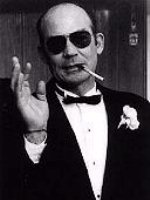 I haven’t read the obituaries. I haven’t read anything. Hunter S. Thompson is gone and his unexpected suicide hit me hard. I was reduced to a blank, morose expression while sitting in a passenger seat in a moving car heading south for some fun. What fun could be had when America’s foremost nihilist and partygoer had decided that enough was enough? It took me about twenty minutes of explaining why Hunter S. Thompson was important and why his work mattered before I could go about my day.
Friends have often noted that I have an older man’s concern with the notable folks who die. But my concerns rest not with mortality, which is inevitable, but the more troubling question of enduring legacy. Who will replace these voices? What other tangible creative things die in the process?
Because Thompson, like all the others, was needed and irreplaceable. The landscape of American letters can never equal the strange mix of chaos and wisdom that Thompson threw into his work with inebriated gusto. It should be noted that Thompson repeatedly read the works of H.L. Mencken and the Book of Revelations in Gideon Bibles when holed up in hotels. Thompson was a man committed to a subjective form of journalism that he believed in with religious fervor, but he never lost sight of the number of the beast painted around Washington.
His work was as shoot-from-the-hip and as inconsistent as any prolific hack. His writings varied from incoherent screeds to astute examinations of American hypocrisy. But at his best (whch was often), he mattered. Thompson stood alone as a courageous voice, and he got people to listen.
A few years ago, Hunter S. Thompson stated repeatedly in interviews, “No one is more astonished than I am that I’m still alive.” I always chalked this up to the Good Doctor defiantly drinking Wild Turkey, imbibing drugs, firing guns into the night, blaring televisions and banging out political diatribes (even howling like a banshee on the commentary track for Fear and Loathing in Las Vegas), maintaining the same life that he had built his career upon. Here was a man who had openly settled for Clinton in his collection, Better than Sex, hoping that some spark of true progressivism would endure. Yet two years later, he was the only writer with the balls to eviscerate Nixon upon his death.
In his autumn years, Thompson had settled into a comfortable routine of writing a sports column for ESPN. He had recently married and was keeping busy. But no one can keep a good political junkie down. And it was no surprise when Thompson came out with high hopes for Kerry in Rolling Stone. His essay concluded:
We were angry and righteous in those days, and there were millions of us. We kicked two chief executives out of the White House because they were stupid warmongers. We conquered Lyndon Johnson and we stomped on Richard Nixon — which wise people said was impossible, but so what? It was fun. We were warriors then, and our tribe was strong like a river.
That river is still running. All we have to do is get out and vote, while it’s still legal, and we will wash those crooked warmongers out of the White House.
Thompson must have taken the results in November hard. Harder than anyone. For as much as any of us stupored around for days, feeling as if our last hopes were defeated when four more years of Bush were upon us, Thompson had to feel the pendulum swinging to the right more viscerally than any Poe character.
There’s the famous passage in Fear and Loathing in Las Vegas in which Thompson describes the death of 1960s idealism:
There was madness in any direction, at any hour. If not across the Bay, then up the Golden Gate or down 101 to Los Altos or La Honda….You could strike sparks anywhere. There was a fantastic universal sense that whatever we were doing was right, that we were winning….
And that, I think, was the handle — that sense of inevitable victory over the forces of Old and Evil. Not in any mean or military sense; we didn’t need that. Our energy would simply prevail. There was no point in fighting — on our side or theirs. We had all the momentum; we were riding the crest of a high and beautiful wave….
So now, less than five years later, you can go up on a steep hill in Las Vegas and look West, and with the right kind of eyes you can almost see the high-water mark — that place where the wave finally broke and rolled back.
I always figured Thompson had found a way to go on and accept the hard realities of a nation thumping to a reactionary beat. And maybe he did for a while.
But make no mistake: despite Thompson’s ultimate answer to the predicament, that river is still very much running. And Thompson’s work will endure. The question now is this: Who has the courage to pick up the slack?