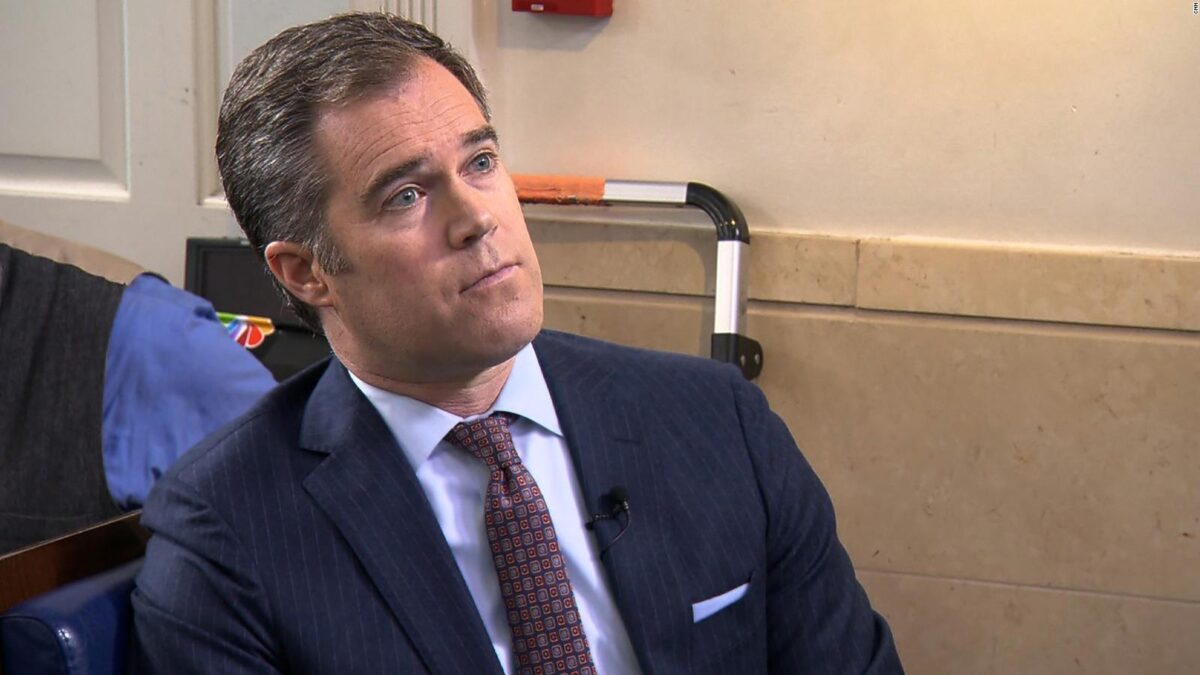
NBC News’s Peter Alexander continues to demonstrate that he is a mediocre man of the Chuck Todd school, more committed to unfounded gossip than substantial journalism.
Every time Chuck Todd says something particularly idiotic (which is about 74% of the time that he’s on camera), my 2019 Todd takedown, in which I outlined Todd’s considerable mediocrities and his wholesale lack of qualifications in lively vitriolic style, goes viral on Twitter. But now that I’ve seen how Peter Alexander — another dim bulb at NBC News who inexplicably hasn’t been replaced by the janitor — has used his Twitter audience of more than half a million followers to whip up conjecture and unsubstantiated rumors as a vital investigation into an attempt to overthrow the government is underway, I’m wondering if the problem isn’t so much Chuck Todd, as it is the way that NBC newsroom culture continues to tolerate piss-poor “hot take” “reporting.” I mean, just look at the man’s eyes. It’s clear that he was manufactured in a hatchery. Has this dullard ever had an original thought or a big scoop? One rarely encounters this level of innate dudebro vacuity outside of aspiring Wall Street sociopaths meeting for an early lunch at some otherwise charming Water Street bistro. But it does tempt me to posit a thesis. NBC News is apparently the ideal place for any mediocre man to rise up the journalistic ladder with the speed of the Parker Space Probe. Not only can you get away with mediocrity. You don’t even have to practice journalism at all!
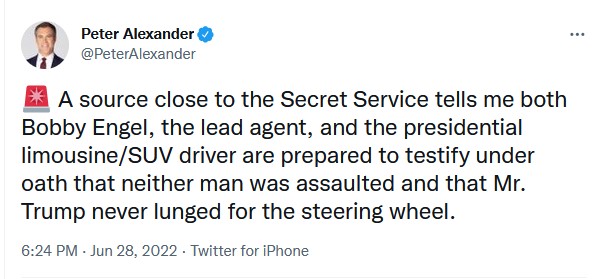
Here was the “big scoop” from Alexander the Far From Great:
If I told you that “a source close to a prominent DC sex club has told me that Peter Alexander is a bottom who enjoys being flogged every Friday night by tall men who weigh over 300 pounds to the point of profuse bleeding and to the point where Mr. Alexander yells, ‘Keep going, big boy! I want to be Phyllis Schlafly’s he-bitch!'” you would rightly ask, “Well, wait a minute there, Ed. Why didn’t you confirm this with Alexander or the club owner?” Or you would ask me what that source is. Or you would ask me what my journalistic motivations are. But because Alexander works for NBC News, his journalistic malpractice — fueled by the type of Bob Woodward “on background” sourcing that he wishes he were capable of — is completely sanctioned by institutional incompetence. Never mind that Secret Service agent Bobby Engel has already testified before the Select Committee behind closed doors and that a professor of law at NYU has already stated that Cassidy Hutchinson is consistent with what Engel has already said. For a low-class Trump rentboy like Alexander, the truth doesn’t matter.
That Alexander is both arrogant and stupid enough to believe that a Select Committee assembled to expose Trump’s wrongdoing would not go out of their way to get it right after two unsuccessful impeachments says everything about Peter Alexander’s pathetic and desperate lunges towards relevance. It’s the kind of bullshit that would be roundly denounced by other journalists (and where is that aging and fatuous gasbag Jack Shafer on Alexander?) only five years ago. But I’ve been waiting for other journalists to call this self-serving turkey out. And they haven’t. So I guess it has to be me. Again.
In the eyes of a grasping and hopelessly corrupt opportunist like Alexander, any form of hearsay is fair game. And sure enough, the right-wingers have scooped up Alexander’s “alternative facts” with all the hunger of a starved beaten-down puppy who just wants to be loved but who will likely die in a ditch because it can’t meet the adorable criteria.
This isn’t the first time that Alexander has tilted at windmills (though without quixotic flair). Just two months ago, as White House Correspondent, Alexander inserted a desperate hoot into a garden-variety dismissal of Republicans by President Biden. Knowing that he didn’t have a story, Alexander tried to manufacture a story through a belabored hem that wouldn’t pass muster at community theater.
And now he’s done it again. Except that the deplorables who wrap their fat idiotic asses in the Confederate flag are lapping this Alexander tweet up as the smoking gun — despite the fact that Alexander’s “scoop” is the epitome of laziness. But Alexander is doing this not only because he knows it gets him inflated attention and artificial “hits” that are the new standard of “success,” but because he knows that NBC News will do nothing whatsoever to reprimand him. The only way that Alexander would suffer serious repercussions for his malfeasance (and even do some serious soul-searching) is if we lived in the Time of Icarus.
[6/30/2022 UPDATE: Snopes has now weighed in on L’Affaire Alexander and debunked his story as “False.”]
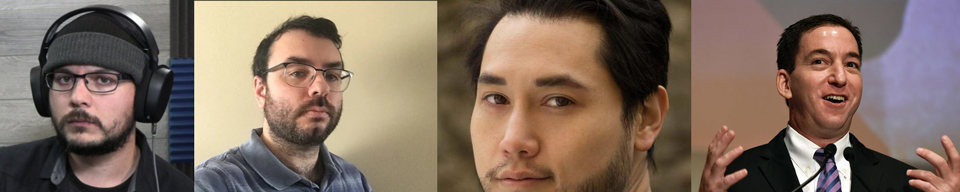
Now that the “fake news” braying from the frayed Trump cabal has faded into the obscurity of a horrifying age feeling improbably older than its actual position on the Gregorian calendar, the time has come to reckon with the alt-journalist sociopath, who may represent one of the greatest threats to empathy and thoughtful reflection in 2021. I speak, of course, of the Tim Pools, the Glenn Greenwalds, the Andy Ngôs, and, most recently, the Michael Traceys of the universe. These scenery-chewing and humorless offshoots of the so-called “intellectual dark web” live for ruining people even as they pretend to espouse some greater “truth-telling” ideal. They have picked up the slack left by Trump’s ban from all social media, catering to the ravenous hordes who wish to believe that the earth is flat and that the illusory Democratic conspiracy against them is very real.
If you are fortunate enough to have never encountered the alt-journalist sociopath, then let me fill you in on his common qualities. For the alt-journalist sociopath is almost invariably a “he” and really makes you aware of this fact by callously disregarding how other people use pronouns. (Ngô has gone to the trouble of deadnaming one of his victims. The YouTube commentator Vaush has limned Pool’s transphobic positions in an epic 85 minute video. Greenwald stumps for transphobic authors. Tulsi Gabbard tag-teamed with Tracey to ridicule the nonbinary.)
The alt-journalist sociopath is usually a white male, ousted from traditional platforms because of seasoned incompetence, outright hubris, or routine dereliction of basic journalistic practice. Facts, or even a cogent argument, do not matter to the alt-journalist sociopath. What does matter is the “truth,” which is often nebulous and subject to constant revision, but almost always tendered as something outside the purview of mainstream media and thus somehow nobler. This gives the alt-journalist sociopath a certain cachet shared by trendy serial killers or domestic terrorists who appeal to the fawning interest of incel shut-ins. This alt-right leaning crowd tends to represent the vast majority of the alt-journalist sociopath’s audience.
By so placing himself as an outlier upholder of dodgy “principles,” the alt-journalist sociopath anoints himself as a kind of deity, usually amassing several hundred thousand followers on his Twitter account. Yes, social media is the wild kingdom for this bilious animal. And because there are no zookeepers to administer to the alt-journalist sociopath’s unhinged rage and false sense of entitlement, the uncaged alt-journalist sociopath paws at his outsize megaphone rather than rattling the bars of his holding cell. These environmental conditions allow the alt-journalist sociopath to stir his legions of febrile acolytes into vengeful id-driven troglodytes.
Despite having the wide reach of a cult leader, the alt-journalist sociopath’s raison is to portray himself as a frail outlier even as he possesses no compassion or remorse for anyone beyond himself. In 2017, Michael Tracey ludicrously attempted to frame a modest brush from then 79-year-old Rep. Maxine Waters as a “shove” in a pathetic attempt to depict himself as victim.
Two years later, Andy Ngô went further than Tracey and secured fame and admiration from mainstream outlets after experiencing alleged violence during the Portland Black Lives Matter protests. The greatest problem with Ngô, aside from the relentless fabrication of his reporting (of which more anon), is that the details didn’t quite add up. Ngô claimed that he had been diagnosed with a brain hemorrhage after being hit with a milkshake mixed with quick-drying cement, but the cement angle was later debunked. Ngô told BuzzFeed reporter Joseph Bernstein, “I don’t feel obliged to share my personal medical records publicly to satisfy internet trolls.” (Bernstein reports that he reviewed a copy of hospital discharge paperwork confirming that he had suffered from a “subarachnoid hemorrhage.”) While no journalist, even dubious ones like Ngô, should experience any form of violence, it’s rather remarkable how Ngô mustered such sympathy for being “attacked” by antifa protesters. He secured a $195,000 GoFundMe nest egg from his ultraconservative enablers.
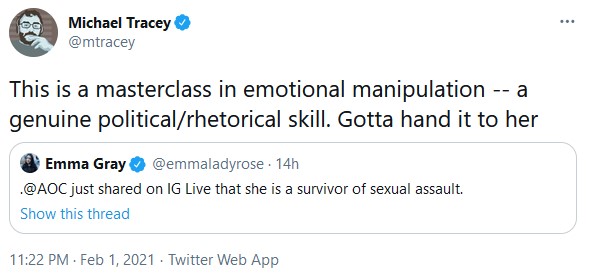
Being a victim is the alt-journalist sociopath’s bread and butter. It’s the winning lottery ticket that secures him some questionable legitimacy in the media food chain. Yet the alt-journalist sociopath is so self-absorbed that he will never consider the misfortunes, much less the victimhood, of anyone beyond himself. If anything, he goes out of his way to denigrate or disparage anyone whom he perceives as a threat. After Rep. Alexandria Ocasio-Cortez bravely revealed that she was a victim of sexual assault on Instagram Live, Tracey claimed this to be “a masterclass in emotional manipulation.”
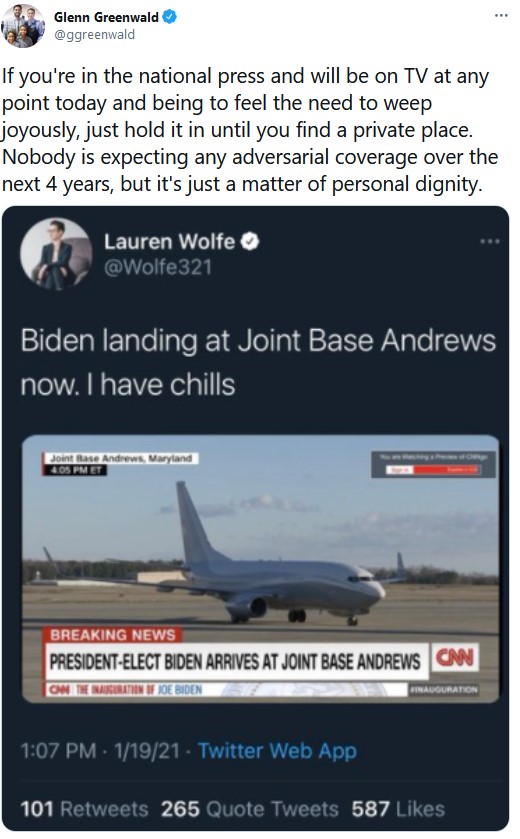
Similarly, Glenn Greenwald inspired a campaign that resulted in New York Times contributor Lauren Wolfe being fired from her job. Why? Because she had the audacity to express that she had “chills” after seeing Biden’s plane land before his inauguration. Wolfe’s tweet was a relatively innocuous statement. Reporters are, after all, human just like the rest of us. But Greenwald’s 1.6 million followers took the catnip and responded with the fierce force of unhinged vigilantes, claiming Wolfe to be a demonic transgressor against journalistic objectivity. Greenwald neither took his original tweet down nor called for the Times to reverse its decision. Because the alt-journalist sociopath is usually a narcissist, Greenwald instead made it about himself, whinging that he bore no responsibility for the results of his reckless tweets and disingenuously cleaving to the great “speak truth to power” lie that all alt-journalist sociopaths champion.
The remarkably indefatigable Twitter account, @TimPoolClips, has tackled Pool and Ngô at length, exquisitely filleting these charlatans down to their oleaginous essence. These two have been highly selective and ideologically convenient about how they frame the “news” they purport to report on. As documented by Jacobin‘s Arun Gupta, in an article for the Wall Street Journal, Ngô omitted key evidence of a driver striking a protester, claiming his falsely edited clip to be the work of “angry, agitated ingrates and criminals.” As Gupta has outlined, Ngô’s journalistic liberties have resulted in other conservative outlets becoming emboldened to commit similarly egregious omissions. In a September 2, 2020 YouTube video, Vaush detailed the “Tim Pool Grift” as follows: Tim Pool has weaved a narrative in which has painted himself as “a liberal who is merely criticizing the Democrat Party” throughout his YouTube existence. But Vaush pointed out that the clickbait titles of Pool’s videos, often factually inaccurate, were more indicative of a Republican.
In any other world, these agitprop quacks would be laughed off the public stage for their risible anti-intellectualism and tendentious cartoonishness. But it is a regrettable truth that these sociopaths are largely impervious to castigation — in large part because they are regularly in the habit of doxxing and shaming their critics or anyone perceived to be “against” their mission. As The New York Times has increasingly shifted to glossy profiles of insurrectionists (the “Nazis! They’re just like us!” school of journalism) and Marjorie Taylor Greene faces no repercussions for expressing the desire to execute prominent Democrats, it’s not much of a surprise to see the alt-journalist sociopath thriving quite well. And since the nadir of what now constitutes “journalism” continues to slip lower than any other time in American history (even the notorious James Callender faced consequences!), the question we must ask is this: What will it take for the public to uproot these toxic demagogues from their perches?
2/2/2021 7:30 PM UPDATE:
Glenn Greenwald using baby voice to mock @AOC for talking about the danger to her life on January 6 and for rejecting an alliance with Ted Cruz. “She ruined that movement. Because all she wants to do is attack Republicans and fortify the Democratic Party”.pic.twitter.com/gWTS67Yknj
Mere hours after I published this essay, Glenn Greenwald further cemented himself as an alt-journalist sociopath, aligning himself with Michael Tracy’s misogyny by belittling AOC’s story. He also offered the false and hyperbolic claim, “All she wants to do is attack Republicans and fortify the Democratic Party.” This, of course, is a Pool/Ngô style airbrushing of actual history. Ocasio-Cortez tweeted just six days ago, “I am happy to work with Republicans on this issue where there’s common ground, but you almost had me murdered 3 weeks ago so you can sit this one out. Happy to work w/ almost any other GOP that aren’t trying to get me killed.”
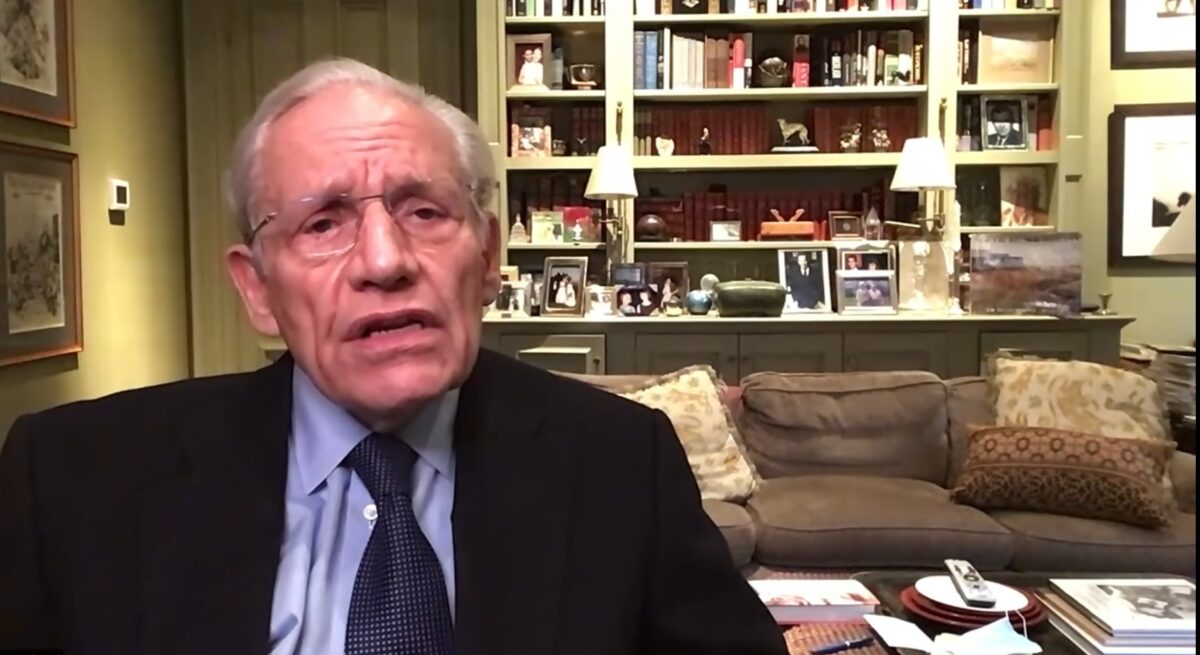
On any given day, Bob Woodward demands a minimum of thirty-two apologies from various people he encounters. Most of the people whom Bob Woodward demands apologies from are women who ask him legitimate questions. But he has already answered these questions. And asking Bob Woodward a question is disrespectful. Do you not recognize the Genius of Bob Woodward? At least Bob Woodward is not grabbing the legs of his enemies like Otto in A Fish Called Wanda, looking down on their bodies from open windows with imperious vengeance and unhinged narcissism. Bob Woodward is too old for such shenanigans. But in his younger days, he may have done this.
This is the way that Bob Woodward rolls. He is a 77-year-old man of the old school. Show Bob Woodward some respect! Just yesterday, Bob Woodward demanded an apology from the barista who got his order wrong. He had ordered a skim milk latte, but the barista had accidentally given him a whole milk latte. Bob Woodward was not pleased. You don’t mess up Bob Woodward’s order. He’s a Journalistic Treasure! Don’t you remember Watergate and Bob Woodward’s invaluable journalistic contributions? Bob Woodward is a hero! Don’t you recognize this? Goddammit, he deserves the correct latte he ordered.
So when the barista politely asks Bob Woodward if he can accept a correctly constructed skim milk latte as recompense for the screwup, Bob Woodward says no. Because the barista should have made the latte right the first time. “Contact my people,” says Bob Woodward, “They’ll send you a free book.”
Bob Woodward sends a free book to anyone he demands an apology from. It seems only fair. He is sitting on a very large pile of his books. On days when Bob Woodward is depressed, he will walk into his study and stare at the vertiginous towers of his volumes stacked neatly in his den and smile and say, “Why yes! This is why I am Bob Woodward!”
It was Saturday morning. The paper boy, who is working two other jobs, hurled a copy of The Washington Post onto Bob Woodward’s porch. But the paper did not land on the pressure-treated redwood slats at the right angle. The paper did not land right next to the tall lantana plant that had spent the summer soaking up the sun. Bob Woodward was very upset by this. We might all be upset with such calumnies, even when there are very small stakes involved. It’s a difficult time to be alive. So Bob Woodward called around to people he knew at the paper and demanded an apology. “Mr. Woodward,” said the kid on the phone. “With all due respect, this is an easily cleared up misunderstanding.” “No,” said Bob Woodward. “This is a matter of pride. I’m Bob Woodward! Don’t you understand this?” And so Bob Woodward reamed into the kid on the phone and made sure that both the paper boy and the kid on the phone were fired. Never mind that these were rough economic times. But that was the regrettable price of crossing Bob Woodward. You don’t question Bob Woodward. Bob Woodward is always right. Bob Woodward has created a life that demands supplication and genuflection and obedience. Bob Woodward doesn’t understand why these kids never got the “Respect your elders!” memo.
Bob Woodward wasn’t feeling very well when Shira Stein and Karen Ho pressed him on a thorny ethical issue — namely, why he held onto the Trump tapes for so long, tapes in which Trump revealed that he knew the true threat of the coronavirus as early as February. If the tapes had been released sooner, was it possible that more American lives would be saved? Would it also be possible that lives in other countries might have been saved if Bob Woodward had not stayed quiet? Bob Woodward insisted to the two uppity women (were they really journalists or did they play journalists on TV?) that he needed to figure out whether Trump was referring to the United States when he said these things multiple times. He needed until at least May. Why the delay in corroboration? Well, Bob Woodward was still catching up on Schitt’s Creek. It was one of the few television series known to penetrate Bob Woodward’s serious hickory mien, a look modeled after Andrew Jackson that he regularly evinced to his wife and to his professional peers and that caused all people in Bob Woodward’s immediate circle to revere him and to fawn over him without criticism. Besides, like anyone, Bob Woodward needed to unwind sometimes. As Bob Woodward caught up on Schitt’s Creek between February and May, you could sometimes see Bob Woodward cracking a smile if you caught him on a good day.
And so Bob Woodward did what he always did. He demanded that Stein and Ho serve up apologies — ideally with a suggestive dance over Zoom. He didn’t really answer their questions.
But this time, much to Bob Woodward’s surprise, the two journalists did not back down. Much to Bob Woodward’s surprise, those who followed the dispute on social media took the side of the two younger journalists.
When Bob Woodward learned that his privilege didn’t inure him to criticism and that people thought he was being a dick, he began calling around for people who would offer apologies to him for invented offenses. For all perceived transgressors, he offered them a free copy of his book. Because a free copy of Rage was apparently the price you paid for abandoning your ethical core and backing down from justifiable criticism of Bob Woodward’s shaky journalistic methods.
It’s possible that Bob Woodward is a confidence man, much in the way that Janet Malcolm had famously described. After the Zoom meeting, Bob Woodward waited all day for the apologies to roll in. The apologies never arrived. Bob Woodward had reached an end point. He was too old to learn. He was too old to change. He was too caught up in the hot fire of his hubris to play it cool.
Bob Woodward had only one option left. He is now demanding an apology from himself. But he can’t seem to summon it. And he still doesn’t know why.
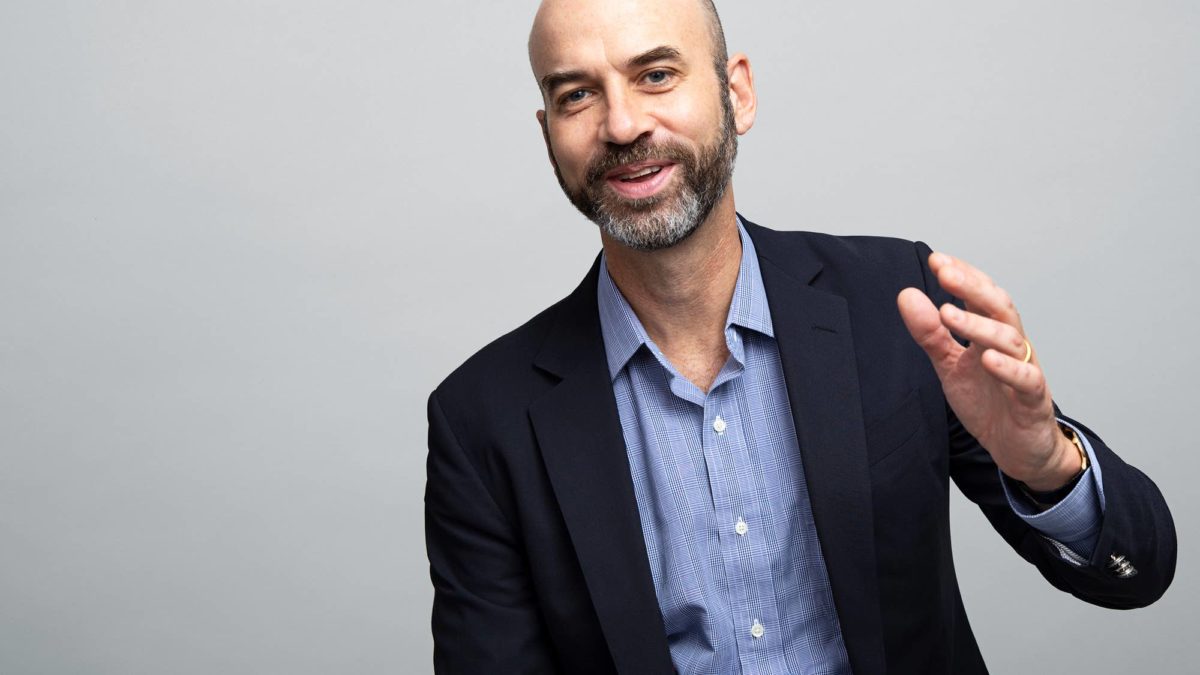
We reached out to New York Times editorial page editor James Bennet to ask him to explain why he continues to publish dangerous opinion pieces. And we were stunned when he sent us an opinion column that he insisted we publish!
Hello there! James Bennet here. You may know me as that fun-loving xenophobic paycheck man who, despite never taking a meaningful moral position in my entire life, fell upward thanks to my vanilla background to oversee the op-ed pages of the New York Times! I’m living proof that, if you’re a sycophantic 54-year-old Yalie who bobs his mouth up and down on the throbbing member of the Establishment on a daily basis, you too will never be fired or rebuked by top brass! Because here at the Times, we’re not just about celebrating the Stuff White People Like or ensuring that David Brooks can fulminate right-wing drivel under the false cover of inclusive intellectualism. We’re not just about refusing to modulate or adjust our voice from our hopelessly dowdy upper middle class roots. We’re also firmly committed to being inexorably puzzled by strange cultural figures like Lizzo, Childish Gambino, Big Sean, Boots Riley, Rungano Nyoni, and Mariama Diallo! And we will continue to deny column-inches to anyone who enjoys these strange dark-skinned people!
Thanks to my cowardly sensibilities, I ensure that the New York Times continues to publish all the affluent Cacuasian opinions fit to print! Aside from a few token individuals who are trending heavily on social media (we do, after all, need your subscription dollars to keep the lights on!), you won’t find many brown people or black people among our guest columnists here! Nor will you find any of those sketchy pinko socialists. No, sir! Not on my watch. I’m so committed to reinforcing fascism and putting our African-American staffers at risk that I’m even willing to publish a racist and authoritarian article by a Senator named Tom Cotton! (Get it? Cotton! Ha ha! Yeah, I chuckled over that little joke too.)
They say that opinions are like assholes. Everyone has one and most of them stink. Well, if you’re the overlord of opinions, as I am, then you can only imagine the kind of asshole you’d have to be to swim in a sea of fuming anuses and earn a living at it! Instead of being a writer’s writer or a journalist’s journalist, I’m an asshole’s asshole! My spineless timidity and willful capitulation of my soul have been the secrets to my success!
Here at the Times, we publish the kind of family-friendly white supremacy that gives the Amy Coopers and the Svitlana Floms of our world all the inspiration they need to use their privilege to sic the police on innocent black people with false accusations! I’m very proud of my work. I wake up every day, smile in the mirror, and, just before I splash a few drops of Clive Christian No. 1 upon my neck and prepare to scarf down $60 strips of Norwegian salmon for breakfast, I say to myself, “Goddammit, James! Look at you, you magnificent white bastard!” Not a streak of melanin in my skin, my friends. I take pride in my work. I take pride in my skin color. Not white power, but white pride. There’s a distinction! Still, I have to say. Ain’t being white grand?
However, I do want to explain why we published the piece today by convicted murderer Harold Bailey, former grand wizard of the KKK and, for many years, a prominent dot on the hate map published by the Southern Poverty Law Center. Yes, it’s true that he filed his column from a maximum facility cell at the Red Onion State Prison, where he is serving time for raping forty-five black people. Nevertheless, Times Opinion owes it to our readers to show them counter-arguments. And it remains my firm belief that a dangerous criminal screaming obscenities and making deranged sculptures from his own fecal matter in a padded cell is capable of thinking along the same lines as a policy expert. After all, that’s democracy!
When Mr. Bailey wrote at length about why he wanted to shove a pineapple into my wife Sarah Jessup’s mouth and tie her down with rope in a chair so that she could watch helplessly as he sodomized my two children, I didn’t flinch one bit! Obviously, most people in our society are opposed to this assault and trauma. And that is fine. But we are in the business of recklessly publishing any diseased opinion we can find. It fits right in with the tacit acceptance of white values that we hold dear to our hearts. And sometimes it’s vital to understand the careful nuances of why someone would be driven to such a violent act of abuse. “But what nuances exist in publishing such an explicit essay?” you may ask? Well, it’s not my job to suss these out. Use your noodle! Think about it!
We understand that many readers find Harold Bailey’s argument painful and even dangerous. We believe that this is one reason why it requires public scrutiny and debate. However, if you look deep enough into anything, such as an unblemished wall that has been freshly painted white or a graphic description of my two children being violated, you will find great shining beauty that you can turn into exciting cocktail party banter!
What’s most important about publishing opinions is to realize that they are just that: merely opinions. It’s my job to deaden your soul and to rob you of your moral compass so that you can look upon the world with a clinically detached eye, remaining flip and casual about the unfolding horrors and staying on the sidelines as these uppity revolutionary bastards lose hope and are pecked off one by one by an authoritarian police force. I mean, if I don’t bat an eye when Mr. Bailey writes in adoring detail about the fantasy of committing vicious crimes against my family, then there’s no reason why you should either! If you don’t raise a stink about Tom Cotton’s column, then his views will become more normalized. And when that happens, it creates a stable world in which you too can worship at the altar of unwavering normalcy. And isn’t that a lofty goal for our society? To walk out into the world, knowing that nobody feels anything, and proudly slam down two dollars and fifty cents for the morning edition, only to read opinions that you once considered horrifying and that are now absolutely the norm. That’s why the Times keeps me, James Bennet, here at the top!
I’ll admit. We did push the envelope a bit with the Cotton and Bailey essays. But the only way to unite this nation is by inoculating the population from horrors and systemic abuse, ensuring that they never feel outrage, and creating a population in which nobody has hope. And with protests and a pandemic happening now, and a Second Great Depression just on the horizon, we’re nearly there! All of these exciting developments make me prouder than ever to be white, status quo, and dead inside.
On the evening of September 25, 2014, I did something awful and tried to kill myself the next morning. I lost everything I had. Is this apparent monster worth forgiving? Or is he not so much of a monster? This 50,000 word essay is a personal reckoning with what I did, who I really am, a treatise on public shaming and how we express ourselves and the importance of getting facts right, as well as a thorough rebuttal to the many invented charges against me.
“In 1970 my mother said to me, ‘I would have been glad to testify to get back at those bastards for what they did…But I suspected, from my own experiences working within the Hollywood system, that people used the blacklist as a way of getting back at other people for things that had nothing to do with politics. And that’s not unique, because it happens in academe too. A lot of people who testified did so to get back at people who had gotten jobs away from them, who had won assignments. It was an opportune moment; in a very cynical way, it was a golden opportunity. This was the government who wanted your testimony. It was sanctioned.”
— Jacoba Atlas, interviewed in Victor Navasky’s Naming Names, an excellent volume on McCarthyism.
“Conformity is a way of guaranteeing and manifesting respectability among those who are not sure that they are respectable enough. The nonconformity of others appears to such persons as a frivolous challenge to the whole order of things they are trying hard to become part of. Naturally it is resented, and the demand for conformity in public becomes at once an expression of such resentment and a means of displaying one’s own soundness. This habit has a tendency to spread from politics into intellectual and social spheres, where it can be made to challenge almost anyone whose pattern of life is different and who is imagined to enjoy a superior social position — notably, as one agitator put it, those in the ‘parlors of the sophisticated, the intellectuals, the so-called academic minds.’”
— Richard Hofstadter, “The Pseudo-Caonservative Revolt –1954”
“Google is an instrument of humiliation. I google a rival to see if I can discover unflattering tidbits. And the very process of googling is humiliating to the rival (in magical form), but also humiliating to me. Any time I exercise the privilege of ‘googling for the hell of it’ I am humiliating myself.” — Wayne Koestenbaum, Humiliation
“I can’t beat it.” — Manchester by the Sea
I slept for many weeks in a stale caged room, surrounded by fragile people who were just as broken and twice as devastated. I had no refuge. I had no family. They left me for dead and still want me vanished to this day. My partner wanted me invisible. I can’t say that I blame her. It seemed as if I didn’t have any friends, although I will always remember the rare ones who did not give up on me as I lived in this hopeless way station of ceaseless grief. Some part of me knew that I had to find a way to appreciate what I still had, which was a roof over my head and a psychiatrist meeting me for about ten minutes each week. It wasn’t much, but the room at the hospital was still more spacious and a bit more private than the cramped expanse I would later land at the homeless shelter. I lived with a friendly schizophrenic who talked in many voices, a shattered congenial man who came to New York to reclaim unspeakable loss from his past, along with several dozen troubled souls. After a few weeks, there were occasional escorted trips up the elevator to play basketball, where I practiced aloof moves on a rooftop asphalt slab that felt something like heaven. I’d wake up in the middle of the night to orderlies quietly sifting through my scant possessions, looking for contraband razors or anything else that I might use to kill myself. That was, after all, why I was there. It was what I had tried to do on the morning of September 26, 2014, after I cracked and did something terrible the night before, something that was fueled by alcohol and a mental breakdown.
I took showers in which I had to dry my naked vulnerable heartbroken body — always surveiled by the cameras — with paper towels. The woman I once loved, the woman who I personally pledged with every honorable bone to leave alone, had served court papers on me as I was trying to recover. I had received the cruel and unnecessary envelope just after finishing a relaxation session. I accepted the summons and burst into tears and fell shellshocked into a blanketless bed that was not mine for what seemed hours, wondering how much lower I’d plummet. She knew that I didn’t have the funds to defend myself, although I was appointed an attorney, arriving embarrassingly late to the first court appearance weeks later after I’d been rustled out of bed only hours before, moved to another shelter at four in the morning in a part of the city I did not know. I am never late. I pride myself with being on time. I am a man who, for better or worse, shows up. But I was late. I was also exhausted, disoriented, heartbroken, and humiliated. She knew that I was never violent towards her, much less any person (save for self-defense against a man who attacked me at Coney Island and, to be completely transparent, a thin young man I verbally confronted at the Franklin Avenue subway station, who repeatedly punched me as I handed him his dropped books and who I never once hit back), and that my father was a damaged man who burned me with cigarettes, who choked me, who abused me, who tried to suffocate me as my sister watched, who told me he loved me just before popping me in the jaw. I had worked very hard to escape this cycle of violence, quietly volunteering off and on over the years with domestic violence hotlines, often interceding whenever I saw a man threatening a woman, and disarming countless near-pugilistic situations with my wit. Now I was this deadly man by legal implication. It was just about the worst thing that she could have done to me. And I suspect she knew this. But then my mentally addled and drunken behavior on the night of September 25, 2014, which momentarily sullied her well-deserved reputation before she excelled quite well without me, was probably the worst thing I could have done to her. All acts of justice, large and small, come down to petty retribution in the end. But the question we’re too hopped up on hurt to answer is when it should stop.
She had visited me once. It wasn’t a long visit. There was upset and sadness in her hardened brown eyes. Warm orbs that once jittered with joy were now forever gone, reduced to a dimming memory of a shimmering figure now more mythical than real. I knew I’d never get back what I once had, that I’d somehow managed to lose it all, and this cold truth caused me to cry for months, even though I had to parcel out my tears because I rarely had space to myself and I couldn’t let the rough men I lived with see me weak. In our last meeting at the hospital, I saw her hands shake. Her voice quavered. Her curls, which once pulled towards me of their own accord, now retreated away with a natural instinct from the suicidal madman. I remember her being so afraid of me that she rattled upon the door, begging for someone to let her out, even though the door was open. I wasn’t in my right mind and had no defense. The nurses and the orderlies, who were all so terribly kind and who later told me how much they liked my writing and a few poetic songs I composed for others to sing, went out of their way to get me a pen and paper. They believed I could win her back. I knew they were wrong. I had little more than twenty minutes to write her a poem. I am sure that the incoherence I put down in words scared her too. For many months, I would have no private place to recover from my crackup and my heartbreak: the terrible, terrible pain of seeing someone who once looked at me with such love shudder and retaliate because she was afraid.
I watched minds break and I witnessed troubled men piss their pants. There was a brilliant Russian intellectual with an unruly shock of wild jet hair demanding his own room to escape the “peons.” There were many very smart people inside, but they were all fragile and broken and needed to get through their pain. At least two of my cellmates — one offering to pay me to house sit, later buying me an extravagant sushi dinner that felt beyond my wildest dreams after I lost thirty pounds on a benefits card diet of cheap sandwiches (always cold, never hot) — took their lives in the year that followed. I played chess with a man because he was lonely and nobody else wanted to push forward pawns with him and, well, I wasn’t going anywhere. And I won. It was a perfunctory victory, one arrived at in a heart-battered haze. Then he sought me out. Because I was the only one he couldn’t beat. And I let him win. Because he needed that and that seemed the decent thing to do. Like all of us, he needed a little hope. He needed just a little dignity, a little faith in himself. This was, after all, the only way to beat the shame and accept the truth of who you were and what you did. But when I left the hospital, reclaiming the confiscated phone that got me in trouble, I had no idea how much more public shaming awaited me online. Most of it involved actions that I never committed.
* * *
Jon Ronson has written about victims of public shaming sitting paralyzed at their kitchen table for nearly a year, frozen and broken by online impressions of what they are not tendered by people they have never met, debased in their efforts to rebuild their lives and to do the hard work of confronting and correcting the impulses that led to their transgressions in the first place. No amount of kindness or honorable action or good faith efforts at redemption will ever win over the crowd. The roots of this cultural disease reside in vengeance trumping compassion, of myths replacing facts, of false allegations begetting more false allegations, of the whole putrid and untrue stew being summoned whenever you say anything, no matter how kind and thoughtful. In an effort to keep up with the fickle jonesing from easily angered social media consumers, longform journalism, which was once committed to an airtight presentation of the facts, has aligned itself with the absolutism of public shaming. It has faltered from its original mission, with cynical editors crafting and encouraging outrage-inducing clickbait, often published at places like Slate and Salon, that have caused perfectly decent writers to debase themselves as they willfully traffic in half-truths for a paycheck.
When Rolling Stone reporter Sabrina Rubin Erdely began investigating an alleged rape gang operating at the University of Virginia in July 2014, she was driven by a passionate need to redress a great wrong. She became so consumed by a larger cultural malady, one that certainly requires a devoted army of journalists, essayists, poets, and fiction writers to keep in check, that the underlying facts, which disproved her thesis, no longer mattered. A real journalist might have clung to doubt and skepticism, or gone out of her way to paint the scene with a subtle and careful brush, but Erdely was determined to push forward even when the professed ringleader of the gang was never interviewed or found out. Erdely never bothered to interview key witnesses who offered differing accounts. She believed too easily in a story that kept changing, one that mimicked details from books and television shows. And because Erdely made several serious mistakes, she set back a vital discussion of an important issue plaguing our nation, one recently reopened with the many courageous women assaulted by Trump stepping forward.
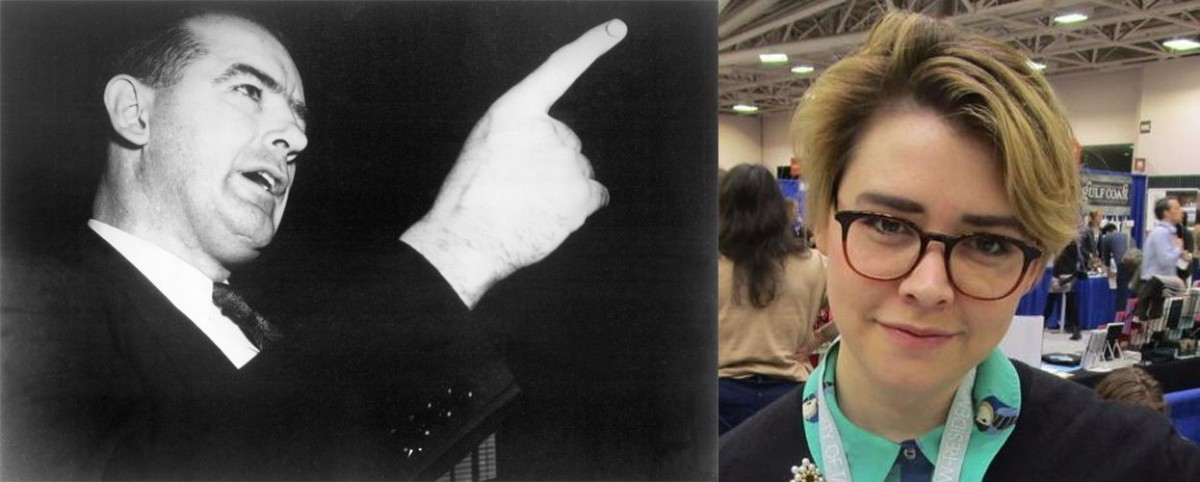
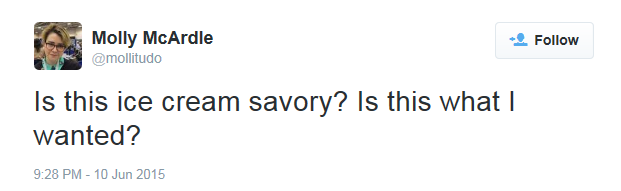
On June 10, 2015, a little more than a week after I escaped my homelessness and moved into a very hard-won one bedroom apartment, the universe did not grant me the dignity to celebrate my near insurmountable triumph against incredibly bleak odds. That day, Brooklyn Magazine published a 9,000 word libelous diatribe written by a self-proclaimed “writer and editor” named Molly McArdle. The article was a nasty seven layer burrito stuffed with hearsay, uncorroborated rumors, conjecture, quote manipulation, speculation, outright lies, willful exclusion of key facts, and other spurious claims that were designed to falsely portray me as a monster with a pattern of abusive behavior that had been silently tolerated for many years by the publishing industry. It was quite uncanny that this reckless person’s name was so close to the infamous witchhunter Joseph McCarthy. For like McCarthy, McArdle had no intent whatsoever in pursuing the truth. “I am more scared of silence than false or petty speech,” declares the article in its final paragraph, meaning that falsehoods and invented grievances matter more to McArdle than the facts. She sought to destroy a man who had suffered a nervous breakdown and committed the worst mistake of his life: a man who lost his home, his partner, his shaky and far from lucrative stature, many friends, and likely the ability to publish anything, no matter how good, for the rest of his natural life. McArdle’s article was also anti-intellectual fundamentalism of the type that the historian Richard Hofstadter once called the one-hundred per cent mentality: “a mind totally committed to the full range of the dominant popular fatuities and determined that no one shall have the right to challenge them.” It was this one-hundred per cent mentality that a group of novelists, publishing insiders, and industry people chose to believe in, willing to promulgate any lie if it meant stubbing out the voice and ruining the life of of a vociferous critic. And if these smart people can willfully buy into such a deceiving and prejudicial account, one riddled with at least fifty-eight unsubstantiated statements and factual errors, then imagine the myths that will bamboozle Americans in our new era of fake news.
There was a time when irresponsible journalists who lied about and fabricated their stories were held more accountable by the public, when Janet Malcolm’s wisdom about impulsive subjectivity and character assassination was better heeded. But a compelling lie or the Liberty Valance idea of “printing the legend” — such as the false claim that Alexander Hamilton called the American people “a great beast,” first falsely promulgated as a fourth-hand rumor more than fifty years after Hamilton’s death — has an ability to latch itself onto a person for life like an unshakable leech, overriding considerable accomplishments and providing no possible allowance for reform. This tendency has become worse in our age of social media and outrage culture, where rapturous fury is rarely tempered with the clarity of thoughtful reflection or even a proper consideration of what actually happened. The experience is often as bad as a prison sentence or a financial setback or a bad breakup, causing pain not only for the wrongly accused party but for his friends and family.
Yet readers continue to have a great appetite for perceived monsters, with even the sharpest blades in the kitchen willing to believe in an untruth if it is juicy enough. Before Jayson Blair and Stephen Glass were discovered to be fabricators, Janet Cooke famously reported on a eight-year-old heroin addict who moved Washington Post readers (including then mayor Marion Barry) to track down this victim, who only existed in Cooke’s imagination. Cooke managed to fool many smart people and even won a Pulitzer Prize for her efforts.
So what today of the self-styled reporter who invents lies about a real person and tarnishes that person’s reputation when the facts don’t line up? What of the journalist who wallows in malice and ice cream rewards like a spoiled adolescent when the lion’s share of her story cannot withstand an extremely rigorous challenge? What of the slipshod character assassin who goes out of her way to destroy the reputation of a man who made one deeply terrible mistake (and a few minor ones) that he has already suffered greatly for, that he continues to seek help and care for, and who must now expend precious time answering to potential employers and creative collaborators and lovers who cannot reconcile the kind, capable, and caring person before them with the alleged demon represented in a work of scabrous sensationalism? If “comment is free and facts are sacred,” as C.P. Scott has famously observed, should not the narrative uniting the twain be rooted in something more diligent than pumping out “the first draft of history”? Should not a journalist go out of her way to take up her allegations directly with the source or accurately set forth the facts to slam dunk her claims?
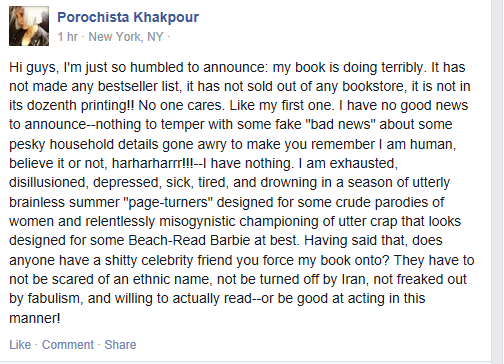
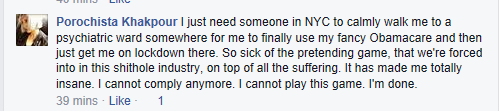
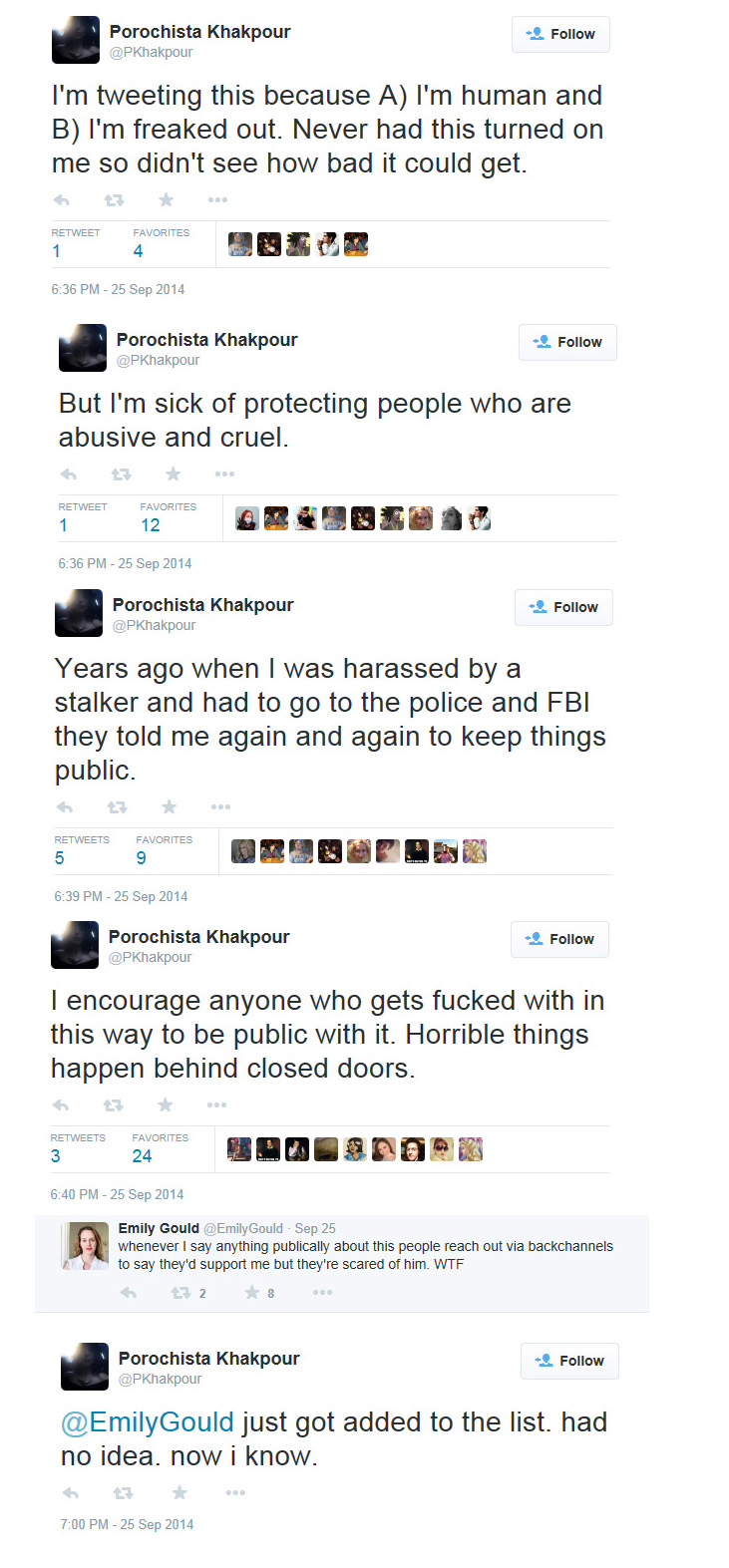
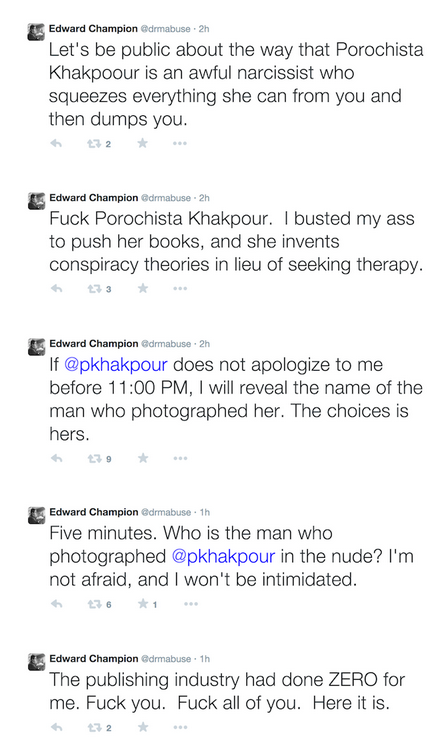
On September 26, 2014, I tried to take my life. And I want to be clear that what I did the night before was terribly wrong and over the line in every way. It was not, however, the final capstone in a sustained run as Edward Champion the literary terrorist. I tried to kill myself after I became massively drunk, suffered a nervous breakdown, committed a diabolical act on Twitter that involved threatening to publish the name of someone who had photographed novelist Porochista Khakpour in a compromising position, which I ended up tweeting and which my then partner deleted soon after. This came after Khakpour had spread poisonous lies about me and whipped up the fury of the literary community. I was broken and desperate and traumatized and had the kind of life-altering meltdown that no amount of regrets or remorse or apologies or setbacks or soul-searching can ever appear to atone for. I was besieged by hate from all corners and lost everything I had.
Many articles followed in the wake of these events when I was in the hospital trying to get well, my only refuge a homeless shelter on the outside where people shot up and smoked K2 (a cheap and deeply potent synthetic drug with a dreadfully lingering second-hand odor more industrial than any pesticide; it is one of the worst smells I have ever experienced) and shouted at all hours and contended with the indignities of a callous and corrupt and graft-happy and largely indifferent administration that was supposed to help them. It was there that I barely escaped very real threats from a psychopathic champion boxer who slept across from me, recently released from Rikers Island and not liked by anyone, who regularly rattled me when he wasn’t starting bloody fights and who sent several of my fellow residents to the hospital. But eight months after the furor had died down, McArdle felt the need to dig her self-righteous heel into what remained of the twitching corpse. No amount of punishment or humiliation was enough for her. If she could use prevarication and invention to bolster her case, she would. She was right about one thing. The “literary community,” as last year’s Charlie Hebdo PEN Gala protest revealed in abundance, is no longer tolerant of anyone who even remotely challenges its rightfully rocky hold on culture. Indeed, why face an opinion you despise, why argue smartly against it, when you can pretend it doesn’t exist or damn the odious orignator without knowing all the facts? The literary community was thus quite willing to believe McArdle’s fraudulent spin. It needed a bad guy, much as trolls need someone to crush. It failed to understand that writers are meant to be united rather than carving up solipsistic parcels of superficial territory that only a few dozen people care about at best.
McArdle created the mirage of journalism by talking to a lot of people, even though, as the evidence will soon abundantly demonstrate, when she wasn’t mangling her facts, she never bothered to perform due diligence to corroborate any of her claims. All she had to do was toss out a damning sentence that she could stitch to her Frankenstein monster of casual and reckless libel and wait for the greedy reward of ice cream after the article was published.
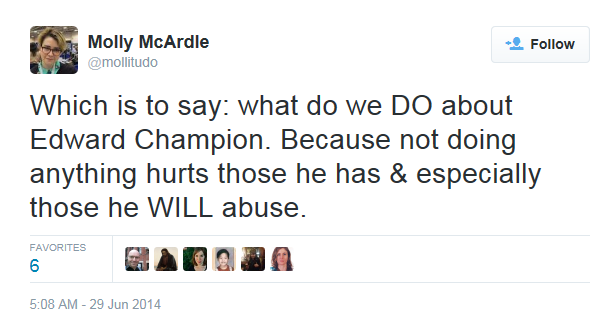
The irresponsible kernel was there from the beginning when, on June 29, 2014, McArdle announced her capitulation of objective bona-fides on Twitter, stating her intent to go after me, beginning with a prerigged thesis that I was someone who went out of his way to hurt and abuse people. McArdle started with an assumption of guilt and spent several months working on an article with the sole purpose of gainsaying more than a decade of honest journalism and positive contributions to the literary world, including 551 in-depth conversations with some of the finest minds on our planet. It was little more than a power grab, a temerarious hit job counting on the reliable monomania of mass rumor and cheap belief, designed to punch down an acerbic voice at the bottom of his game and the end of his rope. She never once called her assumptions into question or took up any of her points directly with me, save through a highly general email on May 7, 2015 that mentioned little more than writing a profile. Indeed, one of her most preposterous smoking guns on the charge that I am a misogynist, a misogynist so hopelessly set in his ways that thirty of the last fifty guests who appeared on Bat Segundo were women, was the apparent use of “cunnilingus” in a joking manner. By that measure, I suppose we should add The Awl‘s Alex Balk, Robin Williams, William Shakespeare (“tongue in your tail”), and Judd Apatow and James Franco onto the list of diabolical comedians hating and oppressing women through prolific usage of and reference to the C word. (See ¶103 below for statistics on how comparatively infrequent my usage was when stacked against other websites.)
When I telephoned a representative at Brooklyn Magazine asking for a retraction to McArdle’s piece and received no reply back, I decided to ignore the article and move on with my life. I truly did not fathom why anybody in the universe would be this obsessed with me. What I did not count on was that people were indeed more interested in me than I was. While I have lived a very happy and positive life, attempting to atone for my sins trying to be more peaceful and graceful after rebounding from a down-and-out existence where stabbings and drug use were regular occurrences, and while I have clawed my way up from an abyss of poverty, humiliations, and joblessness that I would not wish on my worst enemy, I have seen my personal and professional life severely damaged because of McArdle’s article. Where other writers, such as Elon Green, were sensible enough to confine their essays to opinion and speculation (comment is, after all, free), McArdle recklessly and irresponsibly presented her distorted and blinkered version as the truth. And there is simply no escaping what my name now represents.
I have consulted with attorneys who have suggested that I have a case for defamation, largely because McArdle acted with “actual malice,” recklessly perpetuating a story that had been killed by The New Republic by occluding key details that, as the considerable evidence demonstrates, show that the New York Times Co. v. Sullivan standard does not apply. But in order to carry forward with a lawsuit, I have been informed that it would involve a retainer ranging somewhere between $10,000 and $15,000. Aside from not being able to afford this staggering sum (along with any exorbitant costs beyond that), especially after a tough uphill climb from homelessness, a protracted legal battle for financial restitution doesn’t feel nearly as appropriate as factual challenge. And in our epoch of Peter Thiel-financed bullying, I truly don’t feel that stifling the free press is something I want to be part of. I only want journalists to be fair, accurate, and reasonable. Also, if I want to evolve and become a better person, it has to be based on the facts. It has to be based on who I really am and what I really did. This very long document isn’t merely a rebuttal. It’s a personal reckoning. It’s also an examination of how common we are in our perceived transgressions, for some of my accusers have committed far worse behavior than I am alleged to have done. But I am not trying to settle scores. I am trying to come to terms with the facts.
Another reason I didn’t want to respond was because this involved the moral dilemma of republishing emails, instant messages, and Twitter DMs from parties McArdle who interviewed for her piece. I am a big believer in the covenant of private communication, or whatever remains of it in our age of massive data breaches (Sony, Ashley Madison, Target, Anthem, eBay, Wikileaks, Russia’s claws slithering inside the Beltway) and NSA wiretapping. But if people are going to libel me without presenting the underlying facts of the actual correspondence, then I must reveal, with considerable reluctance, the misrepresentations and conduct of my accusers. I shall confine my citations only to those parties who spoke public untruths about me. And after this article is published, I shall maintain my long-held policy of keeping all correspondence sent to me in confidence.
Despite my progress, my life continues to be jarred because of this defamatory article. And I am fairly confident that McArdle still basks in her hatchet job, possessing no remorse or reflection for what she did to me. In a December 19, 2016 tweet, McArdle, who I have blocked on Twitter, intercepted a tense but conciliatory Twitter conversation I was having with Colin Dickey, where I pointed out to Dickey that only four of the article’s six dozen or so claims were valid. McArdle declared, “Which four claims were true? Read to find out!” Truth and journalistic integrity do not matter to her. And the Twitter crowd would rather pass the popcorn and delight in misfortune manifested by myth rather than conjure up some spell of compassion. There is no modern day Joseph Welch asking, “Have you no sense of decency?” Noblesse oblige died sometime in the 21st century, frogmarched and gassed in the same concentration camp that took out bipartisanship and forgiveness.
While I have been fortunate enough to land a very hard-won job with serious responsibilities, I have been denied writing and editing gigs. I became a well-loved regular at a Village bar, where I befriended many of the staff and other customers. Until one night when I accidentally paid with my credit card instead of cash and the staff caught my last name and Googled me and became frosty towards me. And my refuge was taken away from me. My dating life is little more than a string of short-term affairs, each fizzling out the very minute I reveal my last name. I am nothing less than kind and courteous to a woman. She puts my full name into Google. And in most cases, it’s over. (To cite one of many all too common examples, I went on a date with a marvelous woman who I very much liked. She knocked over her beer, which I proceeded to mop up. I was polite and nothing less than a gentleman. This was easy. Because she was very nice, smart, and we hit it off. I wanted to know more about her. (I am sorry to be so general with my description, but I really don’t want to cause this woman any more grief.) This woman told me that she had been on far too many dates and said that I was the first man she had felt anything for in five years. I respected this, did not want to exploit this, and said that I would be happy to take it as slow as she needed. We both wanted to see each other again. She bragged to all her friends about this very nice and smart man that she had met. Unfortunately, one of her friends had been involved in the books world and I discovered, mere hours before the second date, that this friend had scared her off. And there was no appeal. I went to see the feminist hip-hop show I had bought two tickets for alone.) A few “journalists” went out of their way to shame me this year by outing my OKCupid profile. Some women have been kind enough to stay after I’ve told them what happened to me (and I have remained friends with many women I’ve dated), but this means I have to work ten times as hard to find a partner. The happy family I hope to make someday to replace the broken and hateful one I came from may never happen. I’ve taken improv classes at UCB in an attempt to find a new and healthier outlet for the performative streaks that landed me in trouble in the past and, despite being nothing less than affable to my classmates, I was ratted out to the registrar for “rejecting the UCB philosophy” after some student discovered the article. (The registrar, who was a good guy, and I patched it up by telephone.) And when I passed the class, I was quietly dropped from the improv practice sessions. My classmates ended up forming an improv team without me.
But what truly pained me, what caused me unspeakable sorrow, was when two podcast producers who I had never met used the article to lead a campaign to kick me out of the audio drama community. You see, I’ve been working on an audio drama project for a while. I’ve worked on it every day of 2016. It’s my attempt to do right as a person and as an artist. I’ve written some very visceral scripts and, after many years of hiding myself within the seductive certainty of clever writing, I reached a point where I could at long last be real and emotionally vulnerable in my work. As a temporary member of the audio drama community, I went out of my way to be kind, encouraging, professional, and constructive. I did not utter an unkind word about anyone. It was easy to be kind because these people were very kind. But my impeccable behavior, which flowed quite naturally from may largely sanguine disposition, was not enough to overturn the taint of the article. These two podcasters were so driven by malicious zeal that, on July 22, 2016, they even rejected my good faith efforts to meet up and buy them beers, include them in my thoughtful Audio Drama Sunday interview series, and support their project on Patreon, for which they refunded my donation within seven minutes. I took my leave. I didn’t want to cause anyone any undue upset. But I also took it very hard. For I had done nothing wrong other than to have a past that had been distorted into a largely untrue hatchet job.
So it’s become necessary to respond to the article. It’s hurting my life. It’s not going away from Google anytime soon. It’s not helping me come to terms with what I did. There’s also the worry that if McArdle plays this loose with the truth in describing me, she may very well do this to someone else.
I don’t wish to let myself off the hook here. Part of reckoning with your personal history, good and bad, is being completely up front about your flaws. Even before my nervous breakdown, there were a few instances in which my communications were over the top, many of which I have documented in full detail below. I’m not perfect. I don’t know who the hell is.
If McArdle had confined her article to the night of September 25, 2014, as others did, I wouldn’t have to respond with this lengthy rebuttal. McArdle is absolutely right to condemn my behavior triggered by a mental breakdown. And I can personally guarantee that no amount of hatred, scorn, relish in my continued suffering, or vengeance that McArdle or anyone else possesses for me can ever equal how terrible, contrite, and ashamed I feel about what happened. The question here is how much suffering is enough. I lost everything I had. I suffered a mental collapse. I was locked up in a hospital. I was harassed by my abusive mother calling me at all hours on the hallway pay phone as I was trying to get well. I was thoroughly humiliated and heartbroken. I spent months of my life homeless and jobless after being shunned by my family and by people who I thought were my friends. I lost the woman I loved. Is that enough? It is clearly not my question to answer. Some of you may undoubtedly feel that I have not received enough punishment, that I should continue to suffer for the rest of my life. Some of you may feel that I deserve no mercy, no compassion, no dignity, that I should neither have happiness nor offer happiness to others – despite making serious and good faith adjustments to my life with therapy and positivism.
Here is the truth: My transgressions were hardly the frequent and rampant run that McArdle has made them out to be, nor did they reflect an abusive pattern carried out over years. The article severely discounts the considerably more numerous cordial communications I had with writers, publicists, editors, and related parties for more than a decade. (See ¶¶60-61 below for examples of how I typically conducted myself.) Moreover, the many death threats and belligerent communications I received from writers (including a Pulitzer finalist and a National Book Award finalist) over who they believe me to be have suggested very strongly that my extreme behavior on one regrettable night isn’t nearly as uncommon as what goes on regularly among a savage and insular group masquerading as progressive-minded champions of literature.
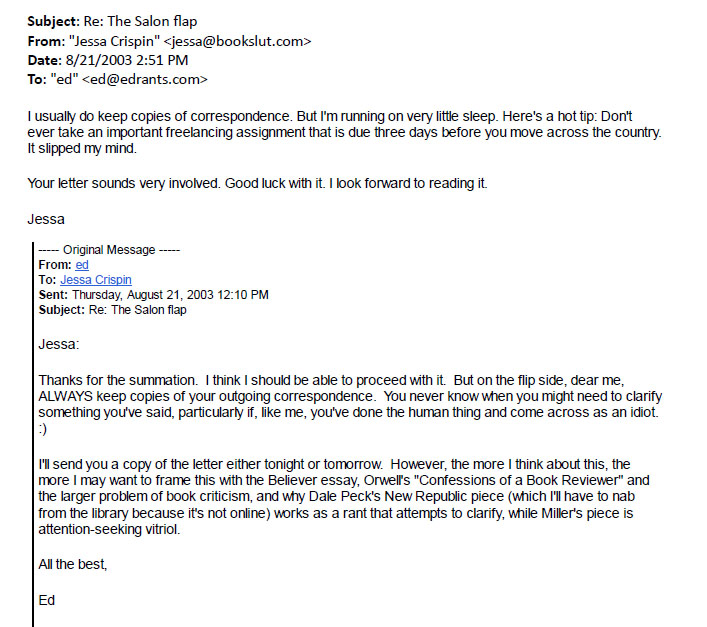
Because this is a very long document with much evidential spillover, I have included two appendices for the sake of keeping this clear and organized. The first appendix outlines in complete detail how the Twitter exchange between Khakpour and I happened, how Khakpour willfully lied and distorted our communications, and how I, in turn, reacted with even more despicable desperation. The second appendix responds to Jessa Crispin’s defamatory claims by including the entirety of our correspondence. Crispin has been making libelous claims about me for many years and her false assertions helped persuade the literary world to howl for my blood, yet conveniently she has never produced any evidence. Unfortunately for her, I have copies of all of our exchanges. Her claims do not hold up. She is a liar and a libeler in the Goebbels tradition.
I have responded to each claim by paragraph number. I do not want to give Brooklyn Magazine any traffic, but the curious can download a copy of the article here.
I have done my best to be as complete as possible and have tried to mitigate against any subjective views by sticking with the facts. I have, however, offered a few personal asides in some cases, in an effort to point out how one’s own shame and guilt is often unseen as the crowd cries loud for retribution. Since I am defending myself, I am sure that my defense will be called into question anyway. And it should. The only way we learn anything in life is through constant challenge. But if there are any mistakes, I will correct this article and hold myself fully to the fire.
One further but very important note: This is a rebuttal grounded in facts, not an invitation for harassment in any form. I seek with this article to not only reveal the truth, but to consider, where I am able to, how my words may have caused the literary community to condemn me. (An interlude on satire and the thorny subject of violence expressed in words can be found sometime after ¶83 below.) I realize that my writing voice is loud, erudite, and often aggressive. But this confession is about how I have actually behaved. I am holding my own terrible deportment on one night up to even more exacting standards than McArdle’s “journalism.”
Claim, ¶2: “On September 26, 2014, Ed Champion stood again…”
FALSE. I made only one suicide attempt on the morning of September 26, 2014. (Reported by The Brooklyn Paper, September 26, 2014.) Why is such a detail important? Because a person who tries to kill himself always remembers the date. The date is a shameful shroud that slowly becomes invisible as the time passes, but it’s a permanent reminder burning into the deepest parts of your soul with the telltale message that you were once so hopeless that you wanted to end it all. Every day away from this diaphanous millstone is a painful baby step, an increment measured in tears that becomes easier as the weeks and the months and the years roll on. But when someone disrupts this melancholy marker by planting another one, it’s akin to smothering a toddler who is just learning to walk. For just as there’s no going back to your life if you do successfully kill yourself, there is also no returning to the person you were before. You must learn how to live again. It was for this reason that I returned to the Manhattan Bridge on September 26, 2015 and walked across it with a deep sense of joy. Finding the beauty and marvel in life is the only way you can beat the suffering. September 26, 2014 will be forever burned into my memory in the same way that others remember their wedding anniversaries or the birthdays of their children or a moment in which their career took off. Despite the dark context, it’s a date I must live with.
Claim, ¶2: “…had written a despairing note on Facebook the night before.”
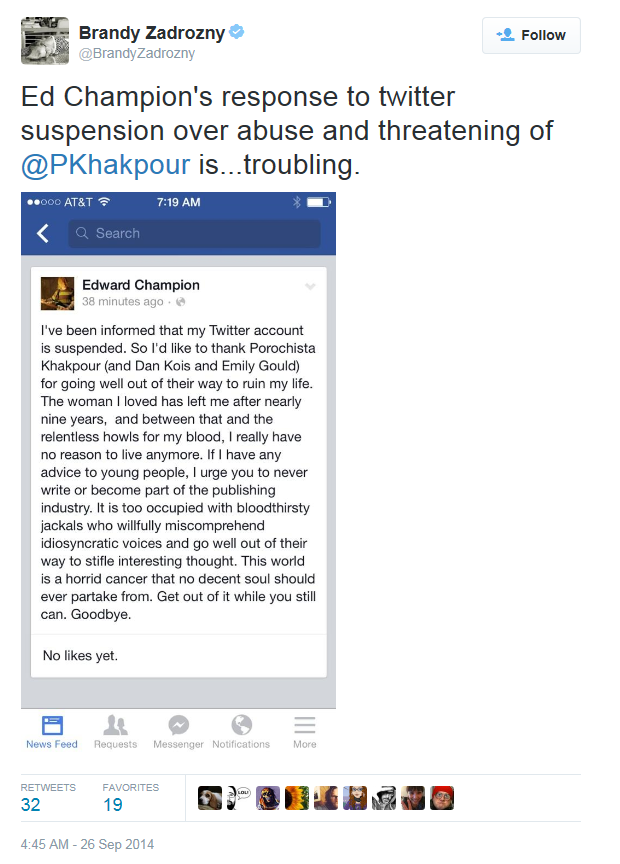
TRUE on despairing note. FALSE on time. The Facebook post, since deleted, that McArdle incorrectly quotes (see brackets) from in ¶1 (“If I have any advice to young people, I urge you [to] never write or become part of the publishing industry.”) was actually posted on the morning of September 26, 2014 circa 7:00 AM. See below screenshot from Brandy Zadrozny (“38 minutes ago”). Time stamp for Twitter is Western time. Zadrozny’s tweet is 4:45 AM, or 7:45 AM Eastern time.
Claim, ¶4: “’Middling Millennials’ overflowed with grotesque descriptions of Gould’s body. She is ‘cold,’ ‘a minx’; she was ‘hatched’ rather than born; and Champion speculates about her ‘dewy newborn hands’ reaching ‘with hollow hunger’ for Twitter even before her umbilical cord is cut.” This is later used to buttress a claim in ¶5 that the essay is “starkly misogynistic.”
GROSSLY MISLEADING BUT SOMEWHAT TRUE. Some very respected writers informed me privately that my essay was not misogynistic. This was very kind, but I don’t entirely agree with them, yet I don’t believe that the 11,000 word piece that I wrote in protest of Emily Gould and superficial thinking was rooted in a desire to hate women, even though I now recognize how some of the language that I used could be perceived that way and am forced to conclude that the essay was partially misogynistic. The paragraph’s topic sentence suggests that the essay “overflow[s] with grotesque descriptions of Gould’s body,” but the examples cited are metaphorical, mostly aligned with a recurring motif of baptism and birth.
Uses of “cold”:
“One clearly sees that, even before she poured the Internet’s water over her naked confessional form in an oddly bathetic baptism, Gould’s relationship with other people was predicated upon diminishing their perspectives and rigging the narrative so that she emerged as the coldblooded white bread winner.” The use of “naked confessional form” here is clearly metaphorical. “Cold” is used in reference to her temperament.
“Did Gould have any sympathy, any sense of the impact of her actions, or any understanding about the way the book business worked (even after her Hyperion stint)? Not at all. She was colder than the mist on a chilled champagne glass.” No reference to the corporeal.
Use of “minx”:
“But when a minx’s head is so deeply deposited up her own slimy passage, it’s often hard to see the sunshine.”
McArdle’s case against me is far from airtight, but in the interest of entertaining her interpretation and trying to grow as a person, I would say that, if the essay is in any way “starkly misogynistic,” it’s probably with this line. This essay was written from a place of welled up anger that had been boiling for years. I am deeply ashamed that it exploded in this feral form with this line, which I should never have included. It was clearly an elegant variation on Gould having her head up her own ass. Many readers interpreted an altogether different cavity from the one I described. It never occurred to me that I was objectifying Gould at the time that I wrote it. And I have in the intervening years reached out to feminist thinkers and worked with therapists in an effort to deracinate this impulse. (As ¶¶99-100 reveal below, while I’d hardly call myself a monk, I rarely sexualized women in my writing.) Two people (both women) reviewed this paragraph before it was published and did not say anything. I made the mistake of not running the essay by someone who was more sensitive to language. And I definitely made the mistake of letting anger overcome my otherwise progressive-minded views on gender inequality, which I am firmly against.
“Minx” is typically a ”a young, pert, wanton girl” or a woman who is daring. This was not intended as a misogynist term, but to reference the image that Gould promoted of herself in both her New York Times Magazine cover story (“‘I’m bad at describing sex, or maybe everyone is,’ I wrote at one point, but I didn’t let that stop me from trying!”) and her memoir, And the Heart Says Whatever. Nevertheless, the word’s etymology goes back to the Low German minsk, which is a vulgar term for “wench, hussy, slut.” And I now comprehend that it’s pretty commonly understood that “minx” is misogynist. Needless to say, I won’t be using this word ever again in describing anyone.
Use of “hatched”:
“Emily Gould was hatched in Silver Spring, Maryland on October 13, 1981: the bouncing daughter of a public relations man and a self-employed lawyer and mediator.” This sentence does not refer to Gould’s body in any way.
Use of “dewy newborn hands,” et al.:
“Had social media and smartphones been around more than three decades ago, it is almost certain that her dewy newborn hands would have stretched out with hollow hunger to replace the default egg avatar on her Twitter account not long after overworked doctors snipped her umbilical cord.” Again, this is a reference to baptism and birth.
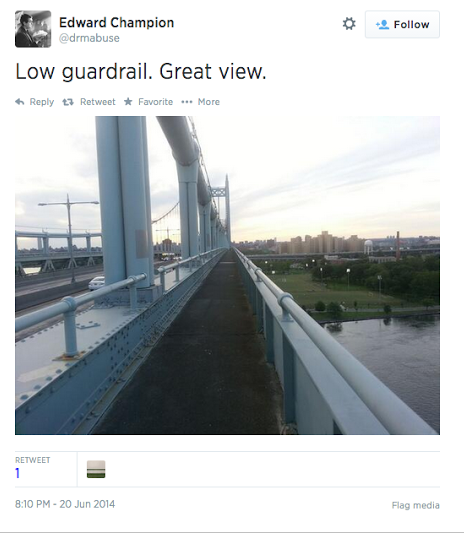
Claim, ¶7: “Minutes later he tweeted a picture of a bridge walkway.”
FALSE. I never tweeted an image of a bridge walkway on June 26th, 2014. This suggestion of intent is recycled from an erroneous article published by an equally irresponsible writer named Miles Klee at The Daily Dot on June 27th, 2014, which took a tweet that I published on June 20, 2014 (and later deleted), claiming that this was evidence that I was going to kill myself. I had no suicidal thoughts when I took this picture, but very much enjoyed the view. I am sure you would too, if you ever have the honor or the good fortune to walk across the Triborough Bridge. And if you examine the tweet timestamp, you will find that the time I tweeted the picture was June 20, 2014, at 8:10 PM
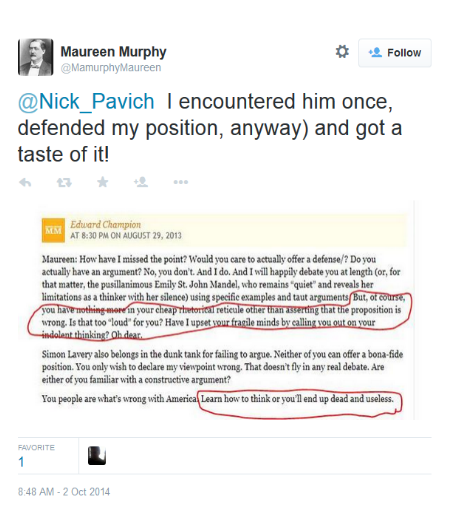
Claim, ¶10: “Millions writer Maureen Murphy offered up a screenshot of a comment Champion had directed towards her: ‘Learn how to think or you’ll end up dead and useless.’”
MISLEADING. The claim here is used to suggest that I threatened Maureen Murphy with this line, but within the context of what Murphy quoted, I clearly proffered a philosophical question, whereby one is alive and thinking or dead and not thinking. This is no different from Max Müller’s sentiment in Science of Language: “Words without thoughts are dead sounds.” Or Samuel Johnson’s idea of existence without thought: “He that lives in that torpid insensibility, wants nothing of a carcase but putrefaction.” Murphy never claimed that I threatened her. This observation is used by McArdle to buttress Maud Newton’s unsubstantiated claim in the same paragraph: “The venom is so widespread and continuous few people keep up with the extent of it.” Here is a link to Murphy’s tweet and to the Millions comment in question.
Claim, ¶11: “’Middling Millennials,’ the collective voice of my Twitter feed suggested, did not come out of left field. How long had this been going on? I wondered. Why hadn’t anything been done about it? What could be done now? And who would be the person, or people, to do it?”
followed by ¶12:
“When he very publicly disparaged another woman online in September, it looked to me not like a duplicate of what had happened in June but like the prolonged conclusion of what June had begun: an individual and an industry coming to grips with a pattern of abuse that stretched back over a decade.”
FALSE PROPOSITION. McArdle’s willingness to play armchair shrink with someone she has never met or spoken with belies her baleful intent. The suggestion here is that my Emily Gould essay was the peremptory cri de coeur of an abusive and threatening man who terrorized the literary world for more than ten years. McArdle suggests that there is a “pattern of abuse,” yet the examples that she serves up throughout the essay are easily debunked by her specious evidential support and the actual correspondence I had with the interviewed parties.
Claim, ¶14: “The catalyst, according to Khakpour, was a comment Champion had written on her Facebook page that disparaged Slate senior editor Dan Kois, a man on his lengthy list of personae non gratae. Khakpour deleted it, perhaps signaling to Champion that she had finally sided with his many censors—had, in fact, become one herself.”
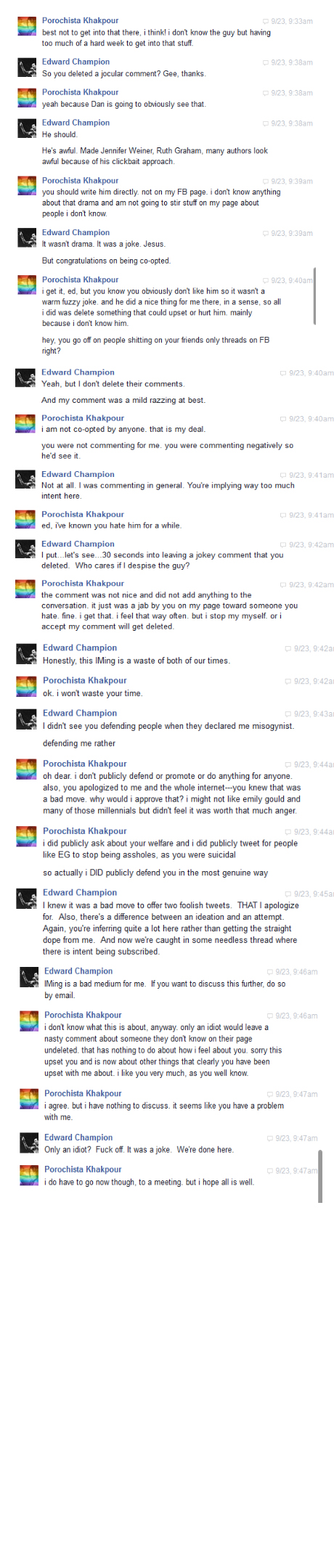
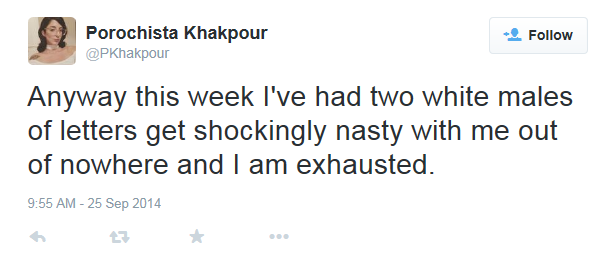
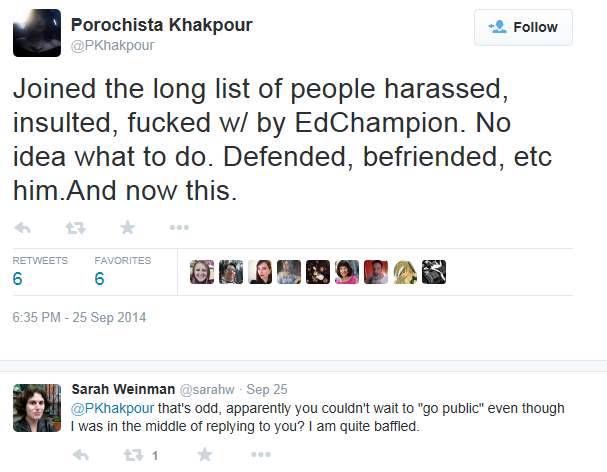
FALSE. Aside from the preposterous suggestion that I maintained a Nixon-style “Enemies List,” the argument against this claim could very well be that McArdle was not entitled to conduct due diligence. But this is nevertheless a one-sided account that fails to tell the full truth. The catalyst for what set me over the edge was the combination of alcohol, mental health issues, and Porochista Khakpour calling me “shockingly nasty” and then railing against me as “cruel and abusive,” suggesting that I was a stalker, when in fact this was not the case. (See Appendix A: The Porochista Chronicles, which documents the entirety of what actually happened. I am ashamed of my reaction.)
Claim, ¶18: “Every agent in the world was rejecting him…That’s why his final tweets where he’s outing me, being really nasty to me, what he’s really saying is fuck you publishing. I’m just a weird symbolic sacrifice.”
FALSE. Aside from the astonishing narcissism driving the “symbolic sacrifice” claim, I establish in Appendix A that Khakpour’s venomous and frenetic communications helped inspire me to crack and do something stupid and horrific. (Again, this reaction was my fault, my gormless and insensate alcohol-fueled decision, my crackup.) Moreover, I only submitted my novel, They Came for Blood, to ten agents, many of whom requested the full manuscript. This is a comparatively small number of agents to query and a decent conversion rate. This unsubstantiated line is adopted by McArdle to paint me as a failed writer.
Claim, ¶22: “’It’s hard to overstate what a positive, moderating force she’s been for him,’ said blogger Eric Rosenfield. Weinman ‘practically defines the term ‘long-suffering.’”
FALSE AND MISLEADING. In my modest friendship with Eric Rosenfeld, he was consistently rude, antisocial, and outright clueless, even though I fondly remember a few times where we sang Bowie songs in his apartment. I introduced him to one of my well-loved, longtime friends who moved out here from California and we all spent time together. There was one time, when we went out to eat in Chinatown, where Rosenfield harassed an overworked restaurant worker who was on his break and demanded to eat his soup. It was some of the most heartless and debasing behavior I have ever seen imparted to an underpaid blue-collar worker from someone I knew. And as someone who grew up relatively poor, this outrageous conduct pretty much signaled to me that I could not have this man in my life. Furthermore, when Rosenfield and I hosted the short-lived Wold Newton reading series at Word Brooklyn, Rosenfield made several science fiction/fantasy writers feel uncomfortable. I did my best to smooth things over with publicists and authors alike. I quietly extricated myself from my involvement with the reading series, but fulfilled my responsibilities. If he considered Weinman “a positive, moderating force,” it was only because I vocalized our collective horror and she didn’t.
Claim, ¶28: “This seemed to go well for a while, but the stream of work trickled to a stop ‘as he began progressively alienating the people who he needed to get freelance work from’ around 2011.”
MISLEADING, UNSUBSTANTIATED. Eric Rosenfield was not privy to my relationships with editors. Thus, he is not a reliable source. McArdle did not appear to contact any of the editors I worked with for this piece. This is, in short, sloppy and unfounded journalism. I had cordial relations with most of the editors I worked with (but with full candor, I will report that there was one unnamed editor, who I became angry with after he did something especially cruel to my former partner: a case where I was very unprofessional), but book review sections were being ruthlessly cut around the same time period, with freelancers among the first to get the axe.
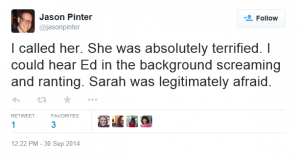
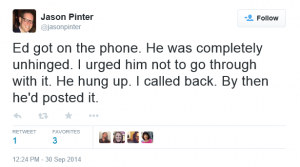
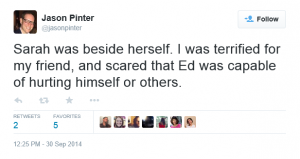
Claim, ¶30: Jason Pinter’s claims. “I could hear Ed in the background screaming and ranting.” “He was completely unhinged.” McArdle sourced from three tweets below:
A SUBJECTIVE MESS. PARTIALLY DISPUTED. I was certainly shouting that evening as the tweets came in. The only acts of violence I committed that night were punching a file cabinet and sliding my phone across a hardwood floor. I had no desire to be physically violent to anyone. This doesn’t excuse what I tweeted to Khakpour. At one point, Weinman called the police, but the police, seeing me sit quietly if sodden and near catatonic on the couch, told Weinman that they couldn’t do anything. So was I unhinged? Or was I in a state of shock? Does such a man deserve compassion or is he a monster who cannot possibly be forgiven? The atmosphere of the apartment was a bleak climate of fear, especially because the tweets from others were menacing. But what did Pinter actually hear? He wasn’t there. Was he permitting the impression generated by Twitter that evening to color and influence his viewpoint? More accurately, was he allowing his justifiable concern for a friend (Weinman, not me; despite the fact that I had nothing but positive things to say about him, Pinter viewed me as some stray diseased dog accompanying Weinman that he had to endure) to cause his own fears and perceptions to run wild? It seems very likely.
In an email exchange I had with Pinter on June 29, 2015, here is what he had to say:
It’s easy to splice and parse every moment of that night in hindsight. But you’re looking to make me the aggressor here, or blame me for not being able to talk you out of it, which is childish and cowardly bullshit. And that’s all this email chain is – you looking to deflect blame, to demonize people who criticize your appalling actions. If this ‘herd’ means not standing for sexual threats or bullying any longer, then fuck it, I’m in the herd. I don’t think you’re a monster. So blame me for whatever you want to blame me for if it helps you feel better about yourself, and so you can keep believing this false narrative that you’re this misunderstood man chased by angry villagers wielding pitchforks and torches. You brought every iota of this upon yourself. You did something unspeakably awful, and while I’m sure some of what was written about in all those articles was also or blown out of proportion, a lot of it was true. And I could write thousands of words trying to get you to see how misguided you are in, nine months later, reaching out solely for the purpose of blaming me for, what? I’m still not exactly sure. Defending your behavior? I’m not going to do that.
I never asked Pinter to defend my behavior. I wrote to him, “I am aware of my transgressions and am more punitive towards my own monstrous behavior than you ever can be.” He wrote, “You’re constructing a narrative to fit whatever story you’ve made up, that I’ve viewed you as a monster for years, or whatever else you need to view yourself as a victim here (you are not).” It never occurred to Pinter that I was drunk and having a nervous breakdown on that night, that I could be both a transgressor experiencing a crackup and a victim of vigilante justice erected by an online impression that was wrong, which I responded to with behavior that was also wrong. It never occurred to Pinter that asking him about the night in question might have been a way for me to come to terms with the full horror of what I did. It never occurred to Pinter that he and McArdle were also constructing a narrative, that all of us create narratives. Can you forgive a man who lost his marbles? Jason Pinter can’t. But Edward Champion sometimes can’t either. That’s why I’m writing this rebuttal, and I’m not liking what I see in myself. Or to quote Gandhi, “The weak can never forgive. Forgiveness is the attribute of the strong.”
What Pinter does do quite helpfully with his response is to demonstrate that there is no possible redemption for the transgressions of one night, that all perceived and invented transgressions outside that night are solely interpreted through that night, that any efforts to reckon with what I did represent a “false narrative,” and that the lies and conjectures promulgated by McArdle of a sustained performance of “sexual threats or bullying” are nevertheless “true.” Is this how we contend with troublemakers? Is this how we help people who we perceive as awful? Is this how “monsters”are “reformed” in the digital age? Do we not forgive people even when they’re actively working to change? Do we not listen to people? Or do we simply create largely mythical articles that nest like punitive parasites in the top Google search results?
Claim, ¶31: “Though the suicide attempt was reported in the Brooklyn Paper, few in publishing connected the Friday morning bridge closure with Champion.”
WILLFUL EFFORT TO EMBARRASS AND HUMILIATE. This is a deliberate effort to embarrass me. I do know that Laura Miller, who delighted in her blinkered and error-prone condemnation of me in Salon (“countless obsessive grudges,” unsubstantiated “horror stories”), was probably aware of my suicide attempt, as were others. But to their credit, they underplayed my suicide attempt. Because some part of them still believed in respect and noblesse oblige. McArdle, however, does not. It is humiliation to reinforce the image of suicide thirty paragraphs later. (She also repeats my Facebook note at ¶32.)
Claim, ¶43: “His first episode featured David Mitchell, who has since appeared on the show a total of four times.”
FALSE. Three times (one in two parts). She can’t count.
Claim, ¶46: “…but at the same time you could see his some of his personality flaws coming through. He could get self-aggrandizing with guests. Sometimes he asked questions that were challenging in the wrong ways, trying to make a point for himself.” Quote from Jacob Silverman.
SPECULATIVE, UNSUBSTANTIATED. Silverman has, in his quotes, largely confined his ideas about me to speculation. But he never cites a specific example of my “personality flaws,” how “self-aggrandizing” I was as an interviewer (and, hell, aren’t most interviewers self-aggrandizing in some way?), or how my questions were “challenging in the wrong ways.”
My interviews were certainly challenging and quite intellectual. It was likely my rigorous engagement, my efforts to conduct interviews that were unlike anything else and that didn’t fall into PR boilerplate, that caused people like Silverman, who frequently interpreted my work falsely, to be “challenging in the wrong ways.” But I think the late David Rakoff, a terribly kind man and a first-class wit, probably summed up why authors sometimes felt scared:
To: Edward Champion
From: David Rakoff
Date: 11/26/2007 11:39 AM
Subject: Re: Thanks!
Ed:
Many thanks right back to you. I’d say yours was among the smartest and most exhaustive (and therefore scary: my Helmut Newton hackdom still rings in my ears) interviews I’ve ever had/done.
Hope all the deadlines are being conquered.
david
Claim, ¶48: “She spoke of conflicts that took place on individual Facebook pages, in direct messages, through at-reply conversations on Twitter. ‘You might see parts of it but not the whole megillah.’”
FALSE, CIRCUMSTANTIAL, AND UNSUBSTANTIATED. There are no examples cited by Jennifer Weiner. What conflicts? As a former journalist, she should know better. But then this is the same writer who invents conspiracies playing out at The New York Times.
Claim, ¶49: “Over the past few months, I’ve spoken to twenty-four people by phone and nineteen more by email. Nearly every person I spoke to had a story about Champion: how he threatened them by phone and by email, on Twitter and in DMs, in comment sections and on his own blog; how he contacted their bosses and publishers and family members; how he created a reputation so toxic people—still—fear drawing his attention. Though his most public clashes have only occurred in the past year, Champion’s history of misbehavior stretches back to the early 2000s.”
MISLEADING, CIRCUMSTANTIAL, AND UNSUBSTANTIATED. This paragraph is used as the basis for the fabrications, conjectures, and rumors that follow. It attempts to establish:
1. Ed Champion threatens people by phone and by email.
2. Ed Champion threatens people on Twitter and in DMs.
3. Ed Champion threatens people in comment sections and on his own blog.
4. Ed Champion contacted bosses and publishers and family members.
5. Ed Champion created a toxic reputation.
6. Ed Champion has been misbehaving since the early 2000s.
This is where the claims start to go south in this deceitful piece, turning into an elaborate inductive fallacy that can be summed up as follows:
1. If Ed Champion had a breakdown and terrorized Porochista Khakpour on one night, then Champion must have done this to other people.
2. We have heard a few things about Champion and we really don’t need to corroborate.
3. Therefore, Champion terrorized nearly everyone he encountered for more than a decade.
McArdle has every right to comment upon the quality of my writing or to even report upon my despicable tweets to Khakpour or my suicide attempt. She does not have the right to stretch the facts so completely out of proportion so that my bad behavior, mostly confined to one night, is symbolic of an entire life. To parrot McArdle: Reader, this is defamation (although grounded on something more than a subjective opinion).
Claim, ¶50: “’We were friendly—and I think this is how a lot of these stories start—he and I were friendly,’ Jessa Crispin told me. ‘I had one of the first breaks with him in that community.’”
FALSE AND UNSUBSTANTIATED. As is clear from Appendix B: The Jessa Crispin-Edward Champion Correspondence, which contains the entirety of my emails with her, it was Jessa who often contacted me, expressing umbrage. I replied back with several kind and largely cordial messages. She undermined the blogging community, accused me of “talking shit,” and I responsibly corrected a blog entry when she brought an error to my attention. I also sent a condolence email when one of her family members died. I even lobbied for her inclusion in the Litblog Co-Op despite her vituperative emails and her dismissiveness of its members. Despite not contacting her at all for a seven year period, she continued to mention me.
Claim, ¶51: “’Ed sent this incredibly unhinged email to Steve,’ Crispin described, ‘and I thought it had to be a joke. Ed essentially threatened him because he wasn’t formatting his paragraphs properly on the blog. That was literally the complaint.’ (Almond has ‘a vague recollection’ of the incident.)”
FALSE. Crispin can’t produce the email, but I never threatened Steve Almond. The “email” was public, part of my old blog, Plight of the Reluctant. The entry was circa mid-September 2003. Since this was more than thirteen years ago, I have been unable to locate it in my archives, but, without evidence, this is a patently false claim. It is interesting how she echoes Pinter’s “unhinged” for an invented transgression, almost as if the narrative established on Twitter is the only one that matters. Elizabeth Loftus’s Eyewitness Testimony is an excellent volume that documents in stunning detail how easily words and details can be implanted in a witness’s memory. The longer that the eyewitness moves away from the events, the more easily manipulated the testimony becomes. It is for this reason that, in reconstructing what I have actually done (and I am not entirely innocent, as can be seen with ¶55, ¶56, and ¶79), I have been very careful to stick with notes and emails that I wrote in the immediate aftermath of the events.
Claim, ¶52: “He sent one of these crazy emails saying ‘You will live to regret this’ and on and on and on. It was terrifying. I immediately deleted it. I didn’t go in the room for two days. It’s just words and he lives in another city, but there is something so violent and body-based about it. You feel so unsafe, like he is behind you with a knife.”
FALSE, MISLEADING, UNSUBSTANTIATED. As Appendix B demonstrates, I never used the word “regret” in any of my exchanges with her. Nor were my messages drenched in “violent and body-based” imagery. That McArdle uses this false and unsubstantiated claim with the “like he is behind you with a knife” claim to suggest that I am some homicidal maniac is outrageous, defamatory, irresponsible, and damaging.
Claim, ¶53: “I started noticing things.” Quote from Laila Lalami.
FALSE AND UNSUBSTANTIATED. What did she notice? No specific incident is mentioned.
Claim, ¶53: “E. Max Magee.”
FALSE. The editor’s name is C. Max Magee.
Claim, ¶54: “Over the years I heard the same story. The details might change and the people might change, but the story was always essentially the same. Somebody would say something that they thought was completely innocent or innocuous, then Ed would take great offense, and then would confront them and demand something, an apology or taking down a post or putting up a post, and if his demands weren’t met then he would become extremely angry. Frankly it was frightening.”
UNSUBSTANTIATED. Why isn’t there a specific incident cited? This is a speculative template. It is not concrete evidence. This is designed to create a myth, to get people believing in a phony pattern suggesting that this is the only way I communicate with people. Yes, I have confronted people when facts are wrong. But there is nothing cited here to buttress this “same story.”
Claim, ¶55: “He flew off the handle at me ages ago (don’t remember when) for a perceived slight,” book marketer Kalen Landow told me in email, “He had put together a list and I shared it on Facebook. For whatever reason he thought I’d stolen his content and I got a blistering series of DMs about it. I clarified with something like, ‘Uh, I posted a link.’ He apologized and that was the end of that. It was a red flag for me.”
FALSE, DEFAMATORY, AND GROSSLY MISLEADING. Here is the Twitter exchange with Kalen Landow. As you can see, the exchange was far from “a blistering series of DMs,” but a misinterpretation on my part which I calmly expressed when I was very tired:
Claim, ¶55: Elyssa East’s claims.
TRUE. What’s missing from this story, however, is the email I sent to Elyssa East on July 1, 2014 at 10:20 PM:
Elyssa:
Just so we’re clear, on November 1, 2012, I sent you two emails during the turmoil of Hurricane Sandy. I was deeply impassioned, extremely worried about people I knew, and concerned about the plight of the poor and sent you a strongly worded email. This was, by no means, intended an attack or threat upon you personally. Nevertheless, I apologize for my tone and language at the time.
Sincerely,
Edward Champion
I never contacted her again.
Claim, ¶56: Emily Mandel’s claims.
TRUE. The tweet in question was intended as satirical. Months later, in realizing how my satire was being misinterpreted, I made amends through this exchange:
To: Emily Mandel
From: Edward Champion
Date: 7/30/2014 3:47 PM
Subject: An apology
Emily:
My apologies if you receive this message twice. I don’t wish to pester you, but I do want to be sure that you get this important message.
On August 30, 2013, I tweeted the following: “Victory is not resorting to the subtweet. I don’t respect you either. Why don’t you go swallow a glass of cyanide?” The intent of the tweet was to present a physically impossible proposition in a satirical context. I never wished for your death nor did I intend to threaten you. I have been on the receiving end of several death threats in response to an essay I wrote, and now understand that my words, despite the jocular intent, were inappropriate. I have deleted the tweet and offer my sincere and heartfelt apologies for any distress that the tweet caused you.
Thanks and all best,
Ed
To: Edward Champion
From: Emily Mandel
Date: 7/30/2014 4:47 PM
Subject: Re: An apology
Thank you, apology received and accepted.
I never contacted her again.
Claim, ¶58: “I’m not saying that Champion could do a lot of damage, but the fear of damage he could do, even by manipulating Google searches, is real.” Quote from John Freeman.
FALSE, ASSUMPTIVE, AND CIRCUMSTANTIAL. John Freeman, one of the most imaginative and defamatory liars quoted in this piece, makes a lot of false assumptions and libelous claims about me. He contends that I could manipulate Google searches, but, if I knew how to do that (and I don’t), I wouldn’t be writing this rebuttal.
Claim, ¶59: “Fear of intimidation, physical safety, and career backlash kept people quiet.” Quote from Rebecca Schlinsky.
SPECULATIVE, ASSUMPTIVE, NO EXAMPLES CITED. The piece never establishes a convincing case for where I threatened anyone’s physical safety. The “intimidation” angle is repeated by Porochista Khakpour’s publicist two paragraphs later. This piece becomes less and less a work of journalism and more of an elaborate smear campaign as it continues.
Claim, ¶60-61: “Every publicist has been harassed by [Champion] at some point,” Summer Smith, associate director of publicity at Bloomsbury, also said on Twitter.” AND “He bullies & threatens, intimidates & insults, that is how he gets interviews.”
FALSE AND DEFAMATORY, PARTIAL EVIDENCE. No incident is cited. I was not in the habit of harassing publicists. Much to my amazement, some even reached out to me after the September incident. I landed interviews because I respected the work and the schedules of authors and publicists.
From a March 19, 2008 email to Summer Smith:
Thanks for getting back to me. Unfortunately, as much as I’ve enjoyed Meg’s work, this is one of those cases in which deadlines and other interviews have precluded me from committing the time, quality, and energy that I usually invest in these conversations. So I’m sorry that I have to pass this time. But I’m happy to touch base the next time around. And again, please feel free to let me know about other authors.
From a June 10, 2010 email to Summer Smith:
It was a pleasure to chat with you on the phone yesterday. This email confirms that Scarlett and I are set to talk on the 22nd at 3:00 PM. Location TBD. It just occurred to me that you’re probably now on summer hours. So what time would your office at Park Avenue South be closed on Friday in order for me to pick up the book?
From a November 11, 2010 email to Summer Smith:
Thanks so much for getting back to me. And I hope all is well! This would be like Scarlett. Around 45 minutes or so. Some public place that’s convenient for him. In person, anywhere in the five boroughs. So if there are a few good time windows and neighborhoods that you have in mind, that would be a good start! How long is Andrew in town for? And what times are looking good? Also, I should add the proviso that I’ll be doing a live interview with Paul Murray at Word Brooklyn on the 5th. So the 7th would probably have to be our earliest day for this.
From an April 18, 2011 email to Summer Smith:
I was wondering if you could direct me to the person handling Susan Freinkel’s PLASTIC: A TOXIC LOVE STORY. This very much sounds like a book that I could generate some coverage around. Additionally, are there plans for Susan to come to New York?
From a June 19, 2013 email to Summer Smith:
Apologies for being slightly late on the draw, but I’m writing to see if we can squeeze Anchee Min into the Bat Segundo lineup when she’s in NYC. My understanding is that she’s here on Monday. I have the book. But I’m also doing two other interviews on Monday without a lot of flexibility for a massive Follow Your Ears show. It is possible for me to meet up with Anchee between noon and 2PM, and even maybe right before her event at B&N. (But we would need a quiet room.) My instincts suggest that this would be an intriguing conversation. Let me know if we can swing this! If not, happy to work with you both on another author.
From an August 13, 2013 email to Summer Smith:
That sounds like a plan, Michelle. And, yeah, I figured Jesmyn’s schedule was tight. You know, we could do this at the Bloomsbury office to make things easier — perhaps scheduling this around signing stock. If we had an office that was quiet, that should work for radio. Let me know if that works and I will get back in touch with you in a few weeks!
I was certainly persistent in my efforts to get interviews, but I was not in the habit of bullying, threatening, intimidating, or insulting. Additionally, Smith has served as Porochista Khakpour’s publicist, a fact and a conflict of interest that goes unmentioned in McArdle’s piece. Moreover, Smith is the only publicist (outside of Shannon Browne in ¶111-115, who is used to impugn Weinman) directly quoted in this piece. I have also spoken with two other publicists to rebut the Joanna Rakoff claim at ¶62 and the Sloane Crosley quote manipulation at ¶160. It is clear that I was a journalist in good standing.
Claim, ¶62: “Elon Green, in his article on Champion for The Toast, reported that writer Joanna Rakoff appeared on The Bat Segundo Show unwillingly this past June. “I had a couple of awful incidents with him, and asked not to do his (awful) show this time around.” Her publicist said, “We don’t want to make him angry, as he might go crazy and smear you.”
FALSE, PARTIAL EVIDENCE. The only communications I had with Joanna Rakoff before she appeared on The Bat Segundo Show was for my Shteyngart Blurbs documentary in which she appeared. Everything went fine. She did ask me to clarify the nature of the documentary over the phone before talking with me and I did so in a courteous and respectful manner. Which was presumably why she agreed to do it. (In a telephone conversation with the publicist on the morning of July 26, 2016, I asked the publicist if she had said anything along the lines of “We don’t want to make him angry.” The publicist told me, “These are words that I would never speak.” The publicist said that Rakoff felt that I was being overly persistent in my efforts to schedule the interview, even though my requests were courteous. “[Rakoff] felt like she was being slightly harassed,” said the publicist. “She was feeling a little bit worried that there was an element of, I don’t know, contentiousness.” Of course, a book publicist’s job is to protect her author. The publicist, who is a highly accomplished veteran who I worked with many times, also told me that most authors feel skittish about interviews and insinuated that such trepidations were normal. She did feel that my persistence was aggressive, if only because there were two simultaneous email exchanges going on, one with her and the other directly with Rakoff, in an effort to schedule the interview. I apologized to the publicist if my persistence was interpreted that way, pointing out that I never intended to come across as aggressive and that journalists do have to be persistent if they want to land interviews.) Rakoff is also very good friends with the man I threatened to name on Twitter on the night of September 25, 2014. So her statement, delivered second-hand, is partial and tainted, even though her sentiments are completely understandable. I bear no bad feelings whatsoever towards anyone who was sticking up for a friend, much less an accomplished author dealing with the butterfly nerves of publication. But it’s clear that this never happened.
Claim, ¶65: “Levi Asher, who calls Champion his best friend…“
FALSE. I love the man formerly known as Levi Asher to death, but he’s not my best friend and, according to Asher, he never said this to McArdle.
Claim, ¶68: “Referring to a period of time in which Champion decided to award “brownie points” to the New York Times Book Review on an issue-by-issue basis and then mail their office actual brownies, Weiner said, “there is a universe in which it’s creepy,” but another “in which I could see myself doing it.” Why not, after all, bring pies representing VIDA’s gender-based pie charts to male-dominated publications?”
NOTABLE OMISSION, TENDENTIOUS: For three years, I conducted the Tanenhaus Brownie Watch on an intermittent basis, whereby each issue of the NYTBR was judged on three criteria: (a) the fiction to non-fiction ratio, (b) the quirky pair-up test, whereby I observed what interesting voices were assigned to reviews, and (c) years before VIDA, the ratio of male to female reviewers writing for the NYTBR. Why is (c) important? Because I was doing a version of McArdle’s “pie charts” as part of the Brownie watch more than a decade before. In other words, between the years 2004 and 2006, I was doing the VIDA count five years before anybody else was. If McArdle were a responsible journalist, she would have observed this, instead of suggesting with her elision that gender balance was never one of my considerations. But of course, this championing of women writers does not fit in with her false thesis that I am a repugnant and unrepentant misogynist going out of his way to attack women.
Claim, ¶70: “When Champion assumed the role in public, Johnson said, ‘it was a scary character. He had a booming voice, very loud, very abusive. He’d come up and say ‘I’m Bat Segundo, who are you, bitch?’”
FALSE, DEFAMATORY: I only performed the role of Bat Segundo once in person (pictured) on the evening of May 15, 2006 at The Big Hunt in Washington, DC, accompanied by a reporter who now works for a major newspaper who was in on the joke. It’s true that he was a loud and annoying Tony Clifton-like character. But he was not abusive and, to the best of my knowledge, he never said, “I’m Bat Segundo, who are you, bitch?” (I reached out by email to a few people who attended the party to be absolutely clear on this point.)
Claim, ¶71-72: “He’s a big guy, a pretty stocky guy.” Johnson, who is 6’2”, described Champion as a few inches taller than himself. “He has this huge voice, and he would lean over these women and call them names. It was borderline violent.” At one BEA event, Johnson was asked by a few women “to get [Champion] out of there because he was terrifying people. I ended up escorting him out of the party.”
FALSE, DEFAMATORY: Not only is Dennis Johnson a liar inventing a story that suits McArdle’s phony narrative of me as a relentless misogynist, but he gets several key details wrong. Bat Segundo appeared at The Big Hunt, part of a Litblog Co-Op party. He did not lean over women and call them names. As can be seen from the photo, he was making people laugh. But perhaps Johnson is consulting the below photo of “Bat Segundo” smiling and talking with Weinman, in which I am seen talking with Weinman, leaning over and falling in love with her. It’s a rather terrible poetic irony, given that this was the evening that my flirtations with Weinman began. Which is why I remember the evening so well.
“Bat Segundo” must have captured Johnson’s imagination. Because my height is 6’2″, not “a few inches taller” than Johnson. Additionally, much as Johnson would like to cast himself as the maverick gunslinger hurling the bad dude at the bar into the dusty street, Johnson did not escort me out of the party. I was kicked out because I briefly left the establishment and, when I returned, I refused to show my ID to the bouncers. I figured this would be in character for Bat Segundo. I called them “blackguards” and, as I recall, my over-the-top performance had the bouncers cracking up. It was a comedy performance, not an opportunity to hurt or abuse people.
Claim, ¶73: “The book he is shopping around is very violent in nature,” Khakpour tweeted on September 26, 2014, “which normally I would never bring up, other than he wrote me many times saying that he was starting to become the main character, who I believe is a murderer.”
FALSE, SPECULATIVE, DEFAMATORY: Khakpour was only sent the first two chapters of They Came for Blood: the first on March 26, 2014 and the second on April 18, 2014. She knew only scant details about the full story, much less the actual character. In the chapters sent to Khakpour, the main character does not murder anyone. He is ruthlessly beaten to a pulp in a bar. He is confronted by the mother of his child. He informs a married woman he is having an affair with that her husband is dead after he sleeps with her. If you want to mine for autobiography in an author’s work – and you probably shouldn’t then this theme of self-loathing and the pain associated with being part of a broken family is probably a bit more accurate of where I was at mentally. I was in deep anguish dwelling on these issues. Much as an actor will use the Stanislavsky Method to summon emotional energy to inhabit a character, a writer will very often summon comparable energies. The suggestion here is that, in writing about violence, I was becoming more violent, when in fact I was never physically violent towards anyone — other than myself when I tried to take my own life.
I’ve reviewed my correspondence with Khakpour three times and I cannot find a single instance where I said that I was “becoming the character.” I did speak with Khakpour on the phone on the evening of January 27, 2014, in which I discussed the progress on my novel, but my notes don’t reveal anything about “becoming the character.” Weinman did once observe me speaking like the character while having quite a lot to drink and had the good sense and the effrontery to confront me during this unsettling episode. But that is the extent of “becoming the character” that I am aware of. The closest passage I can find is from this encouraging email I wrote to her on September 22, 2013, after she had emailed Weinman and me about “a strange group that has formed to hate me suddenly”:
It has been widely observed by several sharp blades that most writers are crazy. Most of the time, this is manageable and (in most cases) charming eccentricity. I mean, we all go into rooms and create weird worlds, right? That’s a really weird job description. But there are a handful of people in the literary world are craven, mean, attention-starved, and truly miserable. We’re not talking people who are in clear need of serious psychological help like Ayelet Waldman, but the slow leeches who project their moribund obsessions on people who are “successful” in some sense, who have little more than crass competition as their raison d’etre. In most cases, these types have lost the ability to marvel at language. In nearly all cases, these types are socially clueless. I’ve had more than a few encounters with these people. No matter HOW nice I am, they still view me as devil incarnate. It’s a no win proposition. So why bother?
The only thing you can do is ignore them. Or call for backup (Porochista, you DO understand that we’re on telephone standby for you, right?) if you feel any impulse to give them power by acknowledging their presence.
But there’s one other thing you can do that these people can’t.
They can’t do the work.
They can’t do the work even when natural forces try to stop them. They can’t do the work even when the world ignites in madness.
But YOU and I can. I wrote close to 500 words of fiction today in a very uncomfortable train, as my stomach quivered with mild motion sickness. And I know you’ve done the same. THAT’S how you win, Porochista. And the brilliant thing is that it’s a victory that is simultaneously constructive and something in which you don’t have to acknowledge the people who want to tear you down. Because they CAN’T take away that.
I want to be clear. It goes without saying that you have done ABSOLUTELY NOTHING WRONG in soliciting help for Lyme disease. Only a heartless or incorrigible type — someone along the lines of what I’ve described above — would demand accounting or, heaven forfrend, a “reward” (Christ, isn’t your life enough?) for having the audacity to say, “Guys, I REALLY need help.”
Claim, ¶74: “On at least two occasions Champion called his threats of violence towards other writers ‘performance art.’”
SPECULATIVE, MISLEADING. There are only two “threats of violence” that McArdle can conjure up and, even here, these are predicated upon the mythical assumptions that there were dozens more. I have responded to McArdle’s wrong, patently ridiculous, and outright defamatory ideas of violence in ¶90.
Claim, ¶76: “Champion made a practice of violating the boundaries between public and private. When some would ignore him, it was not usual for him to contact their siblings or spouses. The message would inevitably reach its intended recipient, Champion’s original target, and speak its true meaning: no one is safe.”
PATENTLY FALSE AND DEFAMATORY. She cannot cite any true example to uphold her claim that I terrorized families or contacted siblings and spouses with malicious intent, especially with the “no one is safe” interpretation. The Freeman story is patently false and debunked at ¶77. The Lennon story (¶79), which is the second worst transgression I ever committed to anyone in the literary world of a mere four that I have concretely determined to be over-the-line and in which I am contrite and ashamed about in every way, involved Lennon’s wife approaching me to mediate between the two of us. Beyond this, these claims, even if true, don’t really do the job of getting a transgressor to own up to how he has actually sinned and what might have triggered him to do so (which I take up at length in ¶79). The Kiesling interpretation in ¶92-93 of a satirical April Fool’s Day comment is a family member reacting to it, not me going after her family. But the article is framed to make it look as if this was my intent all along.
Claim, ¶77: “Champion, who attended high school with Freeman, has written over 100 blog posts that mention the critic since 2004.”
FALSE, MISLEADING. I have published nearly 8,000 posts since December 2, 2003, largely about the book world. John Freeman was an omnipresent part of this and he practiced as a highly prolific critic swirling around in dozens of newspapers. Thus, by Freeman’s sheer ubiquitous presence, he was inevitably going to be mentioned on a regular basis if I wanted to cover the books world properly. I have conducted two independent searches through the entirety of my website. A mere 72 items show up. Many of these references are positive or neutral. Most of these references are part of link roundups I used to do, daily collections of useful articles that litbloggers often assembled in the days before Twitter which would often contain as many as 25 links in one post, such as this October 11, 2007 roundup (note the URL as well: “roundup-193”) in which I wrote, “John Freeman has a surprisingly decent report on the Frankfurt Book Fair.”
Claim, ¶77: “After Champion moved to New York around 2006, he began to show up to Freeman’s events, taking pictures of him, confronting him. Freeman made it a practice to ignore Champion, and so the blogger started reaching out to Freeman’s family members. ‘I wrote some personal essays about my family,’ Freeman told me, ‘and my mother was dying. Ed found my younger brother and started posting comments on his blog.’ Freeman, who had already endured some of Champion’s most extreme attentions, was shocked by this last violation.”
FALSE, DEFAMATORY, MISLEADING. I’ve tried to be very careful about this because I really want to be accurate. Because a source has informed me that Freeman once told the critic Carlin Romano that I was “stalking” him, which is the same suggestion implied by McArdle here. I’ve looked through past calendar entries and many years of emails, and I have concluded that I attended a grand total of four Freeman-moderated events, two during the same weekend when I was covering BookExpo America: (1) a June 1, 2007 BookExpo America panel on ethics in book reviewing (of which I wrote a two part report: Part One and Part Two), (2) a June 3, 2007 BookExpo America panel on the “crisis in book reviewing” (written about here), (3) a June 13, 2007 National Book Critics Circle panel called “Save Our Book Reviews,” in which I asked Freeman why book reviews were so dry and without any vibrancy, and (4) a January 23, 2008 event at McNally Jackson, attended with Levi Asher, largely because the two of us were curious about Lee Siegel (Freeman happened to be interviewing him) and this was a pit stop on the way to an event at the Boxcar Lounge. Why was I taking pictures of him? Because, as the links above demonstrate, I was reporting on the panels.
Tim Freeman, John’s younger brother, actually reached out to me through comments he left on this blog. On October 14, 2009, after I posted a video of an acting performance from my college days, Tim Freeman wrote, “Hah-hah, I like this! That’s exactly how I remember you.” He also left affectionate and cordial comments on another post, when I had put up a video from 1993. I liked Tim. He was a nice and enthusiastic kid. So I left some comments over at his blog not long after this cordial colloquy, which I regrettably can’t corroborate because Tim has made his blog private. (I emailed Tim Freeman to determine the date when I first left a comment on his blog. He did not respond.) John Freeman’s writing had nothing to do with this exchange.
It’s true that I did read some of John Freeman’s personal essays and wrote about this as an example of confessional writing’s dangers on February 8, 2007, in which I referred to Freeman twice as “a good guy” and openly asked “if Freeman’s personal confessions were creating more rancor than resolution.” But in McArdle’s characterization of my reporting – which involves taking pictures, asking questions, and writing lengthy dispatches – she is being outright defamatory and misleading with her language. And Freeman, claiming that my exchange with his brother had to do with him and by suggesting motives that he never took up with me and that were entirely nestled in his deranged imagination, is McArdle’s willing executioner.
Claim, ¶78: “Champion also made a practice of contacting his targets’ employers and—regardless of how unhinged he might sound in those emails—raised uncomfortable conversations for them in their workplaces.”
FALSE, DEFAMATORY, UNSUBTANTIATED. Her examples are fallacious, as the forthcoming responses will reveal.
Claim, ¶79: “On one trip to New York, however, [J. Robert] Lennon had become absorbed in a particularly painful family issue and emailed Champion explaining why they wouldn’t be able to meet up. Champion rejected Lennon’s reasons, called the family issue ‘a first world problem,’ and broke off the friendship. Then Champion forwarded the email in which Lennon had described this dreadful, and clearly private, situation to every contact he had at Graywolf Press, Lennon’s publisher. Champion demanded that they drop Lennon as an author: Graywolf could not in good conscience support the work of a person whose family was involved in such circumstances.”
PARTIALLY TRUE, PARTIALLY FALSE, MISLEADING, A RECKONING FOR WHAT I REALLY DID WRONG. In late 2012, Weinman and I were trying to help Lennon find another agent. We had hoped to meet with him. This was a series of misunderstandings on both sides, one in which Lennon’s wife, Rhian Ellis, attempted to intervene nearly two years later. I had total sympathy for his family situation, but I never sent these details onto Graywolf during our initial exchange. Still I did not appreciate it when Lennon emailed me on November 12, 2012, “Are you insane?” That was the source of my anger. I replied, “Only an inconsiderate and judgmental asshole spouting his litany of fairly legitimate First World problems would further sully the waters by broaching the question, ‘Are you insane?’” Note that, even with my vitriol, I did say that his problems were legitimate.
I never forwarded Lennon’s 2012 email to Graywolf, nor will I publish the details here, nor did I demand that Lennon be dropped as an author. (In fact, I interviewed Graywolf authors Kathryn Davis on September 9, 2013, Dorthe Nors on February 12, 2014, and Leslie Jamison on March 21, 2014 – a very long conversation that I never aired for stupid and irrational reasons chronicled below.) I did, however, contact Graywolf about Lennon two years later.
On March 29, 2014, Graywolf editorial director Ethan Nosowsky tweeted at me, suggesting that I could not read an essay by Geoff Dyer. He was egged on by Lennon. There had been an ongoing feud between Nosowsky and me. In a now deleted tweet, Nosowsky had belittled a thorough investigation I had conducted into the affairs of Dave Eggers, his former employer, in which I had discovered financial improprieties and reported on Abdulrahman Zeitoun’s violent assaults.
I wish I could say that I responded gracefully, but I didn’t. I tweeted, “Yes, @nosowsky, I read it through to the end, you imperious, cowardly, tweet-deleting, shit-talking, midcult cunt.” I was extremely stressed, writing a very difficult chapter, and was nearing the home stretch of finishing my novel (which I completed the next day, on March 30, 2014). I was very sensitive about my work. I should never have been on Twitter. I should not have tweeted what I did to Nosowsky. I also should never have telephoned Lennon that night to confront him about what he was doing on Twitter, in which both of us reacted to each other with outsize theatrical outbursts: he laughing diabolically and me responding with some melodramatic impression of a villain. This doesn’t excuse my behavior, for which I remain ashamed and slackjawed, but it does point to the beginnings of the burgeoning anxieties and path to self-destruction that led me to crack on the evening of September 25, 2014. Because the email I sent to Erin Kottke and Fiona McCrae – demanding an apology, not Lennon dropped as an author — makes absolutely no sense at all:
To: Erin Kottke
Cc: Fiona McCrae
Date: March 29, 2014, 7:51 PM
Subject: Unprofessional conduct from Ethan Nosowsky
Erin and Fiona:
I am very sorry to send this email, but Ethan Nosowsky is absolutely out of line. He has spent much of Saturday harassing me on Twitter, tweeting abusive remarks at me and then deleting them. Admittedly, I stepped over the line and responded with forceful language. But Mr. Nosowsky has continued to badger and malign me, even as I have curtailed my efforts. This is absolutely unacceptable. It’s worth noting that this is a continuation of Mr. Nosowsky’s efforts to impugn me for my journalism over a two year period (specifically in relation to an investigation into Dave Eggers’s The Zeitoun Foundation). He has also solicited J. Robert Lennon, one of your authors, to perpetuate these childish games. I am sorry that one of your authors has to suffer, especially when she has produced a remarkable volume, but I refuse to air my Leslie Jamison interview (a two parter of 90 minutes) unless Mr. Nosowsky immediately apologizes for his misconduct. And I will have absolutely nothing to do with Graywolf in any capacity unless Mr. Nosowsky (and Mr. Lennon) issues a public apology by Monday morning. His conduct has effectively secured a Graywolf boycott unless Mr. Nosowsky can illustrate that he is an adult.
I cannot believe that Graywolf, a press that I have held in great esteem over the last several years, would allow one of its employees to make slanderous public remarks. But if this is the way that it must be, then it is Mr. Nosowsky who has forced my hand. And I will pursue with additional remedies if this egregious conduct continues.
Sincerely,
Edward Champion
Producer, THE BAT SEGUNDO SHOW
Nosowsky’s remarks were critical, but not slanderous. My ultimatum was ridiculous. In my self-loathing, my persona began to become a desperate place of refuge rather than a character to perform. It was to culminate in my total breakdown on the night of September 25, 2014, when, greeted with all manner of falsehoods on Twitter, I gave the crowd the villain it always wanted in a savage act of psychic break.
Lennon’s wife, Rhian Ellis, had sent a number of very kind, conciliatory, and compassionate emails, trying to bridge the divide. I had received a lengthy email from her on March 30, 2014 that I had intended to reply to in the morning. I wanted to sleep on it. But her husband beat me to the punch with a hurtful email that shocked me, revealing that Kottke (for whom I had nothing but kind and positive feelings and had several friendly conversations with in person and on the phone) and McCrae both viewed me as a crackpot. I have reproduced Lennon’s email below, along with my note to Kottke. I have elided the personal details that were inadvertently forwarded to Kottke, feeling shock at the news.
To: Erin Kottke
From: Edward Champion
Date: March 31, 2014 9:02 AM
Subject: Fwd: Twitter
If indeed you and Fiona consider me a crackpot, as Lennon claims in this nasty and accusatory email, I would appreciate the courtesy of a direct reply instead of hearing it from someone else.
Sincerely,
Ed
——– Original Message ——–
To: Edward Champion
From: J. Robert Lennon
Date: March 31, 2014 8:44 AM
Subject: Twitter
Hi Ed—
I’ve publicly apologized to you on twitter for hurting your feelings. You won’t see it in your feed, because I have (and will always have) you blocked, but here’s a link: https://twitter.com/jrobertlennon/status/450613325303275520
I’m writing this against my better judgement, but I feel as though it’s necessary. I really am sorry that I hurt your feelings. But, true to form, your reaction was bizarrely, scarily extreme. Ethan gently mocked you on twitter and you called him a cunt. I told him to ignore you and you rage-subtweeted me and blasted off emails to my publisher and wife, saying god knows what. It doesn’t make sense.
When you originally decided to cut me out of your life, it was because I forgot to answer an email at a time when my personal life was in utter turmoil. I told you that [PERSONAL DETAILS REMOVED], and you said that you didn’t want to hear about my “first world problems.” It’s hard to imagine a more callous and insensitive response to the utter horror and tragedy my family was enduring. So, needless to say, our friendship was over. But I continued to get emails from people I know—writers, editors—telling me I should go see what you were saying about me online. Why, Ed? I forgot to answer an email (in fact, I never did find it, and suspect it never arrived). I was mildly rude to you, by accident. In exchange, you exploded with rage at me in public. (I still don’t know what you said, because I don’t read what anyone says about me on the internet, like any sane person.) People forget to answer my emails all the time, because they have complicated lives. I forgive them, without question. Because they’re my friends.
This is why you aren’t widely known as a writer. Your rage permeates every aspect of your personal presentation and your writing. Even your praise for writers is contextualized by this strange “us-versus-them” attitude. You do people “favors” that they didn’t ask for and don’t want and then you feel slighted when they’re insufficiently grateful, and they become “enemies” and you try to destroy them. Healthy people don’t conceive of the world this way. You’re an intelligent man who should be of real influence in the literary sphere, but you’ve opted to tear things down instead of making things of lasting value. Giving a shit that mediocre writers are famous is a waste of time. Who cares if Dyer wrote a boring essay, or at least an essay you think is boring? Who cares if Eggers and Franzen are overrated? Hell, man, Eggers actually, substantively hurt me back in the day, and do you see me denouncing him in public? I even positively reviewed one of his books in the LRB, because, to my surprise, I actually liked it, and was forced to man up and admit that a guy who was a jerk to me one time might actually write a decent book.
It genuinely shocked me to hear that you had written to Erin and Fiona, people I love, and with whom I have had an excellent relationship for five years. What makes you think that a bunch of invective from some random crackpot could change their minds about me? Because that’s what you are, to them. And now you have permanently lost the potential respect of these wonderful women.
In other words, you are not making my life a living hell. You are making your life a living hell.
I’m sure this will enrage you, but I want to beg you to try to get control of your life, to get some better meds, if you can (and this is not condescension but genuine concern—it’s obvious that you are at the very least bipolar, and I assume under care for it, but if not, please get help), and make amends, publicly, to the many, many people you have bewildered, hurt, and frightened. Rhian won’t tell you this, because she is too nice, but right now she’s in western New York with her sick mother, whose cancer has come back to kill her. That’s the real world your hurtful nonsense is casting its shadow over—it’s distracting my wife from her final months with her mother. I don’t want you in my life, but I care enough about you to tell you how things look out here in the world outside your head. It looks like this: people think you are crazy and dangerous. I know you’re a good person, but most people are not going to give you the benefit of the doubt. They’re just going to shun you.
I’ll unblock you from my email for the day, if you want to reply, but I won’t write again. It is too stressful.
Good luck—
John
I sent this email to Ellis on March 31, 2014 at 9:13 AM:
Rhian:
I received your email last night. I had intended to sleep on it before responding, but this email from John is absolutely nasty, judgmental, out of control, and not reflecting the truth. I greatly appreciate your kind efforts to intercede. You have been nothing less than reasonable, cordial, and fair-minded. I wish to point out that I never wanted to hurt anybody. But when John is this obsessed with smearing me, backbiting, and trying to paint me as a crackpot who is off his meds, it is abundantly clear that I cannot communicate with him in any way.
I am sorry that you have had to contend with this situation, as you face a very difficult time in Buffalo. Again, I offer my greatest hope that your mother will recover swiftly and my gratitude for your efforts under the circumstances.
Sincerely,
Ed
What was happening in March 2014 was this: I was a frail man who didn’t know what to do with his life, a man who had tried to evolve as an artist, but who was contending with the demons of his own self-loathing — demons that I confessed to and later came to terms with with this December 19, 2015 essay. In November 2012, I had shuttered The Bat Segundo Show. I needed to move on. I wanted to do more important and more serious work. I wanted to do more positive work. Because I was tiring of some of the anger and the negativity that was coming out in my writing. I began work on a documentary on Gary Shteyngart’s blurbs in the next two months, a positive work celebrating the silliness of blurbs and Shteyngart’s sense of humor about this, which was uploaded to YouTube on January 3, 2013. Then, when I was morally appalled by the Sandy Hook massacre, I started a new podcast, Follow Your Ears, opening with a two part episode on guns. While I enjoyed making this new radio program, it also became clear that the show was taking far more time than Bat Segundo to make.
So I started a benign Indiegogo campaign on March 18, 2013 to walk across the nation and collect oral history and was deeply humiliated. I only raised $3,185 of the $25,000 that I needed for six months of support – this after I had conducted three trial walks ranging from 25 to 40 miles (complete with photographs, audio, and written reports) that took every bit of mental, emotional, and physical energy I had. My best and my most good faith and my most ambitious work was not enough. It was a failure and that failure felt like the worst thing that could happen to me at the time. And I hated myself for being a failure. I also hated that my partner at the time had to live with me like this: the pathetic man pushing forty who had nothing to contribute. For by then, she was the one supporting us, not me. And that was equally shameful and loathsome to me. The only thing I had left was the beginnings of a second novel (the first had been rightly rejected by agents who were nice enough to read it). But I also had something else.
I revived The Bat Segundo Show, airing the first new episode in May 2013, when it became clear that my Indiegogo campaign was a wash. I needed something that I could do for which I could save face. But even though my interviews were always impeccably conducted, this was a step backwards. And, as I toiled to finish my second novel, I became increasingly sensitive to criticism.
Is any of this forgivable? Why wasn’t I grateful for what I had? I had a kind and tremendously understanding partner and a great deal of time to work on whatever I wanted to (and I worked sixteen hour days). Who was I to believe that I was entitled to some reward for good work when many artists, far smarter, more brilliant, and decidedly more talented than me, go decades without a shred of recognition? Why didn’t I reach out to more people? Why was I so obsessed with going it alone? Why did I throw myself into my labor with the resolute work ethic of a Victorian sweathouse?
Is this the mark of some awful, self-absorbed person? Maybe. Can that person be reformed? Yes. I have seen people more troubled than I am go on to do incredible things. And if he is reformed, if he does recognize and address his own failings in the worst way possible, how much punishment is enough? I’ve asked myself these questions hundreds of times in the past two years as I’ve learned why it’s important to stay grateful and humble and to be as kind as you can. Clearly, for Kevin Nguyen and the 182 people who want me dead (who include writer Warren Ellis, Metafilter founder Matt Haughey, Los Angeles Times books editor Carolyn Kellogg, The Theory of Everything‘s Benjamen Walker (a merciless opportunist who exploited me when I was recovering in the winter of 2014, by repeatedly hectoring me by telephone, feigning friendship, pressuring me for an interview shortly after I was released from the hospital and then humiliating me when I didn’t have a cent to my name by trying to cram my story into his preordained thesis and by showing up with one cup of coffee, just for him, as I took him to the place on the bridge where I tried to kill myself, and then editing the segment to make me look as lousy as possible), B&N Review editor Bill Tipper, writer Kelly Link (who I never uttered an unkind word to and for whom I once helped break down the Small Beer booth at BookExpo America one time), Slack developer Garrett Miller, transgender comedian Avery Edison, New Republic culture editor Michelle Legro, Quartz editor Jean-Luc Bouchard, “perspective counselor” Leah Reich, and Verge entertainment editor Emily Yoshida), who favorited an anti-intellectual December 19, 2016 tweet claiming that something I wrote was “a nonsense Ed Champion complaint” without actually unpacking it, no amount of humiliation is enough. The only thing I can do now, after divulging the underlying facts and emotions of this episode, is to not do anything like this again, to now publicly apologize to Ethan Nosowosky, the people at Graywolf, and J. Robert Lennon – for this very lengthy document is the more definitive and truer assessment of my character. But I’m pretty sure it’s not enough. I’m convinced that, no matter how hard I am on myself here (and I am doing my best to show no mercy), I will never be viewed as a human being. I am fated to be condemned to a lifetime of walking death, for which the parties I’ve cited in this very long piece would happily provide the pistol so that I might blow my brains out on a livestream for the benefit of maximum lulz from the public, ideally broadcast during the holiday so that the family can enjoy this bloodbath with some egg nog and a nice hummus spread just before going to mass. We can even hire James Urbaniak to narrate it! “Will he kill himself or won’t he? Find out if Ed Champion will figure out how to unlock the safety after this message from Blue Apron! Be sure to use the hashtag #killyourselfmisogynistscum!” But, of course, I can’t let that happen. I do, in fact, want to live. And, as someone who enjoys throwing dinner parties and attending potlucks, I certainly don’t want a company that makes cooking too conformist to be involved with sponsoring my death.
This was never about Lennon’s family. The above evidence and the soul-searching that I’ve just excavated makes that clear. This was about the considerable hatred I felt for myself. Before the Emily Gould essay published on June 27, 2014 and my subsequent suicidal ideation, before my Twitter meltdown and my subsequent suicide attempt, before the nine month debasement after I lost everything, I already had plenty of shame and self-destruction that I was inflicting on myself. It turns out that I had to lose everything to find out who I really was and how I needed to live.
Is this candor enough to overturn my mistakes? Or will this document be inevitably compared to the very long and quite frightening manifestos written by Jared Lee Loughner or Elliot Rodger? I haven’t killed anyone, nor did I ever have the desire to kill anyone other than myself. Instead of confirming my absolute misogyny, the hope here is that I’ve addressed some of the modest bits of misogyny, mostly expressed through a few sentences in my essay on Emily Gould, that are perhaps ineluctably intertwined with the unfettered and uncontrolled anger that I’ve tried not to summon (although I haven’t been entirely successful; I can cite one incident from September 2015 in which I got very heartbroken and very angry and very drunk after learning that a writer who I was once friendly with and had nothing but respect for had compared me with a creepy professor sleeping with his students and I made a phone call that I don’t remember and, after the recent presidential election, I did leave an angry voicemail to an Apple employee who called my family “racist”).
Claim, ¶81: “In Champion’s email to Nguyen’s supervisor, he claims he’s trying to take the high road. ‘Then he threatens physical violence against me,’ Nguyen told me. ‘It’s a gem.’”
FALSE AND DEFAMATORY. Kevin Nguyen has a wild imagination. I never threatened physical violence against him. I didn’t want to confront him, possibly in person, with harsh invective. And I had hoped that one of his co-workers, a very kind and far from retaliatory man who I was friendly with and who I will not name, might be able to intervene and find a peaceful resolution. Presumably, Nguyen is too graceless or too stupid to understand how clearing up matters works.
To: ______________
From: Edward Champion
Date: November 15, 2013, 12:45 PM
Subject: Kevin Nguyen
____________:
I’m sorry to involve you on this, but I was hoping you could help me clear up a matter with this guy you work with at ____________ named Kevin Nguyen, who has been tweeting about me in a manner unbecoming of an ____________employee. I’ve never met the guy. But it all started with this tweet back in August 30th:
Kevin linked to a tweet of mine directed at Emily Mandel, but did not comprehend the satirical intent. (I was rereading ULYSSES at the time and was inserting various false interpolations in the style of “Wandering Rocks.” As any basic chemistry student can tell you, it is physically impossible to swallow a glass of cyanide, let alone pour cyanide into a glass.) Kevin decided to smear me as “the worst person in publishing.” I didn’t respond, in large part because I was curious to see if anybody would question the premise of swallowing a glass of cyanide. (A few did off the grid.) I also wanted my Twitter feed to become a riskier place and I was simultaneously testing out some ideas about passive-aggression and subtweets that I later incorporated into this Salon essay:
I’m emailing you because I’m trying to take the high road here. If Kevin’s behavior continues, he is going to have face some very serious repercussions from me, likely face-to-face. As you know, I’m not the type who takes who takes this cavalier smearing, which is patently false and arises out of circumstances that Kevin does not and refuses to comprehend, lightly.
So I was wondering if you — or, even better, one of his direct superiors — could have a talk with him and get him to stop. It’s not worth my time to pursue this. It’s not worth his time to perpetuate this nonsense. And it’s not in anyone’s best interest to disseminate invective when it’s not predicated on fact. (And if only my 2006 self heard my 2013 self typing that last sentence! Maturity or something close to it, who knew? Ha!)
Again, my apologies for bringing you into this. I do hope that all is well. Looking forward to more of your editorial efforts and, of course, your writing!
Thanks and all best,
Ed
To: Edward Champion
From: ______________
Date: November 18, 2013, 11:11 AM
Subject: Re: Kevin Nguyen
Hi Ed,
I would just let it slide — I’m sure Kevin will, too. We aren’t actually colleagues — I know him more from the writing world — but when I see him next I’ll talk to him.
To: ______________
From: Edward Champion
Date: November 18, 2013, 11:38 AM
Subject: Re: Kevin Nguyen
Thanks, ____. I appreciate any words you can offer. You going to be at the National Book Awards?
All best,
Ed
I certainly didn’t want Nguyen to lose his job. I wanted his smearing to stop. I knew this contact to be a kind and reasonable man. But of course, this didn’t stop Nguyen from spreading the lie on September 26, 2014 that “Ed Champion tried to get me fired because I subtweeted him.”
Claim, ¶82: “I want to take a moment, here in the middle, to remind you that as Champion harassed, stalked, and threatened various members of the literary community…”
FALSE AND DEFAMATORY. A real journalist never has to remind her readers of the claims. But since McArdle has assembled more of a patchwork quilt of shoddy and unfounded allegations, she must drive home a thesis that is largely fallacious. So far in her essay, McArdle has failed to establish a clear case of stalking. I’ve debunked every single one of these claims except for four. Of the “threats,” one is a satirical tweet to Emily Mandel and another is a misunderstanding with Elyssa East (both of which I apologized for long before the publication of McArdle’s article and my crackup). The only real case that should trouble anybody, aside from Khakpour, is my reaction to Ethan Nosowosky and J. Robert Lennon, which we have already established never overtly involved revealing Lennon’s family secrets to his publisher.
I have owned up to the streaks of misogyny in the “Middling Millenals” essay. This leaves (so far) four outright factual errors, several cases of deliberately misleading the reader, insufficient psychoanalysis from a person who cannot count or spell the names of prominent online editors correctly, an overall failure to conduct due diligence, quotes from someone who was not privy to my professional life, a “witness” who reveals his partiality and his willingness to condemn quite easily, efforts to embarrass and humiliate, endless speculation from prominent authors without evidence, a thesis based on post hoc ergo propter hoc and inductive reasoning, defamatory accusations and suggestions of intent without evidence from (1) an aspiring media personality with 47,500 Twitter followers, (2) a book marketer, (3) a partial-minded publicist, (4) the head of a prominent independent publisher, and (5) a former literary critic who spews lies to sustain his precarious hold in the books world, insinuations that my work reflected my desire for violence from someone who has not read my novel, and three outright misunderstandings that have been forged into a conspiracy theory. And we are only halfway through the piece.
Claim, ¶83: “Fairly constant throughout his career, however, is the threat of physical violence, which seemed to hang about Champion like a shadow.”
FALSE, SPECULATIVE, DEFAMATORY. Once again, McArdle does not offer anything specific. She frames the threat against Khakpour on one night when I was having a nervous breakdown as indicative of a pattern that is reflected in all of my correspondence. This is just as defamatory as the claim in ¶49, where McArdle writes, “Nearly every person I spoke to had a story about Champion, how he threatened them by phone and by email, on Twitter and in DMs, in comment sections and on his own blog.…” I have rebutted all of these stories (the lies of Jessa Crispin, the unsubstantiated claims of Summer Smith, the gleeful misinterpretation of Kevin Nguyen, et al.) using the actual correspondence, the actual exchanges, and by corroborating the impression of my communications with other parties. The additional phrasing “which seem to hang about Champion like a shadow” suggests that threatening people was an inescapable part of my being, and is also defamatory.
An Interlude on the Subject of Violence and Satire
Is Jessa Crispin (or her critic J.C. Hallman, who parroted the same words to Crispin) “violent” for writing “I want to drown her in a bathtub” (arguably more severe than expressing a preposterously mock desire to put out a cigar in someone’s mouth)? Or what about Molly McArdle herself, who expressed a desire “to kill Thomas Jefferson” in order to change the course of history, suggested that Matt Mullin kill his doppelganger, and wanted to punch Jenn Northington’s ex-husband? By McArdle’s own standards, it sounds like she’s a violent monster with a “long history of physical threats” too.
Just as one would never accuse a standup comic who “killed” of harboring a murderous impulse, I don’t believe that we should hold the “homicidal” way in which we express certain frustrations about people up to such interpretive rigidities.
In May 2009, the writer Sherman Alexie got into trouble with the books world for saying that he wanted to hit a woman who was sitting on a plane with a Kindle. I recognized his remarks for the conversational theater that it was and made a point to contact him about it. Is John Lennon “threatening” when he sings “Well, I’d rather see you dead little girl / Than to be with another man / You better keep your head, little girl / or you won’t know who I am”? Or how about Brotha Lynch Hung when he raps “Cut niggas up, sector by sector / Next to her dead first cousin and nephew / Next to her head, bloody intestines / Next to her bed, other intestines”?
In a 2015 Supreme Court decision, Elonis vs. United States, the Court ruled in a 7-2 opinion that Anthony Elonis, in writing Facebook poetry shortly after a divorce (“There’s one way to love ya, but a thousand ways to kill ya / And I’m not going to rest until your body is a mess”) and serving prison time for it, did not commit an actual threat. The ACLU’s amicus brief in Elonis offers a very useful breakdown of the current free speech problem:
Online communications can easily become decontextualized by third parties. A speaker might send an email to one person, only to see that person forward the message to dozen of others or post it on a public mailing list. Or a speaker may post a comment on his own Facebook profile page, intending it only to be seen only by those friends he has allowed to view his page, and later find that one of those friends has taken a screen-capture of his comments and posted the image to an entirely different website. These actions, completely beyond the control of the speaker, place the speaker’s statements in front of audiences that the speaker had no expectation or intent to reach. Further, such decontextualization circumvents any effort by a speaker to provide additional context, outside the plain words of the statement, that would make the non-threatening intent of the statement clear. Different online communication fora will often develop their own conventions for expressing emotions and sarcasm.
It seems especially incumbent now, especially in an age where freedom of the press faces severe danger under a Trump administration, for any journalist examining a perceived “threat” to know precisely what its intent is before reporting on it. And as I have sufficiently established, McArdle (a) failed almost completely to get the words right, much less the context behind all this right and (b) failed to understand that sarcasm and satire have different conventions in different communities.
Nevertheless, in an age where cyberbullying and aggravated harassment is distressingly and increasingly more the norm, we should probably consider the context and the recipient whenever we do express violence in a verbal way. The point of satire is to expose human follies and vices through exaggeration. If there is an obsession or a relentlessness attached to satire directed at one person, especially satire that imparts violence in some way, then it seems fair and reasonable for the satirist to take some care to let the recipient in on the joke if it is misperceived.
Wu, a prominent game developer, had every reason to fear for her life. She had been mercilessly targeted by 8chan, where users violated her privacy during the GamerGate campaign. She had received multiple rape and death threats. She was so frightened that, depending upon how many threats she would receive on any given day, this would determine whether or not she would sleep in her home or in a hotel. It is harrowing and despicable that any woman would fear for her life and have to adjust her daily existence this way.
Rankowski was not associated with GamerGate. He had uploaded videos of himself brandishing knives. And given Wu’s history, one must legitimately ask why she should be the subject of edgy satire. Is making fun of a frightened woman’s clear fear an act of cruelty? And if the violent impact of any expression is lessened or rendered more ridiculous – such as Bill Hicks’s famous bit asking advertisers to kill themselves – is the satire more acceptable?
Rankowski also suffered consequences for his videos, although hardly as severely as Wu. He was harassed and doxxed, forced to sign an agreement at work pledging not to make any further videos. “I didn’t take this situation seriously,” said Rankowskio to BuzzFeed, “but I see what it means now to be in the other person’s shoes. What her life must feel like. I have this newfound respect for the people who are having to deal with GamerGate, Brianna Wu and Anita [Sarkeesian].”
The question of where satire should function now is underscored, I think, by the following questions: (1) What is the nature of violence expressed in the satire? (2) Is the target of satire in a reasonable position to brace it? (3) Has the target of satire been made aware of the intent? And how close to the actual release of the satire was the underlying intent communicated? (4) How plausible is the violence?
In order for me to come to terms with a strain of writing and performance that has involved the satirical and comical expression of violence, one interpreted to be “threatening,” I am forced to examine the question of whether immediately informing the recipient of your intent and/or apologizing to the recipient actually lessens the perceived “threat” of the expression. I am forced to ask why so many people believed me to be violent when I was not a violent person.
At the time that I made jokes to Boris Kachka, Matt Zoller Seitz, and Mark Athitakis (see below), GamerGate did not exist. The ongoing harassment campaigns initiated bv trolls, as we now know and observe them, were inconceivable. Public shaming on Twitter, as documented by Jon Ronson, was in its infancy. I confined my communications to words and voicemail and I did inform Kachka and Seitz of my true intent. In the case of Mark Athitakis (or even the absurdity of the comments I was leaving at The Millions, although editor C. Max Magee comprehended the comic message), I probably should have contacted him at some point to inform him of my intent. Since these people did not contact me, I had no reason to believe that they were being interpreted any other way other than in a light context. Had I known that my words were harassing people – and in the case of Athitakis, I was not informed until July 15, 2011 — I would have stopped or let them in on the joke.
There’s likely to be a contingent of people reading this essay who may very well ask, “Well, what possessed your mind to spout such crazy talk in the first place?” My immediate answers are “I don’t know” and “Because it’s fun” and “Because when I expressed similar sentiments to my friends, they thought it was hilarious.” Humor, of course, is subjective. Certainly, the outrageous and angry humor in Paul Beatty’s The Sellout was potent enough to rightly earn that comic masterpiece the Booker Prize. I’d like to think that the literary world is intelligent enough to draw distinctions. I can only reply that I did not mean any harm by my comments and I felt that any reasonably intelligent mind would be able to suss out my theatrical hyperbole for what it was. It’s worth pointing out that C. Max Magee, editor of The Millions, did contact me on April 1, 2014, stating, “Can I get you to cut it out in the comments? I get your sense of humor and play and that you like to challenge people, and I think that’s great.” And I agreed to do so. We had a friendly exchange. (For more on what transpired with Magee, see ¶¶92-93.)
In the case of Ron Hogan, I was genuinely concerned about the situation because I feared for the safety of Sarah Weinman. In the case of Glenn Kenny, who continues to troll and obsessively delight in the misfortune of others, I was standing up to a bully who was disruptive to my work and that of others.
Claim, ¶90: “to punch blogger Ron Hogan in 2007”
MISINTERPRETATION; MY SIDE OF THE STORY. While working unhappily at Kinko’s in the 90’s, Ron Hogan spent a good deal of his spare time posting hateful messages under the pseudonym “Jesse Garon” — the misspelled name of Jesse Garron, Elvis’s twin brother who died at birth. “I’ve taken the Usenet by storm!” declared his website. Presumably, his hateful behavior came from a humiliating job.
Nasty messages under both “Ron Hogan” and “Jesse Garon” were both attributed to the email “grifter@primenet.com.” There were some 13,575 of them when I conducted a USENET search on April 5, 2009.
What were some of Garon’s stunts? Well, consider this testimony:
David joined in with Hogan (Garon) because he loves try to enlist people on his side, no matter how slimey. Hogan/Garon became infuriated when someone alluded to a bathroom tryst at the infamous party. The reference was so obscure no one would have ever guessed that anything had occurred if Hogan/Garon hadn’t made sure that everyone did find out. He attacked everyone who so much as liked the people he decided were his enemies, much like David did (and does). He even repeated [sic] taunted a woman, who had never done anything to him at all but was known to like the people he hated, for a miscarraige she had. He found out about it from searching dejanews (when it was called that) and finding posts from her to a support group and then he mercilessly taunted her from then on, although she had never done anything to him. And this was the person that David holds up as an innocent victim all the time. Ron/Jesse posted home addresses and did everything he could to destroy ASG for everyone there, attacking those involved and anyone who was friends with them no matter how they avoided the quarrel. All because of an obscure hint. Sure things escalated and the affair was spelled out eventually, but only because Garon/Hogan pushed the people involved into these actions that they are so vilified for.
Posting home addresses? Taunting women for their miscarriages? Humiliating someone by publicly mocking their efforts to seek support?
But extraordinary claims require extraordinary evidence and the helpful archive of Google Groups provides us with ample and concrete proof that Hogan used USENET as a blunt tool for harassment.
Here’s Hogan (as Garon) on June 8, 1997, making threats towards Melody Clark:
And if you persist in this attitude, we’ll have to find your home address and phone number and post it, which is okay, since you’re not famous.
On the other hand, if you’re a private citizen they happen to resent, then ASG has no problem posting your home address and telephone number or issuing threats of physical violence. But stars are special, unless of course they’re conservative.
On February 1, 1998, here’s Garon responding to the idea of posting another poster’s home address:
Perhaps you should. I certainly have no objections to you doing so, and I gather that Judith cares even less for Desiree than I do.
If Melody Clark wants to run around telling people that she has the FBI investigating me for kicking her ass in a flame war, then tells people who disagree with her that they must be part of the plot against her, if they aren’t actually me in disguise — you know she’s still trying to convince people I’m Stephen Wellington? –, well, I’m just going to have to tell people what a fucking loonytoon she is. Apparently she either took too many drugs in the 60s or isn’t taking enough in the 90s. Either way, this doesn’t end until she admits her mistakes and stifles herself.
If you don’t like that, Monysmom, fuck you. Nobody asked to hear your useless opinion in the first place.
There are countless other incidents, including the following:
Or consider this thread, in which someone from alt.showbiz.gossip left the group and Hogan responded with the heartless “Actually, the problem is that Melody Clark seems to have had problems getting her daily dosage of Zoloft calibrated, and runs around telling perfect strangers that (1) the I does her favors and (2) if you don’t agree with Melody Clark, you must be Ron Hogan in disguise.”
Besides your mysoginist [sic] treatment of ASG women, both online and in person, you waste bandwidth.
Look, it’s no big deal you can’t deal with real women, have a small penis or can’t tell the difference between civil behavior and acting like a lovesick spoiled child.
You have no social skills, OK. We can all deal with that. But, you simply can’t call women bitches, beat up on them online and expect to be treated like a human. Sorry.
I was aware of all this creepiness when, at a cocktail party hosted by St. Martin’s at ThrillerFest on the evening of July 13, 2007, Ron Hogan took a picture of Sarah Weinman and me without permission and then boasted to her about publicly posting it, knowing very well that she was sensitive about such matters. She was Jewish. I was not. This was a delicate matter for Weinman’s family that I went out of my way to respect. Weinman and I had been photographed before by others, including Gawker, but the photographers at least had the decency to ask us if we could be snapped by a camera. But Hogan captured us in a private moment at the corner of the room. Hogan was drunk and slurring his words, lumbering up and down on the floor. It is possible that Hogan’s drunkenness contributed to his insensitivity. As my own incident on September 25, 2014 with Porochista Khakpour confirmed (see Appendix A), alcohol and mental affliction are a toxic mix.
Seeing Hogan glowing about the photo and seeing how hurt Weinman was, and witnessing Hogan’s failure to back off as Weinman became more visibly bothered and as we were both telling him that this was not okay, and observing his unceasing desire to hurt a person I deeply cared about, I couldn’t stand seeing Weinman hurt and humiliated. I walked up to Hogan and said, “If you fucking do anything to fucking hurt Sarah, I will beat the fucking shit out of you. You think that what you did over there was cute? You are persona non grata. Again, if you do anything to hurt Sarah, I will kick your fucking ass. Do you understand?” Hogan never offered an apology. All he said was a sheepish “Yes.” Sarah and I then left the party.
Is it acceptable to confront a man with a clear documented history of terrorizing women on Usenet in this way? I can understand why I said what I did, even if I’m not entirely proud of it. But this was a defense against a man who I knew for a fact to have harassed women online for years and who I had also heard stories about on the party circuit, which included terrible anecdotes of Hogan groping women, that I have been unable to corroborate. I didn’t want him to harass Sarah. And since Hogan was unremitting with the photograph, I reacted with strong emotions.
I believed in 2009 and I believe now that everyone (including Ron Hogan) is worthy of forgiveness. But forgiveness is tough when the transgressor continues to commit the same behavior in the present. This is why I have done serious work on myself to ensure that any behavior I commit which might even be perceived as a threat isn’t a part of my existence. The tricky problem with this, of course, is that the goalposts change from person to person.
The next day, after contemplating what I said, I emailed Hogan and apologized, making an effort at diplomacy:
To: Ron Hogan
From: Edward Champion
Date: July 14, 2007 2:55 PM
Subject: Last night
Ron:
I speak only for myself here, but I feel that at least one of us should take the high road.
First off, I apologize for my words to you last night. I am not fond of seeing people I deeply care about hurt — particularly when the subject of the offense tells you in explicit terms that what you are doing is wrong, and you continue to do it anyway, and when you act without so much as a shred of empathy or human decency, or even attempt to patch things up on the spot (which you could have easily done; I’m not unreasonable). Nevertheless, my own reaction was not the ideal one.
I was prepared, after you acted as if I were an eidolon for the second time — when I was standing right next to Sarah (the first, of course, was at the Mediabistro party at BEA; I had thought that rudeness more or less rectified after our friendly voicemail exchange; I had intended to follow up with a meetup; alas, health and freelancing circumstances got in the way, if this somehow contributed to your most recent spate of rudeness) — to simply go about my business with other folks who were friendlier. Being a more or less affable fellow, this is generally what I do in such circumstances.
But (and this is important) without discounting my own behavior, please understand that you stepped over the line in a very big way. You crossed into a territory of inconsiderate behavior that good people do not wander in if they are interested in keeping the peace, as you have regularly claimed — falsely, I must now presume. I am wondering if some similar event transpired between you and Dave Itzkoff. I am wondering if you truly comprehend how many people don’t care for the way you conduct yourself. (And I should point out that I have often defended you to these naysayers.) You took me aside one BEA ago to admonish me about this sort of behavior. And now I am asking you to consider long and hard about some of the reasons you’re in the spot you’re in right now. And I don’t just mean between you and me, or you and Sarah.
To speak directly to the situation between you and me, I don’t know what particular personal circumstances you are going through or what has warranted your ongoing passive-aggressiveness towards me — which I trace back to December. Before your actions last night, I was open to resolving these circumstances in some peaceful manner. But now I feel that this is no longer possible. Thus, I feel that it would be best if we simply not speak with each other or refer to each other again, thereby ensuring that we can inhabit the same settings, as will likely be the case as long as you and I are on the literary beat.
The upshot is that I cannot trust you in even the smallest sense. Your inability to own up to your own actions, your failure to come to me directly with any problems you’ve had with me, your propensity for passive rapids and rivulets over active resolution, and, to be perfectly blunt, your emotional cowardice leaves me to believe that you and I simply aren’t meant to tango.
But, more than any pedantic quibbles that I have, you hurt someone who is very important to me.
I’ve done my best over the years to highlight your achievements, to draw people your way, to treat you seriously as an author by opening up a Segundo slot for you, and to funnel your name under the radar. Under the present circumstances, this is no longer possible.
I find this all to be a great shame. But as Andre Gide put it, “It is better to be hated for what you are than loved for what you are not.” I am more forgiving than Gide. I do not hate you, but since you cannot be true about who you are or what you feel towards me — well, Gide does have a point.
Sincerely,
Ed
Hogan chose not to reply. But he did reply to Weinman, accusing me of “morning after” behavior:
To: Sarah Weinman
From: Ron Hogan
Date: July 14, 2007, 11:56 AM
Subject: [None]
Just before the two of you left the party, Ed came back into the room and suggested to me that you had been upset by the incident with the photo. I had not sensed any genuine discomfort on your part, and I’m sure you know that I would not have run any photo of you without your approval, no matter who was in it, so I’m genuinely sorry for any distress you felt during that situation.
You should know, however, if Ed didn’t inform you of this himself, that in order to communicate what he perceived as your emotional state, he interrupted an informal interview with two writers and threatened to “beat you to a fucking pulp” if I “ever pulled a stunt like that again.”
Setting aside the issue of your boyfriend threatening your friends–it is totally Not Cool for your boyfriend to threaten your professional colleagues with physical violence, no matter what your emotional state may have been. It is beyond comprehension that he would do so while your colleague is working, no matter how informal the setting, and in the presence of your industry peers. Obviously, I’m not going to hold Ed’s behavior against you, but if he ever pulls a stunt like that with Dylan or any of your other editors, the consequences for your career as well as his could be much worse than ensuring that two thriller writers now know Ed primarily as “Sarah’s psychotic boyfriend.”
I had hoped to be able to speak with you directly about this last night, and was concerned that I was not able to reach you until I realized what night it was. Please do touch base with me this weekend when you get a chance.
Yours,
Ron
I regrettably don’t know the identities of the two thriller writers who Hogan was talking with. And I really wish I could corroborate what happened with them. But I wince at the threatening tone that Hogan uses against Weinman, hoping with all my heart that my own communications have not been perceived the same way. But the one thing I am capable of doing, that Hogan is not, is sincerely apologizing when I do wrong and owning up to my bad behavior in the most forthright way I can.
Claim, ¶90: “to punch New York magazine writer Boris Kachka in 2008″
FALSE: Boris Kachka regularly harassed me. In addition to leaving vituperative comments on this website during 2009 (“Hey loser, did you even read the whole review?”), he also called me multiple times at insanely early hours (6:00 AM) on the morning of September 14, 2005. Since Kachka would not stop, it became necessary, at least to my mind at the time, to have a bit of fun with him. The one thing I did not do was threaten “to punch Boris Kachka.” However, I did leave a highly theatrical voicemail to him, which Kachka understood within hours of my message to be “an interesting and frighteningly convincing homage,” as is reflected in the below email exchange.
To: Edward Champion
From: Boris Kachka
Date: April 21, 2009, 4:26 PM
Subject: Threats of physical violence?
I think this proves my point–there is indeed something wrong with you that can’t be worked out no matter how many convoluted Thesauran passages you spew at the expense of others. Now you have to leave profanity-laced tirades on my voicemail. Stay classy, bud. My recommendation: start smoking again, or consider the patch.
I wasn’t being anonymous, you idiot. I just didn’t want your assinine [sic] website showing up in my Google alert. How many Borises who despise you are in regular contact? Wait, don’t answer that. You’ve posted on my stories, I’ve posted on yours. So I don’t see what there is to get huffy about. The only difference is I’ve only posted on yours when you’ve personally attacked either me or other people. But fine, let’s agree we’ll never be in touch in any form, ever. If I ever meet you, I won’t be throwing the first punch. I have other things to get excited about. That said, I’m sure you wouldn’t amount to much in a fair fight, in person, in print, or anywhere.
Now back to work…
To: Boris Kachka
From: Edward Champion
Date: April 21, 2009, 4:55 PM
Subject: Re: Threats of physical violence?
It doesn’t prove anything, except that you are so literal-minded that you did not hear the specific aural clues I placed in that voicemail. Play it again if you haven’t deleted it (I presume you have). You assume my tone to be rigid and sociopathic, but are you so certain? Do you truly know the full range of the emotional spectrum from the sad small sinecure from which you now sit? If you weren’t anonymous, why then did you not leave your last name or your URL at New York Magazine? (Oh, that’s right. There’s this thing called the yearly review, not to mention keylogged emails.) And why did you feel entitled to call me at 6:00 AM Pacific Time so many years ago? That was quite rude. You chastise me for resorting to ad hominem, and yet here you are with “idiot” in this email and “loser” in the comment. I have specific observations. You have hollow schoolyard nouns that mean nothing. All cowardice and hypocrisy. Just as you assume that writing a book about a publishing house that hardly anyone in Middle America knows or cares about — will it even sell a thousand? — represents some meaningful journalistic contribution. Oh, to be so enslaved to a day job you clearly despise and a medium you clearly loathe. To feel not one ounce of joy about books! No, you’re too uncomprehending for pity.
To: Edward Champion
From: Boris Kachka
Date: April 21, 2009, 5:16 PM
Subject: Re: Threats of physical violence?
Of course I didn’t delete it! It’s fucking hilarious! I’m playing this thing at parties, then for the authorities if a restraining order is deemed necessary.
Well, I hope whatever books you end up writing do fantastically (maybe you’ve written some already–I don’t know, and I don’t really give enough of a shit to find out. Because I hate books, they give me no joy!). I’m sorry to disappoint you by writing about an obscure topic. Here I thought I was at fault for only covering the big stuff–but there’s no pleasing you, no matter how hard I try!
To: Boris Kachka
From: Edward Champion
Date: April 21, 2009, 5:25 PM
Subject: Re: Threats of physical violence?
Well, let me know if you need a remix. Not sure if you’ve heard this clip, but I am known to do mash-ups that turn out to be quite prescient months from now.
Anyway, Boris, you’re a funny guy. I’ll make sure they name a drink after you at a bar in Peoria.
To: Edward Champion
From: Boris Kachka
Date: April 21, 2009, 5:38 PM
Subject: Re: Threats of physical violence?
Okay, you can’t expect me to pick that up from a simple string of profanity (though I’ll grant you “What don’t you fucking understand”). I don’t see the leap from “have you heard the Christian Bale rant” to “sad small sinecure,” and all the hating my life stuff, and it’s those little leaps of logic that concern me. (I don’t know what it takes to make you believe that being paid decently to read books and see plays and do interviews is really not all that bad.) But I grant you, it was an interesting and frighteningly convincing homage…
Claim, ¶90: “to put a cigar out in critic Matt Zoller Seitz’s mouth in 2010”
FALSE, MISLEADING. On the evening of November 16, 2010, Matt Zoller Seitz tweeted a number of sentiments that I interpreted as comical tough guy trash talk.
I replied back with equally preposterous imagery. This was never a threat. I truly did not comprehend how any mind, especially one who had been been a Pulitzer finalist, would take the idea of “using a mouth as an ashtray” seriously, and was careful to preface my ridiculous description noting the “faux trash talk.”
But Matt Zoller Seitz is a violent and deeply angry man. Unlike me, he actually has inflicted violence and bullied upon the weak, openly seeking out violence. He wrote about this in an August 19, 2014 essay called “Different Rules Apply” that was published on rogerebert.com:
When I came out of the deli, this man said something about my shoes and my hat, and because I was looking for a reason to hit somebody, I put my grocery bags down and confronted him. We cursed at each other for a while, puffing up our chests and barking threats, and then he poked me in the chest with his index finger. I knew the second he did it that he didn’t actually mean to touch me, that he was probably just jabbing at me for emphasis and misjudged the distance between us, because it wasn’t a hard impact and the contact seemed to surprise him, too. But I hit him in the face anyway. He stumbled backward, turned around in an attempt to regain his balance, tripped and fell face down on the sidewalk. I jumped on his back and put my forearm around his neck and locked it, to keep him from getting up again. It was a chokehold.
Seitz, in his own words, was “looking for a reason to hit somebody” and went out of his way to be violent towards another man. This is arguably a far worse transgression than anything I have ever done or am alleged to have done (where’s the McArdle hit piece on Seitz?), yet Seitz’s essay was highly commended upon its publication as “one of the best, most compelling essays I’ve read about white privilege written by a white man” and “the difference between knowing and understanding.” But has Seitz truly reformed? And does he really know and understand? He remained so much a bully, presumably “looking for a reason” to be angry, that, on the night of my suicidal ideation of June 26, 2014, when I was recovering and when even my most vociferous and nastiest critics had long stopped commenting upon my Emily Gould essay, sending me the following message to me at a very late hour threatening to beat me up and insisting that my very real emotional problems involved “pretending.”
Contact Form Submission
Date: June 27, 2014, 1:30 AM
From: Matt Zoller Seitz
Message:
Anytime, anyplace, Flatbush Eddie.
I am so confident in this that I promise not to put my hands up.
Stop pretending.
Ed
I decided at this point that the best thing to do was to own up through a peaceful and good faith resolution. What followed were more threats by Seitz.
To: Matt Zoller Seitz
From: Edward Champion
Date: July 1, 2014, 11:20 AM
Subject: Re: Contact Form Submission from matt zoller seitz
Dear Matt:
On November 16, 2010 — nearly four years ago — we had an exchange of tweets on a late night. I was drinking. I suspect you might have been too. I replied to your tweet with macho imagery intended to come across as preposterous, “I’ll be happy to use your mouth as an ashtray for my blunt to keep it real.” You responded with a series of tweets in which you took what was intended as a joke seriously:
There was also a comment I left at the L.A. Review of Books on a Calum Marsh piece, but it appears to have been scrubbed. So I can’t reference the context.
Because you have intermittently nettled at me ever since, and won’t let this go — even going to the trouble of threatening me with the below email on a night when I experienced a suicidal ideation, which I foolishly expressed online — I haven’t exactly felt inclined to apologize for what I tweeted. It is a low blow indeed to want to inflict violence upon a man who has hit his lowest point.
Nevertheless, I was the first to strike. More importantly, it was a low blow for me to ridicule your Salon memoir to your late wife. That was tremendously insensitive of me, even in the impulsive heat of the moment. Who the hell am I to tell anybody how to grieve? What kind of a prick does one have to be to dictate feeling like this?
I sincerely apologize to you for these tweets.
Please understand that I am working very hard right now — with current therapeutic help — to understand how my behavior sets people off. But I cannot issue empty apologies. Because that would satisfy neither of us. I need to understand what I have said and, more importantly, how the other person felt so that I truly feel the searing sting of my impact.
This may not be enough for you, but it’s the best I can do during this time of healing. I assure you that I’m far more effective than you can ever be in destroying myself.
Take care, thanks, and all best,
Ed
To: Edward Champion
From: Matt Zoller Seitz
Date: July 1, 2014, 2:12 PM
Subject: Re: Contact Form Submission from matt zoller seitz
Ed:
Does Ed Champion, writer, understand that words have meaning? The answer, apparently, is no. You thought you could insult a fellow writer who live less than a mile from you on social media and it would not provoke a response. Then you thought you could challenge me to a physical confrontation and I would not accept. You were wrong. Now you come at me with the contrived language of therapeutic apology, though filled with mealy mouthed excuses and passive-aggressive “but remember, you’re just as bad” formulations, and characterize the cigar line as “a joke.”
There are a great many people in this world who do not joke about violence. I am one of those people. I don’t make jokes about that. I respond to threats.
You are a bully. Since your most recent public meltdown I’ve been contacted by six people, two of whom I barely know, who have shared their own versions of being harassed, insulted, stalked and threatened by you, at home, at work, and on social media. One man was reduced to tears by your viciousness. A woman feared for her safety.
My response to bullying is simple: destroy the bully.
Don’t peddle your emotional manipulation here. That email was sent knowing nothing except that you’d melted down (again) and that, unbeknownst to me, you’d been insulting me in the comments thread if the LA Review if Books. I don’t know you. I know nothing of suicide threats or your private demons and I don’t care.
You insulted me, my work, and my marriage, publicly. You pissed on that which is sacred, and you did it knowingly and with glee. When I challenged you to put actions to your words, you hid for for years. And now I recently discovered, through that ridiculous comment on Marsh’s piece, that you have been representing your cowardice as mercy, the classic move of a bully who’s been called out.
Bottom line: I’ll give this “new Ed” a year and see how it goes. If you haven’t terrorized anyone I’ll accept an apology from you, provided it is free of emotional manipulation, equivocation, excuses, and thinly veiled critiques of me that you don’t currently have the moral standing to offer. Until then: don’t write me or contact me or tag me on Twitter or so much as say my name out loud. If you see me coming, cross the street. If you are ever in the same room with me, leave immediately. I consider you a violently disturbed person, and I will deal with you swiftly.
I am saving this email, so that in the event that I ever need to deal with your in person, there will be a record of my warning you exactly what would happen, and under what circumstances.
Matt
Seitz then followed up this violent message with the following two emails:
To: Edward Champion
From: Matt Zoller Seitz
Date: July 1, 2014, 2:49 PM
Subject: Re: Contact Form Submission from matt zoller seitz
You know what? On second thought, I’m sorry about everything, including my own anger management failures. I apologize unreservedly for anything I’ve said or done that might make your healing harder.
I’m in Dallas with my Dad, who just suffered a stroke and might not play piano again, so my own judgment is poor.
My Dad just said, apropos is nothing, “Some depressed people feel better when they act line assholes, but not me,” and of course I instantly wished I could take that email back.
I bet we’re the same person in a lot of ways.
I withdraw any and all promises, threats and bad vibrations.
Matt
Sent from my iPhone
To: Edward Champion
From: Matt Zoller Seitz
Date: July 1, 2014, 3:23 PM
Subject: Re: Contact Form Submission from matt zoller seitz
Also I’m using an iPhone in a hospital, so my typing sucks.
Sent from my iPhone
To: Matt Zoller Seitz
From: Edward Champion
Date: July 1, 2014, 2:52 PM
Subject: Re: Contact Form Submission from matt zoller seitz
Matt:
First and foremost, I’m really sorry to hear about your father. That can’t be an easy situation and, when it comes to ailing family, all emotions are on the table. I do wish you and your father the best. My grandmother has gone through several strokes. So I’m well aware of how they can change people and how important it is to encourage the people you love to live.
I know that words have meaning and that, very often, attempts to communicate sincerity come across as trite, especially through instantaneous mediums like Twitter. I have not stalked anyone. I have never been in a physical altercation with anyone. One can only come across as a defensive lout when there is a witchhunt. But I’ll just say that my partner and my friends can back me up on this, and I will leave it at that.
The suicidal ideation I experienced was real. It was certainly selfish, but it was too caught within the mesh of raw absolutist emotion to be consciously manipulative. I am seeing a therapist.
I don’t think you’re a bad guy. And I certainly haven’t felt any anger towards you. I recognize the same fierce desire to fight when provoked. But I think that the people who love us in the real world need both of us. So I’m going to sign off, wish you well and your father a speedy recovery, and again offer my sincere apologies for any impulsive sentiments that hurt you.
Thanks, take care, and all best,
Ed
Despite this good faith exchange, Seitz continued to express no empathy, even as he continued to spout forth the lie that I had threatened him, not pointing to the above exchange. He has shown a complete incapacity to not only present the facts as they actually happened, and the context that I carefully explicated to him directly at length, but to feel any compassion for a man who he continues to view as one of the greatest villains in the New York culture world. Matt Zoller Seitz is forgiven for actions far worse than mine. I am not. I still forgive the man, even though he threatened multiple times to fight me.
Claim, ¶90: “to promise ‘serious consequences’ to critic Glenn Kenny”
FALSE, MISLEADING. Glenn Kenny is an irascible and often compassionless critic whose Twitter feed is a one-man three-ring circus for vitriol and invective. He has sustained an indefatigible feud with Hollywood Elsewhere blogger Jeffrey Wells extending for years that can be beningly described as overzealous, nasty enough to mock Wells’s sex life and make other untoward suggestions that are decidedly below the belt. He is a self-professed troll who revels in violent imagery, such as presenting Mike Daisey’s scalp to Ira Glass, and telling Emily Gould, “Um, not to put too fine a point on it—and believe me, I know this is going to sound ‘mean,’ but there’s just no way around it—but could you do the rest of humanity the favor of, like, throwing yourself in front of a bus or something? Thanks.” (Kenny later apologized for this.) When the distinguished critic Scott Esposito attempted to inform Kenny that he had written for several esteemed places, Kenny ridiculed him and has gone on ridiculing him, as recently as November 20, 2016 – more than three years after the exchange. Kenny is a man who cannot let things go. And this behavior comes not from some hopped up kid trying to make a name for himself, but a man who is nearly sixty, one who is widely published. He is a prominent example of what I never want to become.
So when Kenny loudly badmouthed me in public, as I was attempting to cover the New York Film Festival, I sent him this email on September 22, 2011:
Glenn:
I’m writing to you with a calm and level head, so that I might give you the benefit of the doubt. This email is written in confidence. It is between us and not to be forwarded to anyone. And if I hear you talk of it, then I will consider it rescinding on good faith.
Here’s the deal: I’m trying to cover a film festival. And that means using those intervals between movies to compose my thoughts.
You are an ostensible professional, but in recent days you have demonstrated a full-fledged commitment to amateurism, speaking loudly of “Guys like Champion” while I was sitting a few rows away. And this behavior has to stop. You can have any thoughts and feelings you want about me. I don’t care. But I will not tolerate efforts to disrupt my work. I certainly would not do that to my worst enemy. If you talk about me in earshot (as you did a few days ago before the Nicholas Ray film) or you encourage a peer to read my tweets aloud while I’m working,then there WILL be serious consequences. If you do not say a word about me, then we can both go about our work and there is no need for either of us to speak with each other or mention each other ever again. As part of the deal, I will not mention you at all at Twitter. Nonoverlapping magisteria is the operative term.
I trust that this clears up this matter. And I trust that both of us can work the rest of the festival in a professional manner rather than give into petty personal grievances.
Thanks,
Ed
Kenny replied on September 22, 2011 at 9:37 AM:
To Edward Champion:
I apologize that my voice carried as it did. But as it happens the discussion to which you refer pertained to matters that, for better or worse, had become part of the public record. I suggest that if you don’t want your tweets or writing discussed, you do not tweet or write.
If I receive any further threats from you referring to “serious consequences” they shall be conveyed to parties appropriate for dealing with threats. For the nonce, though, I will conditionally accede to your request pertaining to confidentiality. I get one phone call that’s a hangup, however, and I’ll have to reconsider. You have crossed a line here, Ed. You can’t not be aware of that.
I HAVE shared your threats with a family member, for that person’s information in the event that anything happens to me. And that is our “deal.” And that is all.
Glenn Kenny
I replied on September 22, 2011 at 11:47 AM:
To Glenn Kenny:
Thank you for your apology. To reiterate: You can have any thoughts and feelings you want about me. I don’t care.
The issue here is behavior along the lines of a few days ago: “in earshot” harassment, which I will not tolerate from you or anybody else. You have just confessed that you knew I was there. Please know that I am fully aware of New York Penal Code Section 240, recent legislation passed in Albany, and that I am prepared to consult with third parties if there are any continued infractions on your part.
So long as you keep your mouth shut about me in my presence and as I am trying to work, we won’t have any problems. It’s as simple as that.
Sincerely,
Edward Champion
Kenny replied at 12:00 PM:
I did not confess that I knew you were present. I was both unaware of your presence AND unaware that you were in earshot. You have now gone and created a situation wherein I absolutely do not wish to be made aware of your presence in any way.
We have no “understanding” from hereon in. I consider you a threat to my personal safety going forward. I will take appropriate steps as I deem necessary.
Glenn Kenny
I replied on 12:28 PM:
To Glenn Kenny:
This correspondence, like all, is personal and confidential.
As a point of clarification, please be advised that I have not made any “threats” to you at all. These emails were sent to rectify a grievance in a civil and timely manner, and adhere to [sic] the standards of information gathering and dissemination followed by reasonable parties. I presented you with a solution and you have responded with false and defamatory assertions.
Please be advised that I will seek appropriate remedies in numerous venues if you continue to slander, libel, defame, and harass me, or if you proceed to mischaracterize my actions as “threats,” in any form and in any medium.
Sincerely,
Edward Champion
Kenny replied on 12:43 PM.
Let it go, Edward. You’re clearly enjoying this far too much. If you don’t believe that your emails are threatening, I’d be glad to take the matter up with Lincoln Center security (for starters) which I shall do if I receive one more email from you. Now. Do YOU understand? We’re done.
Kenny, an angry and dishonorable man responding to Champion, phrasing a request in aloof and bizarrely formal terms, was quite happy to twist a civil if oddly worded effort to clear up a grievance into a “threat,” did not respect the “personal and confidential” nature of this preposterous exchange and willfully violated it on September 30, 2014. It is unknown whether Kenny forwarded the part to McArdle where I clarified that I did not make any personal threats, but his accusation that I was “enjoying [Kenny’s harassment] far too much” speaks to his obsessive mind and his willingness to demonize, which is further buttressed by his own threats.
To his credit, Kenny did once ask for compassion for me. But it seems pretty evident that his obsessive streaks of behavior greatly outweigh whatever benevolence he may possess. Kenny is a man who, like Seitz, is deeply enraged, unwilling to own up to his own part in his many vituperative exchanges and unwilling to see how his own nasty remarks might be perceived as “threats” to the many people he has insulted over the course of many decades. Glenn Kenny, a man now wasting his time and talent on insignificant and often invented beefs through Twitter, is what happens when you live a life where you hold onto grudges and refuse to grow. I feel nothing but empathy for him and hope one day that he will stop being such a mean-spirited person.
Claim, ¶90: “His history of explicit physical threats is long: to punch blogger Ron Hogan in 2007, to punch New York magazine writer Boris Kachka in 2008, to put a cigar out in critic Matt Zoller Seitz’s mouth in 2010, to promise ‘serious consequences’ to critic Glenn Kenny and decapitation to blogger and critic Mark Athitakis in 2011. Athitakis was one of the very few people who notified the police of Champion’s threats. Champion took to his blog to mock Athitakis for overreacting to what was ‘really a bunch of silly performance art.’”
FALSE, MISLEADING, AND DEFAMATORY. I have already addressed the illusory “physical threats” issued to Kachka and Seitz and the justifiable defense against now documented predator Ron Hogan. I have done a website search of Athitakis’s blog in an attempt to determine when or if I (jocularly) called for Athitakis’s decapitation. Aside from the comment for which I’ve provided a screenshot below, I can find no trace of directly “calling” for Athitakis’s death. Here is an excerpt from a December 9, 2011 essay, “2011: The Year in Broken Windows,” in which I articulate the truth behind the Athitakis spat:
On the afternoon of July 19, 2011, I was contacted by a detective from the Cheverly Police Department. The detective was a nice and reasonable guy. He explained to me that blogger and critic Mark Athitakis was accusing me of harassment. What was so harassing? Several comments — all under my real name, really a bunch of silly performance art that I had been leaving intermittently over the last few months, nothing intended to harm and more than a bit absurdist — one evoking a fictitious Shakespeare quote reading “let’s kill the critics” and the like. I told the detective that these comments were clearly satirical. That a comment containing the lyrics for Rebecca Black’s “Friday” could not possibly be written with violence or threats in mind. The detective agreed that he and I both had better things to do with his time. He was merely checking up on the complaint that he received.
At no time did Mark ever contact me personally to (a) clarify the beef that he has with me, (b) state that I was harassing him. He did email me on July 14th, writing, “Your behavior is abusive, disrespectful, and unacceptable. It has to stop.” I emailed him a suggestion on how to clear things up, writing, “If you want to use this email as an opportunity, then I’m all ears.” He repeated the same line in another email on July 15th. I replied, “This comment is not abusive. Here are the facts: you have no sense of humor, you are disrespectful of my thoughts and voice, and you cannot take criticism.”
That was the last direct contact I had with Athitakis. I did not visit his site again until July 19, 2011, when I was attempting to explain the situation to the detective. So Athitakis must have filed the complaint with the Cheverly Police Department after this exchange.
Claim, ¶92-93: “In response to a March 31, 2014 post, Champion speculates on where he’ll be in a year. ‘I am certain that it will involve answering a judge in a courtroom as Lydia’s attorneys stare at my manacled bulk with an admixture of vengeance and purchased alacrity. It will be ‘a hell of a legacy.’’ ‘This comment made my mom call me with real concern,’ Kiesling tweeted on June 28, 2014. ‘I’ve fielded plenty of critical comments without wanting to pack it in; the ones he left during his feud with the Millions made me dread opening my email the day I posted something.’”
MISCHARACTERIZATION, MISINTERPRETATION, MISSING CONTEXT. In October 2011, after a Year in Reading entry on “overlooked books” proved very popular with the readers, I spent a great deal of time writing an essay for The Millions on 20th century critic Dwight Macdonald. I pulled the essay due to editorial differences I had with C. Max Magee, who wanted to play it safe and remove the political elements and unethical conflicts of interest that I had included, which I felt were essential to understanding Macdonald. (The essay can be read here.)
In hindsight, I’m sure Max meant well, but his remarks rubbed me the wrong way. I declined his subsequent request to participate in the Year in Reading series. Magee approached me again in May 2012 to write a polemical piece about science fiction and I was bothered by the request, given that I was asked again to neuter my voice, which seemed contrary to the whole purpose of writing an essay that would work people up..
I suppose all this rankled me because I really liked The Millions and still feel that it publishes quality essays. But I started a playful comic feud with The Millions shortly after this problematic exchange to protest The Millions‘s failure to publish dangerous viewpoints. I left deliberately strange and increasingly odd comments in response to threads, which were taken seriously by people who didn’t know the backstory or who didn’t like my writing. (Mark Sarvas, who was one of my most obsessive haters, as chronicled below in ¶161 and ¶166, left numerous comments under pseudonyms.) Amazingly, Magee let all these comments stand, which I think is a tribute to his tolerance for other viewpoints. This “feud” culminated in an elaborate April Fool’s Day joke on April 1, 2014, in which I left comments on nearly every single thread, which includes the comment cited by Lydia Kiesling (time stamp: April 1, 2014, 12:03 AM). Magee emailed me shortly afterwards asking for a truce, which I agreed to.
Had McArdle actually interviewed Magee (whose first initial she cannot even get right; see ¶53) or even paid attention to the timestamp, she might have learned about this vital comical context. I was not “speculating” on where I would be in a year. I was playing a character. I was not going after Kiesling’s family. Kiesling’s mother, who falsely interpreted it without seeing the time stamp, reacted to it.
Claim, ¶96: “’It’s 100 percent mental illness,’ Porochista Khakpour agreed, ‘and I write a million tweets about misogyny.’ She paused. (We were on the phone.) ‘But Ed actually,’ she said, ‘there’s definitely a sexually violent angle to how he attacked Emily [Gould] and I.’”
FALSE CHARACTERIZATION, SPECULATIVE, UNSUBSTANTIATED. I have addressed the irresponsible and problematic approach of asking a person who is not an expert in psychology to opine upon my mental health in ¶136. And I establish, in ¶4, that my Gould essay, which contained some subconscious misogynistic language that I now own up to, was more rooted in baptismal imagery rather than a desire to inflict sexual violence. As I establish in Appendix A, what sent me over the edge were the lies that Khakpour was disseminating about me. If there was a “sexual violent angle,” then it clearly did not have anything to do with inflicting sexual violence on either Gould or Khakpour, but, in the case of Khakpour, using a humiliating piece of information to retaliate against someone who humiliated me by leading a campaign on Twitter to destroy me with misinformation. But I was drunk and not in my right mind on the evening of September 25, 2014. This was wrong.
Claim, ¶99: “In his writing, Champion regularly drew from a deep well of sexual hyperbole. Though men were subject to this kind of attention, women—far more often—have been subjected to Champion’s explicit descriptions of their bodies and of sexual acts involving them.”
along with Claim, ¶100: Jessa Crispin quote: “There’s something sexual in the way that he imagines a woman and writes about her.”
FALSE, DEFAMATORY, UNSUBSTANTIATED, NO QUANTITATIVE MEASURE, REBUTTED BY EXAMPLE: This rebuttal is very much about reckoning with who I am, and who I am alleged to be. I do not believe that writing from a place of sexual hyperbole automatically makes one a misogynist. But to consider McArdle’s viewpoint, I have cited below every example from my blog of how I described a woman from January 1, 2014 through September 25, 2014 (the night of my crackup), under the theory that examining how a man (i.e., me) describes women in his worst state is probably the better benchmark for what kind of “misogynist” he happens to be. I have omitted the Gould essay (already covered above in ¶4) because this has already been trotted out as the casus belli against me. If the below results damn me, then I clearly have a problem that I need help with. But if they do not, then McArdle is clearly at fault here for (a) not producing evidence and (b) falsely smearing my character to feed a monstrous and libelous myth that has perpetuated to the present day.
The below table is also a solid overview that demonstrates what I was spending most of my time doing: reading and writing about books, conducting journalism, and thoughtfully interviewing authors.
“as brave women document their battles with cancer and callous columnists bully them for their candor”
VERDICT: Not sexualized.
“It is also true that she attracts a large reading audience, a sin as unpardonable to hoity-toity gasbags as a man of the hoi polloi leaving the toilet seat up. Much as the strengths of Jennifer Weiner’s fiction are often dwarfed by her quest for superfluous respect, Anne Lamott’s acumen for sculpting the familiar through smart and lively prose doesn’t always get the credit it deserves.”
VERDICT: Not sexualized.
“Yet one is fascinated not only by Lamott’s unshakable belief that she will remain a single parent for the rest of her natural life”
VERDICT: Not sexualized.
“Compare Lamott and Dooce‘s Heather Armstrong (perhaps the best-known of the mommy bloggers) as they describe contending with a breast pump:”
VERDICT: Not sexualized. This is an effort to show the influence of Lamott on mommy bloggers.
“Jenny Offill is most recently the author of Dept. of Speculation.”
VERDICT: Not sexualized.
“Anyway, so the wife — I’m going to call her “the wife” because she’s the unnamed protagonist of this novel — she has this very unusual relationship with John Keats.”
VERDICT: Not sexualized.In fact, Offill even cracks a joke during this chat that McArdle would likely interpret as someone possessing “violent impulses.”
Offill: That’s why I’m holding the knife to your throat and making sure that you start to praise the book really soon. But I do think…
Correspondent: Can’t I just give you twenty dollars instead? Maybe a hundred?
Offill: Are you kidding? Yeah, when I’m done. I’ll take twenty dollars.
“I was fond of the Raging Grannies. Despite the insinuated belligerence, the Raging Grannies were a calm and lively group of women with an affinity for music.”
VERDICT: Not sexualized, although I suspect describing these women as “calm,” even if it is meant to clarify the Raging Grannies’ temperament in relation to their name, would likely cause McArdle to declare me a “sexist” for “being fond” of calm women.
“It’s the first of your novels to feature the first-person perspective from a woman, “
VERDICT: Not sexualized.
“So Helen. It’s interesting that it takes a woman for you to say, ‘I’m an American too!’”
“She’s a young American. She’s still trying to figure out how people work and how relationships work and where one’s place is in the universe. And I’m wondering why a woman’s voice was the best way for you to really show to yourself and show to the world that you were, in fact, an American as well. “
VERDICT: Not sexualized. Why was I asking Mengestu about writing from a women’s perspective? Well, because I was trying to offer a counterpoint to women writers who are often asked if they can write from a male perspective.
“he once compared Lena Dunham’s artistic growth with ‘a kid playing with this incredible new toy.’”
VERDICT: Not sexualized. Again, I was pushing back against a sexist dismissal of a woman showrunner’s artistic growth.
“To say that Agresta gets public libraries very wrong is an understatement. It is like saying that Brad Paisley does not understand racism or Jenny McCarthy does not understand science. “
“Back in the late 1970s, Jane Fonda met Karen Nussbaum, a remarkable figure who organized women clerical workers in this Nine to Five movement. And Fonda and a screenwriter spent an entire evening talking with 40 office workers. “
“Cecily McMillan, a young woman who had been found guilty of assaulting a police officer on the most draconian and iniquitous of pretexts,”
VERDICT: Not sexualized.
” She is, after all, on a leash. Can she still be a revolutionary?”
VERDICT: Not sexualized. I suspect McArdle’s disturbed and wildly imaginative mind would interpret “on a leash” as something kinky, but it’s clear from the contex that I was reporting upon a revolutionary’s activities being needlessly constrained.
“I chatted with an African-American woman who identified herself as Aanis. She was waiting for another case in another chamber. She wondered if this seemingly indomitable group would stand up for her the next time she was arrested. But most ignored her.”
“Loverin cited her own discomfort sitting through a film, one which she has refused to identify, depicting sexual assault. “
VERDICT: Not sexualized.
“Loverin has stated that she’s a survivor of sexual abuse, but she has not suffered from PTSD“
VERDICT: Not sexualized, unless quoting how a woman is bothered by sexual assault in a piece on trigger warnings counts as sexualization. Which was certainly not the point of this essay.
“She is a second-year literature major who has become an unlikely figure in a debate that threatens to diminish the future of free speech.”
VERDICT: Not sexualized.
“In her thoughtful volume A Paradise Built in Hell, Rebecca Solnit examines numerous instances of people reacting to disasters.”
VERDICT: Not sexualized.
“features the professor pushing Joan Short, one of the Christian activists and the person operating the camera, after she attempts to retrieve her sign from an elevator”
VERDICT: Not sexualized.
“But if an artist or a professor has to consider the way her audience feels at all times, how can she be expected to pursue the truths of being alive?”
VERDICT: Not sexualized. Use of “her” as default pronoun.
“Paula Bomer is most recently the author of Inside Madeleine.”
VERDICT: Not sexualized.
“Many of your stories here feature side characters who have their skin pocked or acned or stretched or otherwise maimed in some sense…. How much do you need to know a character physically before knowing her internally? How does a damaged physical appearance help you find unexpected internal qualities about a character?”
VERDICT: Not sexualized. This question does concentrate upon Bomer’s aesthetics and resulted in an unsurprisingly thoughtful answer from Bomer related to Flannery O’Connor. A fixation on how people look in fiction does not necessarily mean that the person observing this is sexualizing characters. In this case, I clearly wanted to get a sense of how Bomer imagined her internally persuasive characters.
“I love the way you fixated on a physical part like that.”
VERDICT: Not sexualized, although asking an author why she started a story with a back is undoubtedly going to summon the people who think I am overly fixated on the body (thus, a misogynist), even though I used this observation to point out how I connected the hardened back to a Dorothea Lange photo.
“The annoyingly peppy moderator Dominique Raccah kept referencing a “pre-interview” she conducted with the five participants, as if this atoned for the vapid predictability of her questions.”
VERDICT: Not sexualized.
“Tattered Cover owner Joyce Meksis was rightly cheered for the 500 to 600 events she organizes yearly.”
“the justifiable grandstanding is getting in the way of building on heartening truths: namely, that women have gained significant (and in many cases dominant) ground as authors, as editorial tastemakers, and as reviewers in the past year. “
VERDICT: Not sexualized.
“Paul picked up a recent issue of the Review and shuffled through the table of contents.”
VERDICT: Not sexualized.
“Later in the panel, Paul was to correct Weiner, claiming that the Review had full editorial independence.”
VERDICT: Not sexualized.
“Because unlike Paul, Weiner was willing to use case examples to bookend her thorny ideological sentiments.”
VERDICT: Not sexualized.
“An amental agent, whose superficial sensibilities are writ large in her most recent sale.”
VERDICT: Not sexualized.
“And the Women’s Media Group suggested that I was oppressing the room with my loud voice:”
VERDICT: Nothing was being sexualized. I asked an honest question about ambitious novels written by women, which people were offended by.
“Amanda Vaill is most recently the author of Hotel Florida.”
VERDICT: Not sexualized.
“Virginia Cowles, on the other hand, she headed into the Nationalist zone and not only covered it, but did so when a Nationalist staff officer said, ‘You probably shouldn’t be writing about this.’”
“Between Black’s novel and Clare Messud’s The Woman Upstairs, characters named Nora are swiftly becoming the literary answer to NORAD, revealing cold domestic wars nearly as underestimated in their body count as some matter in the Balkans that will be surely resolved by Christmas.”
VERDICT: Not sexualized.
“The book’s 47-year-old protagonist, Augusta, is known as “Gus” by her husband Owen — a teacher and writer whose birthday is strongly insinuated as Bloomsday — and “Augie” by everyone else.”
VERDICT: Not sexualized.
“We learn she is an artist of some kind, yet she is diffident about the projects she has painted. Augie is Jewish.”
VERDICT: Not sexualized.
“Augie is hiding something: not dirty laundry, but an inner turmoil.”
VERDICT: Not sexualized.
“For Augie, making art becomes a strange, seemingly liberating narcotic, a curious, ego-flexing gauze to throw over the more important gaze you need to direct at the world.”
VERDICT: Not sexualized.
“Black introduces a new neighbor named Alison, who has temporarily rented an adjacent house after retreating from an abusive husband.”
VERDICT: Not sexualized.
“Laine, the daughter of the man she had an affair with, offering her pointers on how to be a painter and she hasn’t told her husband about this.”
VERDICT: Not sexualized. The novel is, among other things, about having an affair. Should I elide this detail from my description because the Literary Scooby-Doo Squad finds even an oblique reference to adultery “sexual”?
“Nora, Alison’s daughter, who becomes smitten with Owen and who understandably takes up more of Alison’s time.”
“Malcolm is really exploring how journalistic opportunity and impetuous judgment “
VERDICT: Not sexualized.
“found MacDonald’s wife Colette, and their two children, Kimberley and Kristen, all dead in their respective bedrooms”
VERDICT: Not sexualized.
“she has called upon all journalists to feel ‘some compunction about the exploitative character of the journalist-subject relationship,’ yet claims that her own separate lawsuit was not the driving force in the book’s afterword. Yet even Malcolm, a patient and painstaking practitioner,”
VERDICT: Not sexualized.
“even if she believes herself to be morally or factually in the clear, the journalist”
VERDICT: Not sexualized. Note again my tendency to use “her” over “his” as the default pronoun.
“she is struck by MacDonald’s physical grace as he breaks off pieces of tiny powdered sugar doughnuts”
VERDICT: Not sexualized.
“another excellent book which sets forth the inherent and surprisingly cyclical bias in writing about Sylvia Plath”
VERDICT: Not sexualized.
“Malcolm confessed her own disappointment in how Ingrid Sischy failed to live up to her preconceptions as a bold and modern woman”
VERDICT: Not sexualized.
“lining the crisp and meticulous forms of her svelte and careful arguments”
VERDICT: Not sexualized.
“other middling men who are inexplicably intimidated by women who are smarter, have attempted to paint Malcolm as a hypocrite, an opportunist, and a self-loathing harpy of the first order.”
VERDICT: Not sexualized. Protesting sexism.
“Malcolm is not James Wolcott; she is considerably more thoughtful and interesting”
VERDICT: Not sexualized.
“Malcolm is not as relentless as her generational peer Renata Adler, but she is just as refreshingly formidable. She is as thorough with her positions and almost as misunderstood. She has made many prominent enemies for her controversial positions”
VERDICT: Not sexualized.
“Adler was ousted from The New Yorker, but Malcolm was not. In the last few years, both have rightfully found renewed attention for their years among a new generation.”
VERDICT: Not sexualized.
“One of Morris’s documentary subjects, Joyce McKinney, claimed that she was tricked into giving an interview for what became Tabloid”
VERDICT: Not sexualized.
“Brabantio over why he had eloped with the senator’s daughter Desdemona”
“cited Gay’s Goodreads review of Leslie Jamison’s The Empathy Exams (offering the additional claim that Gay never read the book), Gay’s response to an AWP questionnaire”
VERDICT: Not sexualized.
“This was not only disrespectful towards Gay and Taylor”
VERDICT: Not sexualized.
“or because of any allegiance I may have for Roxane Gay or Justin Taylor”
“Petrusich is kind but keeps her distance. She does not encroach upon or judge her subjects, never painting them as freakish. She heeds their advice and is never condescending, even when they belch in her face.”
VERDICT: Not sexualized.
“Along the way, Petrusich is candid enough to contend with her own music listening issues as a young critic”
VERDICT: Not sexualized.
“Petrusich levels, by her own admission, some shaky Asperger’s charges near the end of her book, but her vivacious reporting is better at answering these questions more than any armchair psychoanalysis.”
VERDICT: Not sexualized.
“she is at a loss to pinpoint the methodology behind his passion
“Malik’s mother, Janae, who works as a cafeteria worker, tries to rescue her son between work stints she is barely able to reduce to half-shifts. She cannot afford an attorney who can offer the appropriate defense on her meager salary.”
VERDICT: Not sexualized.
“As Janae becomes a more uncomfortably visible participant in her son’s story, she comes to understand how the media has built a regressive belief culture on racial bias:”
“a former woman who becomes the male household head in exchange for a vow of chastity, dressing as a man to earn the respect granted to a man”
VERDICT: Not sexualized, although this is an essay on the “sworn virgins” of Albania and one must be clear in describing gender roles..
“Sworn virgins, who are found mostly in northern Albania, act and carry on as men, but do not undergo any surgical change.””
VERDICT: Not sexualized. Declaration of facts.
“The bride and the groom do not meet, with flirtation considered a boorish quality for a man. The bride sheds demonstrative tears when she leaves her family home and, as a wife, a woman is expected to perform quite a bit of labor, often more than the man.”
VERDICT: Not sexualized. This is an anthropological description. Of course, those who wish to declare me a misogynist will use the description of gender to further declare me a repulsive oppressor of women.
“Hana’s early years in America in 2001-2003 and her time in Albania, in which she becomes a sworn virgin (1986, 1996).”
VERDICT: Not sexualized.
“There is also the fragile health of Aunt Katrina”
VERDICT: Not sexualized.
“we see how swiftly Hana has changed, wondering if it will be easy for her to establish yet another new life. She must contend with shaving her legs and skirts that are too wide and operates having ‘no real experience of femininity,’ and she must figure out the new rules of the game before her job interview.”
VERDICT: Not sexualized. This is an anthropological description. Of course, those who wish to declare me a misogynist will use the description of gender to further declare me a repulsive oppressor of women.
“Corrina Park, a young woman who works in an advertising agency. There is nothing interesting or unusual about her, unless you believe the occasional pilfering of a magazine from a convenience store to be jaw-dropping criminal mayhem.”
VERDICT: Not sexualized.
“Corrina is no different from millions of young bourgie aspirants whinging throughout North America.”
Was the choice of the accompanying photo featuring Scott with a leggy woman an attempt to sexualize her? It certainly wasn’t, but because McArdle is losing this quantitative count big time and I’m feeling generous, let’s say that it was and give her a complimentary “Sexualized.”
VERDICT: Sexualized.
“Rebecca Mead rightly called out Ira Glass…”
VERDICT: Not sexualized.
“Ruth Graham telling Slate readers that they need to be ashamed of reading YA (a charge adeptly parried by the Washington Post‘s Alyssa Rosenberg) “
VERDICT: Not sexualized.
“He can commend Walter White on Breaking Bad as a seductive monster, but not examine Olivia Pope’s comparable qualities on Scandal.”
VERDICT: Not sexualized.
“Olivia Pope is arguably a “grown-up” character. Is it not fruitful to examine how Shonda Rhimes depicts adulthood in our culture?”
VERDICT: Not sexualized.
“Olivia Pope is arguably a “grown-up” character. Is it not fruitful to examine how Shonda Rhimes depicts adulthood in our culture?”
“Anthea Bell, one of the best translators working today.”
VERDICT: Not sexualized.
“Anthea Bell is Stefan Zweig’s most renowned translator”
VERDICT: Not sexualized.
“why Lotte Zweig wasn’t just a factotum, attempts to undermine Lotte’s legacy”
VERDICT: Not sexualized. (An attempt, in fact, to stand up for Lotte Zweig.)
“the rigidity reinforced by this woman who goes to a luxurious hotel, is confused with upper-class, who then has to deal with the fact that she can’t pass that way, and is then forced back into this terrible existence where she has to work in this post office.”
VERDICT: Not sexualized.
“And not even her fault. Because her family actually got a bad rap and she fell into this rote impoverished kind of existence.”
“Merritt Tierce is most recently the author of Love Me Back, a lively and fierce debut novel about a young single mother who works as a waitress and disguises her pain and humiliation behind a smile.”
VERDICT: Not sexualized.
“Although in Marie’s case, it becomes just utterly painful to read and to see what she’s going through.”
VERDICT: Not sexualized.
“where Marie subjects herself to self-harm, to cutting”
VERDICT: Not sexualized.
“Marie’s life has been thrown into this degrading trajectory because, well, she’s been thrown into the wilderness without a handbook”
VERDICT: Not sexualized.
“Marie has to learn much of this at the behest of men.”
VERDICT: Awkwardly phrased to demonstrate patriarchy, but not sexualized.
In the nine month period before my mental breakdown, outside of the Emily Gould essay, I described various women 114 times — never in sexual terms, never in body-based or violent imagery (except when the conversation pertained to descrbing an anthropological phenomenon). This proves, without a shadow of a doubt, that both Crispin and McArdle are absolutely inaccurate in their assessment of me. It also concludes that I did not sexualize women in my writing. These two casual defamers are relentless and inveterate liars who don’t have the evidence to back up their claims. A further quantitative breakdown of my “obsession” with sex can be found at ¶103.
Claim, ¶101: “In 2004, he talked about what he’d do to a then 27-year-old assistant at a literary agency in exchange for a look at his manuscript. “We here at Return of the Reluctant have offered to give 24-7 cunnilingus to Kate Lee, if only she’d check out our wares. She’s declined. She doesn’t like our tongue action.”
TRUE, TENDENTIOUS, TAKEN OUT OF CONTEXT: This is taken from a satirical May 26, 2004 post and omits the fact that the post was celebratory of another woman – namely, Maud Newton – who was experiencing anxiety at the time. The idea was to cheer her up. Is a jokey reference to cunnilingus enough to mitigate a non-sexual paean of encouragement to another? You make the call. The commenters on the post certainly didn’t think so. Nobody had complained about this post, more than a decade old, at all until McArdle did. We have already established in ¶99 that I was not in the habit of sexualizing women. McArdle’s deep dive excavation is, in short, a desperate effort to find some scrap of evidence that will fit into her smear campaign like a stray number in a Sudoku puzzle.
Claim, ¶102: “But Champion did not reserve this pattern of deeply inappropriate sexualization to the relatively unknown and powerless. He describes a 2008 video conversation between America’s only living Nobel Laureate in literature and the then-editor of the New York Times Book Review with an equally repugnant image. The interview was so fawning, Champion writes, Sam Tanenhaus’s ‘lips nearly lick[ed] Toni Morrison to a needlessly sensual premature death.’”
TRUE, TENDENTIOUS, TAKEN OUT OF CONTEXT: McArdle, in her eagerness to depict me as a repulsive satyr, fails to detect the clear John Updike parody contained within the December 8, 2008 post in question. This was a critique of then-NYTBR editor Sam Tanenhaus’s tendency to favor review coverage of books published by Knopf and used sexual imagery (in large part because this was a stylistic response to Tanenhaus’s love for John Updike, who was infamous for injecting strange sexual imagery throughout his books). It not only contained an “update” appended a month later describing “the concerns satirized below” to alert readers that this was a joke, but it was also careful to point to a well-written review of a book more pertinent at the time: Alison Bechdel’s The Essential Dykes to Watch Out For. . I selected an incredible book by a gay woman to serve as counterpart for Sam Tanenhaus’s white heteronormative male emphasis. It’s a judgment call whether my Updike parody was “repugnant.” Certainly many considered Updike’s prose repugnant. I guess this means that I parodied Updike accurately.
Claim, ¶103: “Fun fact: if you search Champion’s website for the word “cunnilingus,” Google returns 187 results—twelve pages worth.”
FALSE, INACCURATE, INAPPROPRIATE CONTEXT, LIBEL, DEFAMATION: Fun fact: if you search Gawker for “cunnilingus,” Google returns 586 results.
Fun fact: if you search Thought Catalog for “cunnilingus,” Google returns 577 results.
Fun fact: if you search HTML Giant for “cunnilingus,” Google returns 32 results. So perhaps they are more enlightened than me. But I have been around many years longer. So maybe not!
Fun fact: if you search my website for “cunnilingus,” Google returns 121 results.
(The numbers reported above were from searches conducted on December 19, 2016. It is possible that the results may differ by the time that you read this. I have provided links above so that you can corroborate the data yourself.)
Fun fact: I have conducted two independent searches on my site. I have used the word “cunnilingus” a grand total of – hold on to your hat! – twenty times (not counting this referential essay). And what was the most recent usage of “cunnilngus”? February 23, 2010, in an interview with Kevin Sampsell, used in an informative context. Since McArdle has not been able to use her “Sexualized” card at ¶99 and six years is too long time a time for any self-respecting writer to refrain from writing about cunnilingus, I shall now give McArdle a more explicit opportunity to impugn me for generosity towards the genitals. In our age of selfish men who, despite possessing a plethora of online information (and we ain’t talking porn) on how to make a woman happier, never consider how light darts and angled lashes of the tongue sustains some orgasmic gender balance in the sack, one might think that anyone writing about this regularly in some capacity might be a blessing.
Fun fact: Google counts my use of “cunnilingus” many times because many posts are counted multiple times because of all the keywords.
Fun fact: Molly McArdle, in addition to not being able to count, is terrible with data and likes to fudge her numbers so that she can smear and libel a writer who wasn’t any more celebratory of “cunnilingus” than any other oddball website operating at the time.
This is the linchpin for which McArdle paints me as “a disturbing picture of a man who habitually describes or refers to women in a sexual manner in decidedly nonsexual contexts. Readers: this is misogyny.”
Readers: This is libel. This is defamation. This is reckless and absolutely irresponsnible journalism. This is the very sophist claim that people have used to falsely sculpt my largely innocent musings as the ravings of a misogynist. This is the sham onus I appear fated to carry for the rest of my life.
Claim, ¶111: “In 2007, when Little, Brown publicity manager Shannon Browne wrote a blog post for the National Book Critics Circle website critical of blog culture, she received a pointed email from Champion. ‘I’ll be sure to remember these words the next time you’re seeking an outlet, either print or online, for a thoughtful interview with Michael Connelly,’ a novelist who Browne did publicity for.
MISINTERPRETATION: This was clearly an ironic and self-deprecatory joke. Michael Connelly, being a best-selling author, hardly needed my help with publicity.
Claim, ¶124-126: “By the time Ed left an abusive comment on Book Riot, where Schinsky is content director, in May 2014, ‘I had heard enough versions of this story to know it was likely that he would respond publicly and that I would hear from Sarah privately as a follow-up.’ ‘I notified my colleague (and boss) Jeff O’Neal that I had deleted a comment from Ed and that he should keep an eye out for an angry email about it. And that’s basically what happened—Ed and Sarah both responded to me publicly and in DMs.’ Weinman criticized O’Neal and Schinsky for their zero-tolerance policy for abusive comments. (Champion had called another commenter a ‘preposterous and illiterate child’ and an ‘unthinking oaf’ among other things.) ‘Have a nice time on Sanctimony Island,’ she tweeted. Must be lovely out there.’”
PARTIALLY FALSE, MISLEADING, INCOMPLETE, A PROMINENT EXAMPLE OF WILLFUL DISREGARD FOR THE TRUTH. First off, this was a public dispute and my Twitter records indicate that I never sent a DM to Schinsky. So this is an outright lie from Schinsky. Second, it is clear that McArdle saw the full exchange behind this incident, as she quotes from the conversation in which I confessed my pain and the “zero-tolerance” moderators at Book Riot deleted a comment in which I had said some very forthright things about experiencing abuse. This pivotal context, of course, was elided from McArdle’s article. Because the article’s intent, carried out executed with the idea of leaving out any information that would mitigate the gravity of an alarming charge, was always make to me look bad.
On May 25, 2014, a commenter at Book Riot – one who was completely ignorant of PTSD – denied that I had experienced abuse. So I left a comment drawing upon incredibly difficult emotions about a physically abusive incident in the past and it was deleted. The claim by Book Riot was that, in using relatively mild language like “preposterous and illiterate child” and “unthinking oaf” while attempting to summon the horrors of being beaten by my father, I was being abusive. I received an extremely nasty and insensitive corporate response. The especially condescending message from Jeff O’Neal (“Repost your story without insults if it is important to you”) enraged both Weinman and me, and the whole “if it is important to you” line was extraordinarily callous by just about any standard. For it remains my belief that, when people are hurt or abused, all emotions, provided that they aren’t outright lies or wanton defamation, must be expressed in order to aid the victim in coming to terms with the suffering and have a thoughtful discussion. O’Neal then trotted out my attempt to stand up to someone who had denied my experience, which was akin to someone denying the Holocaust, and this was used to bolster the fictitious “Ed Champion threatens everyone” template upheld by McArdle. But it is clear that my anger had more to do with someone deleting and denying and cheapening a painful personal story.
Claim, ¶135: “It is impossible to ignore the current that runs through this whole story—that Champion is not well. Again and again I heard code words about his mental health: eccentric, unstable, manic. I also heard more explicit descriptors: mental illness, crazy.”
UNSUBSTANTIATED, HEARSAY. It is also impossible to ignore the current of assumption and speculation that runs through McArdle’s bumbling drive-by shooting. What McArdle is doing here is no different from what Pentagon contractor Camille Chidiac did in 2012, smearing journalists Tom Vanden Brook and Ray Locker by casting aspersions on their character when they reported on “information operations” campaigns. It is no differernt from the Baja California smear campaign this year against reporter Navarro Bello that tried to undermine her work by revealing “disgraces” about her private life or the intricate fake news recently used to tar Anne Applebaum. As Applebaum wrote:
As I watched the story move around the Web, I saw how the worlds of fake websites and fake news exist to reinforce one another and give falsehood credence.
As I have already documented, descriptive adjectives such as “unhinged” used to uphold these falsehoods were gleefully lapped up not by right-wing news sites, but by people who actually read books.
Did the people who uttered “eccentric” (and I certainly am a bit eccentric, but that adjective, which my Random House Webster’s unabridged defines as “something that is unusual, peculiar, or odd” or “deviating from the recognized or customary character, practice, etc.” is certainly no bearing on a person’s mind) actually mean to use it to describe my mental health? We’ll never know. Because there are no actual sources cited. And, as I document at ¶160, McArdle’s sources often did not espouse the positions that she imputes to them.
Claim, ¶136: Porochista Khakpour: “People aren’t crazy the way Ed was crazy. This is absolutely a story of severe mental illness.”
PARTIAL, UNSUBSTANTIATED, OPINION FROM SOMEONE WHO IS NOT AN EXPERT. Should I call Porochista Khakpour an unstable person driven by severe mental illness because she has confessed to suicidal ideation? Or because she expressed depression and a desire for “someone in NYC to calmly walk me to a psychiatric ward” in a Facebook thread from June 2014?
I shouldn’t. Because I am not a psychiatrist. If you present a case in court, and you wish to establish the defendant as someone who is suffering from “severe mental illness,” then you need evidence and an expert witness who can affirm the claim. If you were an attorney who brought in some unqualified person — whether a writer like Khakpour operating from a place of vengenace or some rando clod at a bar — to opine upon the mental fitness of the defendant, the judge and jury would laugh you out of a courtroom.
There might have been a ripe opportunity for McArdle to frame her speculations about me by actually talking with a psychiatrist who specializes in how suicidal people express themselves on social media. Had I been a journailst writing this article about Champion’s social media outbursts, I would have contacted Dr. Jan Kalbitzer of the Charité-University Medicine Berlin to get a sense of whether social media can accurately predict a bipolar episode or asked Dr. Vasanth Kaliasam and Dr. Erin Samuels to offer thoughts on Champion based on their work looking into how social media can anticipate and prevent suicide. I would have asked these psychiatrists if one can sufficiently diagnose a person through social media. I probably would have chatted up this trio, who have some fascinating thoughts on how social media can be used to diagnose someone (and who offer the caveat that a diagnosis via Twitter is not entirely reliable). Such an emphasis would have spawned a far more thoughtful, more interesting, and more credible article, steering McArdle away from her thuggish prerigged thesis to find some compassion or understanding for her subject, considering the ways in which social media is both accurate and inaccurate in drawing conclusions. Lacking the chops to conduct such basic background work, McArdle instead asks the victim of my crackup, who is not a psychiatric expert, for her opinion on my mental health.
Claim, ¶142: Eric Rosenfield: “he had a tendency to see slights where they didn’t exist, to see someone bumping into him as a personal attack rather than an accident, for example.”
FALSE, DEFAMATORY. To the best of my knowledge, I have never expressed any sentiment to Eric Rosenfield in which I told him that a deliberate bump into me was a “personal attack.” Having experienced physical abuse in my childhood, I am certainly a little sensitive to touch. But as I have documented here, the people interviewed in this article have clearly gone out of their way to make up lies about me and to use this as the basis for personal attacks on my character.
INTERLUDE: I shall ignore many of the speculations on my character contained in ¶¶142-171, including the completely insensitive remarks from Emily Gould on suicide (who publicly longed for my death on Twitter before she deleted her tweet; I truly did want to die after losing everything).
Claim, ¶146: “ so many people have warned me away, expressed concern and shock, or (helpful but alarming) encouraged me to call the police if ever I felt threatened”
UNSUBSTANTIATED. Who are these people? On what basis would they make these base suggestions?
Claim, ¶152: “’The isolation of it,’ she said of being targeted by Champion. ‘The fact that nobody would talk about it in public. The way that there were real life repercussions to talking about it.’”
FALSE, DEFAMATORY, UNSUBSTANTIATED. We have already rebutted Crispin’s claims successfully at ¶¶51-52, Appendix B. But maybe there weren’t any “real life percussions” because I wasn’t actually a threat. (See ¶160 below.)
Claim, ¶154: Jennifer Weiner: “He was a scary abuser who was also a thoughtful, committed reader. What do you do with that?”
FALSE, DEFAMATORY, UNSUBSTANTIATED. Weiner continues with her unsubstantiated claims, carried over from ¶48, not citing a single example. Shall I accuse Weiner of trying to revive the Matamoros human sacrifice cult because someone told me that she’d visited South Padre Island and because some scabrous hack looking for dirt in the literary world wouldn’t stop pestering me?
Claim, ¶160: “Generally, people I spoke to who lived in New York City knew about Champion’s history of abusive, inappropriate behavior. ‘No one had to warn me about Ed,’ said essayist Sloane Crosley, who appeared on his podcast in 2008. ‘By the time I sat down to speak with him, I had been working in book PR for about seven years.’”
FALSE, QUOTE MANIPULATION, LEADING QUESTIONS, ASSUMPTIVE. In an email to me on November 24, 2015, Sloane Crosley told me that her statement had been willfully manipulated. “As I recall, the reporter asked if anyone had ‘warned’ me about you and I answered her. No one had to give me a heads up about anyone because I worked in book publishing, where everyone knows everyone. You have a sense of all these big personalities after a decade, good and bad, short and tall, everything in between. ‘Warn’ is obviously a loaded word and the better thing for me to do would to have just ignored her request.“ (See also ¶¶60-61 for a representative exemplar of my communications with publicists.) Crosley confirmed with me that, being a well-connected publicist, there was never any reason to fear me when she agreed to talk with me for The Bat Segundo Show. Because she knew everything I had done and everything that had been said about me, which did not include threats.
If McArdle phrased most, if not all, of her questions with such recklessly loaded verbs as “warn,” then this would account for the inaccurate, assumptive, and sensationalistic answers that did not reflect the truth. And speaking as someone who has conducted more than 900 interviews in his career, it is often important to be fairly open with your questioning at times, especially if you hope to get an accurate answer. In 1973, Richard J. Harris conducted an experiment which demonstrated that the wording of a question affected the answer. When his subjects were asked “How long was the movie?” his subjects responded with an average estimated running time of 130 minutes. When his subjects were asked “How short was the movie?” his subjects responded with an average of 100 minutes. There’s a big difference between asking, “Did anyone warn you about Ed Champion?” and “What were your feelings about Ed Champion?” One is a leading question that stacks the deck and misrepresents the subject’s position. The other allows the subject to accurately articulate how she feels.
Claim, ¶161: “I guessed—rightly as it turned out—that if I took away the oxygen and refused to engage with him, he would get bored and move on. That’s more or less precisely what happened.” Quote from Mark Sarvas.
FALSE, MISLEADING. For many years, Mark Sarvas was obsessed with me. To cite one of many examples, he became infuriated when I would not text him back within minutes (such as the fusillade of texts I received from him on January 5, 2009, to which I replied by email, “If you’re going to blow up at me over this, then, again, I think this says more about you than it does me. I’m going to chalk all this up to something else that is going on, something I’m happy to talk about with you. I’m not the one who wants to cut off the conduit here. And I’m certainly not being the stubborn and inflexible one. I suggest a cooling off period. If you want to talk, I’m here. If not, well then that’s your decision.”). I had to clean up many of his messes during the Litblog Co-Op days. I was never obsessed with him; it was quite the reverse, as the @drselfabuse Twitter feed that Sarvas co-created with Tod Goldberg demonstrated (chronicled further in ¶161).
When I sent him an email asking for a civil telephone conversation to resolve the @drselfabuse fiasco, Sarvas responded with the below email on August 13, 2009:
Gentleman? Civil? You are neither, not now, not ever.
How dare you write to me after your horrible, evil posts about me? You asshole. Go fuck yourself.
I apologize if I ever did anything to give you the impression I give the slightest shit about anything you say or do. I assure you I don’t.
I return to my policy of ignoring anything to do with Ed Champion and will not respond to anything else you say, however nasty, you evil goon. Harrass me [sic] and I will block your email and report you as a cyberstalker.
Sent from my iPhone
Claim, ¶165: “When I saw he had interviewed Merritt Tierce [in September 2014]—how come nobody told her? What happened there? Reaching out to someone in retrospect saying ‘Ugh, I’m so sorry’—you know, no. That’s so pointless and useless. I think of them differently than I used to.” Emily Gould quote.
FALSE, MISLEADING. The Merritt Tierce podcast was not defamatory or threatening in any way. (The introduction pointed to 2 Broke Girls‘s sexism and celebrated Tierce’s novel as a corrective against this regressive portrait of women.) Merritt Tierce was not harassed, threatened, or bothered in any way. She agreed to talk with me of her own initiative. What precisely is the point of this quote other than to smear me? There are no examples taken from the podcast that could be used to demonstrate that I was a sinister misogynist interviewer.
Claim, ¶166: “Even giving him a taste of his own medicine—Mark Sarvas, with a partner, started an Ed Champion parody Twitter account, @drselfabuse, in 2009—failed to teach Champion a lesson. There was nothing you could do to make yourself safe, at least, not on an individual basis.”
FALSE, MISLEADING. Mark Sarvas and Tod Goldberg created a vulgar feed that harassed me 24/7. It got very ugly. It often went above and beyond many of the claims that McArdle and company have made about me, as the below screenshots reveal:
Sarvas revived the @drselfabuse account in March 3. 2012. (I apologize for the poor quality of the screenshot. While I was able to save the tweets, I was not able to snag the accompanying graphics.)
I was more concerned for Sarvas’s well-being than anything else. I sent the following email to a friend of his, who shall remain nameless:
To: ____________
From: Edward Champion
Date: March 4, 2012, 6:58 AM
Subject: Mark Sarvas
____________:
I hope that all is well. I’m writing to you because I’m concerned that Mark Sarvas, who recently heeded your advice to join Twitter, may be in need of serious help.
You may be partially familiar with our previous history and our fallout, which arose after Mark harassed me through numerous text messages and emails. I’m not asking you to choose sides. This email is about Mark.
Mark and I had a lot of intense communication. But it got to the point where I was being used. I finally had enough and publicly called him out about his behavior in May 2009. I have not mentioned him since.
Shortly after my post, Mark started a number of pseudonymous Twitter accounts which attempted to defame me — for example, the @drselfabuse account in August 2009 (with a few others), the @AlfredYule account in April 2011, et al. He has left references to “champion” and “reluctant” in many of his Elegant Variation posts. (And, honestly, I’m not seeking this information out. Others have been sending along this stuff for years.) My response has been to ignore him and to never engage him publicly — a policy which I will adhere to, because attention is the very drug he craves.
I have learned this morning, however, that Mark has again been posting under the @drselfabuse handle. My present theory is that my recent appearance in the New Yorker may have tipped the balance. I realize that it has to be quite difficult for Mark right now — especially, because he doesn’t have a second novel and there have been radical changes to online literary discourse in the last three years. I also understand that there may be additional extenuating personal circumstances.
But I really think that Mark’s behavior needs to stop: not because I care about what he has to say, but because of the effect it’s clearly having on him. So I’m reaching out to you. Because I know he’ll listen to you.
When you’re bombarding Twitter with endless @ replies and you’re only getting a few polite responses back, that can’t be easy if you view online interactions as primary, rather than incidental elements of your life. The easiest solution for Mark would be to simply ignore the Troy Pattersons, the Bret Easton Ellises, and the Ed Champions of the world and get back to whatever is is he wants to do: literary criticism, fiction, whatever. That’s what well-adjusted and mentally healthy people do.
I realize that judging someone through online behavior is not always the truest indicator of where they’re at in the real world. But I’ve had my share of stalkers, and Mark’s obsessive behavior towards me has been going on for years. My hope is that you, as a friend, might be able to gently point this out to him. There’s no need to invoke this email at all, if you do decide to talk with him. And my apologies for getting you involved in something you may neither have the time nor the energy to pursue.
I’d be happy to speak about this by phone with you, if you require any further clarification or information. My number is (718) _____________ I’m sorry that it’s come to this. But I’d be plagued with considerable remorse if I didn’t do something to help someone who was clearly troubled.
Thanks again and all best,
Ed
Claim, ¶167: Quote from Khakpour. “These are only the stories we know. There might be double that number. This is a serious, dangerous situation.”
FALSE, MISLEADING, SPECULATIVE. This implies that I have been spending all of my time calculating how to hurt people. I was spending most of my time reading and writing.
Claim, ¶171: “I am more scared of silence than false or petty speech. At least, with the latter, we are talking.”
WILLFUL ADMISSION OF INCOMPETENCE. I can’t think of any self-respecting journalist who would willfully celebrate the possibility of being wrong like this. And yet, astonishingly, this fake news practitioner, who is as guilty and as invidious and as inveterate as any hate merchant toiling at Breitbart News, has parlayed this defamation into gigs at GQ, Travel + Leisure, and Nylon, leaving one to wonder if Jim Nelson, Nathan Lump, and Melissa Giannini actually care about journalistic integrity or maintaining quality control. Let me tell you about what’s truly scary and what’s really worth talking about.
When I was homeless, I discovered strands of invisibility and humiliation that I never could have envisaged when I was domiciled. I was debased, humiliated, further humiliated even after I had been thoroughly humiliated. Homelessness is a seemingly inescapable abyss that causes anyone locked within this sorrowful perdition to feel angry and shriek all manner of profanity and fierce words leagues beyond any of the remarks attributed to me. Even if you manage to escape this state, there is still a great deal of luck and chance involved. But grace is always the other side of rage. Grace is passion and the will to live applied in a more positive sense. This is something that our society does not observe because the homeless are always placed in an undignified and an invisible position.
We choose not to see them. We cavalierly cut benefits — such as Obama signing an $8.7 billion cut in food stamps in 2014 — and because this callous and inhumane bill is enacted with a pen stroke from a mighty hill, tall and far from the huddled throngs who long with every throe for a better life, we cannot acknowledge our potent culpability in this indignity. What nobody understands is that dignity is the way in which we transform rage into grace.
Now I am in another abyss. It is better than the pit I occupied before. But this one is more indomitable, more contingent upon other people granting me dignity. I have been fortunate enough to find some respect with the forty incredible actors who have graciously agreed to work with me on my audio drama project, somehow believing in my vision and tapping the heart that I poured into my stories in ways that exceeded my greatest expectations, and with those in the audio drama community (and a few literary people who took the trouble to meet me and communicate with me) who did not shut me out, knowing that the kind, smart (if a bit difficult), and humorous man is who I really am. But because McArdle’s article nests at the top of Google and because many of us only judge people by what Google says, I am fated to be hated and condemned. When I spend countless hours with potential new friends and we share a number of wonderful moments, and someone Googles my name, I cannot even convey the pain of seeing all that bonhomie painstakingly piled over a long period instantly demolished. How can I not be indignant?
When such compassionless industry people and willful liars as Emily Hughes, the social media person at Penguin Random House, accuse me of racism, misogyny, and homophobia that I have abundantly debunked above, how can I not be a little angry?
Calling Lisa Lucas a “cult leader” (not entirely true; I didn’t call her a cult leader, but used this as a metaphor in a December 15, 2016 email in which I wrote, “You’re as unifying as a tendentious cult leader who considers any view outside her own poison.”) or sending an email to Laura Olin with the subject header “Fuck you!” days after the 2016 presidential election (true) represents the rage I want to transform into grace. I had my anger mostly in check until Trump became President, where I was subsumed with a fury that I had not felt since my breakdown. I was reminded of the first abyss and began to see its connection to the second. The nation I loved was dying, careening towards an ineluctable despotism. But people like me are not allowed to be angry, are not allowed to be passionate, are not allowed to work through emotions, are not allowed to atone, are not allowed to apologize, and are not allowed to be themselves. In a 2003 essay, the great Tom Bissell described a pre-Twitter literary world that was decidedly friendlier than the junior high school online/real world amalgam that exists today. In addition to smartly observing that all literature is written by outsiders, he writes, “One explanation for why writers enjoy hanging around other writers is because writers often instantly forgive one another for being difficult or weird.” This is no longer the case. Among most people, I will always be known as the misogynist literary crank who terrorized women and tried to kill himself. There is no redemption. There is no forgiveness. There is no compassion. There certainly isn’t anyone considering the actual facts. There is no achievement or essay or positive gesture I can ever offer that will overturn my Google curse.
This lengthy rebuttal represents my efforts to finally put the many false claims that have been bandied about me to rest, to tell the truth (and if you’re looking for the real dirt, my real crime is contained within Appendix A), and to reveal the publishing world for what it is: a McCarthyist den where one’s every minor indiscretion is used in lieu of the actual work to impugn a voice who offers an opposing viewpoint, a place where one’s sins are neither forgiven nor forgotten years after a setback, a realm where insignificant and childish minds lash out at each other for small scraps, and where any perceived transgressor is considered the most vicious villain alive instead of a human being.
I have not suggested that women should be “grabbed by the pussy.” I have not sexually assaulted anyone like Devin Faraci. I have not tried to force my way into anyone’s bed like Stephen Elliott. These are thoughts that I have never had and actions that I have never committed. As my 2014 data breakdown in ¶99 clearly demonstrates, I have been a proponent of women writers, purely on the basis of their minds and their work, for more than a decade. My worst crime, memorialized below in Appendix A, was getting drunk and doing something stupid and unthinkable and wrong on Twitter.
All these lies, which grow with the ignoble horror of a flesh-eating virus to the present day, have made me very angry. I do not deny or doubt that. But if I’m to be judged, it must be on what I have actually done. But there’s no escaping the dreaded Google algorithim. Thankfully (and amazingly), I have not had any desire to kill myself. Some friends have described me as the strongest person they know. I don’t know who the hell they’re talking about.
I can’t control how people perceive me, much less the vile myths they wish to ascribe to me. Undoubtedly, most people reading this article, should they get this far, will have no compassion whatsoever for me, much less the other parties revealed here who are even more monstrous than I am, and will still despise me, even after everything I’ve meticulously documented and memorialized. And why not? In an era where fake news reigns over facts and the President-elect willfully tweets misinformation, it’s more comfortable, even among left-leaning literary types, to believe that someone’s an irredeemable monster rather than a human being. It’s more important to condemn a man rather than contemplate what he actually did or how he might contribute. It’s far easier and much more satisfying to wish that he did the world a favor and threw himself off a bridge. And should the sinister villain have the misfortune to live, it’s vital to ensure that he is considered purely as the awful troglodyte that the rumor mill claims him to be rather than the flawed and far from valueless human being he truly is.
But I’m going to forgive these people, including McArdle. And I’m hoping that you will too. It is Christmas Eve, after all. It is said that the purple saxifrage grows in the world’s roughest mountains, blowing bright purple stars from its stems with a sweet smell even while smothered by rocks and battered by the harshest snow. And if forgiveness is the fragrance from which a garden of crushed flowers might rise from the trampling boots of a brutish digital age, maybe all of us have a lot of potential blooming inside us, blooming that will not wait for a surefire spring to exude grace and plant a new field brimming with the beauty of inclusive dignity.
Appendix A: The Porochista Chronicles
SARAH: 98 was a bad year at that school. Either you were being bullied and picked on or you had to turn around and become the bully.
JULIA: Yeah. There was something toxic. Something dark.
SARAH: I think normal bullying, if there’s such a thing as normal bullying, you can identify the perpetrator and the victim and the, like, but it was just so pervasive.
JULIA: Do you remember the day that you realized I was gone?
SARAH: I don’t actually. No. I remember feeling like you were just sad all the time.
JULIA: I remember you being sad too.
SARAH: Yeah.
JULIA: One thing I remember, people would call you “Tubby Taba.”
SARAH: Doesn’t surprise me. Yeah. I remember a lot of stuff like that. I…I can’t help but think that our grade’s behavior had impacts on the staff.
JULIA: What do you mean?
SARAH: Well, actually, I assume — I’m assuming you knew this, but maybe you didn’t. But Miss McDonald killed herself the following year.
JULIA: [DEEP BREATH] Yeah.
NARRATOR: Miss McDonald was Julia’s favorite teacher. And Sarah’s too. Miss McDonald had gone to the school as a student and later returned to teach biology. She was the fun teacher. Who wore frog earrings.
JULIA: You think that there was something to do with what was happening in the school that caused her to, to commit suicide?
SARAH: I think it had a role in her, in her depression. She left right in the end of our good eight year. She…cause what I knew of her. And with her school, it was her passion. It was — she was an old girl. She was there teaching. She wanted to instill this love of animals and biology in all of us. And we were a bunch of brats. I remember there being a lot of associations between that pig that she had on top of her TV and her. A lot of comments about her weight. Yeah, it had an impact.
NARRATOR: Miss McDonald had been hospitalized over the summer. And when she came back in the fall, she was no longer the biology teacher, but a substitute. The last period of the last day she taught before she killed herself was a class called “Personal and Religious Communication.” The students considered the class a joke.
On September 23, 2014, I left a lighthearted remark on a Facebook thread in relation to a Slate/Whiting Second Novel List celebrating second novels. Regrettably I don’t have a copy of the comment, but there was nothing ad hominem contained within it. I merely suggested that this would permit Dan Kois, the man behind the contest, to celebrate the overrated novelist Lev Grossman (who famously doesn’t list his first novel, Warp, in his credits). Khakpour deleted the comment and then immediately DMed me on Facebook. Here is the exchange:
I sent the following email to Khakpour later that afternoon:
Porochista:
I apologize for my contributions to the fracas. It seems utterly stupid for the two of us to blow up some crossway above the River Kwai over what was essentially a miscommunication on both sides. What follows is an attempt to impart where I was coming from:
You deleted my comment because you placed what was essentially a modest spitball standing positively for literary standards on the same guttural level as the misogynistic venom from some #gamergate creep. Your followup IM to me was nebulous. So I clarified by replying, “Gee, thanks.” You then barraged me with more IMs, in which you ascribed some Machiavellian intent to my remarks (“you were commenting negatively so he’d see it”). If there was any subtext, and it seems especially odd to get into such an a posteriori speculation at this point but what the hell, it was my justifiable worry that you would fall into the same trap as Jennifer Weiner, Ruth Graham, Michelle Dean, and various other women who Kois has edited or distorted to look worse than they are for Slate clickbait. Kois is one of those guys who does “something nice” for someone, but who never defends or makes his writers or his purported inspirations look good — and he does so when these writers only collect a mere $300 per piece. He’s one of those despicable hucksters who deliberately promulgates anti-intellectual garbage, such as the “eating your cultural vegetables” nonsense, and actively contributes to a cultural landscape that is hostile to the kind of ambitious and quirky and alive literature that people like us tend to throw off our clothes for. Knowing that Slate has a certain reach, he pits certain literary crowds against each other — such as YA and literary or those who speak only English vs. those who speak multiple languages — because he knows that he can get clicks for fractious division. (Honestly, in thinking about this, he’s probably got a more devoted mission to making people feel upset than I do.) It’s true that he has used his position to foment lies and misinformation about what an “awful” person I am, much as Jessa Crispin did with her three-day torrent of false charges and defamation, but I am vocal about him, perhaps inordinately so, not because of his smears towards me, but because of his attempts to present himself as a legitimate house organ. (Ergo, “who cares if I despise the guy?” We all participate in threads in which people we don’t like show up. Can’t we have discussions anyway?) I will grant that I’m probably one of the only people considering the long-term ramifications of a Slate/Whiting admixture, but, for better or worse, I am fond of anticipating the chess game several moves ahead.
Which brings us back to idiocy, and why your deletion and ancillary charges greatly rankled me. Perhaps it’s overly idealistic of me to believe that those who read books or who are familiar with “stet” on a regular basis are capable of either accepting a comment, challenging a comment, ignoring a comment, or otherwise carrying on a conversation about what the Second Novel news means in various tones and forms. But I don’t think so. After trying to find out why I was so pissed off this morning, Sarah rightly reminded me that Facebook is not a medium where people can work out their differences, whether through IMs or threads. Like its more sinister cousin Twitter, Facebook turns even the finest minds into ravening monsters. The issue I have here is how you have tossed me into some inexplicable troglodyte category — namely, that I am some dilettante (probably) or arriviste (certainly not) whose every vaguely provocative sentence should be flensed from public consciousness and that your impression seems to be predicated on the summer’s events. Three months ago, I had one ideation that lasted five minutes. One. Five minutes. No more, no less. I never made any attempt to kill myself. I have learned in the subsequent months that this is more common than we care to know (and certainly Robin Williams’s suicide put much of this in perspective) and that there are plenty of people out there, people whom both of us know and love, who have it much worse than I ever did. We both know there’s no need for me to belabor the point, because I know you are doing far more research on this than me right now.
I sought therapy, have been writing my ass off (I have written, polished, and submitted four of the five short stories), and reclaimed my bridge walking through the 30 Days project — a kind of improvised exposure therapy — which was necessary after a tabloid jackal attempted to ascribe suicidal intent after the fact and made several false statements that were then mangled out of proportion by reporters from the New York Times, the Los Angeles Times, and various parties with prominent influence. And even though we are both very aware by personal experience that there are people in the literary world who are far worse than me, I was still diagnosed by the armchair Scooby-Doo Squad as some lunatic stalker. The literary world regularly misreads my playfulness as baleful intent (much as you did this morning), overlooks the crux of an argument to find bits deemed misogyny (incidentally, the “slimy passage” line referred to a gender-neutral orifice), and has refused to rebut my argument at length. But then this world is composed of cutthroat jackals fighting for scraps. I’m not a depressive. I’m a very positive person, as I think the lion’s share of the essays and conversations I have published since (most of them women writers) demonstrate. PTSD is what I have, and, in lengthy and tearful talks with my therapist and through a great deal of painful off-the-grid writing, I have been forced to stare at the threads leading back to an especially traumatic and deeply hurtful childhood, likely one of the reasons I am five to ten years behind everybody else. But I persevere anyway, even when I had one agent last week mutter inappropriate comments about my appearance and blurt about having my manuscript in earshot of prominent publishing people at a bookstore. It was deeply humiliating. When I returned home, I withdrew my manuscript from her submission. I offer this as some context as to why I am especially touchy right now.
On that June day, I could handle the many beeps and blurps and buzzes of hate and death threats that spurted from my phone for nine hours — it was hardly anything compared to the hell that Anita Sarkeesian and Zoe Quinn later went through, but quite rough all the same. When so-called friends joined the unthinking mob (they had books to hawk and crowds to court, after all) and went out of their way to condemn me, that was especially hurtful and led me to consider that I should throw myself off a bridge. So at the risk of coming across as melodramatic (although I prefer to see it as the mark of a highly sensitive person; it comes out when people I am fond proceed to backstab me, defying the Wildean definition of a real friend), when you elided my comment and continued to refer to it as “nasty” and “hurtful” — as if I had made some unseemly rape joke about Dan Kois’s family — this felt to me like a very deep betrayal, especially because I spent quite a good deal of time persuading people to read and/or talk about THE LAST ILLUSION and ensuring that people were aware of your prestidigitation on several fronts. I realize in hindsight how my rapid unfurling of “co-opted” (without the Kois intelligence expressed above) caused you to push back, much as I pushed back at your suggestion that my playful comment at the behest of upholding standards was a conspiratorial attempt to make Kois upset. The Facebook IM kerplunks that boomed through my speakers this morning, which I attempted to ameliorate by suggesting we take this to email, were a reminder of that unpleasant day of relentlessness in June and your words reinforced this infuriating impression that any vague razz I offer is a hundred times worse than the laziest Internet troll. That weighted consideration deeply infuriates me and make me feel that I am being unduly penalized. Yet I cannot allow my writing, whether fiction or nonfiction, to be defined by anyone else but me. I blocked you because you would not let this go.
I’m about to abandon the Internet for a while and I’m leaving my phone at home, as there are a few meetings this afternoon and I really do need a break from brawls on the battlefield of blips and pixels. But I am genuinely contrite. In the past, we’ve moved past bigger flareups than this. It would be utterly foolish if both of us permitted something this small to get the better of us. On the other hand, we’re both passionate people. I’ve been as transparent as I can about my part in this exchange. So however you want to resolve this, I’m cool with it.
Thanks and all best,
Ed
There was then the below exchange:
From: Porochista Khakpour
Subject: Re: one last note:
To: Porochista Khakpour
Date: 9/23/2014 1:12 PM
Ed,
I’m sorry my deleting the comment upset you and I’m sorry I’ve upset you in any way.
I don’t believe I barraged you with comments or “I would not let things go.”. My reading of our exchange reveals the opposite actually. It is clear from the transcript you though I called you an idiot and that’s why you blocked me in the end. I did not. And I actually had to go. I was very pressed for time and had to get to a meeting.
I also did not intend to bring up your past or this summer at all. YOU did with “I didn’t see you defending people when they declared me misogynist.” So then I had no idea why you were making this about something bigger. My feeling is that because of what happened last summer, you think people are constantly thinking of that and reacting to it. It makes you defensive and paranoid. You’ve sent me a few emails since then that seem to imply you think I am mad at you or don’t like you or am not your friend. I think you’ve been overly concerned about it and that’s what happened here.
I’m only explaining what I think here, because you spent many (more) words below explaining what you think happened, or I would have preferred not to reach out today at all.
From: Edward Champion
Subject: Re: one last note:
To: Porochista Khakpour
Date: 9/23/2014 5:22 PM
Porochista:
Just to be clear, I was never mad at you before this morning. I don’t know where you’re getting this impression from. I didn’t hold any negative feelings against you at all (although I was very pissed off at you this morning). Maybe this is something that should be clarified and resolved with a phone call or a coffee or something? Let’s pick this up later. You have a big HarperPerennial shindig tonight and I’ve got a cold and a few deadlines to beat.
I emailed Khakpour at 5:54 PM that day. At this point, I was heavily drinking due to a series of attacks orchestrated that afternoon from Emily Gould in response to my Merritt Tierce interview, to which I tried to reply with grace:
The show "somehow still exists" because I treat all authors with respect and take their work seriously. Try listening to it.
I was in low spirits. My initial email to Khakpour was reasonable, but I overreacted in my subsequent reply:
From: Edward Champion
Subject: Shockingly nasty?
To: Porochista Khakpour
Date: 9/25/2014 5:54 PM
Saw your tweet. I was not “shockingly nasty.” We apologized to each other, but apparently you prefer to shit talk me rather than hash things out.
From: Porochista Khakpour
Subject: Re: Shockingly nasty?
To: Edward Champion
Date: 9/25/2014 8:35 PM
Yep, “FUCK OFF” is “shockingly nasty.” I’ve never said that to anyone. Plus the deleting and blocking. That’s not shit-talk. That’s reality.
From: Edward Champion
Subject: Re: Shockingly nasty?
To: Porochista Khakpour
Date: 9/25/2014 9:10 PM
Porochista: “Fuck our banks & our public transportation.” (https://twitter.com/PKhakpour/status/506969004934561792)
Porochista: “and i’m fucking proud to be “NPR” by yr def. violently fuck up any racist, misogynist, homophobe that gets near me, the end” (https://twitter.com/PKhakpour/status/490217577725960192)
Porochista: “oh fuck that trash, I’M TALKING SLEEPLESS IN SEATTLE, DUDE (had to google that)” (https://twitter.com/PKhakpour/status/479827698248728576)
Porochista: “It’s not even food. It’s just . . . WHIMSY or some shit. Fuck yr whimsy.” (https://twitter.com/PKhakpour/status/477466513356505088)
Porochista: “also fuck Amazon while i’m at it, but that seems obvious” (https://twitter.com/PKhakpour/status/470256377211125760)
Porochista: “Men can all go to bro hell for all I care, but when you fuck with young women, I take that seriously.” (https://twitter.com/PKhakpour/status/469495249094864898)
That took all of 20 seconds, by the by.
Don’t paint yourself as the virtuous sweetheart, you shockingly nasty, shit-talking hypocrite.
I didn’t delete a goddam thing. YOU did. THAT’S reality.
Don’t contact me again.
Have a nice life.
From: Porochista Khakpour
Subject: Re: Shockingly nasty?
To: Edward Champion
Date: 9/25/2014 9:15 PM
Yeah there are many uses of the word “fuck.” I don’t say it to my friends.
You are now being an embarrassing asshole, Ed. With some time I thought I could come around but now I can’t.
You did EVERYTHING.
I am not alone in the long list of people you have alienated and frankly many times I thought this day would come.
You are the one who FUCKING contacted me. You are delusional to think I contact you. Please stop.
From: Porochista Khakpour
Subject: Fwd: Shockingly nasty?
To: Sarah Weinman
Date: 9/25/2014 9:21 PM
I’m sorry, Sarah, I no longer can do this. I took your advice to not contact him and he contacted me repeatedly and I replied. Today was too much. He has been monitoring my twitter for a misstep and frankly “shockingly nasty” was the kindest way I could put his behavior.
Please know I adore you hugely. I have incredible respect for you. I just can’t do this anymore with him. He is abusive I am now seeing, to pretty much everyone–I just hope not you.
In the last month two agents and two editors–unrelated–came up to me to ask me about Ed, knowing I was his friend. I recommended him hugely, wrote them long emails, begged them to give him a chance (they had ALL read of the summer’s events, all it takes is a google) and one even said “It is not great for your rep to be associated with this crazy person.” And still I pushed for him.
But to see his hugely awful behavior, now firsthand–I’m done. I’m sorry. Because I think the world of you–and really did Ed as well. But I’m sorry he’s being so reckless. This is not good for him in the least. But he obviously knows this. I cannot do this many favors for someone, be such an intense ally, and see him crash and burn everything after he made a disgusting misstep on my FB page.
I am cc-ing because I have nothing to hide here. I don’t want to go behind his back. But I will go public with this if he keeps pressing and provoking me.
I totally understand if you choose not to talk to me again. But I will miss you and I am grateful for all your kindness.
thanks, P
Khakpour is establishing a narrative that is grossly out of proportion with the crime, a false narrative that was later lapped up by McArdle: the idea that I was abusive to everyone, that I am a “crazy person.” I also overreacted and was lubricated by drink. While I take full responsibility for the unspeakable mistake that followed, this exchange, and the events that followed, might have ended if Khakpour and I had talked it out over the phone like regular people. At this point, I had said nothing public about the exchange.
Minutes after this email to Weinman, at 9:35 PM (please note that the below screenshots were taken with Twitter reflecting Pacific time), before Weinman even had the time to compose a response, Khakpour took to Twitter to memorialize what an apparently horrid person I was:
And this was just the beginning of Khakpour’s distortions. A volley of tweets from Khakpour followed, suggesting that I was a stalker, that I was “abusive and cruel,” of committing “horrible things behind closed doors” when, in fact, the worst of my sins was telling Khakpour to “fuck off” and calling her a “shockingly nasty, shit-talking hypocrite.”
And when Khakpour wasn’t spinning an incredibly wrong and remarkably malicious portrait of me as a monster publicly, she was doing so privately in emails to Weinman, who was painfully fighting a two-front war involving my anguish at the response and the remarkable Twitter shitstorm that followed Khakpour’s baseless charges. Khakpour, claiming that Weinman had been cast under the spell of a “dangerous” man, was incapable of independent thought, and was not a strong woman. As someone who knew and lived with Weinman, I can assure you that this was absolutely wrong.
From: Porochista Khakpour
Subject: Re: Shockingly nasty?
To: Sarah Weinman
Date: 9/25/2014 10:28 PM
See, Sarah, at the end of the day we are all human. Ed is not the only person who gets to be human. He namecalls, harasses, insults. Ruins people’s days. For me, much of this week has dissolved in his manic hysteria. Never sees any real consequences. Helplessly, people can only tweet. This is the bare minimum I can do to stay sane. Sorry if that seems too much.
He crossed way too many lines over and over.
You have done way too many years of damage control.
I considered you a strong woman and even a feminist. But you seem to me like someone under siege.
I understand and except you not to be my friend. But I do feel for you. You are allying yourself with someone who has now proven—to all sorts of people, no patterns, many who were originally his friends (HOW CAN WE ALL BE WRONG??!)–that he is unstable to the point of dangerous.
I went public because I don’t trust him. He freaks me out. That is an acceptable reaction. And now I see why others have gone public.
I will be happy to talk to you again once he is not in your life. I do believe that day will come, but for now, I totally understand.
I am not in the mood to talk to anyone on the phone or spend another minute on this. Thanks, P
Upon seeing this email and all of these malicious tweets from someone who I had thought my friend in a highly drunken state, I cracked and, at 10:50 PM in a terrible act of self-destruction and harm that I have spent two years regretting and hating about myself and trying to come to terms with, one that I have already issued many apologies for, tweeted sentiments (now deleted) that were absolutely over the line, catered to the very charges that Khakpour had leveled at me, and that was the worst mistake of my life:
From: Porochista Khakpour
Subject: Re: Shockingly nasty?
To: Sarah Weinman
Date: 9/25/2014 11:06 PM
Okay, his fucking twitter went too far. There will be police and lawyers–I ACTUALLY HAVE EXPERIENCE WITH THAT. IF HE WANTS TO GO TO JAIL, CONTINUE. I KEEP ALL FILES TOO.
I confirmed with the New York Police Department that Khakpour did file a complaint on September 27, 2014. The investigation did not result in any criminal charges against me. It scarcely mattered. Because I was locked up in a psych ward, having lost everything I had: my home, my partner of nearly nine years, my reputation. I was homeless for nine months. I applied to nearly 200 positions and went on dozens of interviews before I landed the job I have now.
If McArdle’s article had focused on these facts, it would have been fair game. I have certainly received any number of unwanted and often hostile attentions from the media and from numerous parties pining for my demise by email.
It is not for me to answer whether any of the consequences for my abominable act, which I assure you were felt very painfully by me, are punitive enough. But it is clear that, more than two years later, I will only be known for what I did to Khakpour. In the eyes of the literary and media worlds, I am a savage mongrel who must be put out at the pound. I must continue to suffer because I am apparently beyond repair.
This is what social justice and reform is in the digital age. This is what “community” means in the literary world.
I have confessed to everything, which, notwithstanding the awful response to Khakpour, is far lesser than what McArdle has charged me with. I have been forced to expose what others have done in an attempt to provide the complete context. It is all a wretched and sad business, one predicated on a belief that people cannot change, because none of us can forgive or understand each other. We cannot believe in redemption. We cannot believe that we can learn from our mistakes. Not when there’s a vile social medium that allows us to channel our inner id without reflection. Believing the worst in people is the most seductive part of expressing yourself online.
Appendix B: The Jessa Crispin-Edward Champion Correspondence
Two reliable sources close to Crispin (I am protecting their anonymity because I don’t want them to experience any defamatory retaliation) informed me that she spent every day reading my website because she hated me that much. The following Google Instant Search screenshot, taken on August 6, 2014, is a good litmus test for how obsessive Crispin had become:
For a three day period, beginning on June 28, 2014 at 10:57 AM PST and concluding on July 1, 2014 at 9:20 PM PST, Crispin spent nearly her entire time on Twitter writing about me, expressing outrageous untruths about me over the course of three dozen tweets. The spurious charges included the false claims that I stalked John Freeman in 2007 and 2008, showing up “to every event John Freeman hosted for months, simply to intimidate and harass” (untrue: as established above in ¶77, I attended a grand total of four Freeman-moderated events, two while I was reporting on BookExpo America. Crispin’s charge is an insult to bona-fide stalking, such as the one that Helen DeWitt wrote about for the London Review of Books), that I had “threatened friends” (conveniently, no friends were named and no examples were tendered), that I had sent “threatening emails” to Crispin in 2003 (Crispin, of course, could not produce evidence and wrote “I really wish I had not deleted them”; unfortunately, for Crispin, I have the tendency to save everything and I have produced the entirety of our correspondence below, dating back to 2003: it is clear that there were no threats).
When Crispin posted her defamatory tweets, I emailed her for the first time in six years, respectfully asking her to remove her tweets and issue an apology. Instead, she continued to promulgate untruths.
Crispin’s reckless recalcitrance inspired Jane McGonigal to spread defamatory untruths about me, including such extravagant claims that that I had sent her an email that I was a “huge fan” and proceeded to threaten her. Not only have I never sent McGonigal a single email (I don’t even have her email address), but I have never claimed to be a fan of her work. All of my communications in setting up the interview were through the publicist. Here is the email that I sent the publicist on November 15, 2010:
Edward Champion here from The Bat Segundo Show here. Hope all is well.
I’m looking at 2011 guests right now, and I was wondering if you could direct me to the appropriate publicist who is handling REALITY IS BROKEN. I understand that Jane has an event at Fordham on 2/2/11, and this definitely sounds like the kind of book/guest I’d be interested in covering. Can you let me know about what the current galley situation is and so forth?
McGonigal also claimed that her publisher, The Penguin Press, had stopped sending me books or booking authors on my podcast, The Bat Segundo Show, because I had written a lengthy criticism of her book, Reality is Broken. This too was the kind of delusional thinking that runs counter to the facts. I worked closely with The Penguin Press, an imprint that I respect, to include many of their authors on Bat Segundo since, including Eric Schlosser (airdate: September 24, 2013), Sarah Churchwell (airdate: February 17, 2014), and Ben Tarnoff (airdate: April 22, 2014). The truth of the matter is that I had done a great deal of research on Reality is Broken for a Bat Segundo podcast, discovering many lines of specious reasoning and sloppy thinking. I had hoped to discuss this with McGonigal. I am a journalist, not a publicist. McGonigal canceled at the last minute. Because I had spent about ten hours of my life reading about gamification, it seemed profitable to reclaim some of my lost labor by writing about it. McGonigal took offense to her views being challenged, because she lacks the maturity to have a conversation with anyone isn’t a fawning sycophant. I publicly challenged her to a debate on Twitter in a playful nod. She blocked me. She continues to block nearly anyone who disagrees with her (including a few friends of mine). Years later, I continue to receive emails on the McGonigal essay from frustrated grad students contending with lackluster assigned reading, video game designers, and numerous other readers. Instead of responding to my essay, McGonigal has opted to invent libelous untruths. As we have seen, this is a common tactic in the literary world: if you can’t challenge someone on the facts, sketch a fresco of him as a monster.
But the true source of this defamation is Jessa Crispin, an incoherent fabulist who is so conspiratorial minded that she can’t even represent the facts in an essay for the L.A. Review of Books:
Every other issue of The Atlantic carries a cover story on the topic. “Why Women Still Can’t Have It All.” “The Confidence Gap.” “All the Single Ladies.” Then there are the checklists. How many women are heads of Fortune 500 companies? In Congress? Published at The New York Times? Is this men’s fault or women’s fault? And then the surveys. How many women in positions of power at work are married? Unmarried? Have children? Is having children hard? Do women feel conflicted? How is their work-life balance?
The Atlantic essays were respectively published in July/August 2012, April 14, 2014 and November 2011. Three articles published over a three year period do not constitute a cover story that appears “every other issue.” As the complete correspondence between Crispin and me will reveal, not only does Crispin take offense at anything that enrages her, but she maintains the kind of wild and childish grudges that have no clear source of enmity and no grounding in facts.
From: Edward Champion
To: Jessa Crispin
Date: 8/21/2003 11:19 AM
Subject: The Salon flap
Jessa:
Thanks for chronicling the Miller piece.
I’m going to write Salon a very thorough letter about the Miller piece, but I’m wondering if you can send me a copy of the letter that you sent Salon. I suspect there’s more going on here than we realize, but I’d like to be able to respond with as informed an opinion as I can muster.
Additionally, I would suggest that if you want to get Salon’s attention, flummox them with faxes or physical mail. Blockading their phone banks and offering some physical indication of their failure to conduct proper criticism is the way to draw attention to this issue. (Even if 500 people were to send them a letter, and they ended up in some physical form, that would certainly give them food for thought.)
Their fax numbers are:
San Francisco
(415) 645-9204
New York
(212) 905-6138
The addresses are:
Salon.com
22 4th Street, 16th Floor
San Francisco, CA 94103
Salon.com
41 East 11th Street, 11th Floor
New York, NY 10003
Talbot’s in SF and I think Miller’s in New York. Might be wise to hit both of them by fax AND snailmail.
All the best,
Ed
From: Jessa Crispin
To: Edward Champion
Date: 8/21/2003 12:35 AM
Subject: Re: The Salon flap
I wish I had kept a copy of the letter I sent. Here’s basically what it said:
I know that Salon.com has a long history of giving review assignments to people you know will write negative reviews. Stephanie Zacharek seems to have a personal vendetta against Wes Anderson, which she chronicles through her reviews of his films and also brings up how much she hates him in reviews of other movies. And yet you continue to assign her to review his movies. Charles Taylor has written articles basically stating there hasn’t been a good movie released since 1960, and yet he continues to review films, spewing his bile all over my screen.
And now you give a Laura Miller the new Chuck Palahniuk book to review. She spends the first two paragraphs detailing how much she hates him. It almost appears to be personal. I mean, she uses the word “execrable.” And then someone decided to make this review the lead story. Isn’t there a war on? Wasn’t there something more important you should be covering?
Perhaps you were simply trying to get people’s attention. Writing a review like that certainly gets people’s attention, especially a cult writer like Palahniuk. You get word of mouth, your hits go up, and maybe some of those people nod in agreement and decide to stick around. Unfortunately, it makes you look like the crazy old man in his bathrobe, yelling at his college aged neighbors to, “Turn that noise down!” It’s a cheap way to get attention, and it makes me embarrassed to be a subscriber to your premium program.
Jessa Crispin
Bookslut.com
When you send me a copy of the letter you send them?
Jessa
From: Edward Champion
To: Jessa Crispin
Date: 8/21/2003 12:10 PM
Subject: Re: The Salon flap
Jessa:
Thanks for the summation. I think I should be able to proceed with it. But on the flip side, dear me, ALWAYS keep copies of your outgoing correspondence. You never know when you might need to clarify something you’ve said, particularly if, like me, you’ve done the human thing and come across as an idiot.
I’ll send you a copy of the letter either tonight or tomorrow. However, the more I think about this, the more I may want to frame this with the Believer essay, Orwell’s “Confessions of a Book Reviewer” and the larger problem of book criticism, and why Dale Peck’s New Republic piece (which I’ll have to nab from the library because it’s not online) works as a rant that attempts to clarify, while Miller’s piece is attention-seeking vitriol.
All the best,
Ed
From: Edward Champion
To: Jessa Crispin
Date: 8/21/2003 1:20 PM
Subject: An age-old dilemma
Jessa:
Speaking of this, have you checked out Jack Green’s “Fire the Bastards!”?
It goes out of its way to illustrate how inefficient the reviewers were for Gaddis’s “The Recognitions.”
Here’s the complete text:
http://www.nyx.net/~awestrop/ftb/ftb.htm
All the best,
Ed
From: Jessa Crispin
To: Edward Champion
Date: 8/21/2003 2:51 PM
Subject: Re: The Salon flap
I usually do keep copies of correspondence. But I’m running on very little sleep. Here’s a hot tip: Don’t ever take an important freelancing assignment that is due three days before you move across the country. It slipped my mind.
Your letter sounds very involved. Good luck with it. I look forward to reading it.
Jessa
[EDITORIAL NOTE:On an old blog (“Plight of the Reluctant”), I had written an open email to Steve Almond, published around mid-September 2003. Unfortunately, I lost many of the blog entries in a data crash and have not been able to find the specific blog entry referenced by Crispin in the following email.]
From: Jessa Crispin
To: Edward Champion
Date: 9/19/2003 3:22 PM
Subject: Your comments to Steve Almond
Honestly, I was surprised to read your e-mail to Steve. It seems much more hostile (over typography? Is it really worth getting pissed over?) than I would have expected from you.
Jessa
From: Jessa Crispin
To: Edward Champion
Date: 12/2/2003 1:17 PM
Subject: e-mail
I’m not ignoring your e-mail. I’m about six weeks behind on responding to anything that’s not from my writers. I just haven’t had time to write back to anybody.
J.
From: Jessa Crispin
To: Edward Champion
Date: 12/2/2003 1:17 PM
Subject: e-mail
I’m not ignoring your e-mail. I’m about six weeks behind on responding to anything that’s not from my writers. I just haven’t had time to write back to anybody.
J.
From: Jessa Crispin
To: Edward Champion
Date: 12/2/2003 1:17 PM
Subject: e-mail
I’m not ignoring your e-mail. I’m about six weeks behind on responding to anything that’s not from my writers. I just haven’t had time to write back to anybody.
J.
From: Jessa Crispin
To: Edward Champion
Date: 12/2/2003 1:19 PM
Subject: e-mail
I’m not ignoring your e-mail. I’m about six weeks behind on responding to anything that’s not from my writers. I just haven’t had time to write back to anybody.
J.
From: Jessa Crispin
To: Edward Champion
Date: 12/2/2003 1:20 PM
Subject: e-mail
I’m not ignoring your e-mail. I’m about six weeks behind on responding to anything that’s not from my writers. I just haven’t had time to write back to anybody.
J.
From: Jessa Crispin
To: Edward Champion
Date: 12/2/2003 1:26 PM
Subject: e-mail
I’m not ignoring your e-mail. I’m about six weeks behind on responding to anything that’s not from my writers. I just haven’t had time to write back to anybody.
J.
From: Edward Champion
To: Jessa Crispin
Date: 12/2/2003 12:36 PM
Subject: Re: e-mail
Not sure if the five replies I received were automatic replies to all remaining emails in your inbox or not, but it’s all good. Just pointing out that unreasonable people like this Badgley dude sometimes need strange placating that you can never possible anticipate or predict (and of course the fact that HE’S not on the cover probably pisses him off to no end).
Plus, because of the lack of response, I wasn’t sure if you were still pissed about the Steve Almond thing (a truly idiotic move on my part).
Regardless of all this, congrats again on the Chi Reader cover. And to hell with this Badgley punk. The thing about the book world is that, for no apparent reason, sometimes columnists feel the need to make personal attacks. And they will continue to make personal attacks the higher you go.
(Witness the ridiculous Tom Wolfe-John Updike-John Irving thing from years ago, which had established authors calling ad hominen potshots, or, most recently, the King-Bloom thing, which was less about pointing out the strengths or the flaws of King than it was about Bloom making a ponderous appearance.)
Anyway, will stop blabbing. We cool.
All the best,
Ed
From: Jessa Crispin
To: Edward Champion
Date: 12/3/2003 10:59 AM
Subject: Re: e-mail
Sorry about the multiple mails. I was using webbased mail for a while, but it was deleting messages and sending multiple copies so I broke down and started downloading my mail at work. Tricky, but better than losing everything.
Did you see Neil Gaiman linked to the whole fiasco? Made me feel all warm inside.
Best,
J.
From: Edward Champion
To: Jessa Crispin
Date: 12/3/2003 11:19 AM
Subject: Re: e-mail
Jessa:
Wow. Just read Gaiman’s entry. The man’s a class act. I don’t think you could ask for a better write-up than that.
On an altogether different note, have you considered having someone at Bookslut review the 3,299 page Vollmann treatise? (Assuming, of course, that someone would be that devoted or masochistic.) Perhaps you can get seven people to review one volume a piece and then attempt to explain how it might make sense as a whole.
All the best,
Ed
From: Jessa Crispin
To: Edward Champion
Date: 12/4/2003 7:19 AM
Subject: Re: e-mail
McSweeney’s won’t send us review books. Too small, I guess. Ironic, eh?
Anyway, ain’t no way in hell I’m paying $120 for one goddamn book.
J.
From: Jessa Crispin
To: Edward Champion
Date: 12/6/2003 10:40 AM
Subject: Re: e-mail
Hey, any idea why you were included on an invitation list for the Austin Chronicle holiday party? Or for that matter, why I was invited?
J.
From: Edward Champion
To: Jessa Crispin
Date: 12/10/2003 10:11 AM
Subject: Re: e-mail
Jessa:
Was meaning to ask you this, but, outside of the Vollman suggestion, are you interested in more reviewers for Bookslut? I’d be happy to review “Everything and More” or “Wolves of the Calla” or the new Didion, or something else recent in my bookpile.
All the best,
Ed
From: Jessa Crispin
To: Edward Champion
Date: 12/11/2003 10:07 AM
Subject: Re: e-mail
I could use a review of Wolves of the Calla. Do you think you could have it to me by Dec 20? I prefer text attachments.
J
From: Edward Champion
To: Jessa Crispin
Date: 12/22/2003 1:02 PM
Subject: Re: Calla?
I sent you a “Wolves of the Calla” review on Sat. and you’ve been incognito via email, though posting public on your blog. I’m forced to conclude either (a) you’re swamped in holiday madness, (b) you didn’t receive it, or (c) you concluded that the review was terribly written, printed it off, tore into small bits, and burned it in a pyre with leftover copies of random mission statements. Vot hippent?
All best,
Ed
From: Jessa Crispin
To: Edward Champion
Date: 12/22/2003 2:00 PM
Subject: Re: Calla?
That would be a I’ll get around to it.
From: Jessa Crispin
To: Edward Champion
Date: 1/6/2004 3:51 PM
Subject: calla
Just so you know, I really liked the review. It’s going up with only minor changes.
J.
From: Edward Champion
To: Jessa Crispin
Date: 1/6/2004 3:52 PM
Subject: Re: calla
Okay. Cool beans. If you’re interested in any additional reviews (I spy with my eye the Clarke/Baxter collaboration, the new Leonard, the new Wolfe or Wolff — that is, “Wizard” (hubba hubba) or “Old School,” — a potentially disastrous run-in with the Tyler book, or “The Lady and the Unicorn” or that “Hunt Sisters” book with the little girl on the cover that’s everywhere all of a sudden), let me know.
All the best,
Ed
From: Jessa Crispin
To: Edward Champion
Date: 1/6/2004 4:51 PM
Subject: Re: calla
The only one I would say no to is Old School, as we’ve already reviewed it.
But I would run any of the others you mentioned.
J.
From: Jessa Crispin
To: Edward Champion
Date: 1/27/2004 2:18 PM
Subject: hunt
Sorry, I’ve had two author interviews over the past three days. It was pretty hectic. But I have some marks on this review. If you could get me draft 2 by this weekend, that would be great.
J.
From: Edward Champion
To: Jessa Crispin
Date: 2/10/2004 5:27 PM
Subject: Ollie Ollie Tivoli
Has anyone called “Confessions of Max Tivoli?” If not, I can get you review late next week.
Hope you landed the job.
All best,
Ed
From: Jessa Crispin
To: Edward Champion
Date: 2/11/2004 9:37 AM
Subject: RE: Ollie Ollie Tivoli
Already been claimed.
[EDITORIAL NOTE:On February 23, 2004, I made a modest joke about a feud between Jessa Crispin and Terry Teachout and received the following email. Note how Jessa implies that I “get snippy” when I don’t respond to her emails, inferring that my jokey blog post meant that I was upset at her. I wasn’t.]
From: Jessa Crispin
To: Edward Champion
Date: 2/24/2004 7:43 AM
Subject:
I know you get snippy when I don’t respond to each of your e-mails. (This is what, the second time?) But no hard feelings. I went after Terry Teachout because he’s smug and he tries to lay down too many laws on the blogging community. I don’t feel that “poaching” links is on par with plagiarism, which evidently many bloggers do.
Anyway, sorry there is animosity and you will not be submitting reviews anymore. I enjoyed having you write for me.
Best,
Jessa
From: Edward Champion
To: Jessa Crispin
Date: 2/24/2004 12:59 PM
Subject: Re:
Jessa:
I’m sick as a dog, but, I’m going to try and answer in brief:
1. As far as I know I haven’t nailed your photo to a dartboard (even with the antibiotics), nor have I removed a link to Bookslut or stopped regularly linking it or suggesting it as a place to go for people who need more. The major thing I took umbrage with was the blogosphere comment. And was surprised when Terry framed what I said as “shooting prisoner.” See most recent entry for attempt to clarify. As I said, this ain’t Manichean.
2. I’ll have to go into the link poaching argument and the e-mailing thing later. Because it’s a complex issue, and I would like to address it. But I’m trying to rest right now.
3. Never have I said that I would no longer write for Bookslut. I don’t know where you got this from. I queried you on the Max Tivoli thing. You told me someone had it. Was meaning to get back to you on that. But then I got sick. Plus, this big Fringe thing happened. Bad timing. So apologies on my front for being non-responsive on my score. Needless to say, no, there aren’t hard feelings here at all. Disagreement, yes. But nothing to start a Montague/Capulet style feud here (as I tried to preface my entry, contentiousness was last on my mind). And I can understand the immediate emotional impulse to respond to Teachout’s entry. I was definitely guided by a similar one when you singled out the blogosphere.
Anyway, hope this makes some sense. Will try to respond more completely when I’m feeling better.
All best,
Ed
From: Jessa Crispin
To: Edward Champion
Date: 2/25/2004 12:00 PM
Subject: Re:
A little background on my reaction:
In the past week, I have gotten many e-mails accusing me of stealing their links. Without exception, they were from blogs I never read. Also, I dislike Terry Teachout. I dislike him a whole lot. His first round of “rules of blogging” got on my nerves, so his second round just infuriated me. His constant references to his favorite bloggers and then a snide comment about “other bloggers” that he disapproves of didn’t help.
And I don’t like the idea of a blogging community. I’m with Jennifer Howard on this one, and I still feel a bit bad about not supporting her while she was being ripped apart on blogs. (And not just because she’s my editor at the Washington Post and has twice thrown work my way.)
Anyway, get well. Rest, fluids, all that bullshit.
J.
From: Edward Champion
To: Jessa Crispin
Date: 2/24/2004 12:59 PM
Subject: “Love Monkey” review
Jessa:
Will respond to other emails later. But, for now, here’s a review of “Love Monkey” for Bookslut if you’re interested.
All best,
Ed
From: Edward Champion
To: Jessa Crispin
Date: 2/26/2004 1:21 AM
Subject: Re:
Jessa:
Okay, getting better. Will address first part of these e-mails.
I didn’t realize the level of enmity you had for Terry. But as I said in previous post, it was a highly emotional response.
Personally, I think the whole link-poaching issue got a little out of hand — largely because there are limited newspapers and limited book coverage, and Google News ensures that almost everyone gets the same tags to cut and paste. However, stealing phrasing or context — that’s a whole different ball of wax. I think Ron over at Beatrice.com said it best: “My actual words, now those are copyrighted.” And since the context comes somewhere between the two extremes of something anybody can find and something an individual applies context to (itself, a form of discovery), when another person appears to abscond with that context without credit, the initial individual is probably going to feel a little miffed.
You may not realize this, but I’ve received several e-mails from people (well before and entirely independent of of the Terry post, along with a sizable deluge following my response to your post) who have been extremely upset by what I think is a perceived context theft. I’m not so much bothered by it, but I can certainly relate to their feeling. Particularly when it comes with a habit of not returning other people’s e-mails over issues that involve carrying out a favor, which, I’m sorry to say, is just plain rude. (What’s the old quote about wandering large in the world by saying something as small as a thank you. Can’t remember.)
The more aggravated ones react like Shawn Badgely. And this is the kind of thing you can either blatantly disagree with (and maintain enmity) or work something out by finding a microscopic, exceptionally minor compromise within yourself that will get you more respected and probably a lot farther. (Would Robert Redford or Lorne Michaels have been the butt of so many recent attacks if they hadn’t kept people waiting so long?)
The most immediate context analogy I can use is with roommates (or relationships). You wouldn’t walk into your roommate’s room, grab his keys, and run off with the car just for the hell of it. Just as you wouldn’t directly intervene in the way they come to a conclusion in their personal lives. You respect their space, their property, the way they make particular decisions, and their tics, and they (in turn) respect yours. You communicate when necessary. You put everything aside to make the living situation work, to talk things out, and to hash it out for the greater good of everybody.
The blogging community may not impress you as an idea, and you may not relish being part of something crudely formed or vague in nature (and there’s definitely a side argument over whether the blogging community is as abstract or as delineated as its supporters or naysayers expostulate). But I would contend that dismissing a community runs counter to the nature of blogging. Because blogging, and definitely topical blogging, is link-heavy, special interest based, and networked by nature. Other blogs support you, and you support them. Sometimes consciously, sometimes unconsciously. And since in the book blog world, everyone here has the common goal of pursuing the same ideas and exposing the same stories, many of the lit bloggers go beyond the link, pull up their sleeves, and try to apply context. And in the process they recognize or refer to each other, the same way that decent people do in everyday life. (If Tommy is an expert at the cross-stitching club or Alexia has the killer chicken recipe and you publicize it among friends, well, the decent thing to do is to point to them.)
Of course, a community, not to be confused with an amorphous, all-agreeing gestalt, also means that you can have healthy disagreement and discussion on particular issues (such as the whole link poaching thing or the Naomi Wolf deconstructions). It doesn’t preclude you from agreeing with Jennifer Howard or Caitlan Flanagan or, in Terry’s case, trying to work out some ground rules for blogging, even if he may not realize that people have tried this before. But why not encourage others to take the positions you might completely oppose? To stand on one’s own feet without a sense of community is to turn one’s face to the development and open discussion of topics. To not acknowledge one’s peers and jump off the boat giddily with their context is to say no to a really nifty developmental valve. And I highly encourage you to reconsider. Because you may find discoveries higher than the Post in the process.
All best,
Ed
From: Jessa Crispin
To: Edward Champion
Date: 2/26/2004 12:59 PM
Subject: Re: “Love Monkey” review
Sorry, but I’m really not interested in running a review of this book on the site. It’s not our thing.
J.
From: Edward Champion
To: Jessa Crispin
Date: 2/26/2004 8:34 AM
Subject: Re: “Love Monkey” review
So callout titles before? Ollie ollie oxenfree? Current Bookslut policy? Let me know.
Thanks,
Ed
From: Jessa Crispin
To: Edward Champion
Date: 2/26/2004 9:33 AM
Subject: Re: “Love Monkey” review
That’s usually best, if only to make sure that no one else is working on the same review.
From: Jessa Crispin
To: Edward Champion
Date: 2/26/2004 2:25 PM
Subject: Re:
I think something needs to be explained. I’m not really like the other litbloggers. I don’t have a day job that I blog during, something to fill the time. Not anymore. My schedule is to only be on the computer from 8:30 to noon. Instead of just blogging during that time, I’m contacting publishers, editing, working on my website template, screwing with Movable Type, proofreading, writing for other publications, transcribing interviews, answering e-mails, etc. E-mails from readers and other bloggers are my lowest priority. I get a hell of a lot of e-mail in a day, and most of it cannot possibly be answered. If I’m not off the computer by noon, I get frustrated. Today I’m only on at one because I was gone all morning, and I’m about to go to the living room and finish my book. The rest of the day I come in every once and a while to see if something needs to be taken care of, and the rest of the time I’m reading. Because it’s the books I’m interested in, not the community. So I didn’t have time to read the entire story, yes, I took your word for what happened in it, didn’t notice it was tongue in cheek because I was busy. Yeah, it was dumb. No, I didn’t credit you because I’m not religious about that and I don’t see the overwhelming importance of it, and I wanted to finish up the day so I could get to reading. I didn’t reply to your e-mail because I didn’t see why it was important. You corrected me, I changed it, done.
The blog is my least favorite thing about Bookslut. But that’s where the links to Amazon mostly come from, which gives me enough money to keep the website running and that’s where the attention comes from. That’s the only reason I blog as much as I do. So I don’t see myself as a lit blogger. I’m much more interested in the other parts of Bookslut.
I’m also not interested in getting all personal on the blog. I don’t write about my life. I provide links. But the lit blogging “community” seems to be all about talking about “cute little Maud” or Terry Teachout’s penis or dishing on which blogger had lunch with Old Hag this week. It’s boring. I stopped reading several of the lit bloggers a while back once I realized they were never going to stop writing about their mothers. I don’t want to participate.
I have had links poached. Months and months ago, a story I dug out of the archives of a website and linked to showed up on both Maud and Old Hag without mentioning me. Neil Gaiman links to things he found on my website frequently. But I don’t approach them and say, “Hey, you got it off my site, link to me.” It’s not important to me. After all, all I did was do a goddamn Google search. If someone quoted an interview I did on Bookslut without credit, yeah, that would piss me off. But that’s about it.
This is the most tiresome conversation I’ve had in months. Feel free to respond, but don’t expect any more from me. I was never interested in this in the first place.
J.
From: Edward Champion
To: Jessa Crispin
Date: 2/27/2004 12:16 PM
Subject: O’Hara
Jessa:
Would you be interested in a Yardleyesque John O’Hara retrospective? Not his New Yorker stories mind you, but covering his work as a novelist, the idiosynchracies of his prose, the way his characters carry burdens and interesting vicious qualities, and the like. Dealing primarily with “Appointment in Samarra,” “Butterfield 8,” and “Hope of Heaven.” If so, let me know. Turnaround time frame — probably week and a half.
All best,
Ed
From: Jessa Crispin
To: Edward Champion
Date: 2/28/2004 12:136 PM
Subject: Re: O’Hara
From: Jessa Crispin
To: Edward Champion
Date: 3/2/2004 9:46 PM
Subject:
Lay off. Jesus. I asked Jennifer to guest blog because she’s a friend and she’s in the book business. She’s not a blogger.
First you attack Steve Almond for not putting enough lines between paragraphs, now you’re attacking Jennifer for referencing one of the most influential book reviews in American newspapers. Don’t you have anything better to do?
J.
From: Edward Champion
To: Jessa Crispin
Date: 3/8/2004 1:19 PM
Subject: O’Hara update
Jessa:
To assist with your timing, which I don’t know, it’s coming your way by Wed., Thurs. at latest. Will involve both stories and novels, and eschew the “Art of Burning Bridges” angle to dwell on the work (which apparently even Ben Schwarz overlooked). Sorry it’s slightly later than I initially promised, but I had to mop up some other deadlines this weekend.
On a side note, has anyone claimed “The Epicure’s Lament?” If not, I’d be happy to cover that one for April.
All best,
Ed
From: Jessa Crispin
To: Edward Champion
Date: 3/9/2004 5:06 PM
Subject: Re: O’Hara
Epicure is already being reviewed.
From: Edward Champion
To: Jessa Crispin
Date: 3/9/2004 10:31 AM
Subject: Re: O’Hara
Please note that I’m withdrawing my planned O’Hara profile.
From: Jessa Crispin
To: Edward Champion
Date: 3/9/2004 11:25 AM
Subject: Re: O’Hara
Okay. I’m beginning to think your taste in review books doesn’t really match up with what I want to cover on Bookslut, either. I read about the memoir you suggested, and it really doesn’t sound like the type of book Bookslut would review. I know we do the occasional fluff review, but your submissions have consistently been books I have no interest in for the site. I just don’t think you can be a regular reviewer.
Jessa
[EDITORIAL NOTE:After the above exchange, it did not seem especially fruitful to contact Crispin again. This did not stop her from contacting me over the years over any perceived slight. Nevertheless, I still wanted to give her a chance and, in the following excerpt of an email I sent to The Litblog Co-Op on November 18, 2004, I argued for Crispin to be approached and included in the group.]
From: Edward Champion
To: The Litblog Co-Op
Date: 11/18/2004 5:34 AM
Subject: [litblogs] Greetings and an opening sally
III. The Jessa Crispin/Michael Schaub Question
Many of you are aware of my position w/r/t Jessa Crispin. I have, in fact, had email discussions with her before hoping to argue for a sense of community rather than inexplicable anger and solipsism. To understate the obvious, they did not go well.
The fact of the matter is that Jessa doesn’t share the same values that we do. Or so our PERCEPTION would dictate.
However, I think it would be hypocritical NOT to invite her into this group. I like Michael Schaub too, but Bookslut’s editor is not Schaub. It’s Jessa Crispin. And like her or not, Jessa Crispin was one of the earliest voices in the litblog community.
If Jessa acts uncivil or spiteful, or exploits this group in some fashion, then a case can be made for her expulsion. But I truly think she deserves a chance here. It is important, I think, to include voices who are passionate about literature, but also varied voices (say, for example, a Banville hater or a Mitchell hater, both of whom I’d welcome). I’d hate to see a group that failed to include dissent amongst
its members. And for that reason alone, I think inviting Jessa (and perhaps Kevin of Collected Miscellany) would be an attempt to fulfill some of the unique possibilities envisioned.
[EDITORIAL NOTE: On April 19, 2005, I published a blog post pointing out that many of Bookslut’s contributors were unpaid and received the following email from Crispin, claiming that I had “talked shit.” As the correspondence (and the updated blog post) show, I updated the entry to reflect the correct information.]
From: Jessa Crispin
To: Edward Champion
Date: 4/19/2005 4:11 PM
Subject:
Oh, Ed. Talk shit about me if you like, but do some fact checking first. Bookslut pays for features. We don’t pay for reviews or columns as of yet, but we’ve been paying our writers for features since January.
Jessa
From: Edward Champion
To: Jessa Crispin
Date: 4/19/2005 6:02 PM
Subject: parasites
Jessa:
Thanks for letting me know about your payment procedure. I’ve updated the entry.
As for talking shit, this is yet another classic case of the pot calling the kettle black. You were the one who called us “parasites.” I felt the need to clarify what a parsite truly was.For what it’s worth, despite the fact that I’ve experienced nothing but solipsistic rage and rudeness from you, I was actually one of the people who suggested that you be included in the Litblog Co-Op. Not that I’d ever expect someone who has remained continually belligerent and dismissive of the litblog community to understand such a nuanced position.
Ed
From: Jessa Crispin
To: Edward Champion
Date: 4/19/2005 5:11 PM
Subject: Re: parasites
You should check the article again. I did not use the word “parasite,” Joy did, which you seem not to have noticed. And that whole conversation was taken way out of context anyway, not that I’m apologizing for it.
From: Edward Champion
To: Jessa Crispin
Date: 4/19/2005 5:35 PM
Subject: Re: parasites
A journalist’s job is to provide context. And I’d be inclined to agree with you, IF your direct quote hadn’t undermined the efforts of other people, while showing a wholesale lack of knowledge about the many reviews, interviews, and essays that are posted on a DAILY basis completely independent of media outlets.
And, if you don’t apologize for how you were portrayed, then you’re essentially agreeing with the statement.
If you’re “hurt” about why you weren’t included in the LBC, then you might want to examine the lacuna curves regularly spouting out of your mouth. Your continued lack of consideration for others often leaves them disinclined to consider you. That’s hardly rocket science. Without naming anybody specific, there’s more people than you think who you’ve brushed the wrong way.
But then that’s not really my problem, is it?
From: Edward Champion
To: Jessa Crispin
Date: 4/19/2005
Subject: Re: parasites
I never said I was hurt. Just to clear that up.
From: Jessa Crispin
To: Edward Champion
Date: 6/6/2005 5:26 AM
Subject: your mention of sacco
It’s not actually a follow up. It’s two previously comic book-length pieces being collected. The material is actually about ten years old, I believe. (One of them was the first Sacco I ever read.)
From: Edward Champion
To: Jessa Crispin
Date: 6/6/2005 10:12 AM
Subject: Re: your mention of sacco
Jessa:
Thanks. I will correct this. The laptop was dying and I was speeding through my transcribing. Did you see the new small-sized reissues of Sin City (with the oversized slip covers) at the Dark Horse booth? The guy there, Lee, was very cool and I passed along your name to him.
Good meeting you.
All best,
Ed
From: Jessa Crispin
To: Edward Champion
Date: 6/6/2005 11:22 AM
Subject: Re: your mention of sacco
I did see them, but I was disappointed in the quality. The binding is cheap, and the size makes some of the lettering difficult to read. But they are pretty from the outside, that’s for sure. I had the distinct pleasure of having drinks with Frank Miller during BEA, which was definitely the highlight for me.
J.
From: Jessa Crispin
To: Edward Champion
Date: 6/6/2005 12:07 PM
Subject: Re: your mention of sacco
And by the way, if you want to know what happened at the 18 to 34 year old panel, let me know. It was a freak show of the highest order from the very beginning stages to the minute where I lost the will to live. Since you keep referencing it, I thought you might be interested.
From: Edward Champion
To: Jessa Crispin
Date: 6/7/2005 10:12 AM
Subject: Re: your mention of sacco
Jessa:
Big-time backlog here. So pardon my inconsistent response time.
You lost the will to live? Jesus, what happened at the panel? People kept mentioning it to me. What I heard from several folks was that there was a good deal of craziness from the crowd concerning what 18-34 readers actually read. In fact, at the Generation Text panel, pretty much all of the editors there were adamant about not confining their work to just 18-34 titles, but, rather interestingly, they were very willing to dismiss this audience altogether with moribund ideas about video games and the like.
The big impression I got out of BEA (and this is reflected in one of my longass posts) is that the publishers not only don’t know anything about their audiences, but that they seem to view the 18-34 label as some all-encompassing demographic, rather than an interesting confluence of MANY types of people (there are your genre geeks, there are those who could care less about reading, there are those who are staunchly literary, et al.). It really is all about the mass demographic (the people who shop at Wal-Mart), rather than the subcategories of audiences and how some of these subcategories cross over. It’s pretty damn hilarious to me that the publishing industry STILL flourishes despite being completely disconnected from people who read.
All best,
Ed
From: Jessa Crispin
To: Edward Champion
Date: 6/9/2005 12:35 PM
Subject: Re: your mention of sacco
If you want to know what I did for fourteen hours yesterday, you can see Bookslut’s new issue. Now that it’s up, I can finally write some e-mail.
So Mark asked me to chair the panel, but I was, of course, not given any input into who was asked to participate. When I saw that three of the five participants worked at least somewhat in young adult books, I called Mark to find out why they were all invited, and I was told they wanted to talk about finding the bridge between YA writers and the 18-to-34 demographic. But when I got there, they didn’t want to talk about that at all. All they wanted to talk about was how YA novels like Gossip Girl are “really big” with my “demo” as well as self-help books. I tried to steer the conversation into something at all interesting, but there was no hope. There was some clashing, and about halfway through it I kind of just gave up and we just did audience questions. Many of the audience questions were along the lines of “What the hell is wrong with you people?” mostly directed towards the woman responsible for the Gossip Girl series.
It was really painful, especially considering there was just no hope. Audience members started leaving, I was called names by one particular woman on the panel, and there was no real discussion. The marketing folks really wanted to stay on message and just keep repeating the same bullshit over and over again. “The 18-to-34 year olds don’t read books, unless it’s YA or self-help.” After the panel, I was stopped over and over again by people at BEA saying they felt bad for me having to moderate that crap.
I don’t think I’ll be asked to moderate anything again. Mark saw me later on, said, “I heard about your panel!” and just started laughing…
J
From: Edward Champion
To: Jessa Crispin
Date: 06/11/2005 11:47 AM
Subject: RE: your mention of sacco
Jessa:
No worries. I’m still trying to conquer this vicious post-BEA email backlog right now and it’s still kicking my ass. As if the FedEx packages of booty weren’t enough, there was this morning’s balancing act from PO box to apartment. Quite literally, I had about five feet of books that I was only able to carry back by taking all of the tomes out of their packages and stacking them in a precarious vertical pile. Incredible, these publicists. They move quick. Now I have a sense of the mail you’re getting.
Anywho, wanted to say really quick that the new Bookslut issue looks nice and wanted to thank you for the interview. The wine had gone to my head too and I tried to make that clear in the edit by including my own rampant stammering.
As for the panel, I’m very sorry to hear about what happened. You mean that you didn’t get to hand pick your panelists or get an email dialogue going on in advance to at least acclimate these folks into thinking about the question you were propounding? What in the hell do YA writers have to do with the 18-34 demographic? The big question: was the 18-34 approach locked in when you proposed the panel? It makes no sense to me whey they would do something like this.
For what it’s worth, the blog marketing panel I attended faced a similar identity crisis. The panel attracted people who wanted to use blogs as marketing tools, but they didn’t understand them and MJ Rose was left there resorting to mighty pronouncements of how blogs are important without actually engaging the crowd, much less the panelists, about the conversational niche. I was about to jump in myself and point this out to these folks in the form of an audience question, but I had only just arrived that morning and I had only had about a half hour of sleep on the red-eye and was still figuring New York and the BEA out.
The sense I’m getting here is that the people who run the panels aren’t completely connected to the audience who pays for these panels. They’re shelling out meager resources to get information. Not all of the panels were like this, but much like the publishing industry itself, it seems that some of the BEA panels completely misunderstand their audience. If you have a panel on the 18-34 audience, you get people who write for that audience (a hot young writer, I suppose one of the “young hybrid editors,” and someone who does publicity for that crowd). If you have a panel on the marketing of blogs, you prepare case examples in advance and get the appropriate people to talk about them.
Unbelievable.
All best,
Ed
From: Edward Champion
To: Jessa Crispin
Date: 10/24/2007 11:05 AM
Subject: Re: Condolences
Jessa:
Sorry to hear about the death in the family. Please take good care and be gentle to yourself.
All best,
Ed
From: Edward Champion
To: Jessa Crispin
Date: 6/9/2008 9:02 AM
Subject: Re: Condolences
This Mary Roach item has been showing up in your feed since April. Thought I’d bring it to your attention.
http://www.bookslut.com/blog/index.rdf
All best,
Ed
From: Edward Champion
To: Jessa Crispin
Date: 6/28/2014 3:44 PM
Subject: Re: Libel and defamation
Jessa:
I have all of our correspondence going back to 2002. [Editor’s Note:This was a mistake. I communicated with a different “Jessa” in 2002 and it was in the same folder. My first correspondence with Ms. Crispin was in 2003.] Attached is a screenshot of one of our exchanges from 2003, pointing out how you “usually do keep copies of correspondence.” It is clear from my files that I never sent you any threats.
I did not stalk John Freeman. He and I resolved our differences years ago.
I did not write an “inappropriate” takedown of Boris Kachka. I stuck with the facts.
You did not name “your friends” that I purportedly threatened. You have not produced proof.
This is outright defamation — unfounded statements that you cannot back up, a combination of deliberate untruths and actual malice, seen clearly in your tweet to Boris Kachka — and, since you are in Germany, even more defamatory under Criminal Code §186 and §187, which affords greater protections for defamation of character and deliberate untruths. I am sure that either a German or a United States court would be interested in how you set out to deliberately malign me with malice and that you did not stick to the facts, especially after my (now deleted) tweets on Thursday night.
It is one thing to use ad hominem or declare me “monstrous” or proffer any number of opinions. That is perfectly within the legal limits. It is also perfectly reasonable to offer an opinion, even a belligerent one, on established facts. But you are now making claims that run contrary to facts. You are most certainly acting out of malice. New York Times v. Sullivan (1964) established the malice standard for defamation. If you don’t have the emails or the specifics, then it is clear that you, as publisher of the tweets, are acting in reckless disregard of the truth.
I respectfully request that you remove your tweets and issue an immediate apology for your lies and defamation. Thank you in advance for your anticipated cooperation.