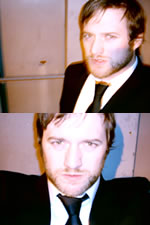
Perhaps Dylan Stableford’s the Real Whore

stableford.jpgOver at Fishbowl NY, Dylan Stableford remarks upon Jessica Cutler’s last-minute cancellation for a Mediabistro panel. Where most professionals would let such a cancellation go without comment, Stableford, who couldn’t possibly be thinking about Mediabistro’s interests at all, writes, “we’re shocked…that someone known for exchanging sex for money would behave this way.”

Bad enough that such a pissy post would be considered pertinent, but the attempt to taint Cutler here as a virago, when Cutler herself offered a reasonable (albeit last-minute) answer, is sleazier than a weekend NAMBLA gathering. And apparently, I’m not alone: the panel’s moderator, Rachel Kramer Bussel, also has some thoughts, pointing to the lawsuit’s possible ramifications and the need for care.

In a later post, Stableford attempts to soften Bussel’s charges, without, of course, pointing to the obvious fact that Fishbowl is owned and operated by Mediabistro.

Roundup

  • I’m afraid I can’t agree with Nick Hornby’s assessment (and Scott’s apparent assent) that reading should be entirely enjoyable. For it subscribes to the idea that novels are almost total escapism, as opposed to a proper art. Proper reading, in my view, demands an intellectual challenge. This is not to suggest that an author can’t write books that are both entertaining and thoughtful. (A recent book that comes to mind is Scarlett Thomas’s The End of Mr. Y.) This is not to suggest that books that are intended to entertain are incapable of being assessed. Nor is this a matter of appearing sophisticated or impressing anyone. (Who knew that reading interests were about looking cool on the subway? I read because I’m interested, dammit, and I don’t give a damn how cornball or hip anyone view my reading selection to be.) But any active reader will raise the bar and insist upon books that are better. Any good reader will read widely and not pooh-pooh certain books because of where they happen to be categorized in a bookstore. Any good reader will continually challenge her perceptions and won’t pussyfoot around the idea that some books are bad (and that there are indeed reasons for this). Revolutionary? Nick Hornby is about as revolutionary as a starry-eyed nineteen year old who believes he can change the world: an insufferable naif; a dime a dozen.
  • Robert Fulford offers this provocative story on reviewing ethics, suggesting that checking for conflicts of interest are unnecessary and prohibitive to discourse. (via TEV)
  • Augusten Burroughs: the new James Frey? (More here.)
  • An interesting questionnaire with Mary Gaitskill. All those fuddy-duddies who pooh-pooh comics might take stock in this assertion: “You shouldn’t listen to any music while reading anything but a comic book.” (Thanks, Stuart!)
  • So Many Books on Bookforum: “This is an extremely dangerous magazine and should be read with care.” I have to agree. I have had many issues of Bookforum attempt to bite me, poison me, and otherwise abscond with my life. This is a magazine that should be locked up or be handled by lion tamers. I’m surprised Bookforum has lasted this long without a lawsuit.
  • Asis Sentinel: “Is it appropriate for a registered charity dedicated to Sri Lanka’s December 2004 tsunami relief to sponsor a foreign literary festival in the middle of what to all intents and purposes is an ethnic and civil war?” And there you have it: twenty minutes of thoughtful cocktail party banter contained in this question alone. Impress all your literary pals and be sure to bring the gruyere!
  • Calling all detectives! Help Mark Gompertz find his community! Where could Mr. Gompertz have misplaced it? Is Mr. Gompertz looking in the wrong place? Or did the community never exist in the first place? (Turn to Page 124 for the answer.)
  • In The New Yorker, Tad Friend ruminates upon The Office.
  • The Poetry Foundation reviews a four-disc box set that collects poetry readings dating back from 1888. (via Isak)
  • Who knew? Those who have lower levels of self-esteem prefer crime and detective stories that confirm their suspicions. In other news, those who go to a website with a ridiculous graphic of a woman in a lotus position for their news are more likely to be duped by Nigerian email scams. (via Sarah)
  • FoxTrot is going Sundays only. Alas, this unexpected development will not hinder UPS from polluting the funny pages with DOA ass-smelling dreck like Garfield and Ziggy.
  • Hitch on Michael Richards and banning language.
  • A breakdown of the 2007 Eisner judges.
  • The real Giuliani.
  • Fi’ty on Oprah.

Will Self’s “Journey”

Gray Lady sideshows don’t get any more navel-gazing than this Will Self trip to New York. Witness a “writer’s journey” as Self adjusts his technological device, adjusts his technological device while trying to cadge a flame (Self has now obtained a beverage!), is asked to pose in front of a Xmas display, still can’t find anyone to light his cigarette (cruel New Yorkers!) while ensuring that his books aren’t being sold for under a dollar (the technological device has returned and must be fiddled with some more! does it contain his Post-Its?), realizes that his bottled water is unsatisfactory (but is hep hep HEP thanks to Jay), is hassled by the photographer as he attempts to eat his lunch, examines a man jumping to his death from the Brooklyn Bridge in broad daylight, and has a near heart attack when he learns how expensive cigarettes are in New York.

Discuss with Class:

1. What is Mr. Self’s journey?
2. Why is there not a single computer or typewriter or pen in any of these photographs?
3. Did Mr. Self enjoy his meal and his bottle of water? And why should this matter?
4. Should the photographer be fired?
5. Was this silly photo session a quid pro quo for a Book of Dave review?

Look Out, Samuel Pepys

Liz Henry at The Other blog points to this fascinating entry on Robert Shields, a man who has kept up a diary for twenty years, working at it no less than four hours a day and recording everything that happens to him. His diary is 35 million words and a sample page can be found here. Apparently, the diary made its way to the Washington State University library, along with a $100,000 donation. Shields stopped in 1996.

Against the Fray

Thomas Pynchon may not have been susceptible to the Rake’s $49 check (and neither apparently is Dave Eggers), but the Ian McEwan flap has had Pynchon issuing a letter in support of McEwan.

Then again, on second thought, given that “indispensable” is misspelled in the letter, I’m wondering if this message truly came from Pynchon. Surely a man of his scrutiny wouldn’t have committed such a rudimentary solecism. And if Pynchon is referencing the Internet, why would he be working off a typewriter? I suspect a possible hoax, unless Pynchon, Ellison-like, clings obstinately to his typewriter. (via Maud)

Here’s the full text:

Given the British genius for coded utterance, this could all be about something else entirely, impossible on this side of the ocean to appreciate in any nuanced way — but assuming that it really is about who owns the rights to describe using gentian violet for ringworm, for heaven’s sake, allow me a gentle suggestion. Oddly enough, most of us who write historical fiction do feel some obligation to accuracy. It is that Ruskin business about “a capacity responsive to the claims of fact, but unoppressed by them.” Unless we were actually there, we must turn to people who were, or to letters, contemporary reporting, the encyclopedia, the Internet, until, with luck, at some point, we can begin to make a few things of our own up. To discover in the course of research some engaging detail we know can be put into a story where it will do some good can hardly be classed as a felonious act — it is simply what we do. The worst you can call it is a form of primitive behavior. Writers are naturally drawn, chimpanzee-like, to the color and the music of the English idiom we are blessed to have inherited. When given the chance we will usually try to use the more vivid and tuneful among its words. I cannot of course speak for Mr. McEwan’s method of processing, but should be very surprised indeed if something of the sort, even for brief moments, had not occurred during his research for Atonement. Gentian violet! Come on. Who among us could have resisted that one?

Memoirs of the Blitz have borne indispensible [sic] witness, and helped later generations know something of the tragedy and heroism of those days. For Mr. McEwan to have put details from one of them to further creative use, acknowledging this openly and often, and then explaining it clearly and honorably, surely merits not our scolding, but our gratitude.