Alistair Harper: Chickenhead of the Month

It’s been a long while since I awarded anyone the “Chickenhead of the Month” prize, but Alistair Harper comes to us from across the Atlantic with a stupidity that is simply too remarkable to let slip.

Alistair Harper knows nothing of the publishing industry. His whole thesis is wrong. How he got to be a Guardian blogger or paid to write is truly amazing. His charge — that “the chip on [Stephen] King’s shoulder as big as the vast American states that are usually his setting” — does not hold. I don’t believe that any author can truly control the nonsense that appears on book covers. Harper doesn’t seem to understand that once a manuscript is turned in, the author is often at the behest of marketing forces. Because the publishing industry is, you know, an industry. And an industry expects to sell products. Or does Harper honestly believe that the publishing industry is in this bookselling business for the philanthropy? If phrases like “words are his power” or “this book will cause you to sodomize a goat” will sell more units, then the publishers will put these words, however preposterous, on covers to sell books. And how is King being uncertain about the shelf life of his work egotistical? Newsflash to Harper: When it comes to nonfiction, King is often as subtle as a Bengal tiger running around Grand Central, and he would be the first to admit this. He is, as he mentioned in Danse Macabre, a self-described “burgers and fries of literature.” And had Harper even bothered to read the introduction to Blaze, for crying out loud a few pages he could have flipped through in a bookstore*, a book that this sad illiterate hasn’t even bothered to examine, he’d realize that King extensively rewrote the book. This hardly a case of a manuscript merely being “dusted off.” And how is it egotistical exactly to want to finish a series when a million readers — many of whom have written King letters and expressed hopes that he would finish, as indicated in the same introduction that Harper quotes from — clamor for it? Has it not occurred to Harper that King simply cannot stop writing? That isn’t egotistical. That’s the mark of a hypergraphic personality.

If Harper hates King, he should simply be honest and say so. But in hiding behind this “Stephen King has an ego” gambit, he attempts to pretend, like some bumbling teenager trying to figure out how to open up a golden Trojan package but too afraid to ask for help, that it’s about King the person and not King the writer. This is hubris of the first order. It’s the kind of thing you expect from 1600 Pennsylvania, not 119 Farringdon Road

* — The UK edition likewise possesses an introduction by King. If it is different from the US edition, please feel free to correct me.

Roundup

  • So who was the real Agatha Christie? Because Christie wrote the lines, “You know, you’re the sort of woman who ought to be raped. It might do you good,” under a pseudonym, the Telegraph‘s Laura Thompson appears to be in a great uproar. I’m not sure whether these striking lines say anything in particular about Christie as a person. (It is a common fallacy to equate a writer’s personality with the dark and disturbing things a writer sets down to paper.) Personally, I won’t be impressed until someone reveals that Christie managed to schtup half the men in Berkshire and single-handedly stopping a seditious affront to Mother England during her mysterious disappearance.
  • Harpo Harper Lee speaks!
  • It doesn’t surprise me too much that Anne Rice is a pro-lifer.
  • Jonathan Coe: not even a bridesmaid?
  • Garth on why Bolano matters.
  • Something for Mr. Asher to consider in his forthcoming symposium: “The Problem with Pricey Paperbacks.” (Of course, Levi was on this issue before Alex Remington. Another example of print cribbing from blogs? For a print-financed blog no less!) (via Orthofer)
  • And speaking of Levi, this consideration of Richard Bach is madness. I was there when the friend in question screamed in horror. Levi held the book. There was a strange Zen-like grimace on his face, as if Levi had just finished having tea with the Dalai Lama. I had been talking with someone and stood silent and slackjawed and horrified when Levi then declared to all of us that Jonathan Livingston Seagull “wasn’t so bad.” I was then forced to exorcise the book so that Levi would be protected from future influence. Things proceeded okay from there. Let this be a lesson. Richard Bach is a dangerous man. Pick up his work at your own peril.
  • Richard Nash on how Jamestown came to be. The summary: not an easy rollout by any measure.
  • Jenny D is quite right about Gibson. Gibson’s houses are built on firm foundations of language and rhythm, and I think it can be sufficiently argued that his conceptual associations are likewise rooted upon these preternatural cadences.
  • Rick Kleffel talks with Karen Joy Fowler, Gavin Grant, and Kelly Link in one sitting. And Mr. Kleffel, what the hell is wrong with epic interviews? This is what podcasting is all about, sir! Don’t hold back on us! (via Locus)
  • Mark Sarvas interviews David Leavitt.
  • Okay, Mr. VanderMeer, I will concede that The National’s Boxer does tread water somewhat. But you are dead wrong about the new Spoon album, sir!
  • Terry Teachout has been the victim of Wikipedia vandalizing.
  • Now that Brad Pitt has tsk-tsked folks for failing to rebuild fast enough after Katrina, I guess that means they’ll be reconstructing New Orleans faster. Next week, Brad Pitt will be using his Hollywood star power to scold the Third Law of Thermodynamics for the entropy resulting from this week’s statement.
  • Ah callow youth! Why are you so goddam non-rebellious when the world’s in the shitter? 64% of these little bastards “wake up happy?” Sixty-four percent? Christ, the generation after mine is disappointing the hell out of me. We were cynical as fuck and that was during the Clinton years! Maybe Charles Rangel is right. Maybe we should reinstate the draft just to give these smug little fucks a wakeup call. BLAM BLAM BLAM! What do you think of that, eh? If you want your nonfat hazelnut latte and your TiVo options, you’re going to have to march through the goddam DMZ to get them! HOW ABOUT THAT? Oh, what’s that? You need to go to the infirmary? Well, now that you’re in the middle of the GREAT CLUSTERFUCK YOU’VE BEEN GLEEFULLY IGNORING, that ought to put a damper on the whole “wake up happy” scenario, eh?

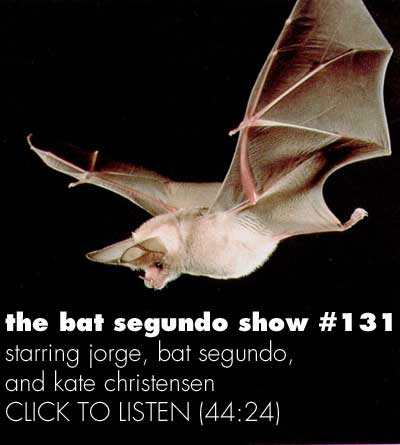
BSS #131: Kate Christensen

segundo131.jpg

Condition of Mr. Segundo: Contemplating his biographical legacy.

Author: Kate Christensen

Subjects Discussed: First-person vs. third-person narration, Hugo from The Epicure’s Lament vs. Oscar in The Great Man, dead men, dying women, being obsessed with death, the sex lives of older women, the difficulties of writing third-person without planning, stacked sentences, Richard Ford, over-the-top observations, MFK Fisher, what food says about people, kosher diets, whether or not an octogenarian can be spry, emasculated men, painting nudes, on being labeled a feminist writer, antipodean biographers, populating a novel with twins, poetry, the many ways of appreciating art, the difficulties of female writers being taken seriously, writing visceral messes, the origin of the fictitious New York Times articles, how unexpected character qualities are discovered, on making Oscar contemptible, and seducing your best friend’s wife.

EXCERPT FROM SHOW:

Christensen: You can say he has certain things in common with Claudia in In the Drink and Hugo especially in The Epicure’s Lament, in that he can say whatever he wants and he’s sort of a loose cannon in a way. He has a lot of opinions and he’s a man of excess appetites, like all the earlier narrators. And he was successful and therefore not interesting to me as a first-person narrator. My first-person narrators tend to be losers. They’re the kind of people whose heads I like to get in and who I like to have take over my brain. That entertains me deeply.

The Case for John Barth

If literary blogs exist to dredge up the underrated authors of our time, I must ask why the litblogosphere, so capable of unearthing the neglected, has remained so silent concerning the great novelist John Barth. If Gilbert Sorrentino, William Gaddis, and David Markson cut the mustard with their postmodernist innovations, then Barth likewise deserves a spot in the This Guy is the Real Deal pantheon. Here is a novelist who playfully uses first person plural in Sabbatical to represent a romantic escapade on the Chesapeake Bay with the apparent descendants of Edgar Allan Poe and Francis Scott Key. Here is a novelist who, in his early trilogy of novels The Floating Opera, The End of the Road, and The Sot-Weed Factor, takes the piss out of absolutist thinking: Todd Andrews, the protagonist of The Floating Opera, is an attorney who contemplates a moment in his life when he should have died. The answer to his conundrum might lie in the ridiculous logic he uses in relation to a court case, unearthed in hilarious fashion over a protracted “logic” reminiscent of the crazy legal brief in William Gaddis’s A Frolic of His Own. Jacob Horner’s reason for living in The End of the Road is predicated upon following the dicta of a mysterious Doctor, with the series of instructions being woefully misunderstood and employed in an insensitive manner that even Horner doesn’t seem to see. Consider, for example, the way that Barth describes this moment in which Jacob Horner shares dinner with the Morgans:

Since there were only four chairs in the kitchen, Rennie and the two boys and I ate at the table while Joe ate standing up at the stove. There would have been no room at the table for one of the sling chairs, and anyhow it did not take long to eat the meal, which consisted of steamed shrimp, boiled rice, and beer for all hands. The boys — husky, well-mannered youngsters — were allowed to dominate the conversation during dinner; they were as lively and loud as any other bright kids their age, but a great deal more physically co-ordinated and self-controlled than most. As soon as we finished eating they went to bed, and though it was still quite light outside, I heard no more from them.

Who is this guy? Is this really a sad domestic situation or is Jacob Horner more concerned with externalizing every situation he comes across? We have all sorts of general details about who this family is and what the dinner entails, but why can’t Jacob Horner pinpoint anything about them? Why the strange comparative qualifiers compared to other boys? Why the concern for the boys’ conversation? These are the questions that pop up when reading a Barth novel.

Likewise The Sot-Weed Factor, possibly Barth’s masterpiece, frames a hypocritical concern for virtue using a real-life historical figure (Ebeneezer Cooke) over the course of a playfully picaresque novel.

Why not Barth? He regularly subverts conventional narrative. He is very funny and regularly irreverent. He is often unapologetically preoccupied with sex. He sneaks in little tidbits about mythology, history, and little-known procedures of the law. And his work often bristles with a warm-hearted sense of mischief, even when the scenario being described is an extremely troubling one involving abortion, rape, or suicide.

If Barth can be accused of any literary crimes, his rap perhaps involves an overwhelming preoccupation with Maryland and Virginia history and a restless ambition. Nearly every Barth reader I’ve talked with gave up on LETTERS at some point. It was the most ambitious volume that Barth produced, involving characters from Barth’s previous novels writing letters to a guy named John Barth. After LETTERS, it seemed that people wanted to forget that Barth even existed. (He is still alive, presumably residing somewhere around the Chesapeake Bay.) Even I, when I first read Barth a decade ago, failed to continue reading Barth’s works in sequence. But now that I’m reading one of the novels that came after LETTERS, Sabbatical, I’m finding it to be a great surprise, just as fun and inventive as his early work. And LETTERS is due for a serious reassessment. (LETTERS and Sabbatical, incidentally, are available from Dalkey Archive Press.)

I have been rereading Barth’s novels in a rather odd manner over the past month, starting with the first two and now including Sabbatical and The Sot-Weed Factor, the latter of which I am reading for the third time. If anything, the playfulness and narrative tinkering that first wowed me when I was feeding on a variety of lengthy and ambitious novels in my early twenties has resonated more.

Has Barth in some sense declined over the years? I don’t think so. I think the guy still has it, even though my reading of his post-LETTERS books remains limited. Nevertheless, I have now obtained almost all of his novels and I aim to figure out precisely what happened.

In the meantime, I jam this message into the bottle and throw it into the tidewater. I cannot be the only guy out here who thinks John Barth is the cat’s pajamas. So what of you, readers? If you tried out Barth, why did you put him back on the shelf? Or have you remained silent over the past few years because Barth ain’t exactly the heppest cat to rave about? Well, I’m here to tell you that Barth is the real deal! You are not alone! Let’s make some noise and get people talking about Barth! Who’s with me?

[UPDATE: Dan Green, wryly quoting me in the manner of a film publicist truncating blurbs, points out that he has written about Barth. The specific words I used were “so silent,” which is not to suggest total silence, but a comparative qualifier. Dammit, let’s make some noise!]