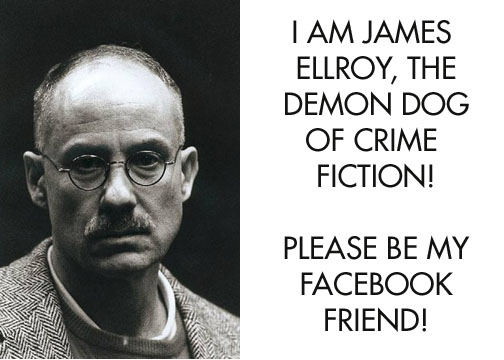
Viral Marketing

ellroyfacebook

As Sarah Weinman reports, in a signed note on the back of the forthcoming James Ellroy novel, Blood’s a Rover, the Demon Dog of Crime Fiction is urging all of his readers to find him on Facebook. This may very well be the most brazen Web 2.0 pitch in the history of book industry marketing. And the last thing I want to do is kick a Demon Dog when he’s down. So go to Facebook, find James Ellroy, and lift this great writer’s spirits for the benefit of arts and letters! Perhaps by befriending Mr. Ellroy in this manner, he might be tempted to write even stranger novels for the joys and pleasures of readers around the world! (That is, when he’s not being poked by people he barely knows, given virtual gifts, or being chatted up by bored 15-year-olds.) Now if only we can convince Mr. Ellroy to get on Twitter and Tumblr, then we may very well make Mr. Ellroy the Demon Dog of All Media.

The Hard Quit

There’s presently a wild perceptive dust floating about in lieu of the daily smoke. It’s a mad balance that comes from giving up one terrible extenuating habit formed in my twenties, committed to (and quit) with varying degrees of government-sanctioned addiction over the past twelve years, and kicked at by the impromptu hooves bucking at salubrity at this present day — just a few years beyond thirty. There have been abject side effects. Sentences unpacked and deployed from my noggin like mad rivets dutifully dipping from a dribbling drill now take thrice as long to squeeze and bounce about my brain and bang into some coherence. All this is frustrating and very disheartening to say the least. I have even misted a bit at not having my apparent chops, but I know that it will come back. I am a stubborn bastard. Precise memories have become foggier, yet incidents that I haven’t given much thought to in several decades shout like mad banshees in the middle of the night, beckoning attention and disrupting my dreams. Minor moments from my first thirteen years have clung like surprise barnacles to the galleon I am presently retrofitting. Why they should come now remains a mystery. I am hardly purer than I was. I suspect that I am much worse.

I can apparently still do interviews quite well, and have done about five since I kicked the habit in anger. And while I can’t wolf down a book in one day (my appetite seems committed elsewhere, I’m afraid; to reduce the inevitable pounds, I have taken to fruit like a ravenous rhesus monkey), I can now read about 150 to 200 pages before my head rattles into the pillow. I can sound coherent on the phone and am apparently semi-erudite in person. (Nobody has yet suggested that I have turned autistic, but it certainly does seem that way at times. I am the worst judge, as many have kindly reminded.) I tend to be angrier over particularly stupid topics and resist all urges to give in completely to this unwholesome fury. Which is not to suggest that I’ve abandoned righteous indignation. Being mad, after all, is an important visceral scenario to countenance from time to time. But I am very aware that I am becoming emotionally and physically cognizant of the individual I hid behind the cigarettes: not the greatest person, but not a bad guy; someone, however, certainly afraid to be adorably crazy. I have, as a result of this, made myself socially scarce and only emerged when called or beckoned. A different kind of disguise, but not as bad as my previous mask of embarrassment that came with the occasional cancer stick I puffed at odd hours and let get out of hand. And it didn’t help that the price went up, and that the heartless bastards who contrived this tax didn’t think of the addicts who needed the frequent tugs and what it really meant to throw it all way.

The upshot is that this has been exceptionally difficult, and the difficulties of quitting are something we aren’t allowed to talk about. But it’s been just about three weeks. And it gets easier. I stay positive and remain active. The associations subside and reform, as does the hiding. I find a surprising new self to know who is perhaps a bit frightening, but who will live better than he did before. And if that sounds like a needlessly boastful statement, then you have never known what it is to be an addict.

RIP J.G. Ballard

Jeff VanderMeer is reporting that J.G. Ballard is dead. If that last sentence doesn’t cause your heart to sink to your feet, then get thee to a bookstore or a library and check the man’s work out immediately. Ballard was one of the greats: an imaginative giant, a profoundly erudite iconoclast, one of those rare talents who came up with a warped concept that needed to be wild while providing the speculative heft needed to keep a thought experiment going. And I hope to have more to say about the man as soon as I can collect my thoughts more coherently.

[UPDATE: Joanne McNeil, Jacket Copy, the AP, Tributes from the Guardian, even Gawker and Entertainment Weekly. But nothing from the New York Times or the Washington Post, who I presume are both too vanilla to appreciate a genius.]

[UPDATE 2: The New York Times and the Washington Post merely ran the AP obit off the wires. So John Updike gets independent coverage. But Ballard, being a mere “speculative” writer, does not.]

Better Than a Thousand Hollow Words

Like oh my God! I would SOOOOOOOO like to meet Louisa Thomas, who like reviews, like, books for the Los Angeles Times, and who, you know, seems to like people. Reading her review, I became convinced that she was, like, the kind of BFF (!!!!) who would, like, go with me to get Häagen-Daz. And we’d like spend the whole day gagging each other with our spoons, wondering, like, why there’s those, like, two funny dots over the first A. I think we would be friends. And I also think that if I decided to, like, enlist Louisa Thomas into my more libertine activities, she’d totally participate in what Sir Richard Burton once described as the Seventh Posture.

The quality of a review doesn’t depend on the personality of the reviewer, but, for fuck’s sake, one expects some minimum of critical acumen. Some of my favorite reviews were written by people who liked to digress or get excited about a strange subject, but they never made the profound mistake of lionizing the author’s personality and losing sight of the text itself. And yet the editors at the Los Angeles Times permitted this dopey and idiotic review to appear, perhaps because they view their audiences with contempt, they believe that lowering the bar as much as possible is the way to attract readership, or Thomas is sucking somebody’s cock.

There is no way to read this review without hating it, without recoiling at how it takes four fucking paragraphs before we actually know anything about the book in question. Louisa Thomas would appear to lack intelligence, would appear to have nothing worthwhile to say about books, would appear to have taken on this assignment and put on her rosy and phony enthusiasm because she wasn’t professional enough or emotional enough to do her job and tell us WHY THE FUCK SHE LIKED THE BOOK.

Liking the author is moot. I like any number of authors, but don’t care for their work. I love any number of books, but think the authors behind them have been total asshats. (Fortunately, 95% of the authors I meet are friendly.) None of this matters in the slightest. I have praised volumes written by assholes and savaged tomes crafted by nice guys. To gush about how much you like an author is to capitulate to the poisonous celebrity culture that is presently deracinating the possibilities of independent thought. It is to accept, as Louisa Thomas clearly accepts, the coward’s knee-jerk sprint to conformist groupthink. It is to waste words, sabotage paragraphs, and to offer nothing original. It is to accept the superficial.

We’re told that Thomas is “a contributing editor for Newsweek.” Here are a few exemplars of Ms. Thomas’s analytical chops:

“A confession: I can’t wait to watch the new DVD of ‘Twilight’-a movie I’ve already seen.”

“What makes a thriller work is a million-dollar question, but why they matter is more than an economic concern.”

And when presented with the opportunity to talk with Yiyun Li, what pithy words did Thomas rustle out of her? “I’m fascinated by people I can’t understand.” Personally I’m fascinated by inept interviewers who choose this generalization, above all others, for a profile piece about a highly acclaimed novelist.

If newspapers are going to publish vapid articles written by Louisa Thomas, why indeed should they be saved? When the Los Angeles Times publishes junk like this, it makes me want to reach for my metaphorical revolver so that I can convey to a few stubborn editors just how serious the situation is. When an editor publishes an article this vacuous, he is committing an act of self-sabotage. Newspapers are not in the position right now to print homogenized junk that speaks down to the reader, nor should they be alienating high-profile ex-editors who can get people fired up and pissed off about books. Newspapers must take more than a few chances right now and demonstrate to the public why this medium is worthwhile. I’m not against having fun in a book review, but speculations on whether Joanna Smith Rakoff has had a few “nice times” in Brooklyn restaurants have no bearing whatsoever on a book’s value. It’s an insult to an audience’s intelligence, and such reviews demonstrate that a newspaper doesn’t really deserve the literary stature or the acclaim it continues to lavish upon itself.