Tools of Change: The Rise of Ebooks

Panelists: Mark Coker (moderator), Joe Wikert, April Hamilton, David Rothman, Russell Wilcox

If I had to compare Tuesday’s panel with Terminator 3: Rise of the Machines, I would say this. Claire Danes was superior to April Hamilton. Russ Wilcox, a rather cocky gentleman who spoke like some snobby Yale know-it-all with his head held high and dashed off a number of wild and extravagant and unprovable claims, would be comparable to Nick Stahl. The difference is that Wilcox isn’t living off the grid. Indeed, despite the technological benefits of his E Ink invention, he’s all too happy to smudge his fingers and sell the human race to Skynet. David Rothman was Ah-nuld, and he did okay. Regrettably, there wasn’t a nude T-X character who liked to seduce and kill, but I suppose Mark Coker, who started off stiff but began to prove his sardonic worth upon poking holes in Wilcox’s extravagant vale, will fit the bill. But Joe Wikert was the smartest guy on the panel: open to present technological realities and a man who, unlike all the other panelists, was not entirely willing to buy into all the hype.

While I will confess that the Brad Fiedel theme played in my head at numerous points, I can say this. With Coker and company relying on Amazon’s dodgy 10% figure, along with Sony’s extravagant claim that 300,000 Readers had been sold, I was skeptical. Ebooks, after all, represent only one half of 1% of the total market. And to my knowledge, there hasn’t yet been a figure from an independent third party to determine if ebooks are indeed the great white hope that will decimate print and get all of us fighting robots in an apocalyptic future.

Rothman said that Amazon’s DRM was what was really killing this natural evolution. In order for the ebook market to expand, it’s going to be necessary to consider open source. Wikert likewise agreed that DRM had to go away, but added that any e-reader should consider adding value to the print products. If future e-readers didn’t do this, then they would eventually hit an artificial ceiling. “When you’ve got a hammer in your hand,” said Wikert, “everything looks like a nail.” He hoped to see more exemplars of rich content. Video and dynamic possibilities. Fancy little bells. But nobody on the panel chose to consider the issue of whether it would be the author or the publisher that would provide this additional content. Still, Coker did joke that the iPhone might be programmed to vibrate at a certain tone upon a new e-volume of erotica cascading against the technological shoals.

Wikert elaborated further. One product, he said, could be calibrated based on what that person wanted to do with it. He urged the audience (and those who work in this industry) to not only study the latest technologies, but to be actively involved in using these technologies.

This sense of play and flexibility did not apply to Russ Wilcox, who should have worn a T-shirt reading I’M HERE TO PIMP MY GOODS in large lettering readable from half a mile away. Wilcox suggested that Moore’s Law now applied to e-readers. The speed of E InkTM innovations now doubles every eighteen months, all contingent upon brightness, contrast, and speed. He foresees this future: In 2010, the flexible displays expand, with a larger size permitting an advertising-driven model in which the profit machine becomes self-aware. By the end of 2010, a full color e-paper device hits the market — initially limited to pastels. Over the next eight to ten years, various color e-readers duke it out with each other and geeks presumably choose sides in the forthcoming jihad. He also cavalierly predicted — with no hard sales or trend data; because we all know that he’s sworn to corporate secrecy on the subject — that in eighteen months, 2-3% of American households would have e-readers in their homes. Coker quibbled with this, pointing out that he would need an enormous growth rate for this massive jump to happen. There was no mention of the limping economy, much less the incentive for Joe Sixpack to buy the latest Kindle at a gargantuan cost, only to see another version released less than a year later.

I am not really certain why April Hamilton was on this panel. But she brought up a notion even more preposterous than the failure to consider the time and money it would take for authors and publishers to generate dynamic content. She believed that smartphone applications would be the future. Never mind that the book is a rather specific medium and that, indeed, some books may not necessarily work this way. As Rothman observed, because of an iPhone’s limited storage space, apps have the tendency to be deleted. This prompted a rather defensive answer from Hamilton, delivered in the timbre of a beauty pageant contestant, “I would say there’s no single answer.” Well, can you perhaps agree that you might be wrong? Can anyone at this damn conference confess that they really don’t know where things are heading?

Actually, yes. Wikert was wise enough to point out that the early version of the iPhone in 2001 looked rather silly and that the current version of the Kindle will look silly in five years. It helped to talk shop with rapid technological evolution in mind. Wikert expanded on the panel’s general anti-DRM sentiment by suggesting that a Kindle App Store might open up Amazon’s possibilities.

Wilcox suggested that Stanza wouldn’t exist without Kindle. This gave him a ripe opportunity to trot out a catchphrase pertaining to the unit: “the container affects the experience.” And just as he was about to get beyond the topic of E InkTM, he then suggested that E InkTM wouldn’t really make its way onto cell phones. The outside of cell phones maybe. But I wondered whether Wilcox might somehow find a way if Nokia came to him with millions of dollars. Then he might appear on another panel, hold his haughty head up high, and remain absolutely convinced that he was right. (Note to Wilcox: If you’re going to talk like a snob, it helps to speak like William Buckley.)

I don’t want to delve into Ms. Hamilton’s Indie Author Movement (almost TM, but since it represents “the people” in a rather naive manner, I will leave subscript silliness outside of my report). Mainstream publishing just doesn’t have what the Indie Author needs. And how dare these other authors tsk-tsk their fingers against self-publishing? It’s not vanity at all to pay your hard-earned money for a slapdash operation without editorial oversight. The books industry, Hamillton proudly declared, is now as ignoble as the movie industry. Nothing more than highly commercial fare! I mean, they haven’t thought about the niche markets at all! An author publishing her work was never vanity.

“Uh, great. Thanks,” responded Coker.

By the time Wilcox brought up “tipping points,” I wondered if the bright young thing had ever considered the common reader. Fortunately, the next panel brought this very important subject to the center.
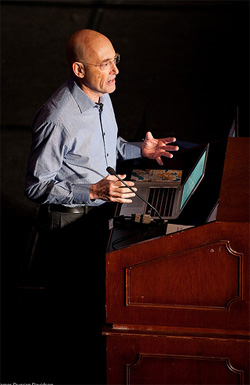
Tools of Change: Jon Orwant

Jon Orwant is a highly confident man. Some might say (and a few certainly did to me) that he is one of the great egotists of our epoch. By his own admission, he is certainly not an amateur. But then when you’re the Engineering Manager for the world’s biggest search engine, and you’re white, and you’re rich, and you’re male, and you’re at a conference with an egregious gender divide in place, and the likes of Tim O’Reilly and Cory Doctorow are there trying to throw a few jabs and you answer their questions without really answering their questions, well then you really don’t have a lot to lose, do you? Particularly when you’re talking about Google Book Search. Which is just so much better and making everybody so much money! Even in this economy. And isn’t cash what it’s really all about in the end?

There was a good deal of swagger at the panel titled “Google Book Search: Past, Present, and Future.” And I don’t believe the Scrooge parallels in the title were entirely unintentional. But it was my second favorite panel of the day.

“I’m happy to geek out about copyright,” announced Orwant at the onset. But everybody wanted to hear him talk about Google Book Search. Google has some seven million books indexed. It’s “a platform for searching, discover, reading, and buying.” (Fun fact: The word “buy” appears six times in Dickens’s “A Christmas Carol” — I know this thanks to Google Book Search — and it is always used, in all cases, in relation to buying items for the poor. But this may not have be the “buying” that Orwant or Google have in mind.) Google Book Search has a Partner Program, in which the rights holder wants the content searchable, with boxes of books and PDFs sent Google’s way for OCR magic. It also has a Library Project, in which 100 million books are checked out of libraries and scanned. Google, Orwant says, doesn’t charge for it. No money exchanges hands. Charity! Nevertheless, the “buying” participle still exists in that “platform” designation.

Thanks to a concept called blending, Google Book Search options remain in the top search results. An effort to direct traffic GBS’s way. For while Google is the patron of GBS, GBS must be kept profitable. You didn’t think they were doing this out of the goodness of their heart now, did you?

There are 1.5 million free books, all public domain titles, available on Google. But if you want to access them, well, you’ll have to go to Google. Or you’ll have to have Google generate results at your site. Because the Google team are specialists in latency. They can do things with milliseconds that you couldn’t work out in your dreams. As an experiment, Google recently unleashed Google Books Mobile, which means that you can nose search Google Book Search from your smartphone, assuming that Thomas Friedman isn’t hogging all the bandwidth on the island. Orwant was careful to point out that Google is not in the handset manufacturing or carrier business. But he anticipated, just as many of the seer-like speakers at Tools of Change did based on sketchy inside information, a “rapid evolution.” Nevertheless, because someone had cracked a Twitter joke about reading Ulysses, there remained the possibility that someone was using GBM for serious literary endeavors. Why? “I personally have no idea,” rejoined Orwant to his own question. This was an experiment to see what usage will be like in the next few years. Google wishes to dominate.

The revelation about 1.5 million free ebooks prompted Cory Doctorow to press Orwant on a question about why these couldn’t be released as a torrent. A sensible idea. But you see, Google needs to keep these books on their site. Because they’re constantly tinkering with the display results. Latency and other assorted topics of expertise, remember? And there is no evidence that GBS harms sales. Trust Orwant on that.

Tim O’Reilly tried to badger Orwant too. You see, O’Reilly used to have good webpage placement for many of his titles. But those days are gone, replaced by Google Book Search results above the O’Reilly pages. And that hardly seems fair. “It’s not me; it’s the algorithm,” responded Orwant. But wasn’t Orwant one of the guys who came up or oversaw the algorithm? Orwant may have only been following orders, but it did raise a very important point. If a publisher has a specific webpage for a book title, should they not have that webpage come up in the search results before a GBS page?

There’s some comfort in knowing that 99% of the books at GBS have been viewed at least once. Even the sleep-inducing textbooks. Which is really quite something. Which brings us to the future, which is based on the past, which does not involve thrown mugs. You see, Orwant was once the editor and publisher of a magazine. Subscription base: 12,000. (He said at the panel that he did not know what he was doing.) Orwant loitered in a bookstore and watched people picked up his magazine and would approach them for insights. (He said he did not know what he was doing.) He learned valuable lessons about pictures, the size of the title, and other layout factors. (He said he did not know what he was doing. But as we learned above, he’s no amateur.) So if Orwant did not know what he was doing, he certainly wanted to figure out these trends. Perhaps in telling us that he did not know what he was doing, he is actually alerting us to the possibility that his real interest was in tracking. And, lo and behold, now GBS is all about figuring out what people are reading next. It hopes to introduce more options to render these images as XML. Which means text-based pages and character recognition. Which means distributing content further and getting more GBS results. And why are the publishers being so irksome about the price point? They can’t possibly make a profit at $50 a pop, but they can at 50 cents a pop. If the information can’t be free, then it can certainly be brokered at a cheaper price thanks to Google technology. Of course, the price has to work for Google, not the publisher.

That snippet view you see with some titles? Orwant’s official position, pressed by Cory Doctorow, is that it’s fair use. But once the October 2008 settlement in Authors Guild v. Google is approved by the court, you’re going to see that snippet view jump to 20% of the book. But in the meantime, GBS’s dominance is all but confirmed. You’ll begin to see public access terminals in libraries. But there’s always consumer purchasing options. A guy named Adam Smith (no joke) is head of the product. Sure, we’ll reap some benefits of these developments, but it doesn’t feel entirely right that a private and cash-heavy corporation holds all the cards. Particularly one with the smarts to keep a savvy guy like Orwant on the payroll.

Tools of Change: Bob Stein & Peter Brantley

tocsteinThe morning started off with Bob Stein, founder and co-director of The Institute for the Future of the Book. It’s worth pointing out that for thirteen years, Stein worked for The Criterion Company, which he founded. Stein observed that he had always viewed the Criterion discs as items that he published and that this notion of “publishing” arose from a then groundbreaking video in 1980 that depicted the moving image with text on a screen. In Stein’s view, there was a McLuhan-like distinction to be made between user-driven media (books) and producer-driven media (movies, radio, and television). But because issuing a laserdisc meant giving an item to one individual at a time, it involved “publishing” it. (In fact, the early Criterion logo featured a book turning into a disc.)

The Internet, however, stretched Stein’s meaning about what a book was. While CD-ROMs offered staggering data that permitted a user to study the life of Stravinsky, the Internet, of course, imploded this notion. There began to emerge a separate sense of what a book was or could be independent of its categorization of an object. The book itself became much more important than data or content, and became very much about connecting other people. To illustrate this, Stein cited three examples: (1) Without Gods, a blog that chronicled Mitchell Stephens writing a book for a year, in which every day had a post and coteries of readers emerged who went on the journey with Stephens; (2) McKenzie Wark’s Gamer Theory, in which a draft of Wark’s book was posted online, with each paragraph represented by a card (and in turn generating numerous comments next to the text, putting the reader on the same level as the author); and (3) an annotated version of Ambrose Bierce’s “An Occurrence at Owl Creek Bridge,” in which twenty students annotated the book (similarly to Wark) using a WordPress plugin called CommentPress.

Stein viewed the recent experiment involving Doris Lessing’s The Golden Notebook as a failure to create a culture of public reading, but a success in connecting seven women together through the annotation. And Stein believed that the connection that the book had engendered was now part of the book as well. In Stein’s view, if you look at a book as an object, you effectively hide and obscure the social engagement that comes with the tome. And that social experience is perhaps more corporeal than we realize. So Stein’s new definition of a book is “a place where readers (and sometimes authors) congregate.” The authors may become leaders of communities of inquiry (nonfiction) or they may become creators of words that readers populate (fiction). To this end, Stein viewed World of Warcraft as “the best book as a place.” It is therefore up to publishers to create a future that involves building and nurturing communities for authors and their readers.

Stein’s examples certainly represent fascinating enhancements which permit a book to take on a supplemental life. And it really had me thinking about some possibilities I may employ to augment the roundtable discussions that crop up here from time to time. But is the supplemental reaction to a book really part of a book? The buzz term “social community” kept cropping up at these keynotes and panels with troubling frequency. While I’m all for the notion of the information wanting to be free, I’m wondering if these supplemental aspects truly encourage other people to think independently about these subjects, and whether open source philosophy and “social community” (soon to be trademarked, I presume) is truly open to opposing viewpoints.

My skepticism was warranted when the Digital Library Foundation’s Peter Brantley gave a presentation that came perilously close to the treacherous Speedlearn experiment from The Prisoner. In Brantley’s view, a book is a social construction simply because we create our own reading environment in our home, shared with other books, or we happen to create that space in public. Therefore, getting involved with a “social community” becomes vital to the form. Such enlightenment! I wondered if Brantley, like many readers I know, had ever read a magazine or a mass market paperback while sitting on the can, or whether his income bracket had made such a common consideration declasse. I suppose if I sat with my ass hanging out long enough, I could probably justify the amount of toilet paper on the roll as a vital “personal space” component. If someone were to pay me money to stand in front of a bunch of unquestioning techies, I could also claim to have seen a deity while reading some Talk of the Town piece in The New Yorker and attempt to persuade you that this was a religious experience that called for a “social community.” But you’d probably throw tomatoes at me and demand that the cane extract me from the stage. And rightly so.

Here was a man who presented a programmed keynote without spontaneity, even producing slides like “ah, let me explain that…” to mimic his seeming asides. It was as if the audience was there to be programmed rather than consider a viewpoint. And it was the primary reason why I decided to skip Cory Doctorow’s predictable anti-DRM rant. One of these was quite enough for me.

Among some of Brantley’s generalizations:

“A book is a social construction.”

“A book is a machine to think with.”

He even used the phrase “We’re reaching into books,” as if to suggest that the reading experience was more of a phony New Age experience in which some fifth circle might be obtained. But then in Brantley’s deense, I’m naturally suspicious of ponderous speakers who walk up and down a stage wearing a silly beret and holding a coffee cup. If Brantley had delivered his keynote in French, smoked an unfiltered cigarette, and perhaps thrown in a few passing references to the oppression of the working class, then I suppose I might have forgiven him. But he was dead serious about this.

A book may be generated by a machine and ebooks may be available through machines, but that does not mean the book itself is a machine. Nor should the reader transform into a machine. This kind of perspective may work in programming circles, where jargon and other linguistic bullshit is tossed around as casually as spitballs. But for those readers — most of us, I would gather — who see books as organic, guys like Brantley really fail to see the bigger picture. And I’ll have more to say about how the reader’s perspective — with the exception of one notable panel organized by Kassia Kroszer — has been utterly ignored by these slick and affluent concept slingers in subsequent posts.

(Photo: James Duncan Davidson)

Tools of Change: Initial Report

During a morning in which news of layoffs at HarperCollins and the future of BookExpo America was severely reduced in time and topography, here at the Marriott Marquis, Tools of Change rolled on. I appear to be the only guy here wearing a T-shirt, but not the only one nursing a hangover.

I’ll have some reports of the panels later in the afternoon. But I can report that the crowds here are largely male, that the recent publishing news has left those attending this conference with their hopes somewhat crestfallen, and that Tim O’Reilly and Cory Doctorow offered a few contrarian questions to Jon Orwant — that too cocksure man from Google, who answered in response to a critical query, “It’s not me; it’s the algorithm.” Orwant’s answer is quite fitting, because nobody here I’ve talked to really does have the answers, nor do they want to take responsibility. A CEO insisted to me that his POD machine will change the world, but when I asked him about whether or not an independent bookstore could afford to lease it, he refused to divulge the details. A new e-reader displays a crossword puzzle, promising “annotations and marks,” but one cannot so much as fill in the letters for 4 Across. Peter Brantley lectures to his audience like a New Age dope hoping that we’ll accept his mantras about “social community” without question, but there are considerable holes to his sunny utopian vision.

Nobody knows anything. But people wish to carry on as if they somehow do know everything. And that means being on the cutting edge for any half-assed technological development that gets people’s eyes bulging out of their sockets.

That’s not the change we were promised. And these aren’t necessarily the tools you’re looking for. But we all carry on. Let us hope we aren’t fiddling while Rome burns.