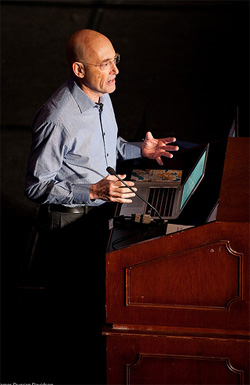
 The morning started off with Bob Stein, founder and co-director of The Institute for the Future of the Book. It’s worth pointing out that for thirteen years, Stein worked for The Criterion Company, which he founded. Stein observed that he had always viewed the Criterion discs as items that he published and that this notion of “publishing” arose from a then groundbreaking video in 1980 that depicted the moving image with text on a screen. In Stein’s view, there was a McLuhan-like distinction to be made between user-driven media (books) and producer-driven media (movies, radio, and television). But because issuing a laserdisc meant giving an item to one individual at a time, it involved “publishing” it. (In fact, the early Criterion logo featured a book turning into a disc.)
The Internet, however, stretched Stein’s meaning about what a book was. While CD-ROMs offered staggering data that permitted a user to study the life of Stravinsky, the Internet, of course, imploded this notion. There began to emerge a separate sense of what a book was or could be independent of its categorization of an object. The book itself became much more important than data or content, and became very much about connecting other people. To illustrate this, Stein cited three examples: (1) Without Gods, a blog that chronicled Mitchell Stephens writing a book for a year, in which every day had a post and coteries of readers emerged who went on the journey with Stephens; (2) McKenzie Wark’s Gamer Theory, in which a draft of Wark’s book was posted online, with each paragraph represented by a card (and in turn generating numerous comments next to the text, putting the reader on the same level as the author); and (3) an annotated version of Ambrose Bierce’s “An Occurrence at Owl Creek Bridge,” in which twenty students annotated the book (similarly to Wark) using a WordPress plugin called CommentPress.
Stein viewed the recent experiment involving Doris Lessing’s The Golden Notebook as a failure to create a culture of public reading, but a success in connecting seven women together through the annotation. And Stein believed that the connection that the book had engendered was now part of the book as well. In Stein’s view, if you look at a book as an object, you effectively hide and obscure the social engagement that comes with the tome. And that social experience is perhaps more corporeal than we realize. So Stein’s new definition of a book is “a place where readers (and sometimes authors) congregate.” The authors may become leaders of communities of inquiry (nonfiction) or they may become creators of words that readers populate (fiction). To this end, Stein viewed World of Warcraft as “the best book as a place.” It is therefore up to publishers to create a future that involves building and nurturing communities for authors and their readers.
Stein’s examples certainly represent fascinating enhancements which permit a book to take on a supplemental life. And it really had me thinking about some possibilities I may employ to augment the roundtable discussions that crop up here from time to time. But is the supplemental reaction to a book really part of a book? The buzz term “social community” kept cropping up at these keynotes and panels with troubling frequency. While I’m all for the notion of the information wanting to be free, I’m wondering if these supplemental aspects truly encourage other people to think independently about these subjects, and whether open source philosophy and “social community” (soon to be trademarked, I presume) is truly open to opposing viewpoints.
My skepticism was warranted when the Digital Library Foundation’s Peter Brantley gave a presentation that came perilously close to the treacherous Speedlearn experiment from The Prisoner. In Brantley’s view, a book is a social construction simply because we create our own reading environment in our home, shared with other books, or we happen to create that space in public. Therefore, getting involved with a “social community” becomes vital to the form. Such enlightenment! I wondered if Brantley, like many readers I know, had ever read a magazine or a mass market paperback while sitting on the can, or whether his income bracket had made such a common consideration declasse. I suppose if I sat with my ass hanging out long enough, I could probably justify the amount of toilet paper on the roll as a vital “personal space” component. If someone were to pay me money to stand in front of a bunch of unquestioning techies, I could also claim to have seen a deity while reading some Talk of the Town piece in The New Yorker and attempt to persuade you that this was a religious experience that called for a “social community.” But you’d probably throw tomatoes at me and demand that the cane extract me from the stage. And rightly so.
Here was a man who presented a programmed keynote without spontaneity, even producing slides like “ah, let me explain that…” to mimic his seeming asides. It was as if the audience was there to be programmed rather than consider a viewpoint. And it was the primary reason why I decided to skip Cory Doctorow’s predictable anti-DRM rant. One of these was quite enough for me.
Among some of Brantley’s generalizations:
“A book is a social construction.”
“A book is a machine to think with.”
He even used the phrase “We’re reaching into books,” as if to suggest that the reading experience was more of a phony New Age experience in which some fifth circle might be obtained. But then in Brantley’s deense, I’m naturally suspicious of ponderous speakers who walk up and down a stage wearing a silly beret and holding a coffee cup. If Brantley had delivered his keynote in French, smoked an unfiltered cigarette, and perhaps thrown in a few passing references to the oppression of the working class, then I suppose I might have forgiven him. But he was dead serious about this.
A book may be generated by a machine and ebooks may be available through machines, but that does not mean the book itself is a machine. Nor should the reader transform into a machine. This kind of perspective may work in programming circles, where jargon and other linguistic bullshit is tossed around as casually as spitballs. But for those readers — most of us, I would gather — who see books as organic, guys like Brantley really fail to see the bigger picture. And I’ll have more to say about how the reader’s perspective — with the exception of one notable panel organized by Kassia Kroszer — has been utterly ignored by these slick and affluent concept slingers in subsequent posts.
(Photo: James Duncan Davidson)
© 2009, Edward Champion. All rights reserved.
Your knee-jerk rejection of Brantley’s assertion that “A book is a machine to think with,” is surprising, even if your reaction to his robotic presentation is not. Many serious, non-beret sporting people have said something similar. Consider the poet Frank Bidart, quoted in the December issue of Poetry:
“I had to learn how to use the materials of a poem to think…”
…Given, this is a reference to the act of writing poetry, not reading books (writ large) and he refers to a poem as “a mind in action,” rather than a machine. The point still seems to hold. Say what you will about the idea of a book as a “social construction.” Say what you will about his pretense, but don’t cast off the idea of a book as a “machine to think with.”
In the same way, don’t cast off the idea that we “reach into books,” as new-age gibberish. It’s only so if taken literally. The idea that reading is (or can be) participatory from the perspective of the reader is something to consider, not merely the representation of a belief in a “Realm of Possibility” or whatever the fuck the “Fifth Circle” is to be defined as.
Seems to me “a place where readers (and sometimes authors) congregate” is to “book” what Choose Your Own Adventure is to “narrative” (in principle, anyway). Thank you so much for taking the care to post and link to the three examples and experiment mentioned in Stein’s talk. Intriguing stuff.
[…] More thoughtful. […]