(This is the forty-sixth entry in The Modern Library Reading Challenge, an ambitious project to read the entire Modern Library from #100 to #1. Previous entry: The Maltese Falcon.)
I didn’t write “On the Road” to be malicious, I wrote it with joy in my heart, and a conviction that somewhere along the line somebody will see it without the present-day goggles on and realize the freedom of expression that still lies ahead. — Jack Kerouac, letter to Carl Solomon, August 5, 1952
I was very devout in those days and was practicing my religious devotions almost to perfection. Since then I’ve become a little hypocritical about my lip-service and a little tired and cynical. Because now I am grown so old and neutral….But then I really believed in the reality of charity and kindness and humility and zeal and neutral tranquility and wisdom and ecstasy, and I believed that I was an oldtime bhikku in modern clothes wandering the world in order to turn the wheel of the True Meaning. — Jack Kerouac, The Dharma Bums
It’s the craze these days to razz and raze Big Beat Jack for the jazzy and jolly crime of rhyming before his time way back when in his be-bop prime. Not gonna lie but the jolt of Jack before his widowing peak — particularly Visions of Cody and Desolation Angels and the first two parts of the rolling scroll — all struck the notes for my own toetapping here, causing me to lift preevie untouched barbells of hot off the press succulent and luscious and hopefully not too lubricious exuberance in homage to the sullen sage who passed too young, dead of the drink at forty-seven, his once robust liver lining reduced to rice paper as he drank and drank and oh lord what a sad dirge it was for a certain kind of hep cat. But before that great tragedy, Jack captured the snowfall cadences of overlooked American life. He kenned the cosmic wonder of the small time and the great merry all around. And it is impossible to tabulate the thousands maybe even six figures of Americans who felt the itch of wanderlust and decided to extend their thumbs — though not Dean Moriarty’s sliced “great goose of the sky” — because of On the Road. You see, this man Kerouac minced and mined the vast American tableau in ways that no jane or joe had done in lit or life before. Mad props then to the peripatetic poet who showed us the stage that the normies ignored.
Near the end of Jack’s days, he held onto his love for the written word like a starving man snapping his chattering teeth on the edge of a cheese sandwich. He was a sad man living in a then here and now, now gone not even tomorrow, here today and yesterday no more, may we mourn, thank you sir may I have another. His exuberant whispers still feel like casual koans delicately plucked from the gasping ast of a vital tree once flush and fluttering with leaves and now locked into extinction. The shade of nature mashed into the marker of words. Reminders turned into remainders. Jack toiled on typescript and was written off by square heavyweights as a cliche (today the swipes and gripes even strike from dubious shrinks fellating Thiel and other mad techbro numbskulls in their flying AI machines, all flocking like brainwashed moths to the dim bulb of cryptofascism). But they couldn’t keep Jack and his mighty Duluoz jalopy off the Modern Library list, could they?
In case you hadn’t guessed from the zip zap zop of this warmup game, I had a grand old time reading and rereading Slim Jacks and Big Jacks, more than two dozen books all told about Jack and the Beats. While I had wolfed much of this down years before in my younger days, during an epoch when our nation seemed more designed for possibility and adventure and less wired for selfishness and cruelty, this time around, some great love for Kerouac caracoled out of nowhere, my admiration roaring and strutting unprompted like a large lion freshly apace outside his cage. I truly saw (and, most importantly, felt) the giddy and ineluctable enormity of Jack’s influence this time and I kept on soldiering on even during a housing scare and the worst breakup of my life. Which accounts for the long delay or perhaps the leisurely gestation of this enormous essay.
Moreover I had to do Jack and the Beats right. This year was also Ginsberg’s 100th. From the fatter books I had not waltzed with in my youth, I kept texting screenshots of Kerouac passages to friends over the late spring and summer, shocked at how naturally lock step boogie I was with Jack at this allegedly advanced stage of my life. I grew into some bald Beatnik beanstalk and my head punctured clouds drifting like Rorschach riddles high in the sky. Goddammit I needed to dream and imagine and feel free after all the hell thrown my way by cruel cosmic gods. And it was all in the prose. That energy, the endless feast that kept me far from depleted. Jack? Even when I was beaten down, toiling and trying to smile through a hideous liminal period in which my ironsides were ironed out by troubling and thoroughly depressing rustles of mortality and terrible nightmares of chances lost like lambs cracking the verge of a pitch, Jack often came to my rescue. This great Bard from Lowell reminded me of the ripe condition of life to be plucked if you just opened your eyes. And I began to live agapē agape like Gaddis’s final match-thin book, remembering that it was divine and unconditional love that defeated most hurt and made the heavy load of grief I carried a little lighter. I may be one of Kerouac’s last living receptacles.
Aside from a Jack Spicer piece I wrote years back for the Los Angeles Times (my byline has been ignobly elided, part of ongoing efforts by people in power to erase my contributions and cast me, right or wrong, in the role of illegitimate crank so that no one will remember me), I’ve never had the privilege to wax long and indulgent and goofy about the Beats in more than two decades of gabbing about literature! Kerouac and his cronies have been ruthlessly skewered by too many normcore fools. But as the forgotten critic Burton Rascoe once observed of Faulkner, the great Oxford giant was “praised by people who haven’t the vaguest notion what he is writing about.” The idea applies quite squarely with corpulent cockalorums living off trust funds, hired to write glorified book summaries solely out of pity from beaten down dads lost in a losing game against telegenic influencers for far too long. I proudly stand as exuberant counterpoint to these ossified and zestless practitioners, dreary men who haven’t the decency to drop to the cement, dead as dimes, their subliterate din little more than a Kleenexed heap of feeble old squirts after popping Cialis.
* * *
The history of On the Road is indeed a long and labyrinthine one.
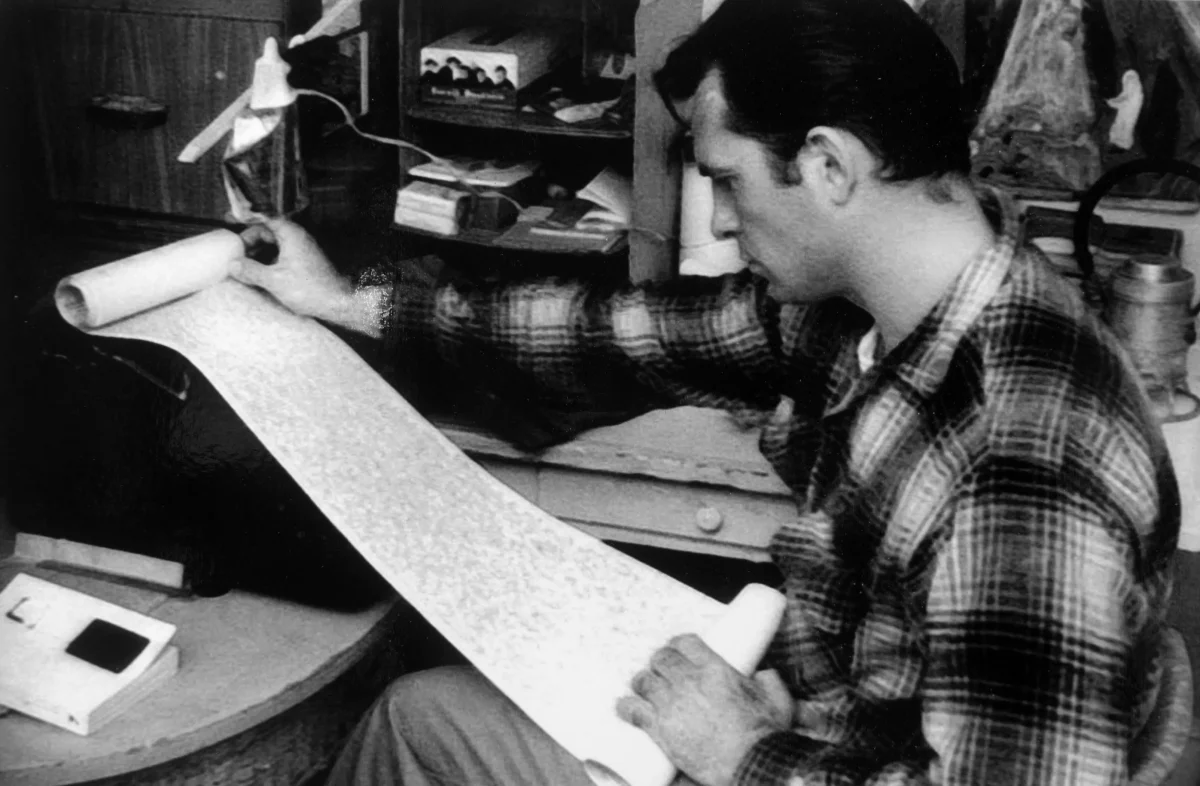
According to biographer Tom Clark, Kerouac attempted the first version of On the Road during an intense stretch in November 1948 in which he banged out 32,500 words — or 1,500 words each day — not long after submitting his first novel, The Town and the City, to various publishers. This early draft of what we know now as Road was rejected by Kerouac’s writing teachers at the New School. Our great sage of the streets felt a profound sense of emptiness after completing it. Much of this depression, however, could be attributed to the uncertain status of his first novel, which had champions in the form of Alfred Kazin and John Clellon Holmes. Kerouac was also solidifying a tight relationship with Allen Ginsberg, who served as muse and “agent” for this budding Beat and inevitable coeval. Like Bird and the other jazzmen he spun on his phonograph like otherworldly saucers, Kerouac careened his ear to the clarion call of the road that came from his good friend Neal Cassady, who was busy trying to lure him out to first Denver, then the Left Coast. The many road trips that followed from this Beat cute would later be mined for material in the subsequent versions of On the Road, which included an awkward stab in 1950 (later published posthumously as Pic) narrated by a young Black kid from the South named Pictorial Review Jackson. Sal Paradise, Kerouac’s alter ego, had not yet arrived front and center for this episodic story. For that, it would take three weeks of benzedrine in April 1951 with mild rain pattering against the pane and comfortably cool temperatures and a giant 120 foot scroll assembled from sheets of tracing paper and, of course, Jack’s fiendish hammering on the keys, taking to spontaneous syntax much like Lionel Hampton sliding up next to Buddy Rich in a smoky club.
Cassady, who would appear in On the Road as Dean Moriarty, gave Kerouac the vital inspiration to turn On the Road into freeform autofiction with the infamous “Joan Anderson letter,” received by Kerouac in December 1950 and later lost by Ginsberg before being rediscovered in an Oakland attic in 2014. And one does see the kernel of Kerouac’s phrasing in Cassady’s bebopping:
Over the prosperous supper on which was soon pounced hung an air of excitement. Joan and I were leaping with lovelooks across the roastbeef, while cabby and wife beamed on us. And we planned, yessir, all four of us, and right out loud too.
I must confess that, after reading Cassady’s letters, two Cassady biographies, and his flat stab at a novel (The First Third), I was not terribly impressed with Cassady. Through many reads of many versions of Road, I despised Dean Moriarty and his domestic violence and his terrible treatment of women. And I had to remember that this was fiction. Or was it? The most charitable reading of Cassady that I can summon is that he seems to be one of those types whom you would find more interesting in person rather than from his writing (or any of the hagiographies that have been written about him).
But Cassady, love him or hate him (and I certainly hate him), was the flint for Kerouac’s steel. So we regrettably cannot disinvite him from this most important fiesta. Comparing Cassady’s letters against On the Road offers us a fascinating exercise in seeing what phrases Kerouac plucked from Cassady.
From a July 3, 1949 letter to Kerouac from Cassady:
Carolyn quit her job and on June 1st I went to work for Goodyear as a mold man curing recapped tires. Very hard and hot work but I liked it. Now it seems I will lose my job Tuesday when I show up with my hand in a cast again. This leaves Goodyear in a hell of a hole, since there is no one to take my place. Of course Carolyn has found no other job so there is no income and, when the fifty bucks I’ve got is gone —
From On the Road:
I had to support Camille and Amy and had to work as fast as I could at Firestone as mold man, curing recapped tires and later hauling big hunnerd-fifty-pound tires from the floor to the top of the cars — could only use my good hand and kept banging the bad — broke it again, had it reset again, and it’s getting all infected and swoled again.
The only flashy turn that made its way to the printed page unchanged is “mold man, curing recapped tires.” Much like standup comics using the aristocrats joke as a rite of expressive passage, the Beats freely stole turns of phrase from each other, with Jack often sour about it even as he leaned heavy to plunder from Cassady. What’s interesting is how Kerouac has reframed this from a scenario in which Cassady is in financial despair and hoping that his wife Carolyn will pick up the slack to a factitious Dean Moriarty presented as an indefatigable working-class hero toiling through a broken hand (and later a sliced thumb) with a Max Weber work ethic because he “had to support Camille and Amy.” Kerouac’s rewrite, as macho as it is, is more effective storytelling and, with the repeat usage of “again,” demonstrates that Kerouac was easily the superior stylist and the superior writer between the two.
* * *
Not that Cassady was all that hard to top.
Many of the key Beats who met this strange Denver-based source of inspiration for Kerouac were not impressed. In Barry Gifford and Lawrence Lee’s Jack’s Book, Allan Temko called Neal Cassady “a terribly treacherous and untrustworthy and destructive person” and alluded to a “born hatred” between himself and Kerouac’s BFF. In On the Road, frankly I was far more fascinated by Kerouac’s depictions of Allen Ginsberg (Carlo Marx) and the Burroughses (William is Old Bull Lee, Joan Vollmer, sadly fated to be struck down years later in the famous William Tell accident, is Jane Lee) than anything that Dean Moriarty had to say.
Nevertheless, the letter’s confessional riffing, which includes quite a number of steamy conquests, together with Kerouac’s reread of Melville’s Pierre, gave Kerouac one of the two last vital ingredients he needed to alter the direction of American literature and unknowingly inspire many dissatisfied suburbanites to shift from office drones to countercultural vagabonds. Cassady, for all of his loutish thuggishness, is, as thoughtfully articulated by Ryan Bowen in 2012, Kerouac’s real world answer to Dostoevsky’s Prince Myshkin. To Kerouac’s mind, idiocy is a bulwark against an “enormous series of sins,” although even a Kerouac stan like me could not in good conscience compare Dean Moriarty against Falstaff or Sancho Panza (or, for that matter, Fear and Loathing in Las Vegas‘s Raoul Duke, who is far more of a destructive Tasmanian Devil than Dean Moriarty). The outlaw figure is certainly a uniquely ineluctable part of American life and culture. One need look no further than the Free Luigi sentiments that still endure two years after the assassination of UnitedHealthcare CEO Brian Thompson. With the graceless capitulation of Chuck Schumer and Hakeem Jeffries towards the greatest threat in American history, is it any wonder that we’re all looking for a new Jesse James? That outlaw to answer the ills of 2026 is clearly not Neal Cassady, although reading On the Road today does provide us with some ideas on how the sausage was made and how the collective appetite for a quasi-nihilist breakfast won’t wane anytime soon.
* * *
The other vital component that Kerouac picked up was “sketching,” an idea which came from his friend Ed White (immortalized in On the Road as Tim Gray and not to be confused with the late great writer) one evening in October 1951 when the two men wolfed down Chinese food at a 124th Street restaurant. “Just sketch in the street like a painter but with words,” said White. And that was precisely what Kerouac started to do, setting up shop in bus stops and slophouses and subway stations to capture the limitless hums and thrums of American life. (Visions of Cody — largely written in 1951 and 1952 and unpublished until 1972 — has several striking examples of this experimental “sketching” phase. Kerouac would crystallize his spontaneous prose approach further with the incredibly underrated volume, Desolation Angels, which I would rank among Kerouac’s best, right up there with Big Sur, The Subterraneans, and Visions of Cody.)
Eventually these many versions of On the Road came together in the accreted version we know today. Kerouac passed the scroll, now in a far more manageable 8 1/2 x 11″ format, along to his friends. In a May 18, 1952 letter to Allen Ginsberg, Kerouac wrote, “On the Road is inspired in its entirety….It is like Ulysses and should be treated with the same gravity.” Even the most egotistical author in the world would be hard-pressed not to cite that claim as a prime specimen of unearned gargantuan bluster.
By this point, Kerouac had toiled on the book so much that he was resistant to any editorial interference and was prepared to serve up Doctor Sax as a backup to publishers. Ginsberg read the manuscript and replied one month later with rapturous praise, but didn’t see how any publisher would scoop it up because of the sex and the insular Beat vernacular. Ginsberg parodied the latter:
You’re handing up the whole goddam junkyard including the I agh up erp esc baglooie ain’t you read what I’m shayinoo im tryinting tink try I mea mama gthatsshokay but you gotta make sense you gotta muk sense, jub, jack, fik, anyone can bup it, you bubblerel, Zag, Nealg, Loog, boolb, Joon, Hawk, Nella Grebsnig.
This rather funny pastiche failed to amuse the highly sensitive Kerouac. Fuse that thin skin with thick nips from the bottle and you’re looking at Jack’s fatal flaw: the sick alcoholic fever that felled him too young and that emboldened the man to be boorish.
Jack would answer, “Goddammit, I’m writing Real Lit!” And let’s face the facts. He was. And the cat fired back a vitriolic letter to Ginsberg on October 8, 1952, prepared to raise his fists should he run into the famed Beatnik again (“Beware of meeting me on the street in New York”).
Ginsberg’s epistolary response to Kerouac’s rage (which included a fantasy of Gregory Corso sticking a knife into Ginsberg) in early November 1952 is one of the most generous replies imaginable. One can see in this extraordinary letter (collected in an excellent volume edited by Bill Morgan and David Stanford) the same nimble diplomacy that Ginsberg used to calm down the Hells Angels years later in 1965. Ginsberg reassures Kerouac that he specializes in an “aural cadence” comparable to Joyce “without much damage to natural sequences of sentence construction.”
Can we swap out Jimmy Joyce with Jack? Two peas in a pod, my friends, though not without some modest moves spilling over. In fact, thanks to the scroll version of On the Road published in 2007 by Paul Slovak (years before he sent Tom Boyle and Bill Vollmann to other houses for the grave publishing crime of prolificity coupled with high paper costs, Slovak valiantly ensured that many Beat volumes were published under his watch at Viking), we may even be better able to track Jack’s progress than Jim’s:
The only people
that interestfor me are the mad ones, the ones who are mad to live, mad to talk, mad to be saved, desirous of everything at the same time, the onesthatwho never yawn or say a commonplace thing, but burn, burn, burn like fabulous yellow roman candles exploding like spiders across thenightstars.
The revisions here are minor but fascinating and really help us to understand how Kerouac worked his magic spell to capture something missing in America. Both the scroll and the published edition of On the Road already share a great deal of descriptive exuberance. In both versions, Kerouac notes that “the prettiest girls in the world live in Des Moines.” In both, the Nebraskan cowboy has “the greatest laugh in the world.” In both, it is suggested that Dean Moriarty (aka Neal Cassady) is “the greatest poet since Rimbaud.” In fact, the words “great” and “greatest” appear so frequently that it’s a wonder that the Kerouac estate hasn’t sued Donald Trump for stealing Kerouac’s light hyperbolic riffs on patriotic self-adulation. (It’s also worth pointing out that W.C. Fields, one of the biggest personalities in American history, is frequently trotted out in Road as a comparative yardstick. Groucho Marx is a close second.)
But what’s interesting is that Kerouac needed more exuberance in his edits. “Roman candles” is augmented with “fabulous yellow.” The added “exploding like spiders” and “stars” replace the flatness of “night.” These edits turn On the Road into something that is both a quasi-fabulist portrait of America in the late 1940s, but with language that is direct and accessible to the common reader. (Kerouac also seems to have picked up some of Joyce’s wordplay in Finnegans Wake, when he coins a phrase from a deliberate malapropism. One such phrase (“fraught with eminent peril”) is falsely attributed to W.C. Fields, with “eminent” instead of “imminent.” He also describes the California Central Valley as having “palmy air” instead of “balmy air.” This is a fascinating method of aligning the book’s tone with the working stiff while simultaneously busting out a bit of badinage. Somewhat related to this is the way in which Joyce and Kerouac were equally fastidious in memorializing just how much money their characters had in their pockets at all times. In Kerouac’s case, it’s food too. What true Kerouac fan can forget the coruscating poetic meter of “ten sandwiches to cross the country on” after the adventure with Terry in Los Angeles?)
What other literary influences did Kerouac draw upon for these interesting stylistic flexes? Fortunately, the man produced so many words during his all-too-brief forty-seven years that we have an answer for this as well:
The first “serious” writing took place after I read about Jack London at the age of 17. Like Jack, I began to paste up “long words” on my bedroom wall in order to memorize them perfectly. At 18 I read Hemingway and Saroyan and began writing little terse short stories in that general style. Then I read [Thomas] Wolfe and began writing in the rolling style. Then I read Joyce and wrote a whole juvenile novel like “Ulysses” called “Vanity of Duluoz.” Then came Dostoevsky. Finally I entered a romantic phase with Rimbaud and Blake which I called my “self-ultimacy” period, burning what I wrote to be “Self-ultimate.” — from Jack Kerouac’s letter to Donald Allen, October 1, 1959
Gerald Nicosia’s massive Kerouac biography, Memory Babe, uncovers a great deal more. Nicosia notes that the use of “bo” for hobo, “Chi” for Chicago, and “yare” for yes all emerge from Jack London and John Dos Passos. There’s also a loving nod to London’s The Cruise of the Snark with the pool shark Tommy Snark.
One thing that’s not so apparent in any cursory plunge into Kerouac is understanding just how gentle he is. While gentle masculinity has thankfully become more welcome as a bulwark against its more toxic cousin in the 21st century, Kerouac was unfortunately determined to present himself (and, even worse, Cassady) as a domineering ladies man. His alter ego Sal Paradise is a loutish bum constantly looking for a lay. (Recall, however, that this is a novel, not an autobiography. This is a common mistake made by certain illiterate louts. The biographies that do exist, even from Kerouac’s lovers, reveal a vast disparity between the real and the fictional when it came to the truth of how often Jack got lucky.)
On the Road truly began to sing for me when Sal meets Terry and the camaraderie Sal finds among Terry’s rowdy family and the quiet dollar and a half Sal collects each day picking cotton, followed by his bicycle trip for groceries. Suddenly, the experience became sublime and dreamy because Kerouac let down his guard during this section (which incidentally was also one of the major chunks of the book that secured Kerouac a publishing deal). He is proud to be “a man of the earth,” but there’s something sweetly endearing in the way he naively confesses, “What kind of old man was I that couldn’t support his own ass, let alone theirs?” It was this charming passage of humility that made me begin to forgive Sal Paradise’s bravado, even some of the vaguely cornball longueurs and his loafing, because Sal Paradise is doing the best he can. And because he lavishes such praise on every hard-won meal (“the greatest meal I ever had”), Kerouac avoids fully succumbing to the cheap male swagger that lesser writers would settle for. And his everyman odyssey turns into something that becomes a legitimately holy pilgrimage.
On the Road foreshadows the no-big-deal spiritualism of The Dharma Bums and Desolation Angels by beautifully fusing Kerouac’s adventures with an infectious gratitude. This attitude was certainly in the air among hobos and freight hoppers after the Great Depression, but, aside from the likes of John Steinbeck (who is given a callback when Sal Paradise impresses a girl with an impression of Burgess Meredith in Of Mice and Men and who would, of course, offer his Road-like response with Travels with Charley), this mix of grit and gratefulness had never been memorialized in literature quite like this. As such, a strong case can be made that On the Road undoubtedly influenced all the wandering countercultural movements that emerged during the 1960s, which were predicated on a similar naivete and resourcefulness that sadly, in our age of AI resume crunching, rising prices, and evil Flock cameras, will never materialize in America anytime soon (although one does see elements of this on TikTok among young couples purchasing vans, cooking dinner on modified hot plates, and driving around the nation while toiling at facile remote jobs for gas money).
* * *
Not long after its publication, On the Road became a commercial success, helped in large part by Gilbert Millstein’s rave review in The New York Times: “the most beautifully executed, the clearest and the most important utterance yet made by the generation Kerouac himself named years ago as ‘beat,’ and whose principal avatar he is.” On the early morning of September 5, 1957, Kerouac was staying with his then-girlfriend Joyce Glassman (later Johnson). The two bought a copy of the Times at a newsstand just after the stroke of midnight and then headed to Donnelly’s Irish Bar (my research indicates that Donnelly’s was a dependable dive located somewhere between 72nd and 86th Streets, with cheap food and, at one point in the early 20th century, a live orchestra, though curiously unmemorialized on the Internet and undoubtedly fated to be lost to time), where they pored over this review and returned to Joyce’s apartment. As Glassman noted in Minor Characters:
Jack kept shaking his head. He didn’t look happy exactly, but strangely puzzled, as if he couldn’t figure out why he wasn’t happier than he was. We returned to the apartment to go back to sleep. Jack lay down obscure for the last time in his life. The ringing phone woke him the next morning and he was famous.
But other critics were not as effusive, including the seemingly Beat-friendly and alleged avant-garde champion Kenneth Rexroth, who would spend the next few years trashing Kerouac’s prose in various newspapers. John Updike also parodied Kerouac in a decidedly unloving manner in the February 14, 1959 issue of The New Yorker. There was also Norman Podhoretz’s infamous driveby, “The Know-Nothing Bohemians,” in The Partisan Review. This crankypants critic resorted to the hack’s old sawhorse of selective quoting and misrepresentation, declaring Kerouac a degenerate for depicting sex and teenage violence:
The plain truth is that the primitivism of the Beat Generation serves first of all as a cover for an anti-intellectualism so bitter that it makes the ordinary American’s hatred of eggheads seem positively benign.
Never mind that Kerouac himself was a formidable reader, wolfing down every writer from Proust to Spengler and that he blasted Bach and Handel from his record player as frequently as Charlie Parker. (In his book Exit Right, Daniel Oppenheimer has a great overview of Podhoretz’s clash with Allen Ginsberg. Additionally, I am obliged to recommend Dennis McNally’s Desolate Angel as a cogent overview juxtaposing Kerouac’s life against 1950s and 1960s America.)
There was also Truman Capote’s infamous smack talk on the January 18, 1959 edition of David Susskind’s Open End, where he whimpered, “That’s not writing; that’s typewriting.” (Sadly, there isn’t a copy or an audio transcript of this episode available for review — believe me, I have looked! Some scholars have reported Capote’s quote as “typing,” but I am deferring to Leonard Lyons’s column as the final authority here.) This was undoubtedly driven by jealousy — for Capote’s talent as a hot young thing was then on the wane. And he was still seven years away from proving his staying power with In Cold Blood. Capote, arguably more of a self-destructive alcoholic than Kerouac, was likely umbraged by Kerouac’s ability to write evocative “creative nonfiction” while going on nightly benders — a “skill” that he famously lacked, given the long “gestation period” of the decidedly spotty Answered Prayers. (The Capote/Kerouac connection can also be seen in the way that Hollywood used the same bland leading man, George Peppard, to bolster the film adaptations of Breakfast at Tiffany’s and The Subterraneans.)
But this checkered critical reception did not present much of a blockade to On the Road‘s steaming success. Despite spending his pre-On the Road days seeking validation for his writing talent from Ginsberg, Burroughs, and countless others, he was utterly baffled as to why the public went wild over this particular volume. “I can’t stand to meet anyone anymore,” wrote Kerouac to John Clellon Holmes. “They talk to me like I wasn’t me.” During the course of my arduous Kerouac research, I learned that he had combed through The Decline of the West to find historical precedent for Kerouacmania. This explains in part why Kerouac, in a 1958 interview with Mike Wallace, invoked Spengler to explain why Beats were new mystics. I had thought for years that Kerouac was simply being ridiculously pretentious, but I now understand that he was genuinely puzzled by all of the media attention he received and he was, like many introverted authors placed uncomfortably in the hot seat, trying to accommodate interviewers who harangued him for deeper meaning.
Unfortunately, there was also a nasty side to Kerouac’s writing.
* * *
Nostalgia, personal experience — these things become meaningful in terms of calculating the badness of the act against the greatness of the work. Greatness isn’t something that is simply agreed upon by authority — as we’ve seen, that authority too often runs contra to the interests or the experiences or simply the aesthetic tastes of too many people. What makes great art depends on who we are and what we live through. It depends on our feelings. — Clare Dederer, Monsters: A Fan’s Dilemma
Not for Joyce Glassman to read, this bleak passage later written in Desolation Angels, this awful metaphysical linking of sex, birth, the grave. I hate Jack’s women-hatred, hate it, mourn it, understand, and finally forgive. — Joyce Johnson, Minor Characters
Kerouac has been rightly criticized for his decidedly regressive and misogynistic depiction of women — particularly Marylou, who is little more than
a pretty blonde with immense ringlets of hair like a sea of golden tresses; she sat there on the edge of the couch with her hands hanging in her lap and her smoky blue country eyes fixed in a wide stare because she was in an evil gray New York pad that she’d heard about back West, and waiting like a longbodied emaciated Modigliani surrealist woman in a serious room. But, outside of being a sweet little girl, she was awfully dumb and capable of doing horrible things
This sounds not unlike Tarantino’s vile and silent depiction of Sharon Tate (played by Margot Robbie) in Once Upon a Time in Hollywood. It is indeed one of the great disappointments for anyone delving through the canon to be regularly reminded that vastly talented men think so little of the inner lives of women.
As a left-leaning humanist who champions gender parity (a reasonable ideal that is sadly not upheld by this male-heavy Modern Library list!), I find myself locked in the conundrum cogently unpacked by Dederer . My feelings and aesthetic sensibilities instinctively tell me that Jack Kerouac is absolutely my kind of writer. I love his style, his commitment to American adventure, and I marvel at his tidy position as an intermediary between Jack London and William T. Vollmann as a humane hitchhiking outlaw gravid with love and exuberance. But should I look, as Dederer has suggested, for a mirror of the quasi-monster I could be now in loving the work? What’s the troubling B-side — the embarrassing cut I want to leave off my greatest hits collection — when I consider my great and singular passion for Jack Kerouac? I mean, I read this passage in Carolyn Cassady’s Heart Beat and became very angry over this despicably patriarchal division of labor:
While I performed my household duties the men would read each other excerpts from their writing in progress or bring out Spengler, Proust or Shakespeare to read aloud, accompanied by energetic discussions and appraisals….I was happy just listening to them and filling their coffee cups. Yet I’d never felt left out. They’d address remarks in me and include me in the group with smiles, pats and requests for opinions or to moderate an argument.
There is also a completely ridiculous section in Visions of Cody in which Kerouac devotes more than two pages describing the breasts of “famous Hollywood actress” Ruth Maytime in which I felt a strong desire to douse Kerouac and Cassady with a fire hose of gelid water.
The closest Kerouac comes to self-awareness on this point (though I wince at the proprietary “our”) is when he has Sal Paradise say, “The truth of the matter is we don’t understand our women, we blame on them and it’s all our fault.” But is that really enough?
* * *
Over the course of this years-long project, I’ve come down hard on Ford Madox Ford and E.L. Doctorow for their far from enlightened views of women. Certainly, the simplistic madonna-whore taxonomy with which Kerouac views women causes me significant chagrin, as does Kerouac’s cruel dismissal of Marilyn Monroe, to say nothing of the many toxic passages (disconsolately juxtaposed against some of Kerouac’s most beautiful prose) in Visions of Cody; a small sample:
My vision of men enslaved to cunts, to women who at or near thirty become lost in a dream of maternity as men die in the night with slavering thirst for the eternal food, the inexpressible security of a conscious caress (or dreamy unconscious)
In a drunken rage during a downtick in interest from publishers, he did call Carolyn Cassady “Lady Cunt” in three letters. There is also the sexist manner in which Kerouac expected his second wife Joan to serve as a full-time job holder and homemaker, while Jack himself committed himself to do-nothing languor, and all this is not helped by the unsavory manner in which they had ended up together. Joan had dated Bill Cannastra, who died in a freak accident after sticking his head out of a subway window. (If you were a “Joan and Bill” couple in the Beat circle, your mortality rate apparently increased by a factor of ten million.) In one of the most influential decapitations in literary history, Cannastra’s noggin rolled like a pineapple onto the spiderweb of tracks beneath Manhattan, leaving a vacant West 21st pad occupied by none other than the twenty-year-old Joan, whom Kerouac promptly married weeks after seducing her in her aggrieved state. One evening, Joan came home from work and Jack demanded that she bake a spice cake for him. She refused. And according to Gerald Nicosia, perhaps the most detailed and sordid of Kerouac’s biographers, Kerouac snapped at Joan with an Oedipal subconscious revelation, “You should never deny your son anything!” Nicosia also alleges some behavior to Kerouac that might cause a particularly vicious critic to coin a “Jackie CK” sobriquet:
Still unwilling to admit that excessive drinking caused his sexual dysfunction, he decided that the problem was his small penis. He developed a morbid fear of people ridiculing his genitals, and as a concomitant began exposing himself all over New York — trying to bring his worst fears to pass, perhaps, to see just how real they were.
Among the luminaries who may have seen Kerouac’s schlong without consent? Paul Bowles, Robert Frank, and Mary Frank. And then there is the increasing loutish behavior in his sad final years. This included being expelled by Lee Krasner (she would know, given that she was married to Jackson Pollock, another prominent alcoholic artist of the time) and 86ed from many of his favorite bars.
How does this all fare in the annals of progressive enlightenment? To quote Pete Campbell from Mad Men, “Not great, Bob!” In her remarkably generous biography, The Voice is All, former Kerouac flame Joyce Johnson (on and off with Jack from 1957 to 1959) had this to say:
He had been culturally conditioned to view women in a very limited way — either as alluring and dangerous sirens or as elemental maternal figures. For true companionship, he would turn to men, always pleasantly surprised yet wary of commitment when he met women who offered him more than his stereotypes.
While Kerouac obviously possessed enough perspicacity and volition to view women in more enlightened terms (and opted not to), Kerouac was nonetheless ahead of his time in accepting marginalized groups. Victor Wong — perhaps best known for his charming role in John Carpenter’s Big Trouble in Little China — was memorialized in Big Sur and remarked in a June 1978 interview with Nicosia that Kerouac was the first white man to show him “utter acceptance as a human person.” In a February 8, 1952 letter to John Clellon Holmes, Kerouac writes happily of meeting Billie Holiday in a 52nd Street club while holding her dog in this arms. And Kerouac was heterofluid enough to engage in a tryst with Gore Vidal at the Chelsea Hotel — documented in Vidal’s Palimpsest and Kerouac’s The Subterraneans.
What we have here, in balancing Kerouac’s talent against his sins, is a game comparable to Russell Kane’s wonderful BBC Radio 4 show, Evil Genius, in which three comedians have to determine whether a historical figure is evil or genius. JK Rowling? Evil. Neil Gaiman? Evil. Norman Mailer, who I’ll be dealing with later? Evil. But my vote for Kerouac is genius. There are gradations with this question and I don’t think Kerouac qualifies when you consider the time period. Cancel me if you need to. I’m too old to care at this point. Kerouac was both an alcoholic and had an extremely thin skin. This doesn’t excuse his nastier and less enlightened behavior, but it does at least give us some context for why a man frequently described by his peers as “gentle” and “soft-spoken” could turn into such a solipsistic monster, particularly when he was tight and hammered on hard liquor.
* * *
Picking up a few volumes of Diane di Prima, Joyce Johnson, and Hettie Jones is probably the best way to cantilever the onerous load of Kerouac’s sexism. One should be very aware of the Beat impact on rock and roll — what with the Smiths writing “Pretty Girls Make Graves” (a phrase taken from The Dharma Bums) in 1984 and a rocking band from Seattle later taking these four words as their name, along with Ginsberg collaborating with The Clash in 1982 on “Ghetto Defendant.” Joy Press and Simon Reynolds’s The Sex Revolts thoughtfully charts many of the misogynistic and homoerotic undercurrents spilling onto punk, heavy guitars, garage rock, metal, and New Wave that emerged in part from the Beats. I’ve mentioned his influence on John Steinbeck and Hunter S. Thompson. And, as Aaron Latham argued in The New York Times Book Review in 1973, there is a great deal more circular influence than most people are willing to admit:
the second Tom Wolfe, the one who wrote “The Electric Kool-Aid Acid Test,” would seem to have learned a lot from Jack Kerouac. If there had been no “On the Road,” then there might have been no “Acid Test.” The bus trip described by Tom Wolfe in his best book was modeled on Kerouac’s trips. The book was even driven by the same man who drove Kerouac: Neal Cassady. Cassady guided the bus and Kerouac seemingly guided Wolfe.
We are dealing then with a frequently brilliant and remarkably alcoholic writer (though anyone attempting to be a Kerouac completist would be best off skipping The Town and the City; an overlong and belabored young man’s hot mess of a debut novel) who had a relationship with his heavily controlling mother that was as alarming as that of Cornell Woolrich’s. When Dody Muller came into Kerouac’s love life in 1958, she would remark upon the fights between Jack and Memere being akin to a “lover’s quarrel.” Indeed, Kerouac was so blinkered by his mother that he even allowed her anti-Semitism to bristle like some toxic peacock and stood silent as she banned his close friend Ginsberg from visiting their home. (Unsurprisingly, the correspondence between these two Beat VIPs fell off drastically in Kerouac’s final decade, although the two men strongly respected each other to the end.)
It’s also easy to forget that Kerouac’s revolutionary voice did inspire women as much as men. In an essay contained within Sixties Without Apology, the poet Marilyn Coffey wrote:
I didn’t understand half what I was reading, but something of the life being described was comprehensive to me, foreign as it was to the young woman who’d been born and bred in the conservative Midwest…The words shot through me like a fusillade of bullets. I was undone, a changed person. I bought myself a straw-covered bottle of Chianti, a candle, and a pad of paper…began to write by candlelight, scribbling words onto paper as fast as my hand could compose, following instinctively Kerouac’s model of Spontaneous Prose.
Additionally, in The Holy Barbarians, journalist Lawrence Lipton (father of James) interviewed many women in Venice Beach during the 1950s. (I was particularly charmed by Sherry McCall, a Beatnik who was into constant knitting and who represented a missing link between World War II and the 1960s counterculture.)
* * *
I spent the first twenty-five years of my life living in the 20th century (and am thus a member of what I have long referred to as “the last analog generation,” meaning that I am the last of the graying Gen Xers who remembers life before the Internet — in which you delighted over the organic bells and whistles of pinball machines (before they were replaced by the equally thrilling crunches of PSG softsynth waveforms), the smell of mimeograph, people smoking cigarettes in restaurants, the long lines in banks on a Friday afternoon for weekend warriors in the days before ATMs and ubiquitous credit cards, and the far more robust middle class (which ensured that more people could afford to buy homes). I’m willing to accept that I may be among the last people to truly appreciate Kerouac’s determination to capture all of mid-20th century American life on a vast and moving literary canvas that he called the Duluoz Legend. It was rather fitting when I discovered that a similarly neglected genius from that era — the radio pioneer Jean Shepherd, who is best known for A Christmas Story — devoted his entire show to Kerouac on the sad day of his far too early passing.
Kerouac is so tricky to appreciate in full that I truly don’t know if Zoomers and millennials can really love him — in large part because the world and the American canvas is now much different than it was in the late 1940s. There was a time perhaps twenty years ago in which critics like Meghan O’Rourke could admire the beauty of his prose (O’Rourke shrewdly observes the anxiety and constraint within Kerouac) while also rightly bemoaning the disposability of Kerouac’s women. But in the late 2020s — an age in which ugly and blunt and libelous social media missives and rage bait masquerading as “think pieces” seems to have won the war against nuanced consideration — Jack Kerouac has acquired the kind of dudebro stigma now attached to writers like David Foster Wallace (who lived only one year shorter than Kerouac’s forty-seven years), Norman Mailer, and Karl Ove Knausgaard. Salon‘s David J. Krajicek called Kerouac “the prototype of the mid-century modern misogynist.” The Link‘s Monica Matin outright calls Kerouac a “terrible author” without quoting a passage and takes unadventurous reactionary umbrage against “directionless people seeking authenticity in poverty and entertaining brief periods of unemployment to ‘find themselves.'” The Guardian‘s Lynnette Lounsbury is more levelheaded, pointing to her early love for the Beats, and does rightfully note that the Beat women are usually “outsiders in offside compendiums, as afterthoughts and even instigators, but rarely as the orchestrators and creators of their own place in literature.”
And while I have tried to be fair in noting his regressive views on women, I can’t deny that I love him as a writer. There’s an electric energy I feel when reading Kerouac at his best. He is absolutely brilliant at pinpointing the marriage dynamic between William Burroughs and Joan Vollmer. In On the Road, he offers one of the best descriptions I’ve ever read of the Mississippi River (which I saw for the first time during a trip years ago to New Orleans, the same vantage point as Kerouac):
On rails we leaned and looked at the great brown father of waters rolling down from mid-America like the torrent of broken souls — bearing Montana logs and Dakota muds and Iowa vales and things that had drowned in Three Forks, where the secret began in ice.
And then later, upon leaving Algiers, the river is
a washed clod in the rainy night, a soft plopping from drooping Missouri banks, a dissolving, a riding of the tide down the eternal waterbed, a contribution to brown foams, a voyaging past endless vales and trees and levees, down along, down along, by Memphis, Greenville, Eudora, Vicksburg, Natchez, Port Allen, and Port Orleans and Port of the Deltas, by Potash, Venice, and the Night’s Great Gulf, and out.
This transition from romantic imagery to a blunt distillation of the Father of Waters as a muddy conduit through waystations is all beautiful stuff.
* * *
Even so, had Kerouac lived beyond 1969, it’s quite likely he would have hardened into a sour reactionary. He was sadly on his way there. His final published essay, “After Me, the Deluge,” with its bitter denouncement of hippie culture, suggests a disappointing late life track akin to Jerry Rubin or Eldridge Cleaver. (Perhaps this was inevitable among the Beats. Recall how even William S. Burroughs couldn’t resist the Nike money when the Madison Avenue people came knocking. And Ginsberg himself was accused of selling out when he sold his archives to Stanford for a cool million in 1994.) Like any rock star who dies young, one has to accept the morbid truth that Kerouac likely would have turned into some pale corporate shadow of his former self.
But will his work endure? Maybe. A thirty-year-old friend of mine decided to pick up Big Sur after seeing me rave about it on TikTok. Then again, maybe not. There are still plenty of calcified critics who are calling On the Road “surprisingly monotonous” and even “hopelessly romantic.” Still, Kerouac shows no immediate signs of being deracinated from American literary history. And there is still money to be made even in this increasingly grim economy. The scroll itself sold for $12 million earlier this year. So maybe there’s some hope that the great Duluoz lighthouse will cast a fine shining beam into the vast sea of lonely literary fisherman, those feverish readers like me who trawl along deeper waters than the rest and who realize that some of the old radio waves that began eight decades before can still inspire a few new and unheard frequencies. No matter how many data centers and strip malls they build, no matter how many venerable mom-and-pop shops are eviscerated by the far from invisible hand of late stage capitalism, there will still be the cry and call of the open road. And even in the blackest of nights, you’ll still see the pinpricks of starry eyes looming large, yearning for more, hungering for something beyond the routine and the familiar. For a certain hearty adventuring type, the clarion call of reaching beyond the same several dozen blocks traversed each day between home and work and the humility of knowing and loving unfamiliar ways of living will be as irresistible and as essential as oxygen itself. Kerouac and his inspiring words remains one of the big reasons why.
Next Up: William Faulkner’s Light in August!
© 2026, Edward Champion. All rights reserved.