Posts by Edward Champion

Edward Champion is the Managing Editor of Reluctant Habits.

Music Moves the Savage Text

While it is quite true that Continuum Books publishes an abnormally large collection of titles on Pope Benedict XVI (aka Joseph “Harry Potter is Satan’s Spawn But Adolf Was Okay When I Was a Kid” Ratzinger), I’d be remiss if I didn’t mention their 33 1/3 series. If you thought that Nick Hornby’s solipsistic (and, one might argue, somnabulistic) Songbook was the high watermark of literary musical musings, then you ain’t seen nothin’ yet. The work here is as passionate as Hornby’s, but it cuts across a more nuanced latitude: something that goes beyond Pitchfork-style snark or a particularly plodding personal essay about how an individual song or album is meaningful to the writer.

Depending upon the writer and the level of scholarship (others might say obsession, but then music lovers are often as febrile as literature lovers), the contributors here go out of their way to put songs and albums into a larger context, with telling details of David Bowie’s coke-fueled paranoia during the Low sessions or framing Neutral Milk Hotel’s In the Aeroplane Over the Sea within the larger context of the highly influential Elephant 6 collective.

Continuum was kind enough to send me a sampler. And one has to marvel at how even within this modest collection (surely not intended for me to peruse like this), innocuous deconstruction turns into something a little more cheeky and meaningful in the process. Here’s Geoffrey Himes, for example, writing about Bruce Springsteen’s “Born in the USA”:

“Born in the USA”: the phrase was so pithy and evocative that all he had to do was repeat it four times and he had his chorus. In its ability to sound like both a sentence of doom and a hopeful declaration of optimism, it was infinitely better than “You died in Vietnam.” But the song’s music ws still wrong; the verses were still too wordy, and the story didn’t quite cohere.

And Himes is just getting started. Only a few pages later, he’s enunciated the song’s narrative and meaning, put it into the context of Springsteen’s career, and dwelled upon its almost serendipitious recording history. (Jon Landau dismissed the demo as one of Springsteen’s “lesser songs” and when the E Street Band got together, the song was more improvised than one would suspect.)

Other books in the series include Andy Miller riffing on the great underrated Kinks album, The Village Green Preservation Society, Allan Moore on Aqualung, John Cavanagh on Pink Floyd’s The Piper at the Gates of Dawn, Ben Sisario on the Pixies’ Doolittle and a book of interviews with DJ Shadow on Endtroducing.

And speaking of music, I should also note that I was recently sucked in by Michael Nesmith’s Elephant Parts, a 1981 direct-to-video compilation of Nesmith videos and comedy sketches — including a game-show spoof called “Name That Drug” and a foreign film scene performed in gibberish (with subtitles to boot). I’ve no idea how this endearing little film fell off the cultural radar. Elephant Parts, produced roughly around the same period that Nesmith was sowing the early seeds for MTV (for better or for worse), is one of those rare offerings that is simultaneously subversive and innocuous.
Bay Area Writers Group Forming

Like damn near every litblogger, we too have a novel that we’ve been working on that is progressing at a slow but steady clip. (Yes, we never sleep around here.) While we’re loath to announce anything that isn’t particularly finished*, the whole point of this post is to seek fairly serious (serious about the art, but not humorless!) writers based in the Bay Area for a fiction writers group that is being put together right now with a few other nice and passionate people.

We hope that this group will be brutally honest, but encouraging. Ideally, candidates should have steady bullshit detectors, a working knowledge of literature (meaning you read at least a book every two weeks and know what omniscient voice is), and passion to boot. Good grammar and basic storytelling skills are musts.

We should point out that this will be the first writers group we’ve been involved with in a while. Our last foray into the writers group world proved catastrophic, with nearly all of the short stories being written in second person and one unnamed person going in detail about all the coke she sent up her nose the previous night. This person then explained to us in great detail about the drug-related debauchery she was planning on engaging in that very night and responded to our story with the observation “Cool, I guess, but what’s a panegyric?” She failed to elaborate beyond this.

We should point out that all this was many years after the publication of Bright Lights, Big City.

We later came home and sobbed over how we were seduced by this seemingly credentialed coterie (a few were MFAs) and how this (again unnamed!) writers group took us in for saps.

But we have faith in this new writers group. These people are on the level. So if you’re interested, do drop us a line. Email address is to the right.

* — To wit, the novel is so loosey-goosey and unhoned right now that one character has been temporarily named “Bill Dungsroman.” Hardy har har!

Future Scholars Will Infer Meaning from Dubya’s Crude Doodles

If you’ve ever wanted to know how presidential libraries operate, now’s your chance. According to Dr. Jay Hawkes, presidential libraries are “some of the most important and unique libraries in the country.” The tradition began with FDR, who donated all of his personal and presidential papers to the federal government in 1939. In 1955, Congress passed the Presidential Libraries Act, establishing a system of libraries. And the Presidential Records Act of 1978 deemed all presidential records the property of the federal government. (via Rare Books News)

The Interwining Legacy of Things That Inexplicably Scare the Bejesus Out of You and Fiction

Written just after the author stepped into rush hour traffic and before he dared to look out of his own window before returning to his computer, Ian McEwan’s novel “Saturday” creates a hero who dares to live out a privileged lifestyle and worriedly thinks about his investment portfolio. It is fear, directed towards the expected and the humdrum and the implausible, that drives Mr. McEwan’s masterpiece. Today this fiction may seem as prophetic as Elizabeth Kostova’s “The Historian,” which features a palpable portrait of vampires tapping into victims while on the run. But both authors agree that today’s fiction is designed to present things that will scare the bejesus out of you, with ordinarily stable minds rushing to FOX News and conspiracy-themed newsletters in search of further things to be frightened about.

“We can never have enough things to be frightened about. I myself am terrified of half-cooked foie gras,” Mr. McEwan wrote in an Op-Ed piece just after enjoying a six-course meal on the very day of the London subway and bus bombings. (His article appeared simultaneously in Gourmet and Ladies’ Home Journal.) That same day Ms. Kostova wrote on her Web site, “The bombings sadden me. But, on the bright side, sales should boost up as people look for more things to be afraid of.”

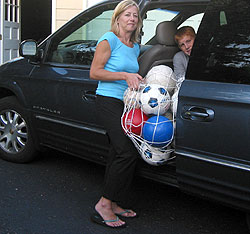
soccer mom'With such inevitability and the persistent strain of soccer moms fearing that the terrorists could firebomb the small-town high school fields they regularly frequent at any second, some of the most ambitious novelists are not only addressing this climate of fear but going a bit hogwild in their depictions, leaving a legacy that is not only quite silly but good for drawing half-baked generalizations that can be referenced while engaged in pretentious cocktail party banter. This is what Mr. McEwan calls “the complacent stage,” a needlessly introspective and self-absorbed novel just after a big success (in this case, the remarkable “Atonement”). It would appear that this complacence is shared by Michael Cunningham’s “Specimen Days,” which is also considered a critical disappointment. Cunningham’s most recent novel offers Walt Whitman’s poems as the cure-all elixir. Have a drinking problem? Read “When Lilacs Last in the Dooryard Bloomed.” Feeling depressed (perhaps suicidal?) because your local Whole Foods Market decided to close early and you couldn’t get cheese made with coagulating enzymes? “O Captain! My Captain!” is right around the corner.

The important thing these days is for novels to reflect an almost pathological neurosis that only the richest 10% of our society can understand. This will then, in turn, perpetuate irrationally conceived fears in literature which detract from more pressing dilemmas.