BBC: “David Tennant is ‘committed’ to Doctor Who, the BBC insists, despite a report that he is leaving the sci-fi drama. The Sun claimed the actor, 35, planned to depart next year, in the middle of the fourth series of the hit programme. But he was currently filming the third series, a BBC spokeswoman said, adding that any episodes beyond that had yet to receive the go-ahead.”
Author / Edward Champion

Goodbye Afternoon
The Top Ten Video Moments from 2006, although it seems a major oversight not to include this one.
The Slate Audio Book Club Strikes Again!
2006 wouldn’t be complete without another inept appearance from those dimwitted trendsetters at the Slate Audio Book Club! When last we checked in with the gang, they had moved on from racist generalizations and had declared Michael Pollan’s investigations into how food is prepared and distributed as “yuppie fussiness.” Not to be outdone, these infamous Three Amigos look into Claire Messud’s The Emperor’s Children.
Meghan O’Rourke is sometimes a good critic and the smartest of the bunch (although being smarter than Roiphe and Metcalf is as seminal an achievement as knowing how to speak Pig Latin). But she sounds bored here, unable to muster up a single shred of enthusiasm, which is odd given her enthusiasm for the book in the NYTBR. It’s as if she just emerged from a day of watching Antonioni’s L’Avventura on an endless loop to impress a few friends. She introduces Stephen Metcalf and Katie “Pipsqueak Ph.D.” Roiphe. She offers a plot summary that makes Messud’s splendid novel no fun at all, a noticeable huff in her voice representing one of two possibilities: either she has to spend another hour suffering generalizations from these two assclowns or she’s going to kill multimedia editor Andy Bowers for setting her up with this gig in the first place.
“We’ll get more into the plot because it’s somewhat ornate and elaborate,” huffs O’Rourke.
Did O’Rourke and I read the same book? If by “ornate and elaborate,” you mean a novel that features more than three characters, then I suppose O’Rourke has a point. Perhaps the assumption here made by the Book Club members (and Bowers) is that those listening in to this podcast have an attention span shorter than Warwick Davis. But if she genuinely believes that Messud’s book features a plot that’s difficult to follow, then perhaps she should be leading her fellow Book Club members into a discussion of Jacqueline Sussan’s oeuvre instead of Messud.
Katie Roiphe is the first to chirp in, remarking that the book is just great. Golly! Because first and foremost it’s a page-turner (again, Sussan sounds more her speed) and that Messud has “higher literary aspirations.” And you know, like, maybe there might be “some element of the kind of 19th century novel,” but, like totally, I can’t figure out what it might be. Could it be a novel of manners? That’s what Meghan said. Yeah! That’s 19th century novel, isn’t it? Maybe I can get to Malibu by day’s end and catch some waves.
But here’s Roiphe’s most profound observation: “It does go into their lives in a way that’s deeper than the kind of usual coming-of-age book, which this sort of falls into roughly into the category of.”
Metcalf then emerges into this folderol, offering the smug pronouncement that he found the early portions of the book better than the latter portions. “We can get into why later.” This is the kind of sentence you hear from someone who wants you to believe he knows what he’s talking about, but who hasn’t really thought out his argument.
Falling naturally into the role of smug parvenu, Metcalf then pronounces, “When I liked it most, I was thinking of Edith Wharton. When I liked it less, well, I was thinking of Zadie Smith’s last book. When I liked it least, I was thinking of David Lodge. And I think it oscillates between those three.”
Fantastic, Stephen. Not a single example elucidating why. Just generalizations as usual with random authors tossed around like throw rugs in a bathroom. It says something about Metcalf’s humorlessness that he thinks so little of David Lodge. But then The Emperor’s Children is neither an academic satire nor a sex comedy. Did this guy even read the damn book? Or was this one of those situations where Metcalf read the book the night before with his mouth permanently affixed to a bottle of bourbon?
Amazingly, Roiphe is at least capable of parsing the Anglicized vernacular within the book. (Metcalf finds this a distraction.) But alas, she sees this as a flaw, apparently unfamiliar with the Anglicized bloviators who can be overheard during any three-block walk through Chelsea or the Marina. Alas, Roiphe is more content to flap her maw rather than actually listen or stop to think.
Close to the four minute mark, I had had quite enough of this, particularly when Katie name-checked her dear mama.
The Slate Audio Book Club is a very good idea. But the only way for it to be meaningful is to up the intellectual bar, have the show’s participants offer some kind of enthusiasm, and pair Meghan O’Rourke up with two people who know what the hell they’re talking about.
BSS #87: Simon Winchester
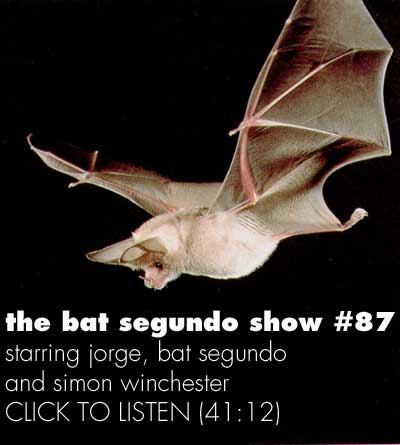
Condition of Mr. Segundo: Ready to drink geologists under the table.
Author: Simon Winchester
Subjects Discussed: San Francisco’s edgy impermanence, San Francisco vs. Venice and the North Sea cities, humankind’s geological privilege, New Orleans & Katrina, the hubris of California residents, anonymous threatening letters, denial vs. geology, Japan and disaster preparation, West Coast subliminal fear, editorial input into Winchester’s work, San Francisco vs. Daly City reactions to the earthquake centenary, Bruce Bolt, the true epicenter of the 1906 earthquake, Jim Tanner, Loma Prieta, subparallel faults, the Parkfield drilling, operating in the geological dark, responding to Bryan Burrough’s NYTBR review and Sam Tanenhaus, the importance of geology, Kevin Starr as an influence, Katrina federal aid vs. 1906 federal aid, looting after the 1906 earthquake, Winchester’s stance on tracking casualties, and defining historical context.
EXCERPT FROM SHOW:
Winchester: The San Francisco event was a minor seismic event, but a major social event and a major scientific event that had huge importance on American history. Because it was the first time in world history that we stopped looking at these catastrophes as the work of a malevolent god and started to look at them as a natural event which should be explained. And so instead of unleashing priests on the problem, which we did in Lisbon in 1755 and after Krakatoa — mullahs there, because it was Islamic — in 1883, we unleashed on the orders of the then Republican Governor of California — Mr. Pardee, a rather dull dentist — we unleashed scientists. And scientists gave us answers. And those answers are of such profound importance that niggling around with whether there were 500 or 50 or 300, whether they were shot, whether they died under falling buildings, whether there was a deaf fireman, are so unimportant. They’re the stuff of tabloid journalism. They’re not the stuff of history.
What I was attempting to grapple with in this book was a historical series of realities, why this was an important earthquake. And whether or not the casualty figures were 1,000 or 5,000 is more or less irrelevant. It was the aftermath, the impact on human society, generally that is important.
Correspondent: So in covering any sort of moment in history, it’s not necessarily the fatality —
Winchester: You don’t cover the moments in history. Journalists cover moments. Historians look back on them with perspective and have, I think, a wider view which does not encompass the tiny details of whether there was a deaf fireman shot. It’s of no consequence whatsoever.
Listen: Play in new window | Download
Top O’ The Heap
One thing I love about year’s end is the funky list. 10 Zen Monkeys serves up another: The Worst Vlogs of 2006. (Thanks, David Cassel.)
And speaking of top ten, now that Xmas is past and we’re all paying off our credit cards, my own top ten books list will appear in the next few days.
And now that I’ve conquered the cold, you’ll also be getting some more podcasts that I had hoped to offer before Xmas, as well as the beginnings of the Pynchon roundtable, very soon. Never let it be said that you didn’t have content from me to help you nurse your hangovers.