Author / Edward Champion

The Dining Experience
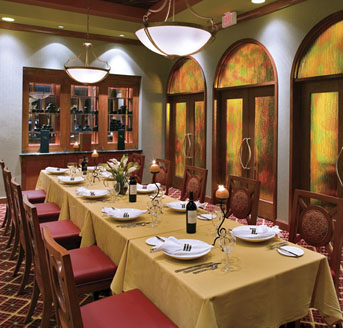
When one investigates the impermanent practice of occupying a restaurant table, distressing logistics begin to emerge.
Let us assume that the customer waits four months for a reservation at a fancy restaurant. Let us also assume that the dining experience extends to a generous two hours. The customer waits 120 days, or 2,880 hours, to lodge at a table for one twelfth of a day. The hotel offers free towels. The restaurant offers free napkins, with the waiter sometimes placing the napkin upon the customer’s lap. (One wonders whether some innovator in the hotel industry will extend this practice to those emerging out of a foggy hotel room bathroom in the buff.) The hotel may offer a mint under a pillow, thereby associating the breath cleanser with sleep. The restaurant may offer a mint with the bill, thereby associating the breath cleanser with money. Depending upon your ideological position, one might be said to be inferior to the other. But the restaurant customer isn’t presented with the option of lingering for additional hours or, in the most generous cases, staying over for a few days — as he sometimes is when having dinner at a friend’s house.
Thus, long-term hospitality is compartmentalized into these strange slivers of time, and the process of waiting for a restaurant table is incommensurate with other proud American activities. Compared against the restaurant reservation, a gun would arrive swifter even after the most rigorous background check. Government bureaucracy, with its slow and circuitous crawl, can handily defeat the restaurant in a race to the finish. One could read an author’s complete works faster. And if one were to adopt the combined qualities of ambition and charisma, one might make love with enough souls to pack three restaurants.
These observations are not intended to impugn either the customer or the good people who work at restaurants. All are victims of a rather silly system. What remains so interesting about all this is that nobody has thought to present an alternative.
Compared to the small-time bribery of tipping a barista and buying a beverage every few hours to secure a rented perch at a wi-fi cafe, the fancy restaurant, in most cases, wants to evict the customer and make the customer wait in the reservation queue for a second appearance. But if the restaurant is extraordinary, should not this experience extend beyond this narrow limit? Or is the experience “extraordinary” because the customer is happily parting with his money? Is it “extraordinary” because the cook is tight-lipped about his recipe? Because the kitchen is cordoned off from the dining room? Because the customer does not bring a side dish or a bottle of wine to a friend’s dining room table?
Even if the restaurant is not fancy, the customer, should he wish to pay the bill and retire, may stay suspended in the post-meal sitting state for quite some time. And there is the additional ethical problem of the customer viewing the waiter as a second-class citizen. The waiter, presenting the customer with an illusion that he is agreeable and nonjudgmental, performs any number of gestures and utters any number of false flatteries to earn his tip. The waiter is addressed not because he is a lively and interesting soul (although many waiters are), but because he is there in obeisance to the customer’s wishes. Small wonder that the fancy restaurant reservation has become a pain in the ass, for so many customers are asses to these needlessly overlooked soldiers.
How did such an experience emerge? Rebecca L. Spang’s The Invention of the Restaurant informs us quite helpfully that restaurants emerged after the French Revolution, the byproduct of breaking catering guilds. The restaurant was happily promulgated through free trade propaganda. An entrepreneur named Mathurian Roze de Chantoiseau, running an information office, thought to tap into the gustatory instinct. He made the need to celebrate social occasions and human togetherness with meals more flexible, tying this burgeoning luxury into an expansive market. Critics complained about the restaurant’s assaults on person-to-person generosity, but Roze de Chantoiseau declared himself a “friend of the world.” Indeed, the restaurant service sector, which has continued to flourish for so many centuries, has proven to be a vocational boon for many. Eaters were “restored” through the practice of sitting at a table. But with “restoration” aligned so closely with the transaction of money, one wonders why more people have welcomed the the restaurant’s rigid class system rather than an uptick in more egalitarian dinner parties. Surely, the restaurant should be rightly renamed bourgeoisant.
The time has come for reform. Let those who cannot find the impulse to cook wait upon the waiters. Since the restaurant initially provided services for travelers, let us return to the original intent. Restaurant regulars have been identified as wispy-eyed figures who live just around the block, but these indolent customers cannot be said to have truly traveled. Thus, restaurants must be enlisted to ask for IDs, verifying the number of miles that the customer has traveled to get to the restaurant. This suggestion may also solve certain insular qualities of Americans. (Just 20% of Americans have passports. Let faraway restaurants encourage these isolationists to spread their wings!) Let us adjust restaurants so that they more resemble their hotel cousins. Red zodiac booths might be transformed into strange beds. The head, encountering Formica rather than a fluffy pillow, would adjust to the instant discomfort.
These remedies will likely be identified by some reactionary minds as madness. But it’s more than a little mad to contend with the dining experience’s needless complications when one might have a more effective restoration among friends at a dining room table.
New H+ Issue Up
The latest issue of h+ has been released, and there’s loads of good stuff: an interview with Ray Kurzweil, Andrew Hessel discussing the formation of the first DIY drug company, and Jonathan Lethem discussing Philip K. Dick. You can also find my review of Daniel Pink’s forthcoming book, Drive, which can be found on page 85.
Pennies Saved
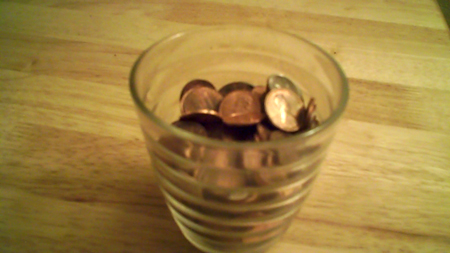
There are more than a hundred pennies crammed into a corrugated tumbler on my desk. I am not particularly interested in imbibing this elliptical manifest, but the thought of putting my money where my mouth is might allow for a strange and stomach-destroying hobby.
The pennies share this impromptu open-air housing with a few random dimes and several Canadian coins left by the person who used to live in this room. I can only assume that this ex-roommate experienced a moral dilemma similar to my own, but I’ve been too polite to ask. It’s worth pointing out that, with the present exchange rate, the Canadian dollar is worth slightly more than the American dollar. There’s no easy way to trade in this small-time currency.
My problem is hardly unique. This isn’t some drastic situation comparable to a Weimar Republic citizen rolling in a wheelbarrow of hyperinflated marks for a loaf of bread. Should I collect two or three more tumblers and bide my time, the currency, if accepted by a kind clerk, may very well depart from my hands. But I don’t wish to burden someone else with this problem. I’ve done my best to get rid of these Lincolns, offering two extra pennies on a $9.27 purchase, a gesture I’ve seen increasingly rejoined with confusion. I can’t very well put these into a tip jar or give it to someone on the streets. Beyond the insult, it presents again this needless problem of transference. I’ve tried shoving off these pennies one at a time, but prices have become more increasingly aligned with even sums.
I don’t blame designer Victor D. Brenner, who surely could not have foreseen a day when his beloved penny would be both ubiquitous and relatively useless. (Brenner, interestingly, was born in Lithuania. It was he who included the phrase IN GOD WE TRUST, which President Theodore Roosevelt believed to be in poor taste. But the penny’s religiosity was secured by William Taft, Roosevelt’s successor. It was the first coin to depict a U.S. President, replacing the Indianheads that had been in circulation for fifty years. Brenner, incidentally enough, is buried in Mount Judah Cemetery in Queens. I will make a future reconnaissance mission to determine if his considerable impact upon American life is being properly respected.)
Somehow I like the penny, perhaps due to pleasant memories of now extinct gumball machines or the contraptions that flattened a penny into an ovoid souvenir. Nostalgia is a silly reason for holding onto anything, but somehow I can’t resist. I don’t support any of the half-hearted penny abolition movements in recent years.
I regret that the pennies have accumulated, and take personal responsibility. About five years ago, I used to keep change in a small pouch within a unisex wallet. When I discovered that ATM cards, IDs, and stray bits of paper were escaping into my pocket, their journey hastened by a leather seam intended to contain, I was forced to conclude that the wallet had reached the end of its life span. I purchased a new wallet in haste, but it did not contain a pouch. I accepted this, and I began carrying change in my pockets, throwing the elliptical remainders into a porcelain mug.
This tactic proved effective for nickels, dimes, and quarters. But the pennies continued to accrue. Because there were so many pennies, it was difficult to name them, but I was impressed by the deeper grooves contained within the 1960s and 1970s pennies (although the Lincoln Memorial sometimes loses detail, even when you can make out the Lincoln Statue between the two pilasters). It became easy to line them up by year and imagine the picaresque paths that had led them to me. Some of these pennies have been puttering around longer than I have. No doubt that many who have owned these pennies have not always appreciated them, or have kept them fleetingly. Perhaps a penny might be likened to a book checked out from a library. It is a coin more public and less inclined to be picked off a sidewalk. The penny’s value is too small to be of any serious capitalist threat. Maybe they’re now meant to be revered in moderation.