Comics are on trial in Missouri. The Marshall Public Library Board of Trustees conducted a hearing to discuss the removal of Alison Bechdel’s Fun Home and Craig Thompson’s Blankets from the local library. Apparently, a few citizens of Marshall, MO found certain drawings within these two graphic novels objectionable. One resident, Louise Miles, of Marshall, spoke before the Board, “We may as well purchase the porn shop down at the junction and move it to Eastwood. Some day this library will be drawing the same clientele.”
Indeed. Let us consider the definition of pornography, as defined by my trusty Webster’s Unabridged:
“obscene literature, art, or photography, esp. that having little or no artistic merit”
Okay, so some of the people of Marshall (and it’s important to note, not all; a brave man named Dave Riley spoke in favor of the two graphic novels) consider illustrations of naked people lying in a postcoital position — a form of illustration, mind you, that goes back to the Paleolithic era and the Moche of Peru, something relatively tame compared against a distinguished history going back centuries before Ms. Miles’ birth — “obscene.” Personally, I found both Bechdel and Thompson’s respective illustrations quite beautiful. But that’s just me.
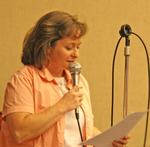 The real question is whether Louise Mills of Marshall (pictured right) is qualified to determine whether Fun Home or Blankets has “little or no artistic merit.” Is Mills an arts major? What are her credentials exactly? By what stretch of the imagination is she an expert on Bechdel and Thompson’s “artistic merit?” An ability to froth at the mouth and cringe in fear? Good golly, make that woman Chairman of the Board!
If this is a situation in which Louise Mills’ tender sentiments were upset by naked people or the implication of sex, then perhaps Ms. Mills might wish to consider how out of step she is with the 21st century. Premarital sex is something that more than 70% of the nation seems to be enjoying these days. I believe this puts Mills in the minority.
© 2006, Edward Champion. All rights reserved.
Book Banning, Again…
Typical. I wrote a post the other day dissing Banned Books Week, and then Edward Champion finds this article on……
Well, the legal definition and the dictionary definition of pornography are different. Under the law, pornography is not necessarily obscene, and it is only obscenity that gets less first amendment protection. The test to determine if something is obscene comes from Miller v. California and is:
1) the average person, applying the standard of their community, has to find that the work on a whole appeals to prurient interests;
2) the work depicts in an offensive way sexual conduct specifically described by state law; and
3) the work lacks serious literary, artistic, political or scientific value.
So after all that–if a work can still be pornographic but not obscene and get full first amendment protection. I think.
So, yes, it is annoying, but it is unlikely that any court would find that Fun Home or Blankets are obscene.
Thanks very much for the clarification.
Oh, I wasn’t trying to say you were wrong or correct you–I was trying to make you feel somewhat better about the situation. There is a pretty high (or is it low) standard that the state has to meet. But, it doesn’t much matter what the Supreme Court says–if the library removes the books, they are still gone–if only for a time. The issue would have to be litigated and that takes time and money and who knows how it would end up coming out in state court, then on appeal…
Now, I’ve made myself feel worse…