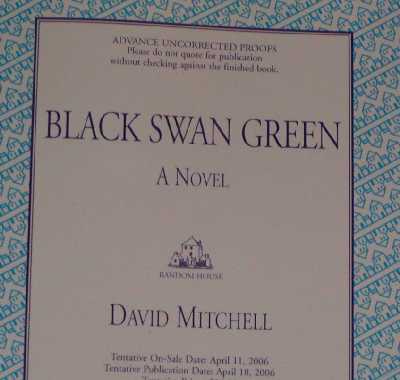
At the risk of coming across as feverish Harry Knowles types, we have in our hands the galley of David Mitchell’s next novel, Black Swan Green. We cannot confess how we got our hands on this, as several extremely nice people may be incriminated. But we will be taking a spin with Mitchell’s latest opus over the holidays and will attempt to report what we can as soon as we can.
© 2005, Edward Champion. All rights reserved.
counting down to april 11 (doubly foolish?).
Dear Ed,
I hate you.
Sincerely,
Abigail
(But seriously, my experience with Mitchell has been that he tends to write the same book over and over again – Ghostwritten read like a dress rehearsal for Cloud Atlas. Now, Mitchell is a fantastic writer and the book he keeps writing is a fantastic one, so I don’t mind, but I have to confess to a certain amount of trepidation about BSG, quite apart from the standard trepidation I’d feel about reading any follow-up to a book I’d loved as much as CA.
Which is not to say that I don’t hate you.)
I would love to get my hands on that. Seriously, you’ve got so many books to review; why not unload this one on me? You can see on Quarterly Conversation that me likes reviewing books.
Please?
Y’all won’t want it after Ed’s had his way with it . . . if you know what I mean.
I also had a galley copy of this given to me some months ago and I have to say it’s not that great. I’d be interested in hearing what others think, but I think it’s the first novel that sat in his drawer while he learned how to write properly. I found it cliched and dull.
But that might be (and probably is) just me.
I’m very sceptical though when he claims its the best thing he’s written. He may want to have a rethink.
Someone above wrote: “….my experience with Mitchell has been that he tends to write the same book over and over again.”
Be prepared, then. This is a total new kind of book from Mitchell and it’s WON.DER.FULL. You won’t be able to put it down, and I can’t tell you how I got my galley copy either, but this book is a charm. For me, his best yet!