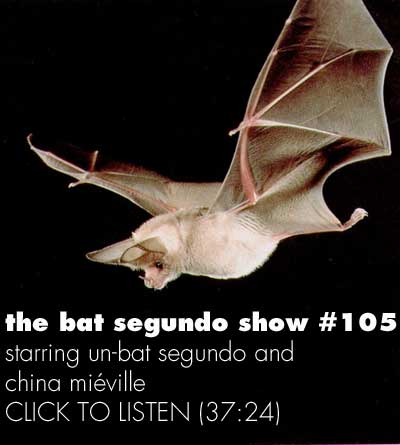
Condition of Mr. Segundo: One might say quite “un”-well.
Author: China Miéville
Subjects Discussed: World-building, building a world with an urban center, being a “city animal,” the imagination-per-page ratio, a creative license to put in anything, C.S. Lewis, ideology and YA books, Marxism, terrorism, the 1952 London smog, London bus drivers, politics and fiction, inventing monsters, environmentalism, the pleasure and joy of the grotesque, Miéville’s creative veto process, Un Lun Dun as a creative experiment, having to lay off arcane words in a YA book, the nature of spoilers, the underrated virtues of sidekicks, narrative surprises, the journey vs. the destination, rigid plotting, the two types of people who respond to “fridge man,” and how literal puns transform into monsters.
EXCERPT FROM SHOW:
Miéville: There are different ways of world-building. When we say “world-building,” we tend to think of that D&D-esque kind, which is not a diss incidentally. It’s just a description. It’s sort of a consolidation between the geography and the history and the culture and so on before writing the story. At that’s one way of doing it. But then there are others, which are less rigid, less to do with internal coherence, in the same way. So in terms of something like Un Lun Dun or some of the short stories or even King Rat, and the book I’m working on the moment as well, it’s less to do with having a coherent back-narrative and more to do with having a coherent moral and emotional feeling. I know the whole question of world-building is quite controversial at the moment, because M. John Harrison just wrote his blistering attack on the idea. Which I thought was, characteristically for his stuff, was a brilliant provocation and full of a certain kind of angry integrity. I don’t agree with him exactly, but I think it would be a fool who dismissed his criticisms out of hand.
© 2007, Edward Champion. All rights reserved.
Listen: Play in new window | Download
To be a good world-builder, or a good writer, is it also necessary to be extremely attractive?
I can look at this in two ways; first, a story that is merely a world building exercise and doesn’t bother to tell a compelling story is not a story I’m interested in reading. I can imagine writing that creates interesting worlds, introduces fascinating characters, but does nothing with either, may be a wonderful exercise in language and worldbuilding, but will be painfully disappointing to consume. At the very least it will leave you unfulfilled at the end when you’ve invested yourself entirely in something the author can’t bring themselves to do anything meaningful with.
The second way to look at this, that worldbuilding is not an entirely necessary precursor to writing a good story I think is complete crap. If you’re writing in a world that’s not fictional, or it’s fictional aspects are so narrowly deviant from a real world that you’re intimately acquainted with, then sure – don’t map it out first as you’ve got a live model in your head. I’d argue in this sense that you’ve been worldbuilding all your life, and you’re now able to write from within it comfortably without any extra planning. If, however, you’re writing a story set in a world that doesn’t and can’t possibly exist, then you have to spend a fair amount of time to define it before you start writing or else you’re bound to deal with something inconsistently, and your readers are going to catch you out on it. If your readers can’t trust you to put in the effort to understand the world you’re writing about, then why should they put forth the effort to read it?