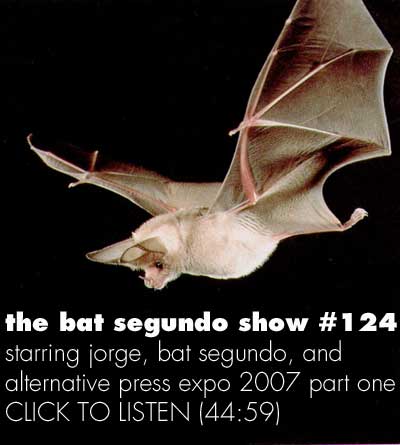
[This is the first in a series of podcasts devoted to Alternative Press Expo 2007.]
GUESTS: Carmen Ogden, Heather Morgan, Jess from CW, Sacha Arnold, Stephen Notley, Sarah Weinman, Jacquelyn Mentz, Tammy Stellanova and booth babe, Gabriel Martinez, Brian Andersen and Preston (cheerleader), Alex Cahill and Jad Ziade the laconic writer, Bryan Lee O’Malley, Tessa Brunton, Melina Mena, DJ Bryant, Travis Fox, two guys talking about waffles, Argel Brown and Michael Galande, Hope & Nicolette Davenport, Jeff Zugale, and Kristian Horn.
SUBJECTS DISCUSSED: The glut of autobiographical comics, Fat Camille, an unexpected skirmish between old media and new media, consulting cartoonists for tax advice, writing age-appropriate comics, handmade books, compartmentalized paneling, urban wildlife, the pigeon ecosystem, satanic raccoons, copraphilia, inverted superheroes, laconic comic book writers, whether or not robots are the savior of humanity, country bands and domain squatting, life’s rich pageant, retail humiliation, ripping off George Harrison, efforts to exploit the comic book circus atmosphere, waffles and freedom fries, turning interviews into comics, how to get rid of excess self-published comics, and superhero political comics.
EXCERPT FROM SHOW:
Correspondent: Whoa, whoa, WB and UPN have merged?
Jess: Yeah. About…
Correspondent: No one told me this!
Jess: I’m sorry. I mean, I’m hear to say. The last one to know. About nine months ago. But, um, it has shows like America’s Top Model and Simpsons and South Park.
Correspondent: But if WB and UPN merged, shouldn’t it be called WPN? Or UB?
Jess: Uh, that’s —
Correspondent: I mean, how the hell did you get CW out of it?
Jess: That’s a very valid…uh…what is this for?
© 2007, Edward Champion. All rights reserved.
Listen: Play in new window | Download
Ed! thanks for posting it. I’m, er, I mean, you’re brilliant!