It was an unwonted warm afternoon in January when my corpus decided that it required protein. My culinary id had screamed for the wrong kind of protein, the messy kind that requires many napkins. We settled ourselves inside a rectilinear restaurant in Fort Greene. I procured a burger, along with a large gantry-like basket of fries that towered over my small glass of RC Cola. I was hungry and had eaten without wisdom that day, but there were more potato slivers here than even the most ravenous soul could devour. The basket was an apparent bargain for three bucks, but ultimately a remarkable waste. Having been instructed as a young boy to “clean my plate” and having maintained this half-hearted economic virtue over the years, I considered all the fries that this restaurant, like many others, had willfully wasted on a daily basis.
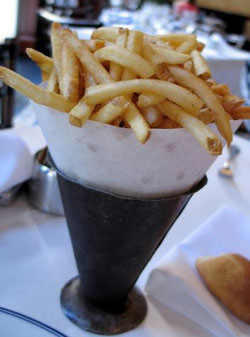 Days before at a French bistro, there had been an elliptical receptacle of fries (or, to be specific, pommes frites, lightly seasoned with salt and fresh parsley). A bonus. An unanticipated side dish, really. We masticated on ten out of the perhaps ninety thin rectangular wedges jutting upward like baked and irregular flowers. But the waiter had not waited to take them away. Indeed, he had not given us the choice of picking away at more fries or a moment of silence in which we could grant them the eulogies they clearly deserved. Perhaps he wanted this table cleared so that another set of customers could use it.
More fried casualties. If someone possessed the foresight to construct a potato cemetery for all these fallen soldiers, there would surely be ten Vietnam Memorials for one day in Manhattan restaurants alone. And yet over three decades of existence, I had never thought to name any of the fries. I had never eaten a French fry and said to it, “Hey, Joe, you’re about to be eaten!” or “Phyllis, nice curves! How did you get away with that daring French fry figure? I hope you don’t have body image problems. Here, let me straighten you out with my bicuspids!”
I speculated to my dining partner that it hadn’t always been like this. There must have been a time in culinary history in which one ordered a burger and there were about five steak fries on the side. A reasonable portion that was neither wasteful nor encouraged sloth on the part of the diner. But at some point during the twentieth century, there may very well have been a collusion between the fries suppliers and the restaurant managers. Perhaps it was not economically sound to throw five mere steak fries into a fryer. From an economic standpoint, it was better to use as much of the fryer’s cooking juice at one time instead of spoiling the oil with small orders. Plus, there was likely a large bag of fries that had to be used, along with many other large bags that had been included in the bulk box purchase. And all the fries had to be used before the expiration date.
Additionally, if the supplier was going to deliver frozen food, expending gas and labor to ship many boxes to many restaurants, then it really needed to be worth his while. The restaurant manager was forced to order too many fries and then had to find a way to move fries. And a dainty portion that came with a meal would result in a surfeit of fries. If, however, the restaurant manager could sucker the customer into paying two or three bucks to order too many fries as a side dish, the restaurant manager could not only move the fries rapidly, but he could also make a large return and ensure that all of his fries would be cooked.
But this does not discount the fact that too many fries are wasted. Now I’m not a religious man, and, as such, I don’t believe in life after death. So I must presume that these glorious fries wither their flaxen luster away, going nowhere in particular and remaining unremembered by anyone save Mama and Papa Spud, both of whom would enact a Charles Bronson-style death wish against ape-descended bipedal life forms if they had minds, mouths, and, most importantly, an ability to use a Luger pistol.
And how does one reuse these abandoned fries? Because of their terrible nutrition value, they cannot be recirculated among the less fortunate with any ethical grounding. They grow cold too quickly. They lose their oily taste if they are microwaved. They cannot be mashed up into a delightful potato concoction because the majority of the fry is a crisp affair and mushiness has been compromised.
Thus, for the moment, suppliers and restaurant managers turn a profit on a product that is readily wasted. And the French have the temerity to call these pommes frites! (The British had gone further with the benign-sounding “fish and chips,” which resulted in a tasty but rather unhealthy fried concoction and more waste.)
I now feel tremendously guilty for having eaten so many fries over the years, because I have never been able to entirely finish a serving. From a dollars-to-food perspective, I am likely losing more money with fries than I am with other dishes.
The only ethical solution here is to stop eating fries or to insist to the person who serves me that I really don’t need that many of them. But even if I were to carry out the latter, more fries would be wasted and led to that black plastic coffin within the garbage can.
There are clearly no winners here in the fries scenario except those who are making the money. And I harbor a not-so-small revolutionary fantasy in which diners rise up, boycott restaurants, and demand smaller portions of fries. It seems only fair to the maligned fries, who are being thrown away every day by the thousands, and this would probably help in a small way to combat the national health problem.