Broadway’s Racial Divide

New York Times: “Urban theater — or what has been called over the years inspirational theater, black Broadway, gospel theater and the chitlin circuit — has been thriving for decades, selling out some of the biggest theaters across the country and grossing millions of dollars a year….The word in the industry is that urban theater is about to go mainstream.”

So let me get this straight. Theater that has proven consistently popular among audiences and that has consistently sold out theaters is not considered mainstream? Simply because of the race of its cast and theatergoers? I have to ask: What does African American-based theater have to do in order to be recognized as “mainstream?” Or perhaps the answer is more ingenuous: Great Jumping Jehosophat! Black people attend the theater too!

In fact, the Times, reporting on New Brunswick theatrical developments (including an all-black version of David Mamet’s American Buffalo), published more or less the same article nearly twenty years ago. Great Jumping Jehosophat! Black people attend the theater too!

A few weeks ago, I attended a revival of Follies, now playing in New York City Center. And one of the things that troubled me about the Follies show was that not one of the theatergoers was African-American. Every single person was white. The only black people in the room were the ushers directing septuagenarians to their seats. And it had me wondering whether I was living in 1957 or 2007.

Granted, one does not attend a Stephen Sondheim revival to find black people. But just as Hollywood continues to remain baffled that black people see movies, Broadway (or, more specifically, the New York Times) does not seem to understand that black people do indeed attend theater and that, heaven forfend, there may be something to this so-called “urban theater” after all! Yes, darling, this “urban theater” is something we simply muuuuuuuust bring up at the next neighborhood association meeting! But we muuuuuuuust see Follies first!

Why this ridiculous categorization of “urban theater?” I certainly don’t call Zora Neale Hurston an “urban writer,” Tupac Shakur an “urban rapper,” Paul Laurence Dunbar an “urban poet” or Scott Joplin an “urban pianist” (although at the 1893 World’s Fair, Joplin was banned from performing ragtime inside the Midway, presumably because he was considered too “urban”). I admire an artist great not because she is “urban” or because she has a darker skin color, but because she produces great art.
Racist Restaurants

coonchicken.jpg

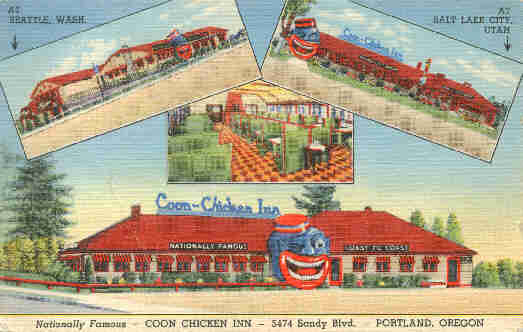
Here’s one of the more disheartening and rarely discussed moments in American cultural history: A restaurant chain called Coon Chicken Inn, alluded to in the films Ghost World and C.S.A., actually existed between the 1920s and the 1950s. Diners would enter through the doors of a ghastly racist caricature. It was one of Portland’s most popular restaurants, in part because there was a small African American population in Portland and in part because the food was cheap.

The restaurant chain was opened by Maxon Lester Graham and Graham’s descendants has issued a wholesale disapproval of the Coon Chicken Inn. This descendant reports that the racist logo was on every dish, piece of silverware, menu and paper product.

Interestingly, a few weeks ago, the Oregonian reported that the former Coon Chicken Inn has been purchased by an African American man named Ernest Clyde Jenkins III.

While Coon Chicken is now gone, it was by no means the only racist American restaurant. If you visit Santa Barbara, you can find the original Sambo’s restaurant, based on Helen Bannerman’s racist children’s book, The Story of Little Black Sambo. There were once as many as 1,200 outlets. Now there is one. Says restaurant critic John Dickson, “So when are you going to go nationwide AGAIN?” Presumably, Mr. Dickson is also fond of golliwoggs.

Racism in San Francisco

Max points me to this disturbing item. Author Ngugi wa Thoing’o was sitting at a local hotel, the Vitale, minding his own business, when a hotel worker asked him to leave the premises. The employee said, “This place is for guests of the hotel. You must leave.”

I’ve sat down many times at the Vitale and have even conducted a few interviews there. But I’ve never been asked to leave, presumably because I’m Caucasian.

The hotel owner has responded with an apology, but I’m not satisfied. And seeing as how this went down in my hometown, I plan to investigate this injustice personally.

Stephen Thompson: Racist Reviewer?

GalleyCat reports on this Stephen Thompson review of Vikram Chandra’s Sacred Games. The opening paragraph reads:

There are certain books that are so similar to one another they almost beg to be grouped together. This is largely true of Indian novels. Look closely at the ones published in the past, say, 25 years, and you’ll see that they’re virtually identical, in theme if not in style and content.

Aside from the racist assertion here that Indian novels are “identical,” Thompson also suggests that Midnight’s Children and A Fine Balance are “indivisible.” This, despite the fact that the former contains a protagonist with a highly sensitive nose and the latter does not, the former chronicles Indian history from 1910 to 1976, while the latter takes place during The Emergency between 1975 and 1977. There are infinite differences in language, characters, and plotting. But don’t tell Thompson this. So long as those brown-skinned people are banging out those novels, there isn’t a single distinction in his eyes.

This isn’t the first time that Thompson’s pen has applied troubling generalizations to ethnic literature. While reviewing Chimamanda Ngozi Adichie’s Half of a Yellow Sun, a book concerning itself with Nigeria, Thompson decried “the destructive effect of colonialism on Africa and its peoples” as “conventional” and “clichéd,” as if simply dwelling upon this cataclysmic shift of cultures was somehow devoid of complexities. (Maud noted this earlier this month.)