[This is the first part in an open series of reports from the New York Film Festival.]
 “You know, I have a copy of The Rape of Europa.”
“The lineup this year was so predictable. It was almost as if they knew how to control my reactions with the programming.”
“I’ve seen so many trainspotting books. So I know what to expect from this film.”
“He’s very enthusiastic about writing for the Web. Yes, it’s not print. But it’s still something.”
These were some of the astonishing sentences that trickled into my upturned ears during the first day of press screenings for the New York Film Festival. And while I plan to cover as many of these films as I can on these pages in a quasi-gonzo style, supplementing these reports with podcasts, I feel the need to declare a few things at the onset: (a) I enjoy writing for the Web and consider it more than just “something,” (b) I have no intention of going into a film and judging on what it might be before I have seen it, and (c) if New York Post film critic Lou Lumenick tries to pull some shit with me, I will kick his ass.
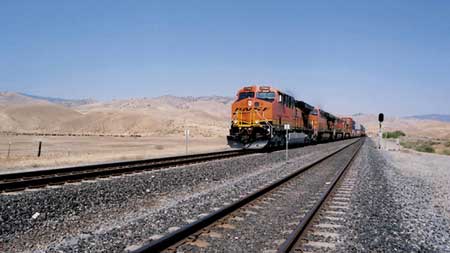
Ozu, of course, loved his train shots. And one of the lengthiest shots in Godfrey Reggio’s Powaqqatsi involves a freight train rolling past the camera, gradually speeding up, for about two minutes. But James Benning’s RR, part of this year’s avant-garde series falls somewhere between a Situationist cinematic exercise and an Andy Warhol film. The film is composed of nothing more than static shots of trains, the camera serving almost as a surrogate driver waiting at a railroad crossing (hence the film’s title, which, if you are a trainspotter, could likewise stand for “rest and relaxation”). Each shot begins with the train arriving and ends with the train leaving. The film, containing nothing more than visuals and sound, intercuts these long takes with a few seconds of black leader. And the film’s 16mm format lends it a grad school feel that admirably deflates its artistic pretensions. I don’t know if it could work as well on 35mm. But it is a rather interesting cinematic experience for anyone fascinated with everyday minutiae.
It is a film that requires patience. I certainly don’t believe that this film quite warranted its 111 minute running time. And RR‘s nearly unwavering commitment to landscape over humans does cause one long for a few souls ambling around in the distance. (Near the end of the film, Benning does give us a gentleman emerging from camera left, walking well into the distance and staring at a passing train to share our vicarious passiveness.)
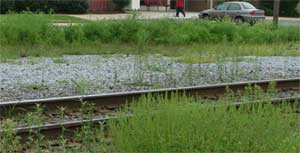 But the trains, rolling through plains, rusty bridges, snowscapes, and dilapidated freight yards, do cause us to dwell on interesting details. I became acutely aware of vegetation and plant life slowly dying and wildly overgrowing close to the tracks. The multihued boxcars and the rolling shadows frequently overtake these sometimes dull landscapes. But as the film progresses, Benning does something quite interesting. In the film’s early shots, there is a sense of anticipatory timing. When will the train first appear? This offers a brief moment to fixate on a beautiful scene of, say, trees and rivers, before the train occludes the view. When the train does arrive, the viewer is left to fixate her attentions on the scrub weed, abandoned blue plastic bags, and dessicated goldenrods that litter “our” side of the tracks. But as the shots continue to come, Benning gives us less time to get our bearings. And when Benning cuts early, the trains begin including a few vacant boxcars that offer hollow recesses and/or hollow frames. And the train’s recurrent bifurcation becomes so imposing that we then start to focus more on the landscape on our side of the view, only to begin ignoring the train itself. In fact, I became so accustomed to doing this that, at one point, I began to fixate on croaking frogs and almost completely overlooked the fact that the train in question was composed of only one car. There are surprises here. But you have to have an attention span.
As the film began to adjust the camera’s relative distance from the train from shot to shot, I also found myself shifting in my seat: moving forward when the train was too far and moving backwards when the train was too close. I found it quite alarming that there was a set distance in which I was comfortable perceiving the train. And I must express some gratitude to Benning for making me aware of this programmed tendency. Who knew?
 When the film juxtaposes radio snippets over its visuals, such as “This Land is Your Land,” some religious nut on the radio, and Eisenhower’s military-industrial complex speech, to impart a bogus significance, I felt the film failed. The film is more true and intriguing when it concerns itself with the unexpected sounds that the train decimates or succumbs to — whether wildlife whooping off-screen, profanity-laced hip-hop blaring from trailers hitched across the tracks, or a loud motorboat speeding beneath a bridge. Benning has claimed in an interview that this film “came to be about consumerism and overconsumption.” But this suggests great political import that really isn’t here. This is a film specializing in the American relationship with landscape. But if it were about the goods transported within freight trains, surely we would have been permitted a glimpse inside? An occasional shot of a bulldozer tied down on a platform or a car bogged down with lumber simply doesn’t cut it. The relationship here doesn’t seem that political to me, even with the film’s final shot in a wind farm. But depending upon how patient or open-minded you are, it may or may not be your kind of ride.