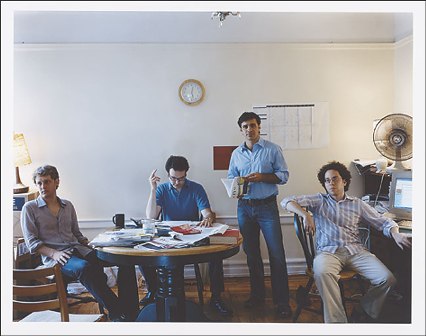
ZeFrank’s last installment of The Show. Thanks, Ze, for a year of fun.
Category / Uncategorized
Dreams
A dream is a horrible thing. It intoxicates your being, keeping you going and keeping you more or less single-minded in your quest. One day, you accept the dream. The next, you deny it in some ways, but you quite can’t let it go. Particularly when a dream’s ethereal slivers tempt you in the same way that disreuptable employers often keep their employees on staff, giving them a yearly raise that is just large enough to keep them on the payroll for another year, but just small enough to keep them financially dependent. The dream is so intoxicating and so lovely and just on the horizon that you must keep going, groping at the rope and slipping off and trying your grip again, seemingly ad infinitum. Even when your friends, even the ones who are also chasing similar dreams*, tell you that you’re a fool and that you should really go dig ditches like the rest of humanity. And you do your best not to tell them to go fuck themselves, because you really do like them and you try to remain civilized. Even when you recognize the underlying pragmatism of their advice.
The problem with dreams is that they must co-exist with this kind of financial reality, which isn’t what you would call dream-friendly but is apparently “necessary” towards existence in Western civilization. The problem with dreams is that they reflect the culmination of certain innate talents that you try to keep quiet about. Hell, it would probably be a lot easier if you didn’t feel the burning desire. But you just can’t help yourself. It’s in your nature. The problem with dreams is that you’ve been burned so many times before when you’ve pursued similar dreams that led to this one. You’ve persisted when people have told you to go to hell. You’ve survived countless horrors, but you keep pretty quiet about it. Because the one tangible Venn diagram between dreams and reality is that, no matter what’s gone down before, the playing field is equal. Nobody likes a whiner.
And nobody is honest enough to confess any of this, because nobody wants to reveal their dreams. Because after a certain age, it becomes “childish” or “juvenile” or otherwise unacceptable. What business do you have pursuing a pipe dream? You think the world owes you a living? (Actually, no.)
At some point, others give up. You watch them get married and have kids, while you still remain obsessed with the dream. While you spend much time alone trying to perfect strategies. Trying to get better. When working for the dream sometimes takes up every spare moment. When those who have the dream can no longer fathom the sheer discipline and tenacity it takes for one who doesn’t to keep on going.
But it could be worse. You too could give up. Or, even worse, you couldn’t have any dreams at all.
* — And, hey, you understand that and encourage them, because you like and admire the hell out of them and wish them happiness and want nothing more than to help them get there. You certainly wouldn’t deny them their dreams. Why is it that they go out of their way sometimes to deny yours?
New Review
My review of Joshua Ferris’s Then We Came to the End appears in today’s Philly Inquirer.
Where is Nicholson Baker?
Why isn’t Nicholson Baker publishing fiction anymore? I ask this question not just because I like his name — the surname a durable representation of Anglicism, the Christian name evocative of an underrated form of American currency that will, in a few short years, become as meaningless as its baser mono-cent cousin, the two names meshing together into a five-syllable charge of the light brigade — but because I am fond of his work, which has dealt in large part with describing minutiae — and by minutiae, I mean the bric-a-brac we take for granted, the pleasures of a straw or a laundry tag, all of it representative of an unexpected euphoria and enthusiasm with the quotidian.
A brief aside: I now have on my desk a 453.6 gram bag of Rold Gold pretzels, cloaked in a sallow hue that I find ghastly, purchased a few evenings ago because more diminutive packagings of pretzels weren’t available at the convenience store immediately around the corner, and because I was too lazy to walk the additional distance to a store that might have a more reasonable size. The bag claims to be a “One Pound Value Bag,” and, if we are to round up the 453.59237 grams to one pound measure to the tenth, we do indeed have 453.6 grams. Of course, since I do not possess a scale or any measuring device that will register this pretzel bag’s mass, I must trust that this bag, before I unsealed its top, its unsealed edge now staring back at me with six crenelated horizontal ridges and its rumpled plastic exterior resting reasonably firm until I decide to unsettle it with a slight movement, did in fact weigh one pound. I must therefore place trust in the Frito Lay Company that I am indeed getting “one pound” of value, even though I paid $2.49 for it when I would have preferred to pay around a dollar or so for a smaller bag of pretzels that would have served my nefarious snacking purpose. So there is, in fact, an excess of pretzels that has rested, untouched, on my desk for two nights. And I don’t know if I will eat the remainder. When I also consider the additional fact that, given these lack of measuring tools, there is no way I could have matched the reported 453.6 grams against the real 453.6 grams, I don’t feel any sense of “value” at all. Even if I were to disseminate the balance of these pretzels amongst the vagrants in my neighborhood or even the drunk and noisy teenagers who I have espied through my bay window (after hearing some unsettling noises), one of whom has just regurgitated on the steps leading up to my apartment building, I’m thinking they would likely reject my offering of pretzels in lieu of a hot meal or a forty ounce bottle or even cold hard cash. So the “value,” which suggests an egalitarian dissemination of goods that evokes a Robin Hood-like figure spreading the wealth, is wrong on multiple levels. And I am stuck with excess pretzels.
If I were to read a new Nicholson Baker volume, there is no doubt in my mind that he could put this conundrum in perspective. I suspect, with his keen eye for the picayune, he would have anticipated my current pretzel contretemps and he would have meditated at length upon this notion of “value,” a word unabashedly printed upon too many things, as if the word “Value” is a kind of naked lady you find in a deck of cards.
I was reminded of Mr. Baker tonight, when I found myself without a book to read on the way home. This caused a slight sense of panic, because, after countless hundreds of journeys on my bus line, I had grown quite accustomed to the many buildings through the window along my commute and had grown very comfortable with this idea of submerging myself into a book to pass the time. And I walked to City Lights, and with the help of the excellent Suzanne, a friendly and intelligent young woman who I once had dinner with and whose name I embarrassingly forgot, even when she had cried, “Ed!” as she saw my rumpled and book-starved form perusing many literary options, I managed to discover a Nicholson Baker volume I had not yet read, a book called Room Temperature which I am now halfway through. And Baker’s concern for these small details and these small conflicts that we take for granted has made me sad that he’s decided to sit it out since Checkpoint, a book savaged by Leon Wieseltier in the most callow of ways. (You can find the details here. I miss Mr. Orthofer’s lengthy reports and I hope we will see another one soon.)
So I must ask what has happened to Nicholson Baker. In the madness of our times, his fictive perspective is badly missed and sorely needed. I could always count upon looking through a dictionary when reading his books. I could always count upon seeing the world around me with fresh eyes. Plus, it helps that he was a bit of a pervert. I can’t say these things of a lot of authors. But I can say them of Nicholson Baker. I don’t know if he has a muse that any of us can speed-dial. But the literary world seems somehow lesser without Baker.