- Bud Parr has video of the ethics and book reviewing panel.
- Scott Esposito talks with Chad Post (who, I learned has a new forthcoming press).
- Maxine returns to the Philly Inquirer pages, reviewing Ian McEwan’s On Chesil Beach, which serves as a thoughtful antidote to useless cockamamie.
- I am reading Bleak Housse right now, among perhaps thirty-three others. Scott Horton has revisited the book at Harper’s. (via Maud)
- Ron Hogan finds a frightening way to merge McCartney album cover photos, lolcats and BEA.
- “The Democracy of Don Quixote” (via Orthofer)
- Robert Birnbaum talks with Nathan Englander.
- RIP Mark Harris.
- Adam Golaski on active reading. (via Dan Green)
- “I think MySpace and You Tube and all the blogs are really the coming thing now.” You can always count on publishers to be a few years behind the curve.
- John Leonard on Yiddish Policemen’s Union.
- Jill Owens talks with Lionel Shriver (via Barking Kitten)
- I’m with Across the East River Ed): Jenny D’s delightful sandwich enthusiasm has me shuffling through numerous Victorian fictive exemplars.
Category / Uncategorized
BEA Panel Report: Ethics in Book Reviewing, Part One
It was originally billed as a conversation between Carlin Romano and John Leonard. The prospect of seeing these two dutiful and distinguished critics discuss a subject as important as book reviewing ethics was enough to secure my attendance. Then more names were added, including Sam Tanenhaus, who showed his clear commitment to ethics not long ago by having John Dean review Mark Felt’s book, the dignified David Ulin, the often needlessly maligned Francine Prose, and the Hitch himself. Then the operation was mysteriously taken over by the NBCC and John Freeman became “introducer.” Which, I suppose, is a bit like all those fourth-tier actors who got offed during Police Squad‘s opening credits. But no matter.
Before the panel began, I saw John Freeman outside the room. There had been an offer to meet for drinks to discuss our differences and come to some civil consensus, which Freeman had rebuffed. Freeman never had the decency, much less the masculinity implied by his surname, to say yes or no. Such is the Freeman Paradox, which doesn’t subscribe to Lincoln’s advice about keeping your enemies close. Only days later, during the Sunday morning hysteria-as-panel depicting a “crisis,” John Freeman publicly declared into the microphone (three times by my count, although I showed up late: the tally may have been higher) that it was essential to have all voices represented. Well, not my voice. And I’m an NBCC member. I raised my hand for a good twenty minutes at this second Freeman-attended panel. I should also note that in response to the aforementioned drink invite, Freeman forwarded my email to Yahoo Customer Care, as if I was some garden-variety spammer.
Some of this needless passive aggression on Freeman’s part may explain a few pedantic preoccupations on my part. But I enter it into the public record in the interest of total transparency, an editorial quality that Freeman appears incapable of.
But I’m nothing if not a tenacious guy and I figured this was an opportunity to get a détente started.
“It’s a pleasure meeting you again,” I said, alluding to our previous attendance in high school.
“Wh…wh…who are you?” said the baffled NBCC president.
I told him my name. Freeman’s eyes widened. He began to shake. He stepped back a half step. He wanted desperately to run away. I certainly hadn’t stabbed anybody. But that’s what Freeman’s reaction reminded me of: a bystander witnessing a shocking crime scene.
“I have nothing against you. So why are we at war?” I asked. “Can you not agree that we’re on the same side?”
“Uh…yeah,” said Freeman. “We’re both at the same panel.”
“Then why don’t you return my emails? We should be working together.”
“I…uh…uh…I get a lot of email.”
I do too, John.
Freeman then scurried away. It was a decidedly unpresidential run.
At least Bud got somewhere with Michael Dirda (I can also attest that Dirda is an opinionated listener rather than a literary fascist). But I mention all this because Freeman simply will not respond to email or face-to-face efforts at resolution. I have tried everything. I confess that I’m a bit angry about this. Not because I give two shits about whether Freeman hates me or not, but because his failure to take a position or to have a civilized conversation with a perceived opponent is deeply dishonest. At the LBC Party, I was very happy to meet Marydell, who has taken some of my posts and positions to task. And that’s fine. I don’t expect people to agree with everything I have to say. And it’s always beneficial to have people examine where my arguments fall flat or where I am uninformed. A good thinker accepts those impassioned people kind enough to quibble with his arguments. The kind of rebellion that Jefferson liked now and then.
I will eventually summarize this panel, but in considering book reviewing ethics as a whole, I must likewise ask whether it is ethical for a president of an organization like the NBCC to remain so stubborn, so unilateral, and so clearly incapable of taking a stand (yes or no for drinks, John?) when one of his members is simply trying to clear the air.
This all comes out right now because, over the course of BEA, I was astonished to learn that writers and critics I admire, people who are far smarter than me and who can write far better than I can, read my blog on a daily basis and have apparently done so for quite a while. In writing this post, I may be misperceived as a hubristic bastard. But I hope this gets at some larger truth about how ridiculous this mess with Freeman is, how the print vs. online “battle” is a grand sham predicated on needless dick wars, and how Freeman (and his older and oilier counterpart Sam Tanenhaus) display the kind of personality disorder traits that aren’t helpful at all.
But more later.
BEA Panel Report: The Blogging Panel
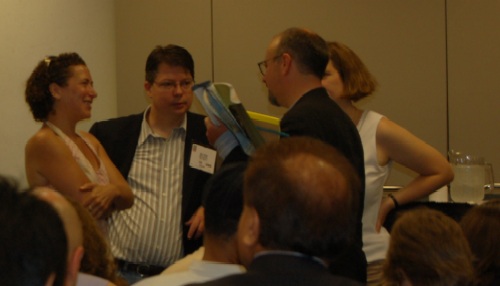
Panel: Blogs: Is Their Growing Influence a Tastemakers Dilemma? The Crossover Hurdle (June 1, 2007)
Moderator: Bud Parr
Participants: James Marcus, Lizzie Skurnick, Dwight Garner, Anne Fernald
“I’m one of the blog people,” said Bud Parr, the moderator of the BEA blogging panel. But he wasn’t the only one. They were other blog people, among them a few beautiful, in the audience. They were there on the panel: three other bloggers, in fact. Dwight Garner was not a blogger, per se, but it’s been argued by Ron Hogan (another blogger, natch) that Garner’s Inside the List column certainly qualifies as blog-like in feel and timbre. I wasn’t certain about the exact purpose of this year’s BEA blogging panel, but it was more effectively organized than previous efforts.
The microphones malfunctioned, thanks to the centrally controlled audio setup in Javits. This left all panelists gravitating to the central lectern to speak to the crowd. The feel resembled a twelve-step program. I kept looking around for the bad coffee and the stale donuts.
What I did observe were bloggers who were as professional as professionals and in many ways less abstract in their positions than their print counterparts.
NYTBR Deputy Editor Dwight Garner, who was amicable but who didn’t have the smarts to attribute a very easy quote from Samuel Johnson, openly pondered how George Orwell and Lionel Trilling would have approached the blog format, had they made their marks decades earlier. Garner confessed that every Monday morning, the NYTBR staff gathered around to see how the blogosphere reacted. This criticism of the critics was, in Garner’s view, “an incredibly healthy thing,” but Garner felt that some of the charges were unfair. Alas, he didn’t offer specific examples of this “heckling and name calling.” The print people almost always never do.
Lizzie Skurnick, who apologized for not preparing remarks, stated that she had started out as a blogger and defected to print. She felt “more sanguine about the future of book reviewing,” in large part because she had often heard from authors. She urged the audience to “embrace the blog world and the new criticism,” pointing out that there is no critic school and that the two professions are closer than people acknowledge.
The high point, apparently unnoticed in Michael Rogers’ lazy and incompetent reporting, was Anne Fernald’s thoughtful presentation of what a blog could be, which followed Lizzie’s remarks. Anne observed that early literary criticism had originated from English aristocrats – all men — who believed that only they could write. Women turned to bestsellers and eventually criticism, roughly about when the comparison between writing and prostitution was introduced. Virginia Woolf was among these new women critics and she was paid double the usual rate for the Times Literary Supplement. Anne also observed that no reviewer, whether print or online, is immune from the accusation that their opinion can be swayed. According to Anne, blogging has created a level playing field and this development, like Woolf before, has created a level playing field.
Anne offered six reasons for why blogging is beneficial and different from its print incarnation: (1) bloggers can cultivate a niche audience; (2) passionate readers search for new voices and blogging provides immediate access to these new voices; (3) there’s the possibility of a tipping point effect through this new channel; (4) blogging offers a new way of grouping novels together; (5) blogs are notebooks with feedback; and (6) blogging builds community. Because of these clear advantages, Anne asked why bloggers and newspapers weren’t working together.
James Marcus, speaking with a comic glint, also bemoaned the “shots fired back and forth” and the “sideshow” of the recent print vs. bloggers debate. He observed quite rightly that book reviewers didn’t exist as a Masonic order, and that he found this form of elitism unattractive. Book reviewing was first and foremost about talent.
After these five lengthy introductions, there was some discussion. When the subject of money was raised, Garner observed, “Money doesn’t drive a writer” and it was generally agreed that the stakes were too small to warrant much of an ethical breach. Lizzie observed that she had made a few thousand from The Old Hag, but she felt less responsibility to her advertisers.
The blog lines, however, were fuzzier than the print ones, because Lizzie was friends with other publicists and authors. She also called for running more excerpts. Anne smartly observed that the ethical lines may very well have been fuzzier during Virginia Woolf’s time. After all, what with Woolf writing a review of her brother-in-law’s book and being published on her husband’s press, the circumstances were pretty incestuous.
I was disappointed to see many minutes wasted on the ridiculous question of whether blogs are parasitic. Not only are blogs constantly generating fresh content, but one might argue that a book review, by way of leeching upon a book’s pages, and journalism, by way of sucking upon real world events, are equally parasitic.
Bud remarked after this regrettable detour into the obvious that 40-50% of blog readers came from Google searches. I’m not sure if he was citing his own stats or referring to another statistic, but I will investigate this. He also noted that one of the reasons Maud Newton was such a success was because it entailed “a great combination of filter and interjecting contextuality.”
There was more on the fracas between bloggers and print reviewers. But I’ll save my protracted observations on this subject when I write up the next panel, where I will also detail the convulsive fear and passive-aggressive belligerence that John Freeman expressed to me when I attempted a peace offering only hours later. Nobody sets a diplomatic precedent like a president.
More panel reports to come.
BEA Tidbits
- I am currently holed up with several fine ladies and bottles of Heineken and then I will hit the town. This is the way to spend an early Saturday night. I am contemplating removing my shirt.
- Not many people ran away from me today. In fact, I suspect many people lingered because of my previous post. Perhaps they feared being reported running away. Whatever the case, there were many fine conversations. Only a handful of people ran away. So I will report no more individuals who scurried along such lines. I will only report the silly person at Duke University Press who saw the Bat Segundo business card and told me in very humorless language that she did not specialize in books about bats. I told this person that I had previously interviewed one of her authors for the show and that she might want to read the not so fine print that specified that I was not, in fact, a small mammal enthusiast — at least not in any zealous, rabid-eyed form. She rolled her eyes and I left. I am beginning to understand that there are reasons why small presses stay pretty small.
- I’m particularly troubled by the Jim Crow treatment given to African-American-based publishing houses. They are all relegated to one area of the floor. I walked down this floor and found myself the only Caucasian person there. I looked for two water fountains, but I’m pleased to report that I found pleasant people.
- The big booths (in particular, the Simon & Schuster crowd, who resemble the most vapid B&T hipsters one might find outside of Central Park West; it can’t be an accident that these selfsame schmucks are also the house who want to take away auctorial rights with this lifetime scam) are filled, for the most part, with the most austere and humorless people one can find in the publishing industry. Thankfully, there are fun guys like Chris Artis who scurry such efforts against bonhomie.
- Contrary to Mr. Sarvas’ previous gripes against him, Steve Wasserman is actually a lot of fun. He’ll be making a Segundo appearance when the BEA podcasts go up.
- Many thanks to Small Beer’s Kelly Link and Gavin Grant for the energy-inducing chocolate that helped me through the late afternoon.
- If you want a whitewashed report of yesterday’s ethics panel, look no further than those trusty spin doctors at the NBCC. My own considerably more detailed report will follow.
- At sometime around 3PM, John Lithgow needed to eat a sandwich. I thought immediately of what Dr. Emilio Lizardo would say. I had hoped to laugh-a while I could. I would impersonate a monkey boy or a transvestite. But there was no time. At 3PM, Lithgow needed to eat a sandwich. And when a man needs to eat a sandwich, you don’t interview him, particularly when you associate him with silly roles.
- I’m off to attend more parties. I’m hoping to get up three panel reports on Sunday. I apologize for my delay. Again, at Javits, it’s a case of bamboozling journalists who deign to use wi-fi. But hopefully these bulleted reports will suffice in the meantime.
The Real Concern Here is Library Journal Hackery
I’ll offer my own report of Bud Parr’s blogging panel later, once I have had the time to log and arrange my extensive notes. But for the moment, I must respond to Michael Rogers, who appears to be a wuss of letters more content to bitch about the warmth (we’re all feeling it, fella; shut up and deal) than offering a report on events. If Rogers had paid less attention to what he styles “self-aggrandizing” and more attention to Anne Fernald’s excellent points of what blogging can do, then he might have had less of a shaggy dog column on his hands.