Washington Post: “Ryan and three other members of Congress have pledged to live for one week on $21 worth of food, the amount the average food stamp recipient receives in federal assistance. That’s $3 a day or $1 a meal. They started yesterday.” Congressman Ryan’s report here and Congressman McGovern’s report here.
Category / Uncategorized
Dem Uribe Apples
I’m nervous the ROTR fans will think me a cornball for posting a poem, but what the hoo. This is from Kirmen Uribe, whose MEANWHILE TAKE MY HAND (what you say when there is nothing else to say) was recently published by Graywolf Press. I offer you “Apples,” first in English w/translation by Elizabeth Macklin, then in the original Basque:
Homer used a single word for body and skin.
Sappho slept on the breasts of her friends.
Etxepare dreamt of stark naked women.All of them silent for ages now.
Today it seems we have to be perfect in bed, too,
like those red apples in the supermarket,
too perfect.
We’re asking too much of ourselves,
and what we hope for
from any of us, nearest neighbors,
almost never happens.
The laws are different when bodies tangle.Homer used a single word for body and skin.
Sappho slept on the breasts of her friends.
Etxepare dreamt of stark-naked women.Still I have in my mind
that epoch when we slept holding each other,
scared tiger cubs in our vigil.Kirmen Uribe, “Apples.”
Okay, Basque now.
Homerok hitz bakarra zerabilen gorputza eta azala izendatzeko.
Safok lagunen bularretan hartzen zuen lo.
Etxeparek emazte biluzgorriekin egiten zuen amets.Aspaldi isildu ziren denak.
Gaur badirudi perfektuak izan behar dugula ohean ere,
supermerkatuko sagar gorri horiek bezala, perfektuegiak.
Larregi eskatzen diogu geure buruari
eta norberaz, ondokoaz
espero duguna ez da ia sekula gertatzen.
Legeak bestelakoak dira gorputzak korapilatzean.Homerok hitz bakarra zerabilen gorputza eta azala izendatzeko.
Safok lagunen bularretan hartzen zuen lo.
Etxeparek emazte biluzgorriekin egiten zuen amets.Gogoan dut oraindik
elkarri besarkatuta lo egiten genuen garaia,
tigrekume ikaratiak gu, gaubeilan.Kirmen Uribe, “Sagarrak”
So, I had no idea Basque existed till I read Uribe. According to its Wikipedia entry, and of course other sources, Basque’s linguistic antecedents are in contention. It isn’t Indoeuropean, for instance. It’s spoken by roughly 1 million people in north-central Spain and southwestern France. Uribe was, according to MEANWHILE TAKE MY HAND, “born in 1970, in Ondarroa, a fishing town on the Bay of Biscay whose port and canneries now handle much of the catch between Galicia and Bayonne on Spain’s northern coast.”
The town, the book’s intro continues, “is home to some 9,900 people now, down from about 14,000 when Uribe was growing up. Just one of his cousins goes out on the fishing boats. Uribe’s mother lives in a farmhouse set back from the cliff that overhangs Saturraran, and these last months he has been living there, writing in a room that looks out at the ocean.” Nice.
Bacacay by Witold Gombrowicz
Have you read Bacacay? If not, I encourage you to do so. A highly pleasing book. Gombrowicz’s short stories are not like anyone else’s.
Here are two very brief moments from Bacacay that I posted a long time ago.
God Bless Hitch
Tom Whalen: The Most Underrated
The “oldest” writer, and by far the most underrated, from my 1979 “Young Writers I Admire” article was Tom Whalen, who was barely 30. I praised his poetry chapbook The Spare Key and the stories I’d seen in some of the same little mags I also got published in: Nantucket Review, Interstate, Panache, Laughing Bear, Iron – as well as his editorship of New Orleans’ Lowlands Review (the first publisher of soon-to-be-household-names like Madison Smartt Bell, then a Princeton undergrad).
Later Tom would become a close friend when he asked me to be a guest teacher at the New Orleans Center for Creative Arts, where he founded and directed the most rigorous high school creative program in America from 1977 to 1999, giving teenagers the equivalent of a pre-undergrad MFA. Named New Orleans Public Schools Teacher of the Year in 1984, Tom has published literally hundreds of stories, poems, prose poems and reviews, as well as works of literary and film criticism and screenplays. It’s hard to think of a major literary publication of the last thirty years that hasn’t published Tom Whalen’s astonishing work, which The Review of Contemporary Fiction has called “thickly lyrical and meditative, interrogating the relation of language to things, of books to life.”
Now retired in Germany (but retired like I am — in other words, still working part-time, Tom as a visiting professor of film and North American Studies at the Universities of Stuttgart and Freiburg, respectively), Tom gets my vote for the undisputed world champion in the heavyweight division of Writer You Should Know About But Don’t.
So you never heard of the little mags I mentioned in the first paragraph? Since Tom’s first story appeared in INTRO, the AWP anthology of graduate student work, when he was studying at Hollins back in 1972, he’s endured, like Dilsey, while many of the publications he’s appeared in have gone by the wayside. What has he done lately? See his recent stories “History Lesson” in AGNI Review, “Prose Piece for Martha Stewart” at Pindeldyboz and “Surviving Death” at Barrelhouse, for one. (Okay, I guess that’s three.)
The author of Roithamer’s Universe and other novels, Elongated Figures and other story collections, Winter Coat and other poetry collections, co-author of A Visitor’s Guide to the Afterlife and distinguished translator of Robert Walser, Tom has two new books out:
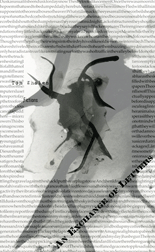
In the story collection An Exchange of Letters, just released by Parsifal Editions, levels of reality are exchanged, shuffled, made to dance, fuse and vanish. In “After the Rain”’s post-apocalyptic landscape, “Children congregate around the puddles and point to the reflection of the planes crashing at the water’s edges.” The eponymous “Jorinda and Joringel” (from the tale by the Brothers Grimm) appear trapped forever in their past, but the generative nature of the form of their discourse resists despair. “Report from the Dump,” “Twenty-six Novels” and “Critical Tendencies of the Middle Ages” present Tom’s chiseled prose in all its remarkable diversity.
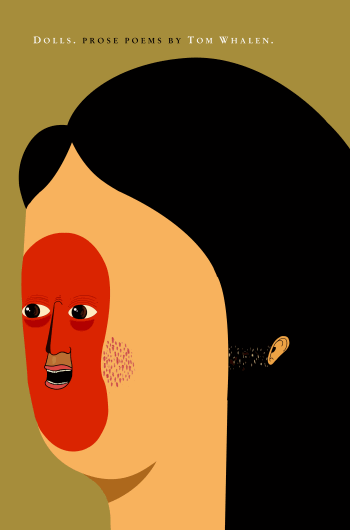
And just out in the last couple of weeks (I got my copy in the mail only a few days ago) is Dolls, Tom’s winning entry in the 2006 Caketrain Chapbook Competition, judged by one of my favorite poets, Denise Duhamel (we’re old friends, I’m old friends with Tom, but like too many of you, Denise had never heard of Tom before she discovered she’d selected his anonymous manuscript). This is what she has to say about Dolls:
“Baudelaire wrote that ‘the overriding desire of most children is to get at and see the soul of their toys.’ Rilke claimed that when children realize that their dolls are inanimate, that their toys have no souls at all, they grow disgusted with their dolls. Enter Tom Whalen….these beautifully crafted prose poems are as animated and frightening as voodoo dolls—think the American Girl collection in the hands of Cindy Sherman. Dolls delighted and scared me beyond belief.”
The penultimate word on Dolls comes from Sven Birkerts:
“Tom Whalen’s book is malign and unsettling and darkly outré – he re-Wittgensteins the world that used to be the case through the impassive, but vigilant, eyes of his dolls, and returns it to us strikingly changed.”
The last word on Tom Whalen comes from me: Don’t just sit there, read him. What have you been waiting 35 years for?