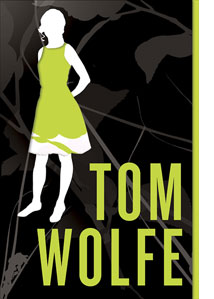
The Los Angeles Times: “The paperback publisher of Tom Wolfe’s unevenly reviewed latest novel “I Am Charlotte Simmons” is hoping that a dramatically redesigned cover — and a youth-oriented marketing campaign, complete with a contest featuring a trip to Cancun — will help draw young adults to the book, mocked by some reviewers who found the septuagenarian author’s accounts of campus sex life unconvincing.”
INSIDE A MANHATTAN OFFICE, NINE MONTHS AGO:
“Ladies and gentlemen, I have some terrible news.”
 “Dave Eggers wants us to publish a book of McSweeney’s lists?”
“No.”
“Jonathan Safran Foer wants six covers for the paperback release of Extremely Loud and Incredibly Close?”
“No. Even worse. We’re handling the paperback campaign for Tom Wolfe’s I Am Charlotte Simmons.”
“But nobody liked that book!”
“That chick at the Seattle Times did.”
“But she was the classical music reviewer! Not a book reviewer!”
“That’s exactly right, Hank. Sometimes you have to think outside the box.”
“But who’s going to read this book?”
“I’ve got two words for you: youth market.”
“Look, Samantha, we’ve marketed crap before. But have you lost your mind? This thing won the Bad Sex Award. ‘Slither slither went the tongue.’ All those STATICs. The PlayStation 3? The poorly realized characters? Do you really think today’s youth will go for it?”
“All good points, but we landed this deal. And there’s no way out. It’s the only chance we’ve got. Now I’ve had Jo, that new color specialist we just hired, look into this problem. And she says that green is the new black. Green is the color that the human eye sees the best. It’s one of the reasons why it’s used for night vision goggles. Jo says that a neon olive will probably ingratiate us with the martini crowd.”
“Um, Samantha, I may not be the hippest cat here. I don’t understand Beyonce or Kayne West. In fact, you folks don’t pay me enough. So I can’t very well set foot inside a Crate & Barrel. But I can tell you this: lounge revival is so 1997.”
“We’re thinking a nondescript young lady on the front. Perhaps something for the Lindy Hop revival set.”
“Samantha, did you even hear a word I just said?”
“Yes, goddammit! But can’t you see we’re painted into a corner here? Tom Wolfe’s fans have already read this. The literary set has already read this. There’s nobody left! And we’ve got to sell this thing!”
“Guys, calm down. I think I might have the answer.”
“What?”
“Earlier, you mentioned thinking outside the box. Well, what about this? We don’t even have to put the title on the book! We can take your lounge revival motif and just put the name TOM WOLFE on the front. Those who haven’t heard about the book, that youth market you were talking about, might be vaguely familiar with the name and they’ll scoop the book up. We just have to make sure that we buy out all the remainders so that they have no frame of reference.”
“That’s not bad, Hank.”
“Now here’s the other thing. You can never go wrong with black. We may not stand a chance in hell, but I have to say: black is audacious. It implies that there’s something deviant and steamy within the pages.”
“It also implies that this book is the prodigal son of literature.”
“Even better!”
“Well, does anyone else have a better idea?”
Silence.
“Okay. Let’s roll with this.”
(Hat tip: Jeff.)
© 2005, Edward Champion. All rights reserved.
Those MacArthur fuckers missed you again this year! Had they only read this, you’d be farting through silk (as they say in Chicago— that’s a city in the fly over zone).
‘Course the fuckers missed me too. Enough said.
“All good points, but we landed this deal.”
Funny enough, but Picador, being, like FSG, a subsidiary of Holtzbrinck, and its paperback house, is the presumptive publisher for FSG hardcovers. I doubt they angled for this particular title.
This is the kind of playful conceit I’ve come to expect from you liberal bloggers. You wouldn’t know the inside of a meeting room if you smelled it. There are backroom deals made in these places that affect the conditions of our time. The time has come, Mr. Champion, for you to stop mocking it and start embracing it.
i don’t understand tom wolfe
what does he want from life?
i’d like to follow him around for a day and ask him that
ask him what he wants from life
[…] still getting props for the way he got into Molly Bloom’s dirty, dirty mind; Tom Wolfe was nearly laughed out of the sorority by some critics when he wrote a book from the point of view of a college student named Charlotte Simmons. (And […]