[The following article is an excerpt from my soon-to-be-published book, Eating Young Jewish Writers.]
When I was young, I would often spend the weekend at my grandmother’s house. She would ask me if I was hungry. And when I would cry, she would tell me that I needed to toughen up and expand my gustatory horizons. It wasn’t until years later that I realized she was testing me to see if I had eaten a young Jewish writer for dinner.
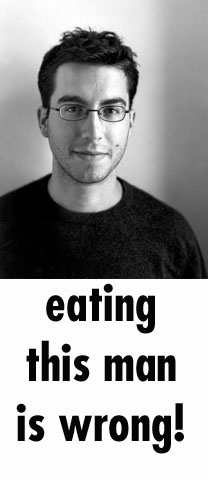 You see, my grandmother survived the Great Depression eating young Jewish writers. It wasn’t that she was anti-Semitic or anything. My grandmother would scavenge around America looking for inedibles. Unfortunately, other hobos had eaten the rest of the food. When the rotting potatoes, discarded scraps of meat, skins and the bits that clung to bones and pits had all been exhausted, the people who were still hungry would turn to other human beings to eat. This was before the Holocaust, when one could still eat a young Jewish writer and not be declared a National Socialist. I remember attending hotel buffets: while the rest of us kept our meals vegetarian, there would be some adventurous diners who would gnaw upon young Jewish writers and think nothing of it. After all, Jews tended to write a lot of books. This was one of the reasons that Alfred Kazin made so many infrequent appearances in his younger days. He feared being eaten by those who weren’t picky.
It was my grandmother who taught me that eating a young Jewish writer saved you money. The meat would last a long time. You wouldn’t have to go to a butcher. You could just show up at some shul, wait for some eager young Jewish intellectual to open up his notebook, throw a burlap sack over his head, and whisk him away. You could really make a young Jewish writer last a long time if you had a walk-in freezer. Of course, you’d have to inure yourself to his shrieks of anguish as you chopped him up with the hatchet. But if you were hungry enough, well, the possibilities were limitless.
We thought my grandmother was the greatest chef who ever lived. And we’d enjoy our meals until we realized that we were eating human meat. Then we’d throw up onto our plates and ask for seconds. There was always plenty of young Jewish meat to go around.
POSSIBLE AGAIN
When I was 2, the writers of all my bedtime books were young Jewish writers. The first thing I can remember learning in school was how to pet a young Jewish writer without accidentally killing it. This required some skill because many young Jewish writers were hypochondriacs. One summer my family fostered a young Jewish writer. I kicked him. My father told me that we don’t kick young Jewish writers. Years later, the young Jewish writer would write a three-volume memoir about how he had experienced severe anti-Semitism when staying with my family. He would base an entire lecture around the incident. Because of this, there were many years where I was banned from attending bar mitzvahs. When I had earned enough pocket money as a teenager, I was forced to hire a group of young Jewish writers to kick me repeatedly over the weekend.
When I was 7, I mourned the death of a young Jewish writer I’d won the previous weekend. I discovered that my father had chopped up the young Jewish writer and flushed him down the toilet. I told my father — using other, less familial language — we don’t flush young Jewish writers down the toilet. When I was 9, I had a babysitter who didn’t want to hurt anything. She put it just like that when I asked her why she wasn’t reading young Jewish writers with me.
“How is reading a young Jewish writer hurting him?” I asked.
“Because we goys can’t possibly know their level of suffering. We might hurt them accidentally if we read about their pain.”
The babysitter’s intention might or might not have been to convert us, but being a kid herself, she lacked whatever restraint it is that so often prevents a full retelling of this particular story. Frank is probably eating a young Jewish writer as I type these words.
Mark Twain said that quitting smoking is among the easiest things you can do: he did it all the time. I would add avoiding cannibalism to the list of easy things. In high school I refused to eat human flesh — whether Jewish or not Jewish, young or old — most often to claim a bit of identity in a world of people whose identities seemed to come effortlessly. I also wanted to be the biggest wanker in America. I wanted people to hate me because I crammed my views down their throat. Because I was a smug kid then and I’m a smug kid now. Eating young Jewish writers is certainly wrong and I don’t know if I can forgive my grandmother for what she did. But writing a boastful book on the subject is almost certainly worse. Thankfully, I have hired a bunch of young Jewish writers to beat me up at every stop I make on my next book tour. Together, we can correct the moral divide. But if you’re not willing to beat me up, perhaps you can find it within your heart to spend $25.99 on my 352 page book, Eating Young Jewish Writers.
© 2009, Edward Champion. All rights reserved.
Mmmm, feeling peckish now.
More or less irrelevant, but have you ever noticed how everyone’s always drinking Coke in Bellow’s work?