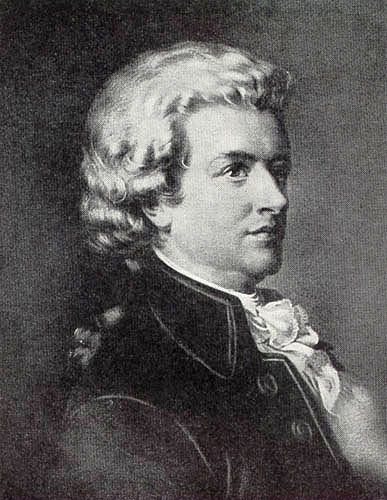
Wendi beat me to the punch. I had intended to write a lengthy post about what Mozart means to me, but, staring at my workload here, such a verbal celebration will have to wait for another day. So for now, I’ll merely say that Mozart’s “Salzburg Symphony #2″ was, in fact, the first piece of music I ever laid down for a Super 8 film in film school (figuring then that, while not necessarily sharing Mozart’s talents, I too was a young and giddy bastard eager to produce), that I have always related more to Mozart than to Beethoven (while not discounting the other, the Mozart-Beethoven “If pressed, which one would you choose and why?” question is a fun personality test), and that I am extremely happy after listening to about an hour of Mozart this morning.
So thanks Wolfgang for the groovy and timeless tunes! Thank you for that uncanny visceral quality that has always made me slightly delirious and made my solar plexus extremely tingly. I have always wondered what you would have composed after the age of 35!

Angelmaker by Nick Harkaway: Harkaway's latest novel greatly improves on his previous book, The Gone-Away World, which I'm already on record as praising. Angelmaker adopts genre elements without ever feeling like a genre book, and it leads me to believe that Harkaway is well on his way to a narrative grace close to China MiƩville's. Yet inexplicably this very fun book, which includes an eightysomething badass named Edie Banister, a mysterious mechanical object that may destroy the world, farcical scenarios involving lawyers and the police, and some unexpectedly moving moments about fatherhood, doesn't appear to be getting much attention in American newspapers. Nothing from the snobs at The New York Times Book Review, nothing from The Washington Post. And since I can't get Harkaway on Bat Segundo, I hope this Jump Up and Down mention gets you hopping as well.
The Age of Insight by Eric Kandel: Unless you're really pressed for time, forget Jonah Lehrer. If you want to understand creativity and its relationship to neuroscience, then the bowtie-wearing Nobel laureate is your man. In addition to being a physically beautiful book (you will drool over many of the paintings), there are helpful overviews on optical illusions, science, biographical backgrounds, and many vital figures from the Vienna Secession. Kandel's enthusiasm (and his call for greater unity between the humanities and science) is contagious.
Will you kick me if I put a “Rock Me Amadeus” reference in here?