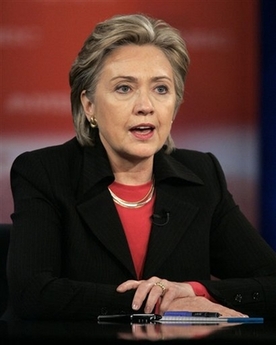
 Lorrie Moore’s naive essay on Hillary Clinton not only demonstrates the unspoken precept that skilled fiction writers are sometimes remarkably simplistic when they write about politics, but deploys the same scripted liberalism that every progressive is now expected to chant to peers in coffeehouses. The formula, it seems, boils down to this: Hillary Bad, Obama Good.
Now I’m not exactly a Hillary lover. Clinton waffled from a 1993 universal health care plan which mandated all employers to provide health care for employees to her latest “universal” plan, which shifts the mandatory financial burden to individual citizens. But a proper universal health care program is single-payer, regulated by the government, and doesn’t abdicate the spoils to HMOs. Clinton is also the senator who received the most money from HMOs in the 2008 election cycle. (Obama was second.)
Like every good left-leaning American, I have been seduced by the seemingly limitless reserves of Obama’s charisma: his smooth handling of Bill O’Reilly’s arrogant attack dog antics, his adroit response to anti-abortion protesters, insert your magical Obama moment here.
The man is slick. Slicker than Bill Clinton. I firmly believe that he can be the next President. He looks good. Too good.
In comparing Obama with Clinton, Moore writes that “unlike her, he is original and of the moment. He embodies, at the deepest levels, the bringing together of separate worlds. The sexes have always lived together, but the races have not.”
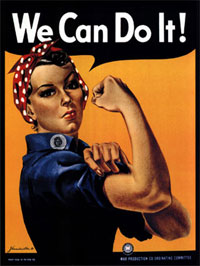 I wonder if Moore remains aware that, according to the U.S. Census Bureau, women earn 77 cents for every dollar their male counterparts make. (The disparity, incidentally, is better in Washington, DC, where women make 91 cents to the male dollar. This may explain why Capitol Hill remains somewhat out-of-touch on this issue. An Equal Rights Amendment may provide succor to these problems.) Or maybe Moore remains unaware that young women are earning degrees at a higher rate than men do.
This certainly doesn’t reflect a case where the sexes “have always lived together.” Unless, of course, we’re talking garden-variety cohabitation. And while Obama may talk the talk, I fail to see how Obama’s legislation record brings together separate worlds in any way that is substantially different from Hillary Clinton. The oft bandied boast is that Obama was not Senator in 2002 and therefore unable to vote for the congressional resolution authorizing Bush to use force in Iraq. But what’s not to suggest that within this climate of fear, Obama wouldn’t have done so? (The record demonstrates that John Edwards also voted for it. Kucinich and Paul did not.)
The distinction then is predicated on retroactive speculation. Which is a bit like seriously considering the ridiculous question Bernard Shaw asked of Michael Dukakis during the 1984 Democratic presidential debates: “Governor, if Kitty Dukakis were raped and murdered, would you favor an irrevocable death penalty for the killer?” Kitty Dukakis was not raped and murdered. Obama was not Senator during 2002. Nonetheless, it is an American political tradition to rate presidential candidates according to what they may have done under certain circumstances, as opposed to a more reasonable survey of what they are likely to do based on their past records.
So ultimately the difference between Obama and Clinton comes down to charisma. To watch Obama in action is to experience the most pleasant and capable of political machines. He’ll jazz up a crowd in minutes and give them the fleeting sense that they can change the world. But who is the wizard behind the curtain? Progressives — including myself — were so eager to fixate upon Karl Rove, but why do we fail to apply the same standards to those who run Obama’s campaign?
Last week, Hillary Clinton welled up on camera and was roundly ridiculed. The question arose over whether this was sincere. Cruel YouTube parodies surfaced soon after. For some, the tears confirmed the inevitable. Here are some of the YouTube comments:
I really feel that Hillary Clinton is a worhless [sic] piece of shit.
i hate this woman
This bitch won because she got on national television with her fake crocodile tears in front of million of viewers.
Yea what a fucking cow. She should be making pizza.
This is a very EVIL fricken human being…She should be ashamed of herself! If she had any heart at all she would finally tell the truth!
Go and fuck Bill.. instead of cheating people
Hillary Clinton is a worthless piece of shit.
And so on.
This was not, however, a Muskie moment, even if an op-ed columnist like Newsweek‘s Karen Breslau was keen to dredge up the droplet that careened down Muskie’s cheek and sealed his political fate. Until the primary results dictate otherwise, Clinton is still very much in the game.
What was not factored in Breslau’s article was the double standard with regard to gender. I find myself being one of the few who remains suspicious about never seeing a gaffe from Obama. Real humans screw up. But presidential politics demands perfection or, as Bush’s two victories confirm, a guy you can drink a beer with.
The cult of personality remains so seductive that even adept writers like Moore offer this foolishness: “it is a little late in the day to become sentimental about a woman running for president. The political moment for feminine role models, arguably, has passed us by.”
On the contrary, the present political moment is very much about whether a president has the right to appear sentimental before the cameras, which in turn is very much predicated upon whether the candidate is a man or a woman. It does not matter what Hillary Clinton’s positions are. What matters most of all is whether or not the “bitch” or “the worthless piece of shit” fabricated her tears.
The question we should be asking is just why these gratuitous issues of telegenic interpretation are deflecting more pressing concerns, such as platforms and positions, and why even the best of us are happily swallowing the bait.
© 2008, Edward Champion. All rights reserved.
I’m an unabashed Obama supporter/Clinton detractor, but I will leave that discussion alone to just mention this- Youtube comments are never a convincing argument. People will crawl over each other to call Hillary a bitch as fervently as they will to call Obama a crack-smoking Muslim or his grandfather “a chimpanzee”. Youtube is a cesspool of attention whoring and Ron Paul supporters. Its collective opinions on politics is indicative of nothing.
I wish the media would focus more on policy and less on soundbites and “emotional moments”.
Imagine if *your* every mood, tic, cough and mote in the eye was filmed, endlessly replayed and debated in the news:
“Ed said he got dust in his eye from a passing truck, but did he really mean heavy traffic made him shed a tear?” Good Grief!
But the problem is, the news media has decided that their audience (us) are a bunch of gullible idiots, and treat us accordingly:
“Today on CNN: A politician cries, and some pictures of cute cats.”
(Remember when CNN didn’t run “Cute animal” stories as news? What the hell happened???)
I can’t laugh at the guy wearing the pink mop because his bit demonstrates the misognous nature of our country. Is it any wonder that the guys in the media and elsewhere make lame anti-women jokes rather than listen to what candidate Clinton has to say? As a woman, I’m sick of it! It’s time to stop being dazzled by the current “big guy on campus.” Let’s go for a woman who clearly cares about the country and has the smarts to make it better. Give a woman a chance. We’ve already seen what a man can do. Maybe we need a lady to clean up the mess made by Bush.
Aunt Laura
I think this is really best read as a counterpoint to the Steinem column from last week. It’s a lot more measured than Steinem’s simplistic “women have it worse than black men” thesis. At least Moore introduces the third, and probably most determinative factor of class (though admittedly, she doesn’t quite address it directly). Insofar as race and class are often inextricable in this country, the matter is far more complicated than Steinem was admitting.
But really, I don’t see the utility of these arguments to the larger progressive agenda. I’m not sure what a ranking of oppression gets us. The more important question is whether women– as women, but also not just as women–would be better off under a Clinton or Obama presidency.
Frankly, I’m not sure there’d be much of a difference. Both are on the right side of women’s issues. Either candidate would represent with their physical selves some sort of symbolic progress in the most general sense. But the safest bet is that this symbolism wouldn’t track with their actions as president, at least not in any discernable manner. They’d both spend most of their time mopping up after this last asshole.
If you accept that as a premise, Moore’s argument in favor of Obama is a bit more persuasive. I wouldn’t have made every point the way she does, but hey.