[This is the fourth in a series of dispatches relating to the New Directors/New Films series, running between March 25 and April 5 at MOMA and the Film Society of Lincoln Center.]
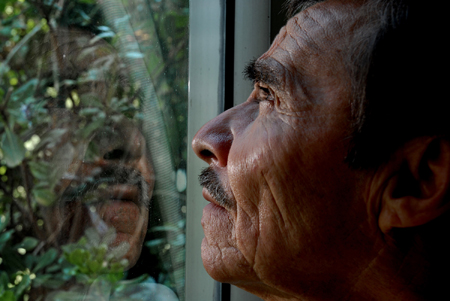
The first image of Enrique Rivero’s striking feature debut sees a spider crushed by a boot. The boot belongs to a man with a wan and wrinkled face named Beto. Beto is a housekeeper living in a desolate and unoccupied manse in Mexico City that can’t be sold. He wears the same white shirt every day and scrubs the same ellipitical perimeter of the bathtub. His life is one of droll and circular routine. He turns corners in the house at rigid right angles. Gruesome news headlines blare at him from the television as he chows down on tacos. Last month’s newspapers, bundled in a tidy and philanthropic bunch, are given to him for reading. He feasts on the news of the outside world, but does not wish to involve himself in it. He is a spider caught within a web of perfunctory duty.
There’s some solace for Beto in visits from Lupe, a middle-aged woman who sleeps with him every week. Beto, we learn later, is a widower. But Lupe isn’t necessarily a black widow preying upon the last of his identity. The film does not explicitly state whether or not Beto pays Lupe for the privilege, but it does something much craftier. Our first glimpse of Lupe is through an extended long take as she dances with a man. We learn that she’s Mexico City’s answer to a dime dancing girl. (And it’s interesting that this taxi dancer rides to her appointment in taxis.) But we don’t see the man she’s with — just the back of his head. We do see Lupe’s bored expression. She snaps her gum. She fixes her hair. Her life is a husk and the man paying her for the privilege, too busy burying his head into her shoulder, cannot see this. That Rivero reveals such a major socioeconomic chasm with such sideways glimpses is a testament to his talent.
Is Beto paying Lupe for these weekly trysts? During one bored morning, shortly before Lupe’s visit, Beto orders some tamales from a cart, asking for the third one to be given to him on credit. He wolfs down the tamales. Lupe arrives. When she undresses, Beto claims that he is too full and cannot sleep with her. The underlying assumption is clear. A roll in the hay with Lupe is the price of two tamales. But is this precise detail something which the audience infers? Or is it the calculated truth? One is tempted to say yes to the latter question. Rivero himself is an engineer who turned to filmmaking. And he has presented us with a film, with many stretches in which nobody says a thing, that feels at times like a brazen calculation worked out over a series of large chalkboards. But in saying yes, does the audience confirm its blind worldview? Why shouldn’t Beto and Lupe have their small frivolities? Does the fact that Lupe is later arrested for lewd behavior attest to her lowly status? Or is this film challenging us with a more striking hypothesis? If we are presented with another view of class relations, carried out from a different viewpiont, will we come to the same conclusions?
This troubling series of dilemmas isn’t just limited to class. There’s an interesting dialectic here, operating often in yin-yang, between the interior and the exterior worlds. The dichotomy is there when trick-or-treaters knock on the door and Beto, lacking candy to give the youngsters, screws up his eyes and pretends to be a monster. But perhaps Beto does not have the eyes to see the world beyond the house? Beto sits in his chair, sucking down news and food, and the drapes behind him are drawn. But the daylight seeps through on the undrawn part of the window. Prospective buyers often stop by to look at the house. Beto observes them through the window. Initially, we do not hear the conversation. But as the film progresses, the chatter starts to penetrate through the window. And at this point, Beto isn’t capable of existing in the outside world without total collapse. But is it his occupation or his locale that causes such agoraphobia?
Parque Vía shares many qualities with Todd Haynes’s 1995 film, Safe. Both films feature main characters who have terrible physical reactions to the external world. But where Haynes had multiple chemical sensitivity, there isn’t a clear-cut diagnosis for Beto. We know that he doesn’t wish to leave the house. We also know that his occupation is far from secure, even if the house manages to get sold. And it’s something of a cruel joke that certain events playing out late in the film occur over Christmas.
Then there’s the mysterious Señora, her white hair bundled in a genteel beehive, who owns the estate and keeps Beto on the payroll. What are two tamales to her? What indeed are her pleasures outside of the parties we see from the perspective of her servants? She does something kind for Beto late in the film, but is her generosity rooted less out of an intrinsic concern for people beneath her social station and more from a cruder sense of blind duty? Is she just as isolated in her internal world as Beto? The Señora asks Beto if he is happy, and he says yes. But surely she should see that he’s not. She knows that Beto has lost his wife and she suggests to Beto that he should marry another woman. But are these not a vassal’s vagaries?
This film works as well as it does because it constantly challenges our assumptions like this. Rivero invites us to get close to people that the world does not wish to be intimate with, giving us small gestures such as Beto constantly curling his hands and little details like Beto’s alarm clock resting on top of a Bible. And yet Rivero’s intimacy is often false, and that’s only because his characters are locked into specific societal roles that we might perceive if only we could get beyond the class system. Beto’s world is sadly insular. He is talked about by others, but rarely engaged. Not even his fellow servants will answer his questions. So what does society do with a lonely man like Beto? Rivero doesn’t offer any easy answers, but he presents a cinematic viewpoint that gently compels us to step beyond our comforts and consider the richer possibilities of brotherhood. For if we don’t, we may just be hiding within our own dark houses.
© 2009, Edward Champion. All rights reserved.