[This is the twelfth part in an open series of reports from the New York Film Festival.]
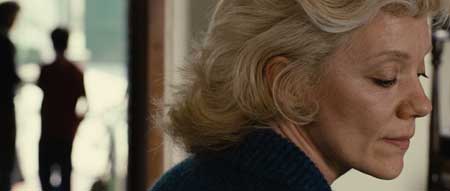
Argentine filmmaker Lucrecia Martel — sadly one of the few women represented among the predominantly male auteurs in the New York Film Festival — doesn’t wish to spell out her entire scheme to the audience. She does have a crackling knack for presenting her muzzled puzzle from a subjective viewpoint. In The Headless Woman, Martel’s characters are often photographed from the passenger seat or the back of a car, suggesting that the audience is sitting right next to protagonist Vero, but helpless to intercede as this wealthy woman slips further down the drainage of her ethical predicament. Cinematographer Barbara Alverez confines the vista to medium shots, often static, with subjects in the background often fuzzing out in soft focus. From car windows, smiling motorcyclists pass and point to turn left while the air conditioning leaves those inside perspiring with a comfy gloom. When the camera opts for a long shot, Martel places her characters at extreme edges of the frame. One of Vero’s house workers discovers the remnants of a swimming pool or an old fountain paved over for Vero’s endlessly renovated garden. But there are no visible apples in this garden, presumably because privileged exoneration has made temptation unnecessary. Vero, you see, has driven over what may be a boy or a calf, reaching for her cell phone as the engine purrs on and rendered catatonic by this bump in the ontological road. Instead of stopping and living up to her moral responsibilities, she drives off, refusing to look back and suffering a severe emotional crisis that has her questioning her own powers of recall. We’re left to believe at film’s end that the incident may not have happened, but, by then, the dye in Vero’s hair has shifted from flaxen to black. Martel’s film represents the transformation; the accident is, quite literally, the calm before the storm.
Martel surrounds Vero with endless children who remind her of the crime. Martel makes Vero a dentist, and there is the suggestion here that Vero’s dutiful drilling upon these children’s teeth represents a full-bore assault on wisdom. After the accident, the tougher cavity jobs have been delegated to others. The mise en scene likewise deracinates the top physical features of characters. Vero is visually headless, framed by her own insularity. Vero is not heartless, for she breaks down in tears while attempting to wash her hands of the affair. The faucet malfunctions. She accepts the kindness of a concerned worker. Her head moves out of frame, revealing nothing more than her craned neck behind the partition separating Vero from the audience. We hear the baptismal rush of bottled water pouring down the top of her head. That the crime takes place on a road near a dry canal, filled by the weekend rainstorm precipitating the crime, suggests a theme of liquid replenishment. Vero is doted upon by help at the house, colleagues at work, and cannot even admire her husband in too-tight trunks. The crime, whether real or illusory, has revealed her true empty nature. “I killed someone on the road,” she states to anyone who will listen. But there is no proof, and this insinuates a deeper question of faith: an ethical stretch that is not quite religious spanning along a sinuous road leading to the annual “Smile Day,” where dentists investigate the porous ivory inside young mouths in the name of public service.
But the journey here is not entirely satisfying. Martel remains so determined to juxtapose Vero in a series of tapestries that match her internal despair that the audience does not have a choice but to go along. There is nobody here who truly scolds Vero for being so callous or unfeeling. There is nobody here who does not dote on her. We are left to witness a woman who, like Bartleby, would prefer not to. When police begin investigating details of the boy/calf’s death, we see Vero and those close to Vero craning their necks near the scene of the accident.
And while Martel injects some interesting subtext into her film, the story of a wealthy person who gets away with a crime has been done too many times before. One thinks quite naturally of The Strange Love of Martha Ivers, and it becomes apparent that Maria Onetto (who plays Vero) lacks Barbara Stanwyck’s eclat. This film could have used a Liz Scott-like side character to shake things up. But we do have an intriguing mother representing Vero’s logical development. This woman watches wedding videos from the past, barks at people to rewind moments because her memories are shot, and rattles off such unthinking “You were so beautiful. Why did you let yourself go?” to the snowy VHS bride, who is standing before her decades later.
Martel showed greater flair for depicting unexpected human behavior with The Holy Girl, which followed a religious teenage girl obsessed with a man who groped her on the street. But I suspect the absence of religion in The Headless Woman is one of the reasons why this film doesn’t quite work. Martel is a filmmaker who, like Pedro Almodovar, cannot make a secular film that packs the same punch. Religion is clearly in her blood. Had it likewise been in Vero’s blood, Martel would have had a hell of a movie.
© 2008, Edward Champion. All rights reserved.
“Vero, you see, has driven over what may be a boy or a calf”
I’m really puzzled by the apparent confusion over this point. We see very clearly what she hits, and it’s neither a boy nor a calf. It’s a dog. I just saw the film a second time and that’s not even remotely ambiguous. We clearly see a dog, and we see it in an omniscient shot, not from what would ostensibly be Vero’s POV. So you can’t even argue that the image is somehow unreliable.
There is no crime in this movie. That is in fact what makes it so fascinating.
The fact of the matter, md’a, is that the shot is filmed with the dead corpse — whether boy, dog, or calf — at least thirty feet away from the camera. And unless someone can furnish me with a DVD or a screenshot, I’m going to stick with Martel’s visual insinuation that we SHOULDN’T know what it is and that we are intended to share in Vero’s subjective experience. The image is most certainly unreliable if you have the good fortune of seeing this in the theater for the first time.
When the screenshot becomes available, you will see that it’s unmistakably a dog. There is certainly no possibility whatsoever that it’s a human being. Martel is too cool to provide a close-up, but the only conceivable function of this shot is to ensure that we know what Vero actually hit. The only way to make a case for ambiguity is to argue that this shot exists solely in her mind, which I find too far-fetched to credit.
I agree with md’a: it is startingly clear that she has run over an animal. I am baffled by ALL the reviews that hold that it may very well be a person. Not so.
things are like this; she run over something… she stops and continue driving. we don’t see her looking back. But there is an omniscient shot of god on the side of the road.
when she come back with her husband to check the things out… he said; you killed a god, you scared, you killed a dog… but as viewers we never see the dog in fact again… that’s the most fascinating thing about this movie! It make us complicit of something that we don’t know exactly if it took place for first! we are complicit in denying and covering up a truth that scare us.