Twelve

Whirring wind, the whistling of asthmatic ghosts, the clinks of cans and other detritus thrown out windows by careless neighbors and left to pick up in an unpredictable gust. Spooky and grandiloquent gestures in lieu of snow. The slush well melted. Two inch puddles evaporating before tomorrow morning. Footfalls beyond walls. Eight days before the unfulfilled promise of a wintry wonderland. Mere weeks before year’s end. Party poppers and streamers and the clinks of champagne flutes, but not today. The phones are dead at this zero hour, batteries left to expire and the monitors dissolving into screensavers. Everyone is shaking. Jittery souls packed in thick soles, stampeding through powdery barricades. The other half packed inside clinging to lovers and protective blankets. Times Square half-deserted, the heavy credit card swiping primed for the robust nor’easter of Penn Station procrastinators. Subways chug and conductors repeat MTA warnings. They are the lonely drivers of this city, saturating these barely populated cars with lonely chatter. The rest ride silent in cabs because it beats shivering in shelters.

The smarter and richer ones have fled to warmer places, to friends and families, to wintering — although they’ll never use that gerund. There are still places that pulse with life. Warm tableaus where everybody seems mystified that the holiday hasn’t come to pass. Which explains the reliance upon safe tunes that everybody knows like the Beatles blasted over speakers, defacing the silence and filling in for the thirty-seventh version of “Jingle Bell Rock.”

Daylight’s at a premium and everyone knows it. In particular, the nine-to-fivers are sad because they’re inside when the sun stabs through the clouds. It’s hard to smile, but jokes come easier. And sometimes there’s the prospect of a shared flask. Conversations are quieter, subjects less scintillating. It’s as if we’re all part of a mandatory Secret Santa operation. Brain cells dwindle, fires kindle. But cats and dogs jump on laps and are walked around blocks, whether sun or sleet. Kids bristle with energy and anticipation. The haul might be pretty good or anticlimactic. The alone hole up with big bottles and are left alone.

Jonathan Ames Pilot on Showtime

Longtime readers know that many years ago, I opened an envelope in my mail that contained a hastily handwritten letter and a small, poorly Xeroxed photograph of Ed McMahon. Unlike other mysterious envelopes that came in the mail along these lines, I was not promised millions of dollars. Indeed, money was never one of the promised options — at least not immediately. But there was the promise of a mysterious potato salad recipe and guitar lessons. Both of these promised to be of a very special nature that would win me friends, further my career, and earn me more invites to BDSM parties than a teenager’s libido could possibly handle. The latter was a particularly ideal prospect, because, as the letter put it, the party invites would mean getting the opportunity to place many local political figures in sexually humiliating positions.

potatosalad.jpgFor all this to happen, all I’d have to do is meet a thin, cadaverous man at a crossroads and continue to mention any news involving Jonathan Ames on these pages. Well, I showed up at the crossroads in question. And the man never showed up. But being a man of my word, here is the latest piece of Jonathan Ames news.
A few years ago, Jonathan Ames did not meet a man at a crossroads and, to this very day, does not know how to make potato salad. But he did shoot a TV pilot called What’s Not to Love? And Showtime will at long last be airing this on Tuesday, December 18th at 11:30 PM, as well as on Showtime Showcase on December 19 at 1:25 AM and Showtime Too on December 20 at 4:30 AM and December 26 at 3:15 AM.

In other words, Showtime has decided that the ideal audience for Jonathan Ames’s pilot are speed freaks and insomniacs. So if you don’t have a sleeping problem or you’re not sitting on a Sudafed stockpile for ideal home brew, be sure to set your TiVo options if you have them!

Roundup

O Lucky Man! Revisited — Part One

This is the first in a series of posts on Lindsay Anderson’s masterpiece, O Lucky Man!

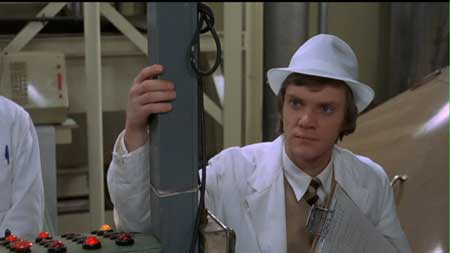
The other night, I revisited O Lucky Man!, courtesy of the recent DVD release, seeing it for the first time in its proper aspect ratio. While it isn’t so readily apparent in pan-and-scan versions of the film, Anderson’s subtle and very specific framings — which are often composed of medium and long shots — are as integral to the film as its many outrageous moments among its side characters. The coffee salesman and former if… revolutionary Mick Travis (played wonderfully by Malcolm McDowell) is often framed in the center of a tableau, and this positioning foreshadows Travis’s later victimization by political forces, both left and right.

oluckyman1.jpg

Travis’s first appearance comes at the end of a slow pan, where we see Travis in the middle of an orientation meeting at a coffee company. He’s paying very close attention to a supervisor who is training many salesmen for possible lucre on the road. He has a clipboard under his left arm. Travis’s right arm grasps a pillar, his bicep (and thus his strength) interestingly occluded by the beam, connected to an unspecified part of the corporate machinery that keeps the factory in motion. In addition to this conformist image standing in sharp contrast to if…‘s violent revolutionary, it’s suggested by this establishing shot that this Everyman figure is drawn moth-like to the machinery. Indeed, only minutes later, we see Travis calculating on a piece of paper just what kind of money he can make on the road. From the protagonist’s introduction, the imperialism observed in the film’s black-and-white prologue is indeed reflected by modern forces. And this is just the first of Anderson and screenwriter David Sherwin’s onslaughts upon contemporary culture.

oluckyman2.jpg

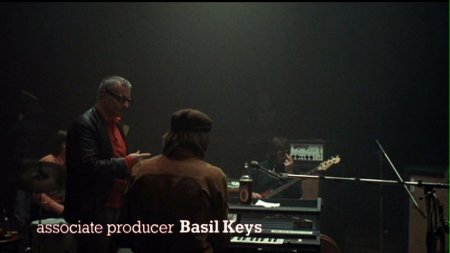
But what of the film’s opening title sequence just before Travis’s introduction? The film features numerous interstitial interruptions from Alan Price and his band, playing songs that often reflect and respond to Travis’s adventures. The effect is certainly reminiscent of a Greek chorus responding to the events on a stage. But since this is the film medium, there’s something fundamentally more surreal going on. The band also appears inside the movie’s narrative midway through the movie, as Travis flees from Professor Millar’s hospital. So the film’s technical enablers have just as sizable a role on Travis’s predicament as the forces of the world.

In the above image, we see Lindsay Anderson, clad throughout the film in a black leather jacket and a red shirt (perhaps just as important a sartorial choice as Travis’s protective gold suit?), going over the script with Price during a guitar solo. (The film’s hefty script is also used by Anderson in the film’s closing moments to strike Travis.)

You can find this shot at the 3:25 mark. It’s a roughly 220 degree dolly shot around Price and his keyboard that suggests that Anderson not only has no problems crossing the axis, but that the director (and the script) does indeed have a hand in the forthcoming events. But it’s also worth observing that whereas the camera remains stationary on its tripod in relation to Travis, this is not quite the case within the free-floating kinetic safety of the recording studio where Alan Price and company play their music. (However, there still remain tangible connections between the studio and Travis’s narrative, which I will go into very soon.)

In a future post, I’ll go into greater length about how the film willfully (and often defiantly) flaunts these fascinating cinematic techniques. (The film’s frequent cutaways to static blackness, for example, suggest imagined moments to be filled in by the film’s audience.)