Along Central Park’s Perimeter

Saturday morning’s walk extended, to my surprise, across six miles in Manhattan. Mammoth bleachers for the Thanksgiving Day Parade were settled and half-unpacked by imposing tractors, stretched in sequential array upon the western edge of Central Park from West 81st to somewhere in the seventies, more no doubt to follow in the forthcoming days. There were numerous dogs — one unduly burdened by a carriage attached to his hind legs, as if he were a miniature Ben-Hur steed in service to his owner. I had thought that this poor dog had suffered an injured leg, and that the owner had attached the carriage to provide locative succor. But the contraption appeared more in the service of the owner, who didn’t seem to be aware that dogs could perambulate as fast, if not faster, than mere humans. A boy no more than seven years of age observed this rigged dog and thought him special by way of the wheels, but I felt sad for the dog, who was pressed to move faster by his master.

The bleachers were something of a burden, for they impeded steady foot traffic and we were forced to cross the street, contending with oppressive red lights, which we defied by jaywalking, and pedestrians who didn’t shuffle down sidewalks with our celerity. Certainly, they had the right to saunter. But when you get into the groove of walking, it’s hard not to go hard-core and we weaved like cars desperately careening across lanes to make an appointment. But we had no particular destination in mind.

The poor pedicab drivers, mostly African-American, shiver in the cold along 59th Street, waiting for desperate fares. They are the modern rickshaws, but the tourists prefer the horses. The statue of poor General William Tecumseh Sherman — at 59th Street and Park, in considerable disrepair, with a fading gold sheen — is largely ignored by the tourists, who settle for the horse drawn carriages at $37 per half hour, when they can have this needlessly abandoned historical figure for free. Perhaps they disapprove of the general’s march or Trump’s gilded endowment from not long ago. I find myself commiserating with the forgotten historical figures interspersed throughout the five boroughs, sometimes addressing them directly. “Who are you?” I ask a statue with an unfamiliar name. I then begin to apologize to them personally for not knowing the history and start asking these bronzed and iron representations questions, for the plagues which depict their histories are often unsuitable. I never seem to receive answers, nor do I receive strange looks from other New Yorkers. Perhaps inquiries along these lines are a common practice, or perhaps nobody is as interested in the past as I am. I am forced to Google the info later.

Concerning Trump, easily the most wretched buildings along the southern edge of Central Park are the Trump condos, which are as inventive as an accountant taking on architecture as a hobby with their flat rectilinear exteriors and banal facades.

Near the end of this peregrination, I stepped into a Men’s Wearhouse just to time how long it would take for a salesman to approach me. Total interval: nine seconds. And I was besieged with endless questions about my suit size, the smart sartorial items I was presumably pining for, and the suggestion of smart pants. But I left the store, not particularly surprised at the aggressive sales tactic. At least the Men’s Wearhouse staff have the decency to stand away from the door, which is not the case with the Madison Avenue men’s clothing stores, who hound you within two to three seconds with pathological fervor. They stand right by the doors and one considers applying for a restraining order.

Generally speaking, no clothing was purchased, I’m afraid to report. But if you have nothing to purchase or nothing to see as a tourist, it’s often a defiance of other’s expectations when you randomly walk through the streets of New York.
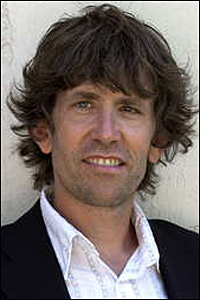
John Freeman — Ethical Reviewer

Here’s an ethical question for you — a query not rooted in malice, but in a curiosity and concern for journalistic integrity. If your partner is a literary agent representing Jonathan Safran Foer, Manil Suri, Edwidge Danticat, and Junot Díaz, do you recuse yourself from reviewing or interviewing their books?

John Freeman interviewed Jonathan Safran Foer in 2005. Personally, I see no problem with interviewing an author who is a friend or an associate, provided one holds one’s questions to the same probing journalistic standards. (A few friends and associates have been interviewed for The Bat Segundo Show, but I always inform them that I’m not going to offer them softball questions. And they know what they’re in for with me.)

Reviewing books, on the other hand, is a more clear-cut ethical scenario. I have dug around. Unless I am missing something, it appears that Freeman has avoided reviewing any of Nicole Aragi’s clients since 2004. So I must commend Freeman for maintaining an ethically honest reviewing practice.

[UPDATE: Before other parties blow this out of proportion, Freeman leaves this comment at Mark’s:

Hpp — to answer your question, sadly, yes, which is a shame because it means no more Colson Whitehead, Thuy Le The Diem, Edwidge Danticat, Viktor Pelevin, Jonathan Safran Foer, Junot Diaz. It also means I’ve had to recuse myself in voting at the NBCC sometimes. Occasionally, an English or overseas newspaper will ask me to interview one of Nicole’s clients — Jonathan Safran Foer, say — and have said go ahead after I explain the connection. But I don’t seek those assignments out.

]

Did Richard Curtis and Rowan Atkinson Rip Off Grant Naylor?

In consideration of British comedy history, here are two video clips. The first clip is from “The End,” the first episode of Red Dwarf, written by Rob Grant and Doug Naylor and produced in 1987:

The second clip is “The Exam,” written by Richard Curtis and Rowan Atkinson, taken from the first episode of Mr. Bean and produced in 1989:

Both of these scenes are funny, but there are a number of striking similarities: the effort to blow into the paper, the cheater flipping over the paper and being surprised that there is information on both sides of the exam, and the cheater closing his eyes in disbelief only to open his eyes and see the exam in front of him.

The National Post reported that Mr. Bean was conceived as a test character in 1987. Sketches for Mr. Bean had apparently been performed on stage. But in this interview, Atkinson revealed, “And so we thought wouldn’t it be interesting to bring them to Montreal, which we did in 1989. We tried them out on basically a French-speaking audience. And then we did the English-speaking side.”

The big question here is what Mr. Bean sketch he’s talking about. Was “The Exam” one of the candidates? According to the Just for Laughs page:

The sketch, which was in the form of a lecture on dating techniques, was first tested out at one of the French galas. It was met with such an overwhelming positive response, that it was added to the HBO special, and was met with the same response. BBC brass watched the tape of his performance at Juste pour rire and the following year Atkinson’s “Mr. Bean” TV series aired for the first time and made Atkinson an international star.

This suggests that “The Exam” may have been written sometime in 1989 — shortly after the BBC commissioned the first thirty-minute installment of Mr. Bean. A version of this sketch was also included in a Rowan Atkinson one hour HBO special, which was performed and filmed on December 19th and 20th, 1991 in Boston’s Huntington Theater.

Still, I have to wonder whether Curtis and Atkinson were inspired, in part, by Red Dwarf. Obviously, hot off the success of Blackadder, they were very concerned about whether Mr. Bean was going to draw a major audience. But did they see Red Dwarf and abscond with a few of Grant Naylor’s ideas just after signing on with the BBC? And what do Grant and Naylor have to say about this?

Coming Soon to The Bat Segundo Show

Just hours before 2006 NBA finalist Jess Walter headed on a plane back to Spokane, we talked about his novel, The Zero, which he fully confesses to be an allegory of post-9/11 life.

jesswalter.jpgWalter: We were clinging to our economy, and the fact that our leaders — Giuliani and Bush at the time — said they attacked our economy. They attacked our way of life. And the fact that we didn’t bat an eye over the fact that they equated our economy with America, with our way of life, it was as if we had forgotten that there was some larger thing. And then, as we started debating whether or not it was okay to torture, and this lurched into a war that I didn’t agree with, it just seemed as if the conflation of victim and hero, the confusion of economy and country, were disastrous. And so, it comes out in a novel.

Correspondent: But it’s not all bad. You have, for example, the honor of the tip. The dollars constantly inserted under the martini glass.

Walter: Right.

Correspondent: So I don’t think it’s entirely a cynical view you have of the..

Walter: No, no. I’m not entirely cynical. Again, this is all — I sound so dour and political. But this is all framed in a novel that’s hopefully funny and entertaining. And I remember those ghost bars being in Lower Manhattan. I mean, I was right in the thick of Ground Zero. So you’d walk into these ghost bars and there’s no reason for firefighters not to take the bottle down and take a drink. And some of them would leave a dollar tip. Was that an ironic tip? Was that a real tip? I don’t know. But the descriptions of Ground Zero in the book. In my mind, the book starts when I arrived five days after. And so, from that moment on, it does hopefully capture everything. Some honor, some pathos, and a lot of cynicism.

Correspondent: The whole notion of Jesus being mentioned 93 times in the Koran. Where did that come from?

Walter: Jesus is mentioned 93 times in the Koran.

Correspondent: It really is?

Walter: It really is. If you think about the history of religion in our world and all these pantheistic movements, and all these animism and natural worship, to all of a sudden come up with monotheism with gods that are almost exactly the same, with some of the same prophets, but just these tiny gradations of difference — to have those cause the death and destruction of millions upon millions of people and lead us to the brink of mutual destruction over a couple of degrees, it’s another kind of insanity. These religions are so incredibly similar. And within the differences, obviously, are enough places for all of us to die and the fundamentalists are the one who cling to those differences.

Roundup

  • I’ve learned from a few people that there are falsehoods now circulating about things that I purportedly did at the National Book Awards. Look, folks, if you think I did something, email me and I’ll be happy to clarify and tell you the truth. (For example, since I learned that Joan Didion did not want to be interviewed, I left her alone. And I was sure to ask everyone I taped if they had a few minutes before talking with them.) Frankly, I was too busy working my ass off to do much of anything else besides journalism.
  • Lee Goldberg observes that the AMPTP has been smearing the WGA with attack ads in newspapers, and notes WGA President Patric Verrone’s response.
  • There’s a new Bookforum up, with lots of good stuff, including John Banville on the pulp age, pointing out that the worlds portrayed in The Big Book of Pulps — alas, its hefty thud has not yet landed in my mailbox — “where men were men and women loved them for it, where crooks were crooks and easily identified by the scars on their faces and the gats in their mitts, where policemen were dull but honest and never used four-letter words, where a good man was feared by the lawless and respected by the law-abiding.”
  • I realize that I’m slacking on the podcasts, but there’s work to be done and deadlines to meet, and I’m dancing as fast as I can. For those of you awaiting the Andrea Barrett interview, Curled Up has also talked with Barrett. (via Chasing Ray)
  • James Marcus has his National Book Awards report up, and he is right to observe that Didion’s voice “was like hearing somebody play a piano with only two keys–C and C-sharp.” And here’s Levi’s report. Jason has begun posting several videos, where he’s asked many writers what their first job was. He even got Hitch on tape, who I understand told Jason that he hadn’t been asked that question in a very long time.
  • I’ve been asking the same question: Where is the new Gawker blog involving Annalee Newitz?
  • Granta 20 author Adam Thirlwell has, at long last, followed up Politics with a new volume, Miss Herbert. But another Granta 20 Phillip Hensher doesn’t care for it, calling it “a rambling and highly egocentric work of criticism, about a bunch of unconnected writers whom Thirlwell happens to have read, and with whom he wants to associate himself.” Actually, he’s made me more curious about the book. Is it possible that Thirlwell has styled a Nicholson Baker’s U and I for this decade? We’ll see.
  • USA Today now has a voluntary buyout offer for 45 staffers. Presumably, this means later firings. I hope that Bob Minzesheimer, the amicable staffer who sat with us at the bloggers’ table on Wednesday, isn’t one of the casualties when the blade comes down.
  • There are currently some excited rumblings for Robert Williams, a Manchester bookseller who recently enticed Faber for a partially completed first novel for teenagers.
  • Poetry at the movies. (via Bookslut)
  • No kvetching from you, Wheeler. This blog’s reading level is elementary school, likely due to the rudimentary crudity of recent live-blogging reports. Or perhaps the truth has finally come out that I’m actually a nine years old prodigy who has been grounded to his bedroom for the past four years and is regularly beaten on the schoolyard for his recurrent use of “jejune” in everyday conversation.