- Having recently examined Hermione Lee’s Wharton biography, I sure do wish I could make this tonight. Alas, other engagements await me. But if you’re interested in Wharton’s New York, you might want to check this out at The Tenement Museum.
- Eric Reynolds has strong words in response to this Scott Mitchell Rosenberg profile — in large part because Rosenberg manipulated the Entertainment Weekly comic bestseller list. And I have to agree. Ehrenreich’s reportage suffers from pulled punches. What could be a more perfect stomping ground for Ben Ehrenreich the Journalist than Rosenberg’s market manipulations, built and maintained by the Platinum empire? I’m surprised that nobody at EW was contacted for this piece to comment upon what safeguards have been put up to prevent this unethical business practice from occurring again.
- Lost showrunner Damon Lindelof on the writers strike. (via Laila)
- 21 good albums that could have been great EPs.
- Have I mentioned how fun Girl Talk‘s mash-ups are? Check out the defiant appropriations of Elton John and Neutral Milk Hotel.
- Mitt Romney, Cylon.
- The top ten political sex scandals.
- The strange case of Jean-Claude Van Damme. (via Quiet Bubble)
- Also from Quiet Bubble, Bill Watterson’s college work.
- Carolyn quite rightly takes David Denby to task for his failures in understanding the silent era.
- Are libraries becoming more like bookstores? (via Bookstore Tourism)
- If you missed Roy Kesey reading “Interview” on the road, Dzanc Books has a video up.
- The 12 Devices of Peanuts. (via Derik)
- The Twenty (Intentionally) Funniest Web Videos of 2007.
- Stephen Fry on the iPhone.
- Are we losing the fight for porn?
- Susannah Breslin’s “Hardyman.”
- One other thing about Girl Talk: it takes effrontery to mash up Wings’ “Silly Love Songs” with 2 Live Crew’s “We Want Some Pussy,” as he does on “Peak Out” And Wikipedia is sometimes good for something. Here’s a complete list of samples used, although I find it more enjoyable to guess.
Sam Tanenhaus: You’ll Like Our Translation Pick Or Else!
Languagehat unearths a hilarious online expose involving Sam Tanenhaus’s failure to dictate to the masses. It seems that Tanenhaus attempted to strong-arm his readership into loving the Richard Peevar and Larissa Volokhonsky translation of War and Peace and his readers, begging to differ, express their preference for other translations. Peevar then shows up, defends his translation, is then humiliated, and then comes back again with a whiny defensive rejoinder. And Sammy Boy just can’t stand it! How dare the readers think for themselves? How dare they fail to recognize the Grand Importance of the New York Times Book Review?
Needless to say, I don’t have to analyze this week’s issue or dig up the Brownie Watch to tell you that this kind of hubris from Tanenhaus, his inability to listen to readers and his colossal misunderstanding of dissent among the blogosphere, deserves no brownies.
No brownies for you, Sam! Not this week, or for the next four weeks! Maybe if you considered that the people who read the New York Times actually have brains inside their heads, you might do better.
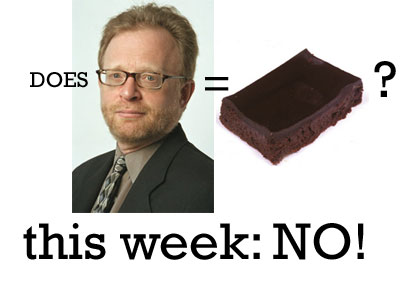
(Thanks, Kári!)
Bees in His Bonnet
Tomorrow’s Great American Novelists
James Tata reconsiders that particular strata known as the mid-career (b. 1960 or thereabouts) Great American Novelist. It is, of course, most regrettable that Age should matter, but with so many GANs dropping off of late (Vonnegut, Mailer, et al.), one wonders who will be taught in tomorrow’s classrooms. The current crop identified by Mr. Tata do in part fall into a certain rubric of, as he suggests, “nothing more than comic book characters and escapist fantasy,” which suggests a new concern for the next hopeful pantheon. But this “hopeful” qualifier presumes that these writers care about being listed in syllabi, much less proscribing their concerns for what is Important Literature by writing Serious Novels. So I put forth the question to the peanut gallery: Who, born between the years of 1960 and 1970, has a shot at being tomorrow’s Great American Novelist? Is the list that Tata offers the True List? Or is it too early to tell? Has literature become something too specialized to make such a judgment call? (I respond “yes” to the last rhetorical question, but I don’t necessarily think that this is a bad thing.)