Ryan Wild: Mastodon Fascist, Tendentious Universeodon Admin, and Enemy of the Fourth Estate

Ryan Wild is a wildly arrogant and deeply manipulative despot who lives in Swindon — a town in England’s Wiltshire district. He operates out of the Highworth borough, which voted for Conservative Vijay Kumar Manro as Borough Councillor in the last election. Wild, who has the husky well-fed mien of a man who has never known a day without a hot meal, will turn twenty-six next month. Like any garden-variety huckster, Wild is an “entrepreneur” who wants you to buy into his dubious hosting services and support his Mastodon instance Universeodon or his other instance Mastodon App UK, which was home to British cultural treasure Stephen Fry until Fry stopped posting sometime last year. (For those not in the know, “instances” are servers that are interconnected with each other on Mastodon. When I was on Wild’s instance, I did chip into his Ko-fi account and had planned to chip in more. Because I’m always happy to pay the people who keep the lights on. This effectively placed me within only 2.7% of the active users on Universeodon.)

But don’t think for a second that Wild has your best interests at heart. He is fundamentally opposed to any creator — especially journalists — who point out the iniquities and injustice carried out by the ruling class. Particularly if you are critical of Israel or people in power. On October 11, 2021, when Google offered free security keys for elected officials and journalists (historically speaking, both of these classes have faced significant harassment and, with heightened extremism in the United States, this has only escalated) to provide better security to elected officials and journalists, Wild had zero sympathy and called such protection “a huge waste of money.” He is also an avowed Brexit supporter and has also claimed that Hitler “should have been in power” because he was “legally voted in,” a colossal misreading of history that came laced with Wild significantly understating Hitler’s evil by saying “what he did was wrong yes.” Which is a bit like suggesting that the flooding that ravaged China in July 1931 and killed four million people was “just a tiny little rainstorm.” (Never mind that Hitler was defeated by Paul von Hindenburg in the 1932 Weimar Republic presidential election and that, as any high school graduate should know, Hitler manipulated his way into the Chancellor seat, taking only a few months after that to suspend civil liberties for all Germans and become dictator.)

(Mr. Wild did not return multiple requests for comment on this story over the course of five days. I emailed him at every address that was publicly listed for him and his business ventures. Then he blocked my main email address when I sent him a followup message — this when I was nothing but polite and respectful in my correspondence. (An email sent from another account went through.) Just before the deadline I gave him to reply to my questions was about to pass (and I would have been happy to grant him an extension to answer if he had simply asked), Wild claimed that he was sick. If he is indeed sick, I truly do wish Mr. Wild a healthy recovery. This still doesn’t explain why he blocked my email address before he was sick. After this article was published, in a futile attempt to discredit my good faith efforts to get him on the record, Wild claimed that his Mastodon UK email was not working. But I also contacted Wild at the very Atlas Media Group email address he cites in his post.)

In short, this diminutive businessman — this bright vanilla chunk of ice cream scooped ignominiously onto a slice of pumpkin pie — has no problem covertly upholding right-wing sentiments and shutting down left-wing ones when he’s not preventing users from accessing vital news. He has blocked numerous journalists from being seen by users on his instance. And if, heaven forfend, you make a mocking post against the rich, as one trans woman did, Wild will close your account faster than Anthony Comstock opposing the suffragettes in the late nineteenth century.

Wild risibly and falsely claims on the Universeodon about page, “From exploring the universe, to exploring the world we all share – everyone is welcome here.”

This, of course, is a lie.

To a great degree, one can sympathize with Wild and any other instance admin on Mastodon. Admins are usually hosting servers on their own dime, often at a loss, and, as X (previously known as Twitter) increasingly hardens into a toxic wasteland under Elon Musk, these admins are being besieged by thousands of new users. If an instance does have a moderation team, it usually consists of unpaid volunteers, who may tender false flags at the end of a long and exhausting day. But as the Fedeiverse — the collective network of instances connected to each other — burgeons into what many declare to be a calmer and more viable open source alternative to BlueSky, Threads, and X, it’s important to consider how certain biases from admins are contributing to a form of fascism rather than democracy, where viewpoints from the marginalized or those who don’t fit so neatly into an affluent Caucasian neoliberal box often struggle to have their vital voices heard. And, in Wild’s case, his clearly tendentious biases and elastic approach to moderation has resulted in a form of odious muzzling that is no different from the way that the Nazis demonized Black music that had flourished so beautifully in Berlin before 1933 or the way that, more recently, the Taliban has silenced Afghan journalists. If one of the most awe-inspiring realizations of the Internet is being exposed to marginalized voices and realizing that we all have far more in common than we know, then Mastodon — at least under the sloppy and corrupt hands of admins like Ryan Wild — is far from the great ideal that its most prominent boosters insist that it is.

Not unlike Elon Musk suspending numerous journalist accounts in December 2022, Wild is so fundamentally opposed to the noble efforts of the Fourth Estate that he has invented reasons to block journalists on his instance. He has claimed, without a shred of evidence, that newsie.social — an instance in which journalists valiantly report from all corners of the globe — supports “transphobic content.” (In fact, the newsie.social rules make clear that transphobia is explicitly prohibited.) So this means that anyone with a Mastodon account on his instance cannot access invaluable posts from the likes of ProPublica, which rightfully won a Pulitzer Prize last week for its valiant coverage of the Supreme Court. As William Maggos noted in the same thread, this was clearly a pretext to silence “commentary against the Israel govt.” (Requests for comment from newsie.social were not returned.)

Back in February, Jeffrey Phillips Freeman — who runs an instance devoted to the Assn for Computing Machinery — complained to Wild that his instance was wrongly included on what he deemed a “notoriously abusive” block list. Even when pointing to examples of how he had blocked racists, Freeman was gaslighted without full context. (Freeman was kind enough to return my request for comment and informed me that the meetings he had with fellow Fediverse boosters were quiet but that “bad actors” were a problem. I pressed him on a hypothetical, asking him what he would do if, say, J.K. Rowling created a new account on his instance and started posting TERF content, but he did not reply.)

But bad actors — in addition to disrupting thoughtful and civil meetings hoping to actualize a tech utopia dream — do become instance admins. And bad actors very often recruit other bad actors, as Wild did when — as Alan Jenkins pointed out on November 16, 2022 — he recruited a moderator named @lyicx, who used words and terms associated with the alt-right. (When called out on this in a followup thread, @lycix hurled abuse at Jenkins.) Ryan Wild is almost certainly operating his instance with the intent of propping up voices he agrees with and gagging any rules-abiding user he personally disagrees with.

A detailed examination of Wild’s Twitter feed reveals Wild to be a shady right-winger who cloaks his Tory loyalism behind centrist “common sense” claptrap and who appears to be thoroughly opposed to the vital practice of critical thinking. In a January 21, 2017 tweet, Wild claimed that criticism of Trump and Brexit was invalid until the policies were enabled. In other words, Wild declared that policies enacted on xenophobia should not be questioned until they “actually [did] something worthy of critique.” Likewise, on January 21, 2017, he believed that Trump should not be judged as President until he had been office. Never mind that the perspicacious Naomi Klein has written an invaluable book, No is Not Enough, that offered smart reasons why Trump and his cronies should be judged before his disastrous administration had started. To offer some defense for Wild, on September 8, 2019, Wild expressed some mild concern for policies that are “treasonous” and once compared Conservatives to “petty little children who haven’t gotten [sic] their own way.” But he also once described the Labour Party as possessing “shite leadership.” Yet on March 14, 2020, at the start of the pandemic, Wild expressed far too much faith in Boris Johnson’s abilities to contend with it. The portrait that Wild has presented of himself is that of a company man who lacks the spine or the moral conviction to criticize governmental policies and who resents anyone who does.

Wild is able to get away with his censorship on the sly because, while he’s been ardently and rightly opposed to transphobia in other contexts, he has, like any spineless and well-trained neoliberal, learned to pay shrewd and performative lip service to humanism, even as he covertly suspends accounts that are critical of Israel — even when these accounts abide by his rules. It’s one thing to claim to be for LGBTQIA rights. It’s another thing altogether to muzzle the very LGBTQIA voices that you profess to be “for” — because you are fundamentally uncomfortable with the perspectives they have to offer. (This has also been a problem among Black users of Mastodon as well. Black users are theoretically “welcomed” by the largely white admins, only to have their accounts suspended without warning. Or, as the user Ra’il IK quipped on X last November, “Welcome to the ‘I am Black and suspended by Mastodon with no warning and no process’ club!!!!!!!”) Ryan Wild is, in short, the walking and talking embodiment of George Orwell’s “All animals are equal, but some are more equal than others” line. One can logically infer that, as far as Wild is concerned, criticizing the rich or those who launch unprovoked attacks into territory populated by marginalized starving people makes one a lesser “animal.” And, sure, Wild is all too happy to rightfully protest web hosts that claim perpetual commercial rights over all hosted content (well, not so much a protest, as an opportunity for him to pimp his far from “Superior” goods), while simultaneously succumbing to similar tyrannical proclivities himself. If you are a writer like me, it is an act of thuggish and shameful dehumanization to have one’s work deleted or “suspended” without warning. Especially since I would have been more than happy to address any concerns and strike a mutually agreeable resolution, had I been given the heads up.

I greatly enjoyed my time on Mastodon. Numerous journalists and writers became mutuals. Despite the fact that I am a pugnacious (and some would say obnoxious) middle-aged punk, I didn’t get into too many fights — in large part because the user base (including myself) wanted to create a more thoughtful alternative to the mephitic online hellscapes of X and BlueSky. And I learned so much from everyone. People helpfully offered corrections when I was conducting what used to be known as “live tweeting” on Mastodon in relation to unfolding events, which I was happy to amend. And you know what? The user who initially expressed umbrage with my minor mistake and I became mutuals. But because Ryan Wild is so fundamentally opposed to the democratic possibilities of the delightful discussions which spring from people with other viewpoints, this man suspended my account on Tuesday afternoon under flimsy pretext and without warning and has proven indifferent and unresponsive to my efforts to resolve what I had hoped was simply a colossal misunderstanding. With Wild’s inexplicable ban of my main email address, this now appears to be a deliberate effort to target and silence me because of my progressive politics and the fact that I am not shy about speaking out against bad actors in prominent positions of power. And if you’re setting up a new Mastodon account, I would highly advise you to not use Universeodon. If you’re on Universeodon right now, I strongly urge you to switch to another instance before Wild shuts you down too. (Here’s a helpful guide on how to switch Mastodon instances.)

Last year, I had selected Wild’s instance at random. George Takei — a man whom I have admired and respected since watching Star Trek reruns as a kid — was on Universeodon. (Years ago, I once received an incredibly kind email from him, to which I naturally shouted “Oh my!” with great enthusiasm. So Takei is forever brokered in as one of the Cool Cats.) I figured that any instance that was good enough for this national treasure was good enough for me.

But my random decision turned out to be a tremendous mistake.

On Tuesday afternoon, as I was trying to report on a Zionist extremist who drove his car into peaceful Columbia protesters, I was shocked to learn that my Universeodon account was suspended. Now I’m no stranger to this elastic approach to moderation. After I had reached more than 40,000 followers on TikTok for my mix of leftist politics and surreal comedy, the moderators there invented excuses to ban me, siding with the right-wingers who mass-reported me — much as Wild did to me on Universeodon. While I always abide by the rules of any social media platform I join and stand firmly against harassment, Wild had to go all the way back to January to invent an excuse to ban me. I had merely documented a vicious cyberbullying and harassing campaign against me on BlueSky (with screenshots and receipts). But Wild claimed that these posts, which were simply expressing disbelief that some unhinged tech person would libel me with lies for 96 posts within an eleven hour period — violated the rules on his instance and that I was the one somehow harassing people while documenting a very flagrant and coordinated harassment campaign against me that carried on long after I had deleted my BlueSky account. This was classic and predictable gaslighting against political opponents, in other words.

But if Wild is going to go back in time, then I suppose I should do the same with him. Nothing that I posted on his instance was even remotely close to the unhinged teenage angst he expressed on September 23, 2014: “You wounder why I get pissed off then you go ahead and act like a world class dickhead. Fuck you.”

My account — which was largely concerned with books, culture, politics, news, and reposts of goofy TikToks — remained fairly consistent throughout my run on Universeodon. The only thing that changed was that I was more vocal in my criticism of Israel in the last month. I challenged the propagandist Steve Herman (who, ironically, was one of the “journalists” banned by Musk on Twitter), who claimed that Columbia protesters were terrorizing Jewish students. But Herman is such a sloppy “journalist” that he refused to corroborate the provenance of the video he cited — even when he hadn’t been to Columbia (I had and reported on it via TikTok after talking with dozens of people (most declined to appear on camera, for understandable reasons), none of whom had seen any violent protesters). I directed Herman to the dubious source of said video and noted how nobody had looked into who was shouting and observed that the audio did not match the “transcript.” Unlike Herman, I did my best to ensure that the information I posted was correct.

Now I had contended with Wild’s love for defending authoritarian maniacs last September, when I posted a clearly satirical post against Elon Musk, protesting Musk’s anti-Semitism in particular and pointing out that Musk was so clumsy that there was a good chance that he could accidentally set himself on fire. But Wild, who has no sense of humor and who appears to have a dog whistle against anyone who protests racism or denigration of a particular group, fired a warning to me and refused to keep my post up. Fair enough. It’s his instance.

But he then claimed that details about George Mitchell that I posted — which were reported and sourced in Josh Ruebner’s excellent book Shattered Hopes — constituted “misinformation.” Regrettably, I cannot access my original post due to Wild’s gleeful zeal in scrubbing posts (with the additional advantage of removing evidence that makes him accountable), but I was able to find my response to him:
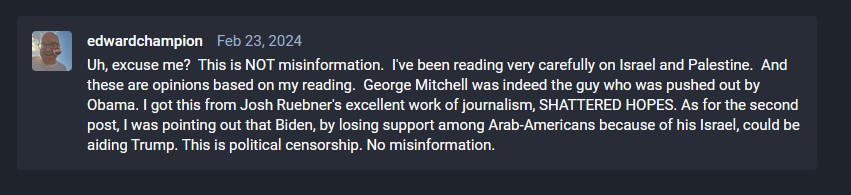
But by suspending my account and refusing to give me the benefit of the doubt, Wild was effectively deplatforming the modest but robust presence I had built on Mastodon.

In other words, Ryan Wild is very keen on cracking down on nearly anyone who conducts journalism and who points out social injustice. He is a Mastodon fascist. And I’d like to qualify that by citing Lawrence Britt’s 2003 article in Free Inquiry in which he identified up fourteen characteristics of fascism. Wild certainly seems keen on powerful and continuing nationalism with his low tolerance for anyone critical of the government and his apparent love for Brexit and Boris Johnson. In blocking journalists and those critical of Israel, he certainly has a disdain for the recognition of human rights. He’s certainly for a highly controlled instance and, much like Truth Social, he has recruited alt-right moderators to offer the illusion of free speech. And he obviously has a priapic zest for corporate power and the rich, as well as a disdain for journalists (and thus the intellectual pursuit of the real truth). And in my attempt to get answers from Wild, he has expressed a colossal arrogance towards me.

The upshot is that, if you’re going to choose a Mastodon instance, you now need to deeply research the admin and the moderators of that instance to ensure that they aren’t twisting the rules to silence your viewpoint — especially if you are not white and affluent.

Ryan Wild’s clear corruption betrays the utopian potential of the Fediverse, which is certainly not going to flourish very well with compromised moderation on Universeodon, Mastodon UK, and other instances that are covertly censoring certain political voices and perspectives.

5/11/24 4:00 PM UPDATE: Wild sent me an email after this article dropped. Unable to rebut any of the claims in this article, he has instead falsely claimed that I am doxxing him. All information about Wild in this article was pulled from public information that is easily Googleable within thirty seconds. To be clear, I am firmly against doxxing. I have never doxxed anyone. Mr. Wild is still invited to tender a response to this piece to correct any “misinformation,” but he seems more content to spread misinformation of his own:
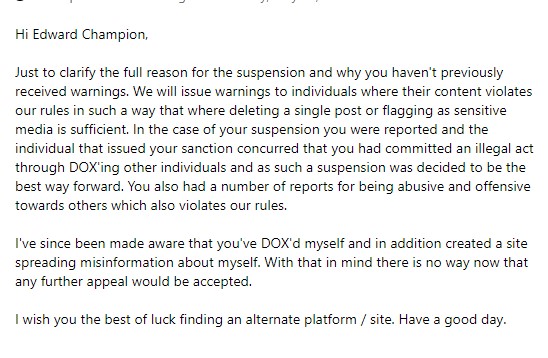
5/12/24 2:00 AM UPDATE: I arrived home from a very fun Saturday night out to discover more gaslighting from Mr. Wild, including a libelous claim that I am a “stalker,” as seen below:
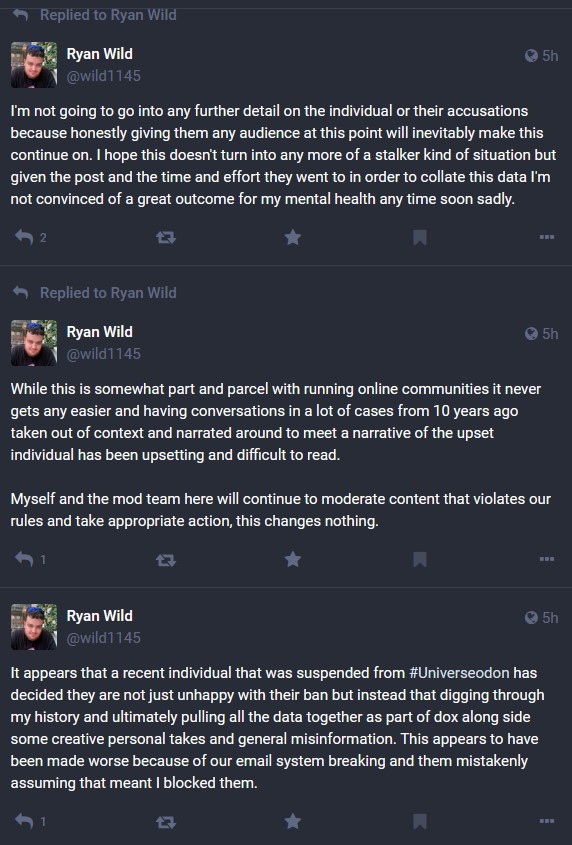
Mr. Wild was contacted in advance of this article at two email addresses (including his email at Atlas Media Group, which was not part of an “email system breaking’) with a request for comment. He chose not to reply. He was informed of many of the claims in this piece in advance of publication. He has yet to refute or rebut any of the allegations expressed in this story. And he continues to promulgate the outright lie that I have doxxed him.

To demonstrate that Wild’s location is public information, the Atlas Media Group website lists Ryan Wild as being in Swindon. His Keybase page lists him as living in Swindon. I have not doxxed him. Wild has been quite transparent about where he lives. I have included screenshots below:


Concerning Mr. Wild’s birthday, this too is public information. Like any human being, Mr. Wild has tweeted repeatedly that his birthday is June 6th. If Mr. Wild did not want anyone to know what his birthday is, then he should have said nothing. But given how much Mr. Wild has publicized his own birthday (indeed far more than I have), this cannot, by any stretch of the imagination, be called doxxing.

Once again, if Mr. Wild would like to rebut the claims in this piece, then I will be more than happy to append his remarks to this article.

I have also updated the main article to include Wild’s claims that his email was not working. Again, Mr. Wild was contacted in advance of this story’s publication through the very same backup email address (i.e., the working email) he cites in his post.
RIP Paul Auster (1947-2024)

Paul Auster, the ferociously ambitious writer behind such masterpieces as The Book of Illusions and Oracle Night, has passed away. He was 77 years old.

During the summer of 2008, on the occasion of Man in the Dark being published, I had the good fortune of interviewing Auster at his Park Slope home. He sized me up fairly fast with some off-tape banter concerning the most creative methods of scoring free and cheap drinks, which we both laughed about. And I think that’s why we probably had such a thoughtful conversation. I played my usual role of delivering questions for Auster to parry and punch through. That dynamic resulted in some revealing answers about his creative process, which was rightfully different from my speculations.

You can listen to the conversation by clicking on the Bat picture below.

Condition of Mr. Segundo: Opening himself up to explanation.

Author: Paul Auster

Subjects Discussed: Starting a novel from a title, the advance titles contained within The Book of Illusions, the working title of The Music of Chance, Mr. Blank, the relationship between Travels in the Scriptorium and Man in the Dark, shorter baroque novels vs. longer naturalistic novels, the use and non-use of quotation marks within speech, the writing history of The Brooklyn Follies, the political nature of ending novels, the 2000 presidential election, parallel worlds, the death of Uri Grossman, didactic novels, the comfort of books, the Auster eye-popping moment, the party scene in The Book of Illusions, violence, reminding the reader that he is in a novel, emotional states revealed through imaginary material, Vermont’s frequent appearance in Auster’s novel, Virginia Blaine as the shared element between Brill and Brick in Man in the Dark, magic, The Invention of Solitude, memorializing memory, Rose Hawthorne, website archives, Auster’s relationship with the Internet, having an email surrogate, Auster’s concern for specific dollar amounts in Man in the Dark and Oracle Night, Hand to Mouth, Auster’s reading habits, the 8-10 contemporary novelists Auster follows closely, being distracted, the intrusive nature of the telephone, diner moments in Auster’s most recent novels, perception and stock situations, summaries of books and films within Auster’s books, and intimate moments in great movies.

EXCERPT FROM SHOW:

Correspondent: I wanted to ask you about something that I’ve long been interested in your books, and that is your concern for specific dollar amounts. Again, it plays up here in the Pulaski Diner, where everything is five dollars. And I also think about the scenario with M.R. Chang in Oracle Night, in which there’s the whole situation between the ten dollar notebook and the ten thousand dollar notebook.

Auster: Right.

Correspondent: And again it becomes completely, ridiculously violent. But there is something about the propinquity of the dollar amount that you keep coming back to in your work. What is it about money? And what is it about a specific figure like this?

Auster: It’s funny. I never, never thought about that. Wow. Well, listen, money’s important. Everyone cares about money. And when you don’t have money, money becomes the overriding obsession of your life. I wrote a whole book about that.

Correspondent: Yeah.

Auster: Hand to Mouth. And the only good thing about making money is that you don’t have to think about money. It’s the only value. Because if you don’t have it, you’re crushed. And for a long period in my life, I was crushed. And so maybe this is a reflection of those tough years. I don’t know. I don’t know.

Correspondent: Or maybe there is something absurd about a specific dollar amount or something. I mean, certainly, when I go to a store and I see that something is set at a particular dollar amount or it fluctuates, it becomes a rather ridiculous scenario. Because all you want to do is get that particular object.

Auster: Yes, yes, yes. But often in my books, people don’t have a lot of money in their pockets. So they have to budget themselves carefully.

Correspondent: Well, not always. You tend to have characters like, for example in The Brooklyn Follies, people who have a good windfall to fall back on and who also offer frequently to help pay for things, and their efforts are often rejected out of pride by your supporting characters. And so again, money is this interesting concern. But I’m wondering why you’ve held on to this notion. It’s now thirty years since the events depicted in Hand to Mouth. I mean, is this something you just haven’t forgotten about?

Auster: I guess I haven’t forgotten about it. (laughs)

Correspondent: Do you still pinch pennies to this day?

Auster: No, no, no. Not at all. No, I’m not a tightwad at all.

Correspondent: (laughs)

Auster: I’m generous. I give good tips. It’s just — the way I live my life, ironically enough, is: I don’t want anything. I’m not a consumer. I don’t crave objects. I don’t have a car. We don’t have a country house. We don’t have a boat. We don’t have anything that lots of people have. And I’m not interested. I barely can go shopping for clothes. I find it difficult to walk into stores. The whole thing bores me so much. I guess the only thing that I spend money on is cigars and food and alcohol. Those are the main expenses.

Correspondent: Not books?

Auster: No. Because our library in the house is so bursting, we have no more room. We have things on the floor. And books come into the house at the rate of — you see, three came today for example. I’m pointing to them on the table. So we’re just inundated with books.

Download BSS #231: Paul Auster (MP3)

This text will be replaced

Steve Halloran: A Rape Fantasist and White Nationalist Unfit to Hold Political Office in Nebraska

Meet Steve Halloran, State Senator for the 33rd District of Nebraka. Objectively speaking, Halloran can be sufficiently described as a 75-year-old fossil, a misogynistic pettifogger, and a walking and talking colostomy bag who slips and saunters around Lincoln with the slimy telltale mien of an impotent man popping Cialis every hour in his futile attempt to revive his unresponsive and forever diminutive chorizo. When not introducing measures ensuring that hate groups drown out liberal voices or using “Nebraska nice” to defend fascism, this detestable autocrat can be seen in photographs smiling like a squealing pig while standing next to Nazis. He is so rigidly opposed to the rights of women that, in 2017, he was one of only three senators to vote against a measure that would have required schools to build accommodations that would help mothers breastfeed their children. And he is so hateful of working stiffs that, in March 2019, he opposed increasing the minimum wage for tipped workers.

Halloran’s hideous combination of misogyny and stupidity is so deeply ingrained into his evil reptilian core that he actually had the temerity to declare last year that rape did not induce pregnancy: “No one’s forcing anyone to be pregnant. Pregnancy’s a voluntary act between two consenting adults.”

Indeed, rape seems to be the only topic that fuels Halloran’s diseased and dimwitted imagination.

But on Monday morning, as the Nebraska State Senate was discussing Legislative Bill 441, this baleful man did the unthinkable. The bill in question targeted “obscenity and pornography” in K-12 schools. And Halloran, who possesses the crusty gusto of a crested gecko, read a passage from Alice Sebold’s Lucky that described a rape. And he inserted the name “Senator Cavanaugh” (likely, that of Senator Machaela Cavanaugh, who is a Democrat) into the excerpt. (The full video can be found here.) Halloran is not a very good reader, but that should not detract from the full scope of this bastard’s completely unacceptable rape fantasy. Here is the full transcript:

Something tore. I began to bleed there. I was wet now, Senator Cavanaugh. I’m excited. I made him excited. He was intrigued and worked his whole fist into my vagina and pumped it. And it went into….it went into my brain. Stop staring at it, he said. I’m sorry, I said. You’re strong. I tried. I liked it. He started pumping me, pumping me again, wildly. The base of my spine was crushed into the ground. Glass cut my back and behind. He kneeled back. Raise your legs, he said. Spread them. Give me a blowjob, he said. [At this point, Halloran emphasized “blow,” almost as if he was confessing a secret fantasy.] He was standing now. I was grounded on the ground, trying to search about, uh, the filth on my clothes. He kicked me and I crawled into a ball. I want a blowjob, Senator Cavanaugh. He held his dick in his hand. I don’t know how, I said. What do you mean you don’t know how? I’ve never done it before, I said. I’m a virgin. Put it in your mouth. I kneeled before him, Senator Cavanaugh.

There are exactly zero circumstances in which such a performance is acceptable in political life. While Halloran did apologize on Tuesday, the easy and eager lust with which this abhorrent windbag transposed Senator Cavanaugh’s name into this passage needs to be answered with considerably greater consequences. It is incumbent upon the good people of Nebraska to turn this man’s life into a miserable and neverending hell, to protest Halloran at every public appearance until this unqualified reprobate resigns from office.

At the very least, Halloran should know what it feels like to have one’s name inserted into literature like this. I’ve taken the liberty of working Halloran into a passage from Alan Hollinghurst’s The Folding Star — an iconic and pioneering work of gay fiction:

I fucked Steve Halloran across the armchair, his feet over his shoulders; I had to see Steve’s face and read what I was doing in his winces and gasps, his violent blush as I forced my cock in, the quick confusion of welcome and repulsion. I’d used up all the lube Cherif had left in the jar, but I saw tears slide from the corners of Steve’s eyes, his upper lip curled back in a gesture like anguish or goaded aggression.

If you’d like to tell Steve how you feel about his boorishness, his contact information is here. Take the most disturbing passages in fiction, pop Steve’s name in, and give his office a call! I’m sure it will liven up the days of his staffers and offer the proper context for Steve’s rock-soft ardor for literature.

The Gnostic Gospels (Modern Library Nonfiction #72)

(This is the twenty-ninth entry in The Modern Library Nonfiction Challenge, an ambitious project to read and write about the Modern Library Nonfiction books from #100 to #1. There is also The Modern Library Reading Challenge, a fiction-based counterpart to this list. Previous entry: James Joyce.)

As I write these words — some eight months before a fateful presidential election threatens to steer my nation into a theocratic hellscape that will permanently erode many of the liberties and freedoms I have been humbled to partake in for cnearly fifty years — the tireless researchers at PRII inform me that Christian nationalism has substantive support in all fifty states (with the exception of California, New York, and Virginia — in which 75% remain skeptics or outright reject it), the Pew Research Center reports that 45% of Americans believe that our democratic republic should be “a Christian nation,” and 55% of Latino Protestants support Christian nationalism. Blind zealotry, even with white supremacy mixed into the sickening formula, comes in many colors.

Undoubtedly, many of these hayseed fanatics are easily manipulated and illiterate. They conveniently overlook the “love thy neighbor” ethos from Western civilization’s best known zombie in favor of a greater affinity for the limitless imbecility of zealous violence and tyranny, falsely believing themselves to be misunderstood rebels living in a new Roman Empire — this as the very institutional framework continues to uphold their right to yap and bellow in hateful and discriminatory terms as they line the pockets of wealthy telegenic carpetbaggers like Joel Osteen. They lead campaigns to ban books and to deracinate vital areas of knowledge from schools which offend their delicate and autocratically vanilla sensibilities. While the Book of Luke informs us that Christ asked us to “love and pray for our enemies,” you will find these unremarkable lemmings keeping their traps shut as trans kids commit suicide or another maniac massacres dozens in the week’s latest mass shooting. (Unable to summon true comity for anyone who deviates from their ugly and crudely formed politics, right-wing statesmen have substituted “love” for “thoughts,” presumably so they can show up to church on Sunday with a “clean” Christian conscience — even though they do nothing to curb this malignant cancer and care no more for these victims than any garden-variety sociopath.)

It has frequently been observed that atheists like myself know the Bible better than these monomoniacal morons. I have often been surprised by how easy it is to thoroughly rebut some born-again loser based on a singular reading of the King James more than twenty years ago and my apparent recall of specific passages that are well outside the soft and useless hippocampi of my hopelessly dim opponents. It never occurs to Christians to question their faith or even to comprehend (much less read) the very words they purport to uphold in their everyday living. And it certainly wouldn’t occur to them to consider that, much like any moment in history, the narrative and the very belief structure upholding this nonsense was written by the winners, by those who spent the majority of their lives silencing (and even murdering) anyone who offered perfectly reasonable questions about a man who rose from the dead.

Elaine Pagels’s excellent book, The Gnostic Gospels, is an equitable study of the many Gnostic sects that dared to question the Christian status quo. Indeed, had not the 52 treatises been discovered in Nag Hammadi in 1945, there is a good chance that many of us who tirelessly call out bullshit on all fronts would have lacked a far more seminal faith than one in Christ — namely, a boundless pride in our ancestors practicing the vital art of critical thinking.

The orthodox position of the Resurrection, as defined by Tertullian, is quite clear. Jesus Christ rose from the dead with full corporeal gusto. It was “this flesh, suffused with blood, built up with bones, interwoven with nerves, entwined with veins” (one might add “consummated with claptrap” and “molded with malarkey” to this laundry list). Tertullian further adds, “it must be believed, because it is absurd!” And, look, I’d like to believe in kaiju secretly emerging from the oceans to stomp on every megachurch from here to Alpharetta, Georgia, but I have confined my love for absurdity to my deviant imagination and my performative antics on TikTok.

What’s especially astonishing about Tertullian is how literal he is. The New Testament is ripe with stories in which Jesus’s disciples are invited to prod and touch the newly reanimated corpse. (There is curiously nothing in the Bible in which anyone asks Jesus about why he doesn’t carry the pungent smell of the dead or how the bearded wonder managed to rid himself of all the maggots gnawing at his decaying flesh.) And yet Pagels points out that not every story within the New Testament aligns with Tertullian’s “my way or the highway” interpretation of full-fledged concrete return. Acts 9:3-4 informs us that Christ’s Resurrection is merely “a light from heaven” with a voice. Acts 22:9 even points out that some observed the light, but ‘heard not the voice that spake to me.” And if that’s the case, would Tertullian have declared the Apostles heretics? In Acts, Christ’s “return” sounds very much like a low-rent Vegas act without a PA system.

And that’s just in the Bible, folks! I haven’t even snapped my fingers to summon the Gnostics on stage. Depending upon what part of the Bible you read, it is either Peter or Mary Magdalene who first sees Christ rise from the dead. Paul tells us that Christ said hello to five hundred people all at once. And if we take that literally, any of us could now do the same thing on social media. Pagels informs us that from the second century onward, “orthodox churches developed the view that only certain resurrection appearances actually conferred authority on those who received them.” And just like that, the manner in which you contend with Christ’s reappearance isn’t all that different from telling the right story to some bouncer on a Saturday night to slip past the velvet rope!

Believe in the power of this two-bit magician and the terms of the deal, as set up by Luke, are as follows: Christ returned from the dead, walked the earth for forty days, and then rose to the heavens in a bright coruscating light. This may not have the razzle-dazzle of Cirque du Soleil, but it is a belief that has nevertheless been swallowed whole and without question by generations of gullible rubes.

The Gnostics were the first to call this “the faith of fools.” In The Acts of John, one of the rare Gnostic texts that survived before Nag Hammadi in fragmented form, John offers the completely reasonable argument that, because Christ did not leave any footprints, he could not possibly be human, but spiritual. The Gnostics clearly had a more sophisticated interpretation of the Resurrection: it was not the literal observation of Christ’s Resurrection that counted, but the spiritual meaning behind it. But the underlying facts didn’t matter nearly as much as winning over the authorities who conferred you with a position of trust:

Consider the political implications of the Gospel of Mary: Peter and Andrew, here representing the leaders of the orthodox group, accuse Mary — the gnostic — of pretending to have seen the Lord in order to justify the strange ideas, fictions, and lies she invents and attributes to divine inspiration. Mary lacks the proper credentials for leadership, from the orthodox viewpoint: she is not one of the ‘twelve.’ But as Mary stands up to Peter, so the gnostics who take her as their prototype challenge the authority of those priests and bishops who claim to be Peter’s successors.

It thus became necessary for the Gnostics to expand authority to those who stood outside the Twelve. Some Gnostics were generous enough to ascribe VIP treatment to the Disciples, claiming that they had received the kind of custom vision that is a bit like the gift you receive nine months after you donate to a Kickstarter campaign. But as you can imagine, all this resulted in many elbowing their way into a vicious power grab over which interpretation of the Resurrection represented the “true” belief. And there was another important consideration. If Christ himself served as the truest source of spiritual authority, who then would be the authority in the years after his crucifixion and his “Hey there, baby!” sojurn from the great beyond?

The more bellicose strains of Christianity continue to endure in large part because a belief in Christ conveniently allows you to disguise your own sinister lunges for power. Enter Pope Clement I, who was arguably the first significantly ruthless monster who saw an opportunity. Clement insisted that, in the absence of his august presence, God delegates his authority to the “rulers and leaders on earth.” Naturally, these “rulers and leaders” were bishops, deacons, and priests. And if you didn’t bend at the knee to these sham practitioners, then Clement stated, with his great gift for speaking without nuance, that you would receive the death penalty.

Of course, this raises the question of whom you can trust within the church: an issue that has become evermore important given the decades of sexual abuse carried out by men of the cloth within the Catholic Church. A bloodthirsty fellow by the name of Irenaeus succeeded in widening the divide between orthodoxy and the Gnostics by suggesting that any interpretation existing outside Clement’s stern terms was not only heretical, but originated from Satan himself, thus paving the way for Christians to denounce any belief or behavior they disagreed with as “Satanic” over the next two thousand years. Over the years, they proceeded to execute innocent women in Salem and imagine Satanic messages in records.

These developments spelled trouble for the poor Gnostics. Within a few centuries, their texts were buried and destroyed. Their reasonable questions and liberal interpretations became casus belli to string them up. The Christians had the good sense to market themselves as victims persecuted by the Roman Empire and they began to realize sometime in the second century that pointing out how Christians suffered was a great draw for new acolytes. (Eighteen centuries later, Israel would employ the same tactic: use the suffering from the Holocaust to recruit Zionists, where they could then justify the seizure of Palestinian land and the mass-murdering of children on the Gaza Strip.) All this is a pity. Because the Gnostics were often far more interesting in their radicalism and their creative liturgical analysis than what we find in the so-called Holy Book. Consider The Gospel of Philip‘s inventive spin on the virgin birth. How can the Spirit be both Virgin and Mother? By a union between the Father of All and the Holy Spirit. And unlike the Christians, The Gospel of Peter ascribed a third quality to the Divine Mother (the first two being the Silence and the Holy Spirit): Wisdom, clearly delineated as a feminine power.

It is a testament to Christianity’s enduring evil that few people listen to the Gnostics in the twenty-first century. But if their reasonable transposition of literal interpretation to metaphor had become the more dominant text, it is quite possible that the millions of nonbelievers who died during the Crusades might have survived and that the present plague of Christian nationalism, which remains highly dangerous and ubiquitous in our dystopian epoch, might have nestled into the less injurious category of “optional only.”

{Next Up! William H. McNeill’s The Rise of the West!)

The Moviegoer (Modern Library #60)

(This is the forty-first entry in The Modern Library Reading Challenge, an ambitious project to read the entire Modern Library from #100 to #1. Previous entry: Death Comes for the Archbishop.)

There are many go-nowhere men like Walker Percy’s Jack “Binx” Bolling in American life: the type who creates nothing and who lives like some vaguely seedy salesman overly concerned with easy comities and sartorial aesthetics, the quasi-urbane man who, at his worst, is so terrified of even remotely staining his choppers that he slurps nothing but colorless sugar-free smoothies for breakfast, lunch, and dinner. I can’t say that I’ve wanted to spend a day (much less a life) like this. I am too much of a creative, feverishly curious, and pro-active man with a formidable work ethic and a great brio for life (and all of its attendant messes) to do so, but I do have my moments when I feel the draw to lie in bed for hours and listen to the beautiful rap of rain against my window pane, which is certainly a more human pastime than sucking on the cheap glass teats of television and being extremely online. Then I come to my senses and realize that I do need to make something that day, with the fulsome freedom of not needing approbation, so that I can sleep better at night and feel some self-respect — a drive for independence and authenticity that is decreasingly shared by my fellow Americans as the apocalyptic headlines lull many formidable workhorses into permanent or partial fatigue. I don’t blame anyone for slumming it. This is an exhausting asceticism for anyone to practice and the prolificity that results from my febrile commitment is probably one reason why some people fear me.

But poor Binx Bolling has nothing like that, which is why I find him so interesting and why I find Walker Percy’s The Moviegoer to be more weirdly meaningful with each fresh reeread. Absent of any real purpose, Bolling spends much of this plotless novel trying to shoehorn his rudderless life into something, particularly a “search,” which is not really a search for anything. He seems unwilling to ride or die with unconscious instinct, with the sheer enjoyment of being alive. (Typical of Bolling, he has no allegiance. At one point, he even declares himself “Jewish by instinct.”) He recognizes that instinct is something that people possess, but that doesn’t seem enough for him:

At the great moments of life — success, failure, marriage, death— our kind of folks have always possessed a native instinct for behavior, a natural piety or grace, I don’t mind calling it. Whatever else we did or failed to do, we always had that. I’ll make you a little confession. I am not ashamed to use the word class. I will also plead guilty to another charge. The charge is that people belonging to my class think they’re better than other people. You’re damn right we’re better. We’re better because we do not shirk our obligations either to ourselves or to others. We do not whine. We do not organize a minority group and blackmail the government. We do not prize mediocrity for mediocrity’s sake…Our civilization has achieved a distinction of sorts. It will be remembered not for its technology nor even its wars but for its novel ethos. Ours is the only civilization in history which has enshrined mediocrity as its national ideal.

But is this really so “better”? This is fairly similar to Holden Caulfield’s insufferable kvetching, except that it is far more fascinating because Bolling, unlike Caulfield, is more actively self-aware and constantly observant of others. He chooses to think and feel this way. It is what I call the “fuck my life” look that you see on people’s faces after they have given up on any dreams after the age of forty.

While the Binx Bollings of our world are capable of a few spontaneous decisions and may possess some cultural tastes and perhaps a soupçon of passion, they differ from the “slacker” types that Richard Linklater rightfully celebrated in his wonderful 1991 film in that exuberance is often absent and there isn’t an unusual nobility or even an ethos to their indolence. (And I would contend that Bollling’s “novel ethos” is a false one. For he says this when he has nothing in particular he is striving for. And those who strive for something rarely have a mediocre ideal in mind.)

The Binx Bollings simply live and that’s about it. They are, in short, working stiffs and the burden of surviving is often too much to do much more than that. You’ll find them represented in varying shades within Richard Yates’s Revolutionary Road, Richard Ford’s Frank Bascombe books, John Kennedy Toole’s A Confederacy of Dunces, Frederick Exley’s A Fan’s Notes, John P. Marquand’s The Late George Apley, Sam Lipsyte’s Homeland, Richard Russo’s Nobody’s Fool, Stewart O’Nan’s Last Night at the Lobster, and John Williams’s Stoner. And while I have no desire to leave out women in my literary consideration, yes, the fear of becoming “mediocre” or “detached” like this — the natural “evolution” of Dostoevsky’s “Underground Man” or what Colin Wilson unpacked in The Outsider — does seem to be an overwhelmingly male concern. Contemporary novelists as brilliant as Adelle Waldman, Kate Christensen, and Lauren Groff (you should very much read their work too) have also tackled this to great effect, although they are usually more interested in effect rather than cause or state and the vicarious first-person experience is of less importance. Think of the way that the characters in Edith Wharton, Muriel Spark, and Iris Murdoch (all literary queens who I will enthuse about to my dying day!) are so much more alive than the Binx Bolling type. I also can’t help but think of the way Ross McElwee (also a man of the South) brilliantly and vulnerably put himself front and center in such a way with his fascinating series of personal documentaries. Updike, in particular, was one of the foremost literary Johns drawn to these men and he nimbly spoke to American readers who recognized the telltale cadences of Durkheimian anomie.

Which is not to negate the quotidian struggles of the Binx Bollings. The miracle of Percy’s novel is that we’re still with him on his journey despite all this. Still, it often never occurs to these types to pay attention to the “beloved father” or “husband of X” found so ubiquitously on tombstones, which matters so much more than the roll of a Taylorist scroll memorializing an endless concatenation of checked off tasks. The worst of these aimless men possess no sense of humor and somehow transform into a homely insectoid creature worse than anything that ever bolted upward from Kafka’s imagination, a listless monstrosity commonly referred to as a “critic.” The critic, who is often a cretin, is a pitiful and unsmiling quadraped incapable of expressing joy, much less stridulating his legs together to make a pleasant sound in springtime.

And while we’re on the subject of bugs, as it so happens, there is a cameo appearance from a coterie of creepy-crawlies in Walker Percy’s The Moviegoer that saunter right past our malaise-fueled man Binx: “They dive and utter their thrumming skonk-skonk and go sculling up into the bright upper air.” Percy’s emphasis on sounds and gerunds here really says it all. That same whirlydirsh language is often beyond poor Binx.

* * *

The source for Boiling — as well as Williston Barrett, a Percy protagonist who would be explored in two stages of life (youthful folly and middle age) in, respectively, The Last Gentleman and The Second Coming) — was Percy’s essay “The Man on the Train” (collected in The Message in the Bottle) — in which Percy firmly established the type of protagonist he was interested in writing about:

There is no such thing, strictly speaking, as a literature of alienation. In the re-presenting of alienation the category is reserved and becomes something entirely different. There is a great deal of difference between an alienated commuter riding a train and this same commuter reading a book about an alienated commuter riding a train….The nonreading commuter exists in true alienation, which is unspeakable; the reading commuter rejoices in the speakability of his alienation and in the new triple alliance of himself, the alienated character, and the author. His mood is affirmatory and glad: Yes! that is how it is! — which is an aesthetic reversal of alienation.

In other words, Percy could not bring himself to write about a character in unbearable despair (it is not an artistic focus for the faint of heart) — largely because his natural writing voice is driven by a fine comedic impetus, with the Catholic novelist’s concern for philosophy planting one foot in the wings and the other on stage. (Look no further than Antonia White, Gene Wolfe, and Graham Greene for similarly intriguing juxtapositions.) Much like Richard Linklater’s “slacker” archetype, Percy seeks to pursue the bare minimum of alienation, although, as can be seen with Dr. Thomas More in Love in the Ruins, Percy’s characters are more eggs-in-one-basket types (in More’s case, the Ontological Lapsometer that he sees as a decaying society’s cure-all) and less committed to the free-floating spontaneity of hitching a ride with strangers, taking the entire day to assemble an elaborate rock structure to represent femininity, or being interviewed for a film student’s documentary.

At this point, the gusto-driven reader may rightfully ask, “So why read about this?” For the same reason that we read about any “unlikable” character. This is a form of living, albeit while clutching the bottom of one’s hemp, that is part of the human experience. The eccentric film journalist Jeffrey Wells has recently suggested that the criteria of art (specifically movies) involves being put into “a kind of alternate-reality mescaline dream state.” And while escapism is certainly a dopamine-fueled pastime practiced by a population increasingly hostile to pleasurable cerebration, requiring little of the mind but an uncritical blank slate and a sybarite’s zeal for incessant orgasm, what of the wisdom picked up from raw human experience? Art gives us the advantage of having access to the interior thoughts and feelings of those we may be disinclined to meet in the here and now. Wells’s limited definition therefore nullifies Jonathan Glazer’s excellent film adaptation of Martin Amis’s novel, The Zone of Interest, which is nothing less than a vital and deeply horrifying atmospheric experience warning us of the shockingly pedestrian character of fascism, which is dangerously close to permanently destroying the very fabric of this bountiful nation should the Orange Menace emerge victorious in November.

Likewise, Walker Percy’s masterpiece is a similar (if less baleful) cautionary tale of what it means to coast and how commitment to something (or, in Bolling’s case, someone) represents the inevitable reckoning that anyone is fated to face at one point or another. It is a sneaky warning to anyone with true fuck-it-all drive that even the dreamer faces the risk of slipping into adamantine complacency and is ill-equipped to gently pluck a rose from the carefully maintained bush planted atop a Sisyphean alp.

The New Yorker‘s Paul Elie has smartly observed that The Moviegoer is curiously ahistorical: less taken with unpacking the neverending residue of the Civil War, racial tension, or other hallmarks found prodigiously within typical Southern fiction. The novel is also, by its own prefatory admission, an inexact version of New Orleans: far from meticulously recreated like Joyce’s Dublin, though not entirely fabulist.

But I do think Elie is a tad too dismissive of Southern inventiveness to suggest that Percy mined exclusively from the European existentialists to summon his vision of the unlived and shakily examined life — even though the debt to Kierkegaard is obvious in The Moviegoer (and in “The Man on the Train”), not just because of the opening epigraph:

As for my search, I have not the inclination to say much on the subject. For one thing, I have not the authority, as the great Danish philosopher declared, to speak of such matters in any way other than the edifying. For another thing, it is not open to me even to be edifying, since the time is later than his, much too late to edify or do much of anything except plant a foot in the right place as opportunity presents itself – if indeed asskicking is properly distinguished from edification.

But what is this search? I strongly recommend Rose Engler’s smart unpacking, which eloquently outlines the religious component that was dear to Percy, but there is something intriguingly postmodern about it. One of Percy’s early reviewers — Edwin Kennebeck in Commonweal — believed that The Moviegoer entailed a search not merely for meaning, but for something beyond despair. And there is something to this, given how Bolling categorizes the search early on as “what anyone would undertake if he were not sunk in the everydayness of his own life.” The movies that Bolling regularly watches do not present a true search. And, for Bolling, it can be argued that his search involves doing everything possible to avoid that search, even though he knows inherently that he must search. Denied definitive time and space by Percy, Bolling splits up his search into horizontal and vertical ones, framed without any proper construct from Eddington’s The Expanding Universe. He complains of his family not understanding his search. He searches for a starting point by scribbling in a notebook and, after all this “effort,” tells us, “The search has spoiled the pleasure of my tidy and ingenious life in Gentilly.”

Kenneback pinpointed, quite rightly, that Bolling’s decision to marry Kate represented “a search ended and an ordeal begun.” Belonging then, which most of us crave for and which Bolling is not especially good at, represents the cruel gauntlet thrown down by the universe. Bolling tells us, “Show me a nice Jose cheering up an old lady and I’ll show you two people existing in despair.” He believes that Kate sustains a look of being serious, “which is not seriousness at all but despair masquerading as seriousness.”

Perhaps we’re all pretending in one way or another as we saunter about this mortal coil. But the tragedy of Binx Bolling is that, even with his apparent religious conversion, he cannot seem to accept life at face value. But he is not the only one suffering. Kate has this to say:

“Have you ever noticed that only in time of illness or disaster or death are people real? I remember at the time of the wreck — people were so kind and helpful and solid. Everyone pretended that our lives until that moment had been every bit as real as the moment itself and that the future must be real too, when the truth was that our reality had been purchased only by Lyell’s death. In another hour or so we had all faded out again and gone our dim ways.”

If our presence here is indeed ephemeral, should this not provide greater motive to connect and to find joy? The Catholic mind, and thus the Catholic novel, is not without its involutions and contradictions.

Next Up: Max Beerbohm’s Zuleika Dobson!