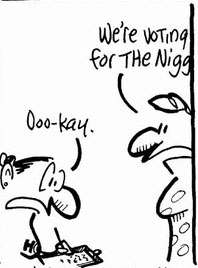
 I learned through The Beat (via Eric) that an installment of Keith Knight’s The K Chronicle has caused an uproar at the Montclair State University newspaper. Despite Knight basing his strip on a real-life incident and not even printing the full word in question, the editors of the student newspaper issued a campus-wide apology, with Montclarion editor-in-chief Bobby Melok stating, “It is never The Montclarion’s intention to offend its readership, and we sincerely apologize to all who were upset with this comic.”
I don’t know what’s more disheartening here: a newspaper of any sort lacking the courage to “offend” by depicting the truth or Melok’s current spinelessness-in-training, a passive-aggressive quality that will serve Melok well should he somehow nab one of the few jobs left at a Sam Zell-owned newspaper. To apologize for an artistic depiction of the word “nigger” (which, incidentally, never appeared in Knight’s strip in its entirety) is to draw greater attention to racial division, to give that word more significance than it deserves, and to suggest that anything probing into the cancer of racism is somehow racist. If anything, Melok should apologize for lacking the guts or the brains to determine what he deems appropriate. Melok went on to write, “We assumed because it was part of the syndicate, it was appropriate.” And I assume that because Melok assumes, Melok is incapable of the most elementary editorial judgment.
© 2008, Edward Champion. All rights reserved.


And, based on what I’ve just read, I assume your assumption concerning Melok’s assumption’s above reproach. (Bloody passive-aggressives; bane of my existence; but, this is beyond pukifaction.)
I so agree with you, Ed; and, not only should an apology be tendered, it should be accepted with grace and alacrity.