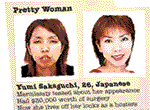
 Angry Asian Man points to this fascinating article on the booming plastic surgery in Asia: “The culturally loaded issue today is the number of Asians looking to remake themselves to look more Caucasian. It’s a charge many deny, although few would argue that under the relentless bombardment of Hollywood, satellite TV, and Madison Avenue, Asia’s aesthetic ideal has changed drastically. ‘Beauty, after all, is evolutionary,’ says Harvard psychology professor Nancy Etcoff, who is the author of Survival of the Prettiest: The Science of Beauty?not coincidentally a best seller in Japan, Korea, Hong Kong and China. Asians are increasingly asking their surgeons for wider eyes, longer noses and fuller breasts?features not typical of the race. To accommodate such demands, surgeons in the region have had to invent unique techniques. The No. 1 procedure by far in Asia is a form of blepharoplasty, in which a crease is created above the eye by scalpel or by needle and thread.”
© 2003 – 2005, DrMabuse. All rights reserved.