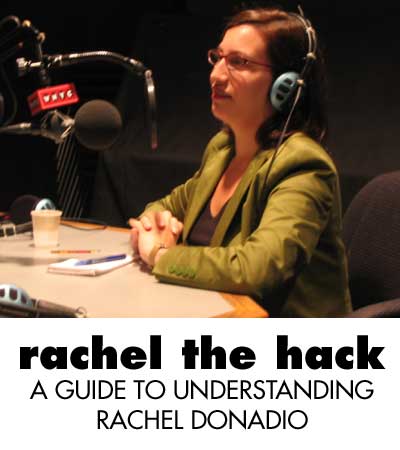
It’s time for a new installment of Rachel the Hack, an essential guide to understanding Ms. Donadio’s warblings.
This week’s NYTBR sees Ms. Donadio writing about poetry critic Helen Vendler, a subject who might just be as humorless as Donadio. Donadio sets the article’s tone with a few clipped sentences (“Sunlight plays on ivy-covered brick,” etcetera), suggesting perhaps that this critic is as “literary” as these ragamuffins who dare to pen verse while starving in frosty garrets. Alas, Donadio is not Hemingway (and I’d hazard a guess that she ain’t exactly starving), no matter how many times she might have read The Sun Also Rises.
We learn that Vendler “has an extraordinary command of the lyric tradition.” (Does Vendler have groupies too? Who knew?) And, offering us yet another classic Donadio maneuver, Donadio glosses over what this “lyric tradition” might be in favor of Vendler’s clip-on microphone. It’s telling that Vendler’s “soft, Boston-tinged voice” is more important that what Vendler has to say. Sure, Donadio’s going to tell you the phrases Vendler cited in her lecture, but damned if the readers will actually get a sense of how Vendler processed the poetry. Which is, after all, what a critic does.
In fact, I was reading this nonsense wondering why David Orr didn’t talk with Vendler, seeing as how he disagreed with Vendler’s assessment of the Elizabeth Bishop book. Sure enough, Orr’s name is name-checked in Donadio’s article. In other words, Orr, a talented poetry critic very well-equipped to have a provocative interview about poetry with Vendler, was passed over by the likes of Rachel “Let Me Get Up to Speed at the Last Minute” Donadio. No doubt Sam “We Take No Chances” Tanenhaus signed off on this without a single provocative thought.
But no matter. The rest of Donadio’s article is thankfully composed of Vendler quotes, which makes it more readable, when Donadio isn’t trying to tell us exactly what Vendler means. But then we all know that NYTBR house style is to write to your audience as if they are idiots. We’re told that Vendler is “sitting on a chair facing the window and a life mask of Keats,” a typical profile flourish.
The rest of the article, at least, gives us the biographical basics. But then, at long last, Vendler’s connection to the NYTBR becomes apparent and we finally see that this article really isn’t about Vendler at all, but about how “important” the NYTBR is.
There’s one interesting moment where Vendler reveals that she doesn’t review poets under 50 and, instead of challenging this ageism with several questions, Donadio takes in this prejudice with all the predictable elan of an establishment writer sucking up to her establishment subject. Donadio and Donadio’s work, seamlessly intertwined.
© 2006, Edward Champion. All rights reserved.