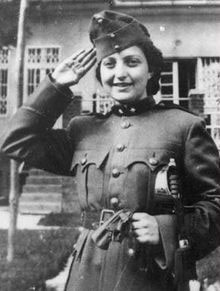
 The most truthful moment contained within Roberta Grossman’s documentary, Blessed is the Match, comes from parachutist Reuven Dafni. Dafni reveals, in what Grossman bills as his final interview, that he did not like the widely celebrated Hannah Senesh very much, but that he admired her stubbornness. One is curious to know why. But the question is never asked.
It is this journalistic diffidence that prevents Grossman’s documentary from being anything more than a helpful yet tendentious refresher course for those who wish to learn more about the intriguing Senesh. The film, littered with spoon-fed “recreations” of existing photos, Indiana Jones-style animated trails across maps, and Joan Allen’s stately, Oscar-nominated voice reading Catherine Senesh’s writings, chooses to present Hannah Senesh as a martyr, but doesn’t make any serious efforts to ask whether Senesh’s martyrdom was premeditated, or whether history has the right to judge Senesh’s life almost exclusively from her final days. All this is a pity and a missed opportunity. For are not noble actions committed without the expectation of credit? If Senesh set herself up to be a martyr, and there exists some possibility that she did, is there not more wisdom to be found crawling around the gray areas?
Senesh, of course, is known for her courage in parachuting into Yugoslavia, working her way to Nazi-occupied Hungary to rescue imprisoned Jews, only to be captured by Arrow Cross soldiers and systematically tortured in prison. But Senesh offered hope to her fellow inmates, singing songs and flashing vital signals with a mirror through her cell window. She communicated to her fellow inmates that there was indeed an end in sight, and Senesh did all this while brutal interrogators continued to beat her, punching out her teeth, and bringing her mother into the cell in an attempt to loosen the information.
Senesh did not talk. Her mother, Catherine, wandered up and down the streets of Budapest hoping to obtain her release. But despite Hannah’s reported eloquence before the judges during her tribunal, she was tried for treason and executed.
It is difficult to argue against the idea that Senesh espoused bravery. But Senesh was also a human being, flawed as human beings are. In 1939, she emigrated to Palestine to attend the Nahalal Agricultural School. Grossman presents but smooths over the fact that Senesh skipped town just after the First Jewish Law was passed in 1938, which restricted the number of Jews employed in liberal vocations to 20%. Known as a precocious intellectual among her largely upper-class peers in Budapest, the documentary informs us that Senesh wrote haughtily back to her family that she could put her abilities to better use. We are also informed that Senesh was exceptionally idealistic, but that she kept largely to herself and couldn’t share any of her concerns with others in the kibbutz. But instead of examining all this through interviews with surviving members of Senesh’s family, or even “recreating” these flawed moments, we’re given a film with an inflexible and somewhat primitive perspective, all set to Todd Boekelheide’s heavy-handed orchestral music.
Here is a fascinating and complex figure who deserves better than the Biography Channel treatment. Sir Martin Gilbert lends some gravitas to the project, providing extremely useful historical context. But what’s troubling about this film is that, long before the film is over, the audience has already made up its mind about Senesh’s virtues. As the current atrocities in Gaza cause any feeling mind to draw uncomfortable parallels with other historical actions, Blessed is the Match arrives in theaters without an ability to expand its perspective beyond simplistic good vs. evil dichotomies. With the high watermarks established by Marcel Ophuls and Claude Lanzmann, this is a film terrified of offending and presenting, and not altogether different from hundreds of other Holocaust documentaries.
© 2009, Edward Champion. All rights reserved.