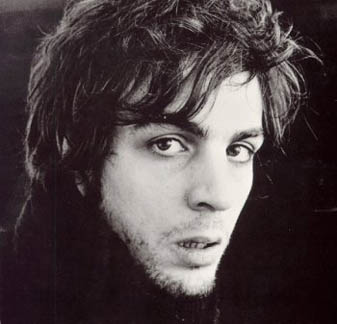
 So I avoid the cultural headlines for twelve hours, scratch my head over why people are suddenly quoting Syd Barrett lyrics, and learn that the great Syd Barrett has died. He was only 60 years old, spending much of his life indoors, withdrawn from humanity.
One shouldn’t discount the importance of Pink Floyd’s The Piper at the Gates of Dawn, an homage to Barrett’s favorite childhood book, The Wind in the Willows. It was the album that launched Pink Floyd and psychedelic rock as a whole. Barrett was the kind of artist who made you wonder if, in a parallel universe, Salvador Dali had chosen the guitar over the paintbrush. With Barrett as bandleader, Piper is a far more literate, playful and innovative album than the austere aural bombast Pink Floyd committed themselves to in the 1970s. One can single out Piper‘s lunatic organ sounds, its jangly noise, or the crazed lyrical and instrumental dissonance that tantalizes from the get-go. (Who could forget the incoherent but strangely poetic “Line and limpid green a second scene, a fight between the blue you once knew?”) Or one can simply kick back and enjoy “Interstate Overdrive” as a driving dreamlike dirge.
Barrett would later put out the strong solo album The Madcap Laughs, recording it with former bandmates Roger Waters and David Gilmour, and another album (which I never got around to listening to) simply called Barrett before disappearing into his inner sanctum, sometimes homeless, always tortured, for good. It’s a pity that Barrett wasn’t able to conquer his demons and carry on further. But a tamed Barrett wouldn’t have created the devilish oeuvre that will carry on for many years to come.
(via Jeff)
[UPDATE: Levi Asher also offers a remembrance.]
© 2006, Edward Champion. All rights reserved.
I assume you’re referring to Kenneth Grahame’s The Wind in the Willows (rather than “Windows”), which includes a chapter titled “Piper at the Gates of Dawn?
Sorry about that. Guess I was shaken up a bit by Barrett’s death. 🙂
RIP Syd Barrett
One shouldn’t discount the importance of Pink Floyd’s The Piper at the Gates of Dawn, an homage to Barrett’s favorite childhood book, The Wind in the Willows. It was the album that launched Pink Floyd and psychedelic rock as a whole. Barrett was …
Niether Piper at the Gates of Dawn nor Pink Floyd itself was responsible for launching “psychedelic rock as a whole”. This was already being done by the Grateful Dead in San Francisco. It was bands like The Pink Floyd and Soft Machine who were interested in making thier own Height Ashbury scene in England at the UFO Club. It was the Dead’s sound man, millionare Stanley Owsley, that was making LSD and putting it on paper and large trash cans filled with cool-aid at Ken Kesey’s club for the famed Acid tests. Not that the Dead invented the whole music and LSD connection. This was done by the 40’s jazz musicians like Dizzie Guilespie, Charlie Parker, and Charlie Byrd. This stuff will plain put the fear of God into a persons soul while properly chemicaly influenced. Much like the Floyd’s 1969 Ummagumma album.
Also, the above article give the song name “Interstate Overdrive as a driving dreamlike dirge”. The song name is Interstellar Overdrive and it is a cosmic sound that pierces the mind with sharp guitar notes that drops the listener off in dark reaches of the universe. If properly chemicaly induced that is.
I have listened to all the psychedelic albums done by Floyd and Barrett. They reach parts of the mind that can only be interpreted while under the influence of certain chemicals. After the release of Dark Side of the Moon the Floyd never returned to this style of music. From there Roger formulated an equation that musicly created top selling albums forever leaving the days of psychedelic rock behind and creating a new sound known as the Atmospheric Sound, which can first be heard on the album Meddle.
For those interested check out Floyd’s pre-Dark Side of the Moon albums. Albums like, More, Atom Heart Mother, Obscured By Clouds, A Saucerful of Secrets, Piper At the Gates Of Dawn, Ummagumma, and Meddle. They also did some interesting work for a movie called Zabriskie Point and you can find some nice stuff on an album of the same name along with some great solo work of Jerry Garcia of the Grateful Dead.