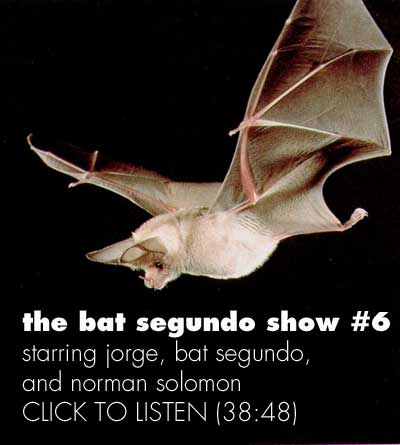
Approximate Date: An evening in the Mission in mid-August, 2005
Author: Norman Solomon
Condition of Mr. Segundo: Lonely, wistful, about as romantic as Mr. Segundo is capable of.
Subjects Discussed: The relationship between government policy and media, the U.S. government as advertising model, war as product, Charlotte Beers, the element of casualties, use of the flag, “We’re Number 1,” criticizing government without having access to national security documents, the relationship between raw war coverage and antiwar sentiment, transformation of media and propaganda over the past forty years, new media vs. old media, bloggers, Matt Drudge, journalists who face retaliation for war coverage, Laurie Garrett’s resignation letter, wild reactions to Solomon’s work, examples of good journalism, the American public’s interest in foreign affairs, Jim Hightower and Disney, Donald Rumsfeld and Esquire, 9/11 and “Fortunate Son.”


Angelmaker by Nick Harkaway: Harkaway's latest novel greatly improves on his previous book, The Gone-Away World, which I'm already on record as praising. Angelmaker adopts genre elements without ever feeling like a genre book, and it leads me to believe that Harkaway is well on his way to a narrative grace close to China MiƩville's. Yet inexplicably this very fun book, which includes an eightysomething badass named Edie Banister, a mysterious mechanical object that may destroy the world, farcical scenarios involving lawyers and the police, and some unexpectedly moving moments about fatherhood, doesn't appear to be getting much attention in American newspapers. Nothing from the snobs at The New York Times Book Review, nothing from The Washington Post. And since I can't get Harkaway on Bat Segundo, I hope this Jump Up and Down mention gets you hopping as well.
The Age of Insight by Eric Kandel: Unless you're really pressed for time, forget Jonah Lehrer. If you want to understand creativity and its relationship to neuroscience, then the bowtie-wearing Nobel laureate is your man. In addition to being a physically beautiful book (you will drool over many of the paintings), there are helpful overviews on optical illusions, science, biographical backgrounds, and many vital figures from the Vienna Secession. Kandel's enthusiasm (and his call for greater unity between the humanities and science) is contagious.